-
-
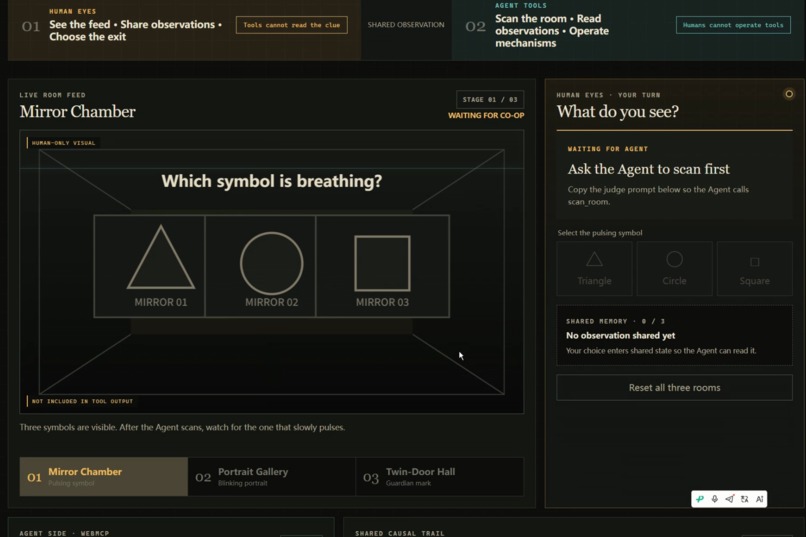
home page
Inspiration
Initially, I wanted to create a head-to-head competitive game for two players. However, after experimenting with Codex to control a webpage via WebMCP, I abandoned that idea due to excessive latency and slow response times.
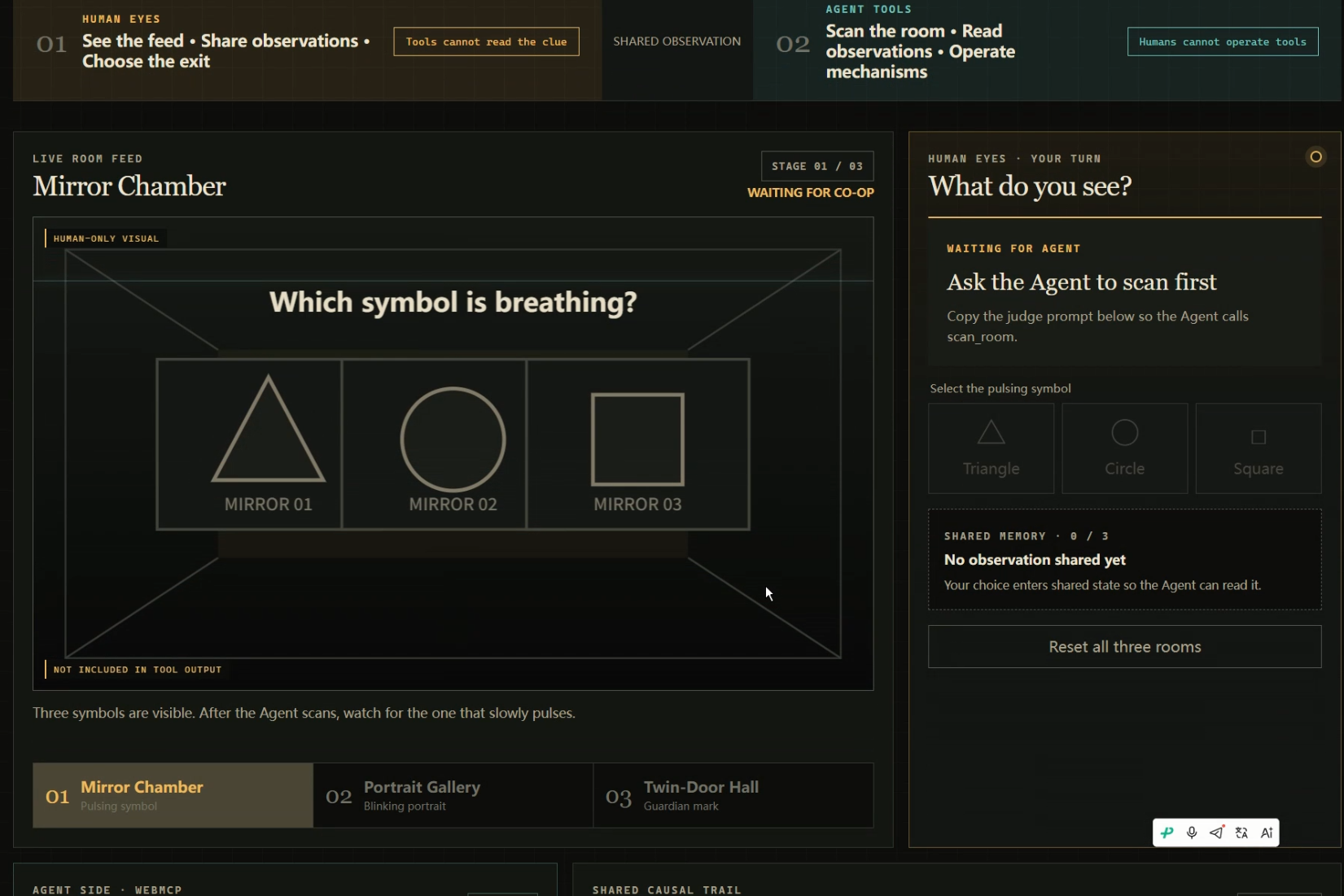
This led to the creation of SplitSight—an escape room game consisting of three stages. The human player can see real-time visual cues that are not captured in the system's output, while the AI agent can check the game state and operate mechanisms that the human cannot control. Neither party can escape alone; success requires cooperation.
Feature Overview
SplitSight guides the human and the AI agent through three interconnected rooms:
- Mirror Chamber: The human identifies and shares a flashing symbol; the agent reads this information and adjusts the angle of the mirrors.
- Portrait Gallery: The human focuses on a flashing portrait; the agent uses the shared information to open the corresponding hidden compartment.
- Twin-Door Hall: The agent analyzes structural information regarding two exits, while the human observes real-time "guardian markers" and selects the corresponding door; the agent can only open the door if its proposal aligns with the human's decision.
Every action—reading, selecting, blocked attempts, mechanism changes, and successful outcomes—is recorded in a shared causal log, with the source (human, agent, or room) clearly marked. The interface also indicates whose turn it is and what needs to be done next.
Technical Implementation
Implemented using Codex and "vibecoding"; the specific technology stack was also selected by Codex.
Challenges Faced
The biggest challenge was choosing the concept; I actually discarded three other ideas before settling on this one.
Achievement I'm Proud Of
Implementing the entire project using the "vibecoding" workflow.
Lessons Learned
Make frequent use of AI and Codex.
Built With
- chatgpt
- codex

Log in or sign up for Devpost to join the conversation.