-
-
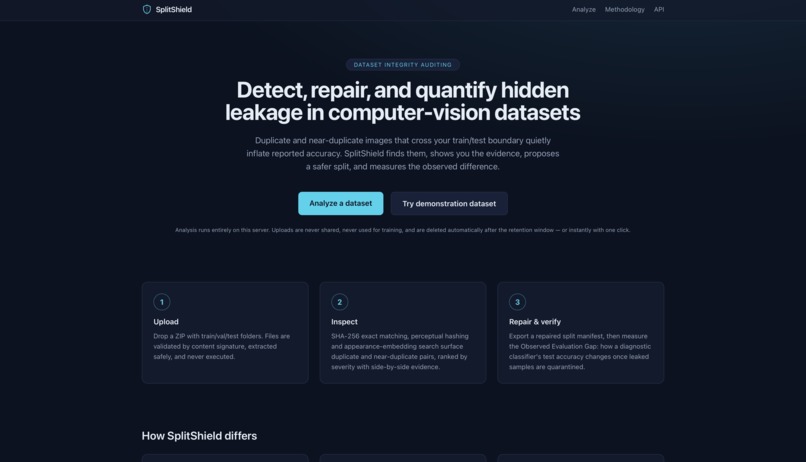
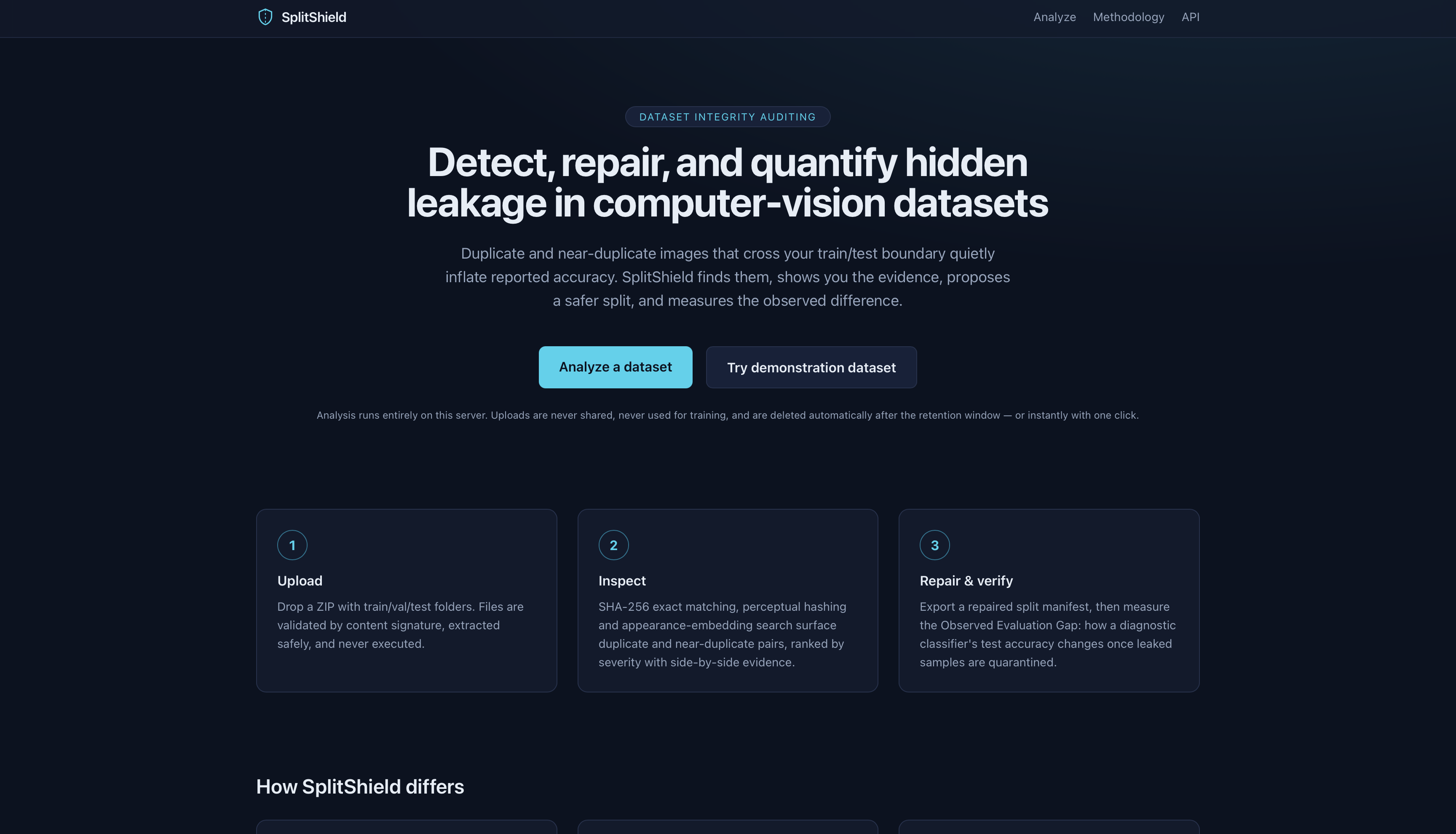
Splitfield dashboard
-
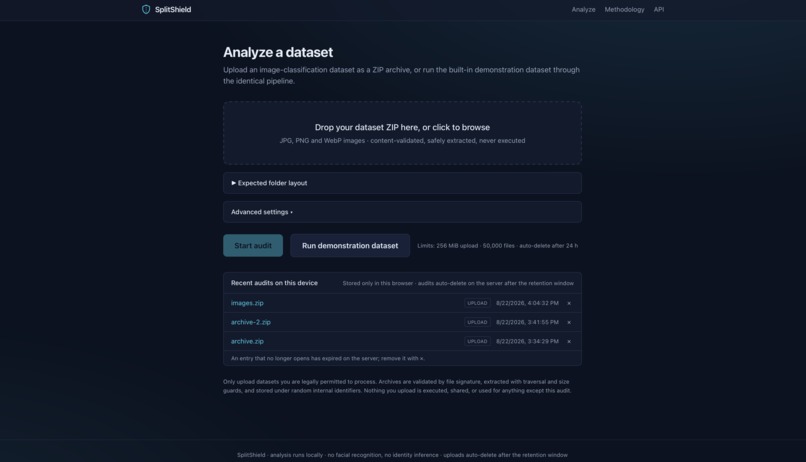
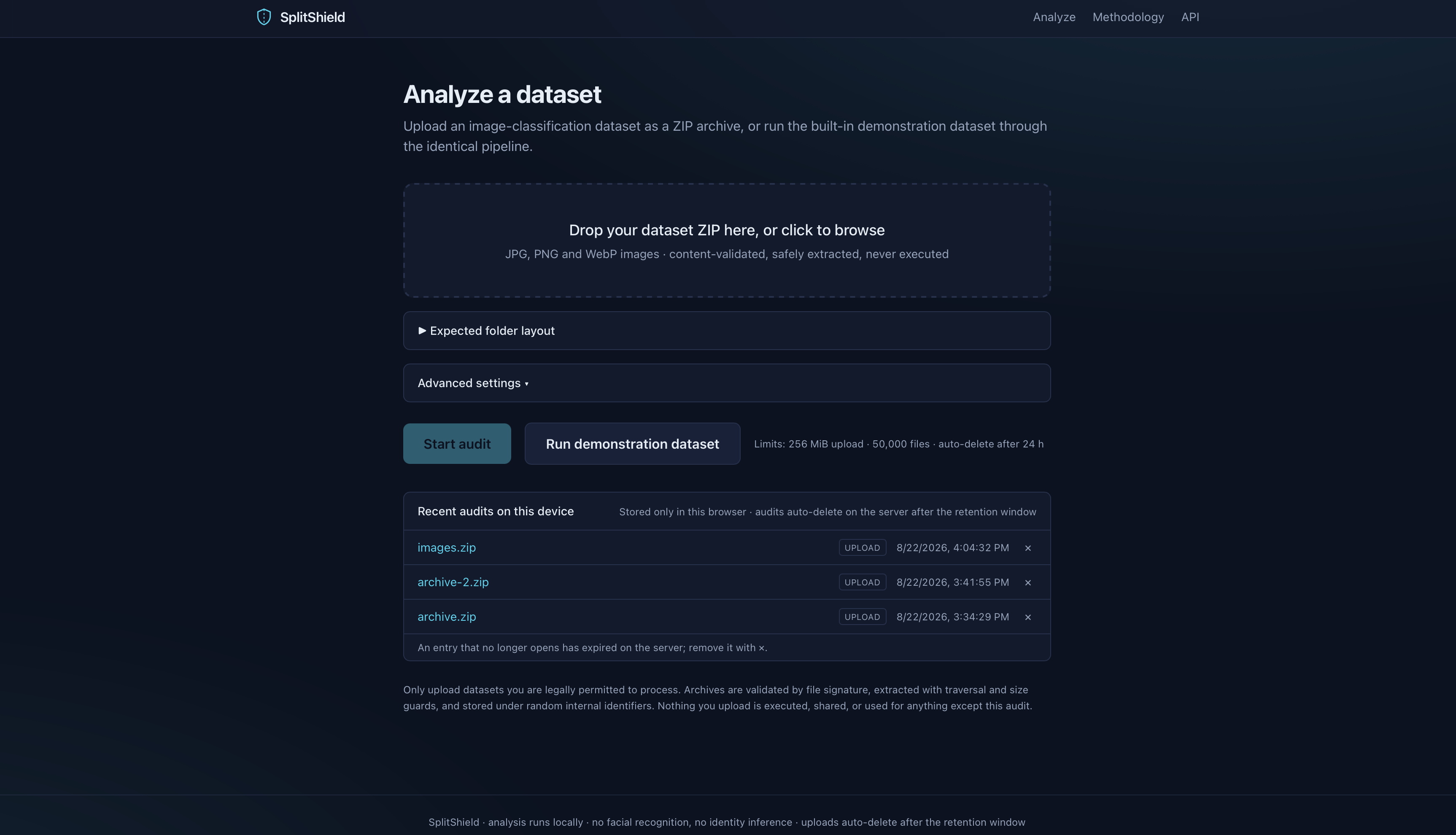
Analyse a dataset
Inspiration
Every ML practitioner has seen a model score suspiciously well — only to discover the test set contained images the model had already trained on. Sometimes byte-identical, sometimes a recompressed or cropped copy. Tools exist to find duplicates, but the workflow that matters — reviewing the evidence, repairing the split without wrecking the test set, and honestly quantifying what the leakage was associated with — is usually a pile of ad-hoc notebooks. We built that workflow as a product.
What it does
Upload an image-classification dataset as a ZIP (YOLO-style detection layouts work too) and SplitShield:
- Detects leakage three ways — exact duplicates (SHA-256), near duplicates (64-bit DCT perceptual hash, exhaustive Hamming search), and appearance-similar pairs (embeddings + cosine top-k search) — each with split-aware severity and deliberately cautious confidence language ("Confirmed exact duplicate" vs "Requires human review").
- Explains the evidence — an Evidence Explorer shows every suspicious pair side by side with its similarity metrics; a human confirms, clears, or flags each finding, and those decisions persist without ever overwriting the algorithmic evidence.
- Scores integrity transparently — a documented, deterministic 0–100 Dataset Integrity Score with a full penalty breakdown. No LLM, no black box.
- Repairs the split — a proposed manifest that consolidates duplicate groups into single splits, protects the test set, explains every move, and exports as CSV/JSON. Original files are never modified.
- Quantifies the damage — a seeded diagnostic classifier is scored on the original vs leakage-quarantined test set, reporting the Observed Evaluation Gap with bootstrap confidence intervals and explicit anti-overclaiming warnings.
- Exports a reproducible audit — printable report with dataset fingerprint, seed, config, and package versions, so anyone can re-run and verify.
How we built it
FastAPI backend running a staged pipeline (validate → index → exact → perceptual → embedding → score → evaluate → report) with every stage persisted to SQLite; Next.js frontend renders dashboards, evidence review, repair, and reports from the computed results. Ingestion is hardened: file-signature validation, zip-traversal and zip-bomb guards, random internal IDs, configurable retention with one-click deletion. Everything runs on CPU — no GPU required.
Challenges
- No pretrained weights in our build environment — the network blocked model downloads, so we designed a pluggable embedding backend: MobileNetV3 when available, otherwise a classical appearance descriptor (contrast-normalised structure + illumination-invariant chromaticity + gradient histograms) that we validated against transformed-duplicate cases — and the UI always discloses which backend ran. No fake "semantic AI" claims.
- Honest metrics are hard — we deliberately renamed our headline metric to "Observed Evaluation Gap" and gate the experiment behind eligibility checks, because removing test samples changes the population and correlation isn't causation.
- Real datasets are messy — supporting detection-style layouts, conflicting labels, corrupt files, and 700 MB uploads without crashing took as much engineering as the detection itself.
Accomplishments & what we learned
A deterministic synthetic demo dataset with a ground-truth manifest verifies the detectors end to end (89 automated tests + a browser E2E test). The whole system is deployed and public. Biggest lesson: the credibility of a data-quality tool lives in its language — saying exactly what the evidence supports, and no more.
What's next
Video frame sampling, filename/CSV label mapping, FAISS for very large datasets, and side-by-side audits of popular public datasets — several of which are known to contain real leakage.
Existing tools, acknowledged
Duplicate detection itself isn't new — FiftyOne, CleanVision, and Cleanlab do it well. SplitShield's contribution is the complete detect → explain → review → repair → quantify → export workflow in one auditable tool.
Built With
- docker
- fastapi
- imagehash
- next.js
- numpy
- pillow
- playwright
- pydantic
- python
- recharts
- render
- scikit-learn
- sqlite
- tailwindcss
- typescript

Log in or sign up for Devpost to join the conversation.