-
-
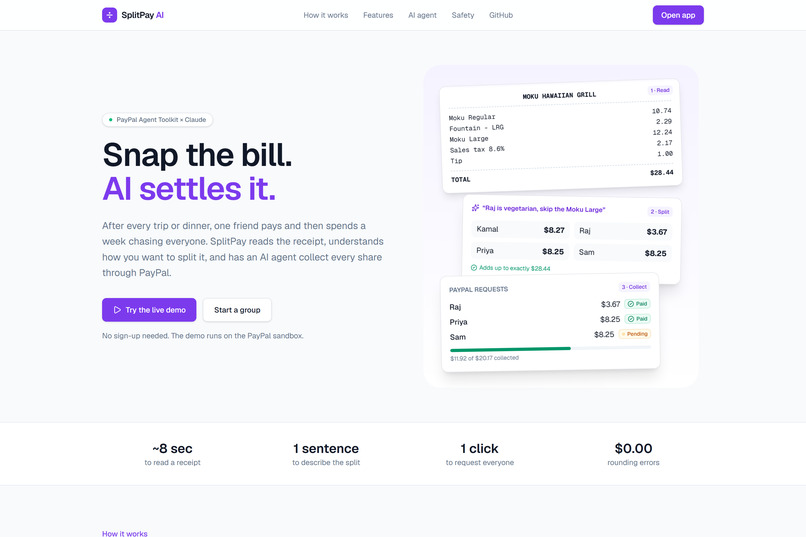
Snap the bill, say how to split it, and an AI agent collects through PayPal.
-
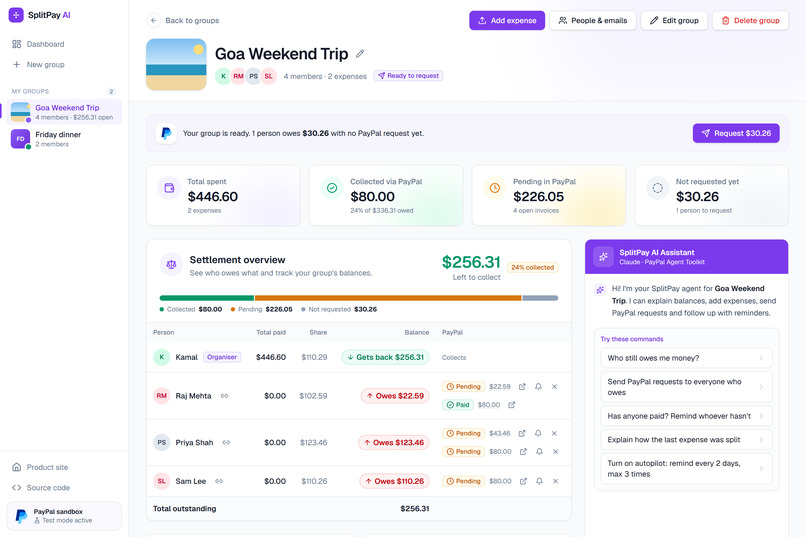
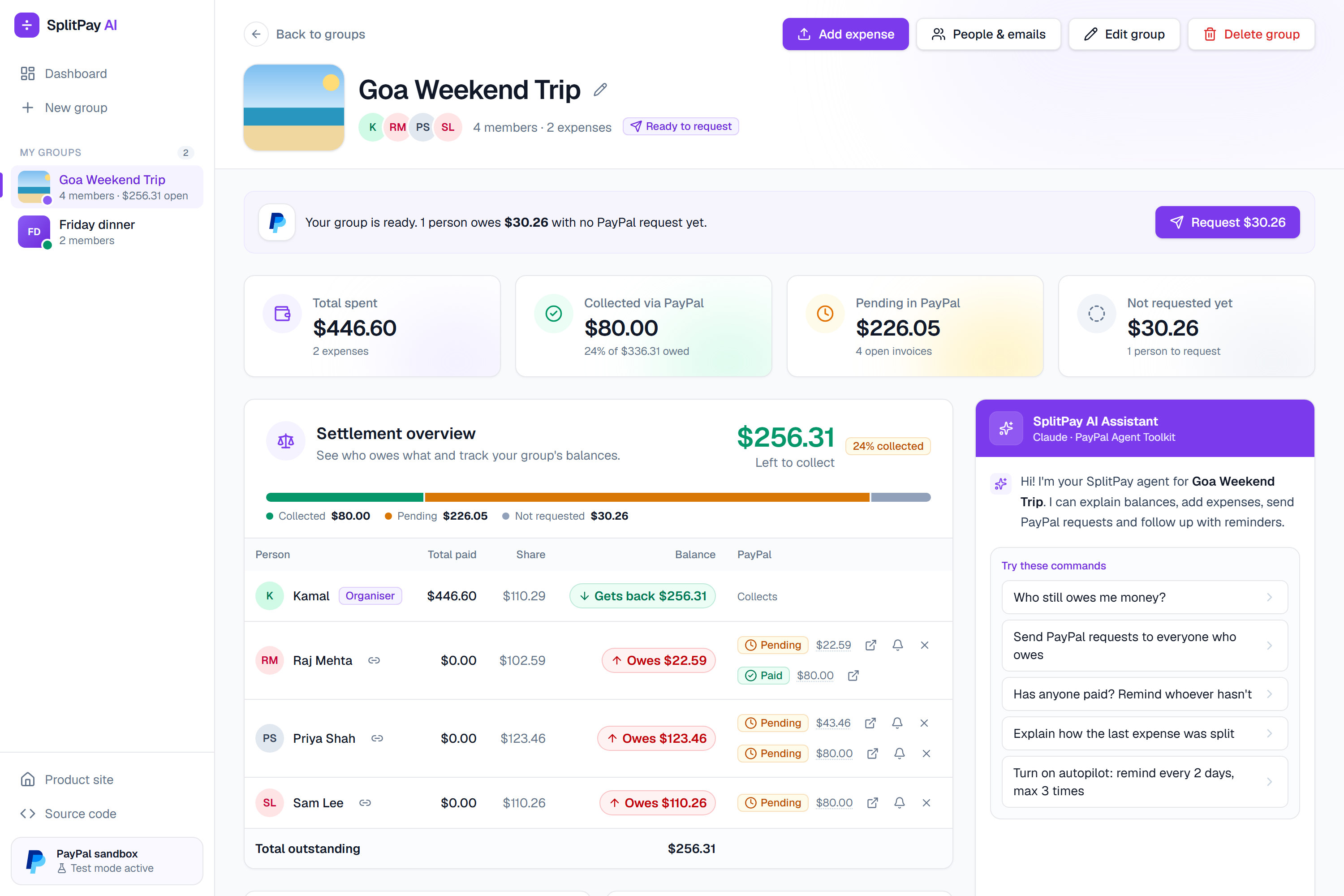
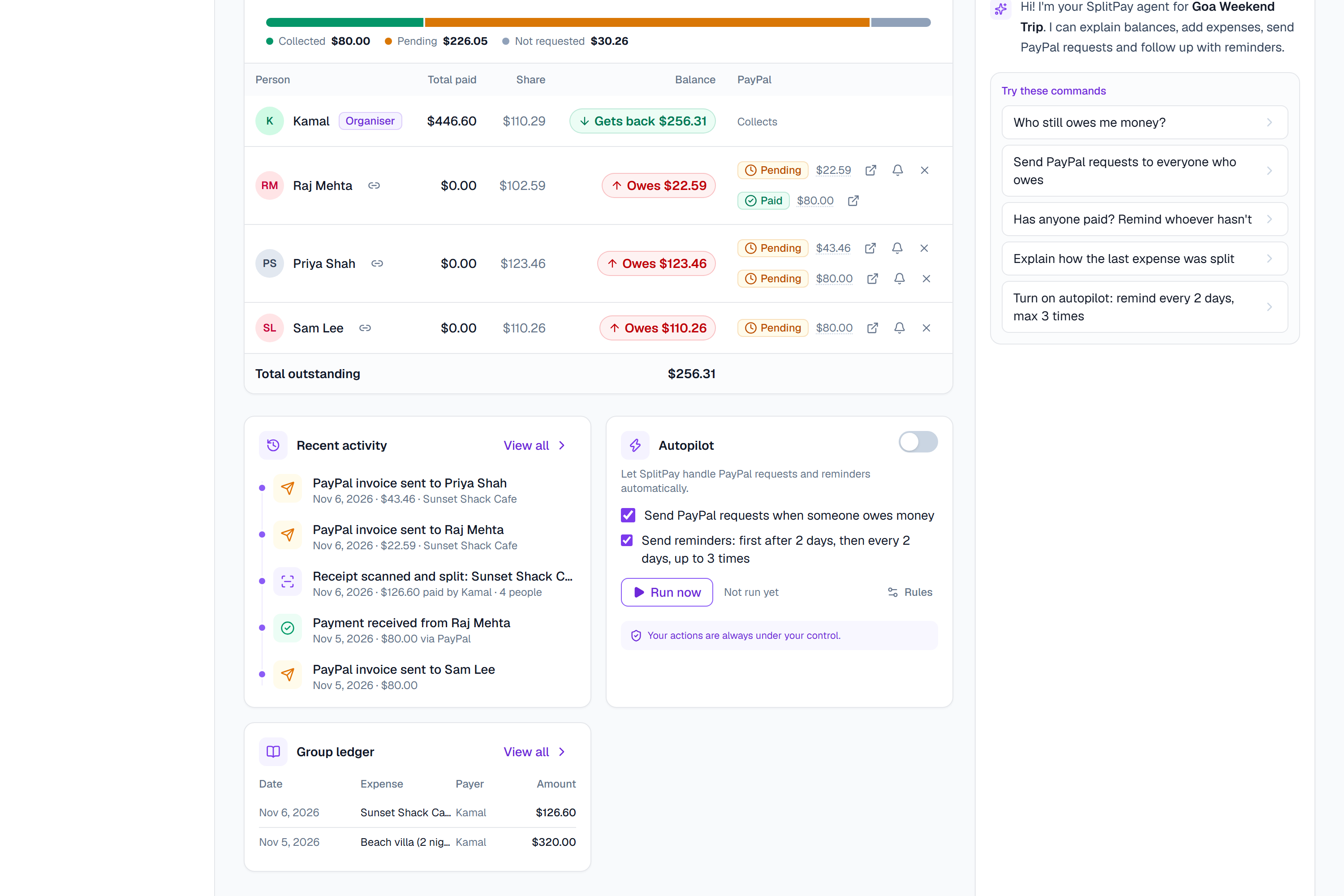
Every balance at a glance, with each person's PayPal invoices, reminders and status.
-
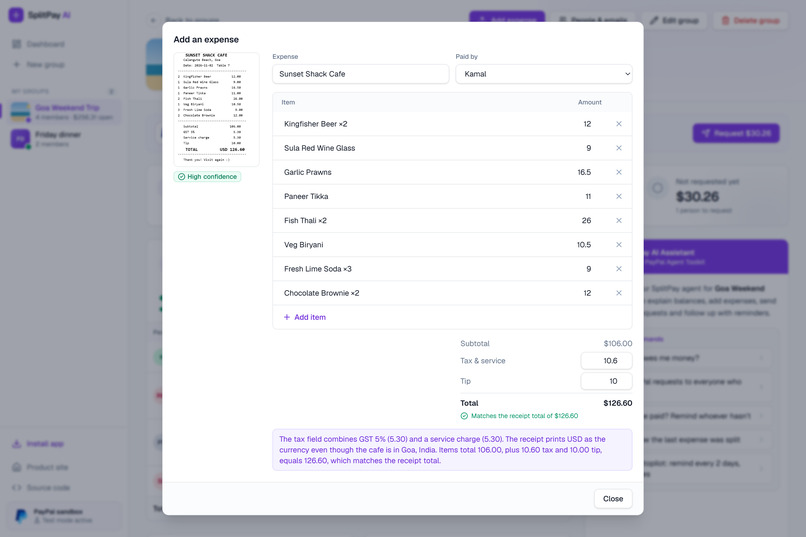
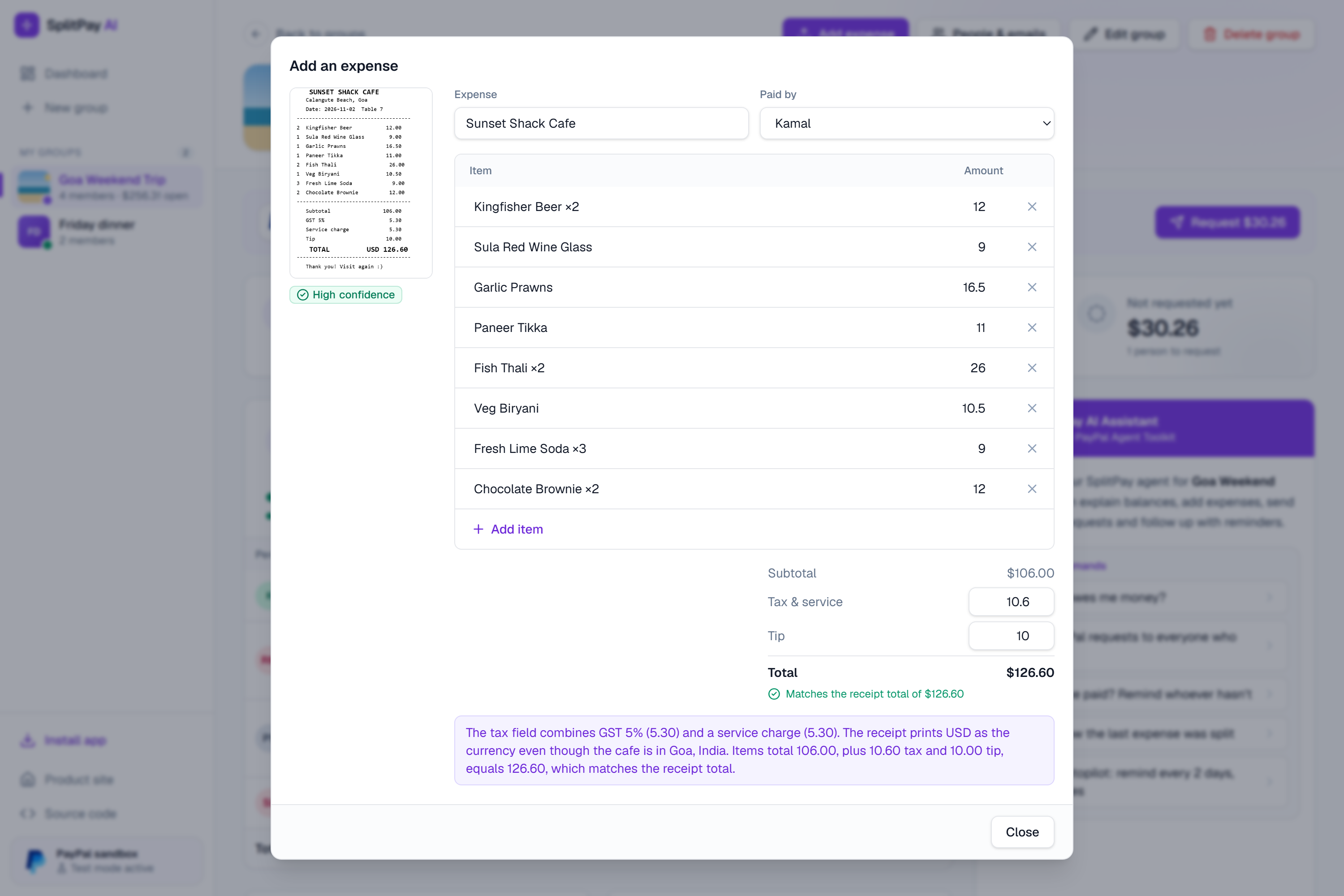
Claude reads every line of the receipt and checks it adds up.
-
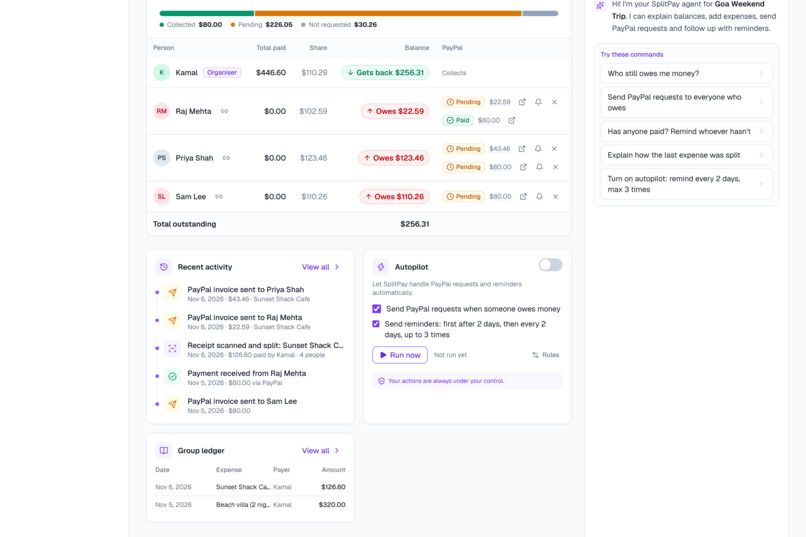
Real-time activity, rule-based Autopilot follow-ups, and the group ledger.
-
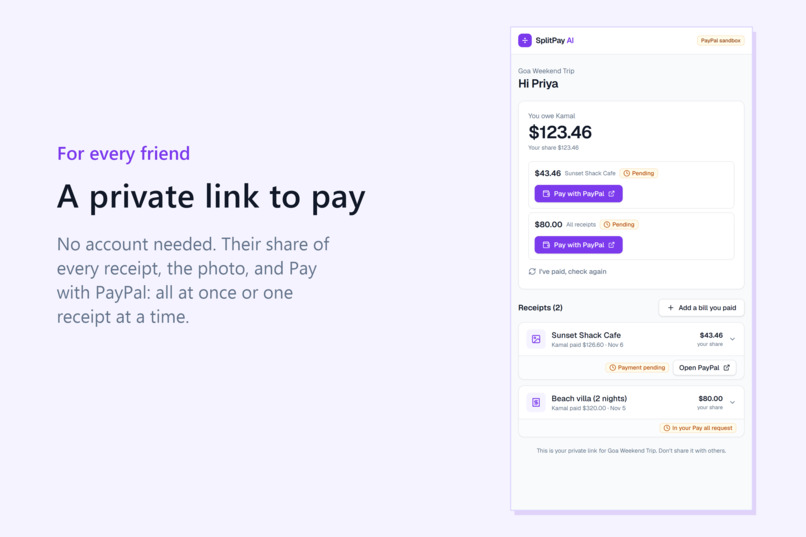
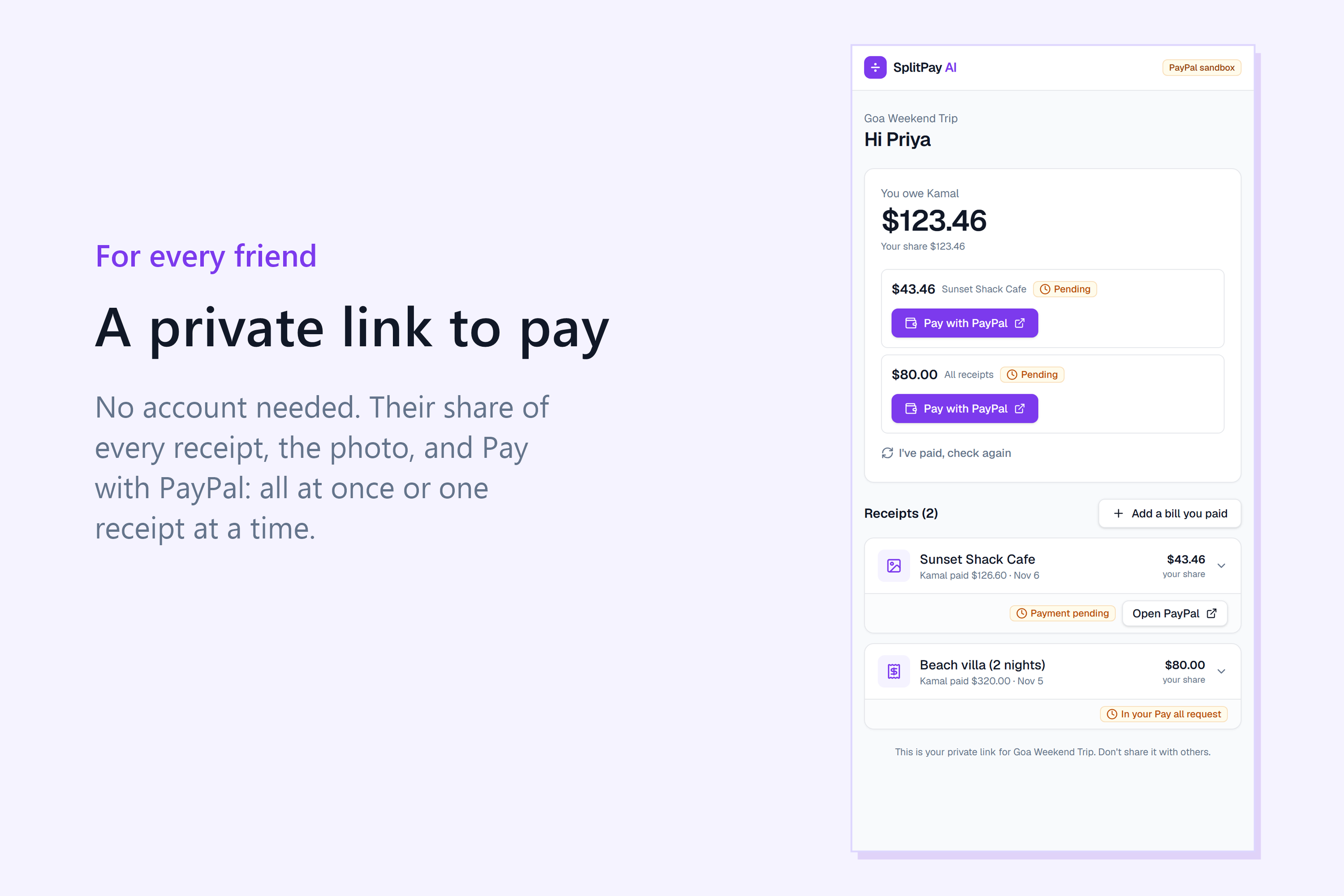
Each friend gets a private link: their share of every receipt and Pay with PayPal.
-
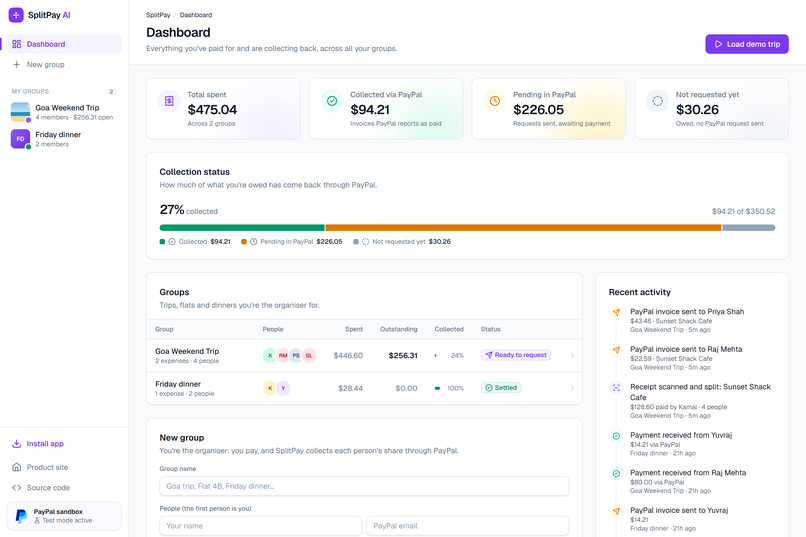
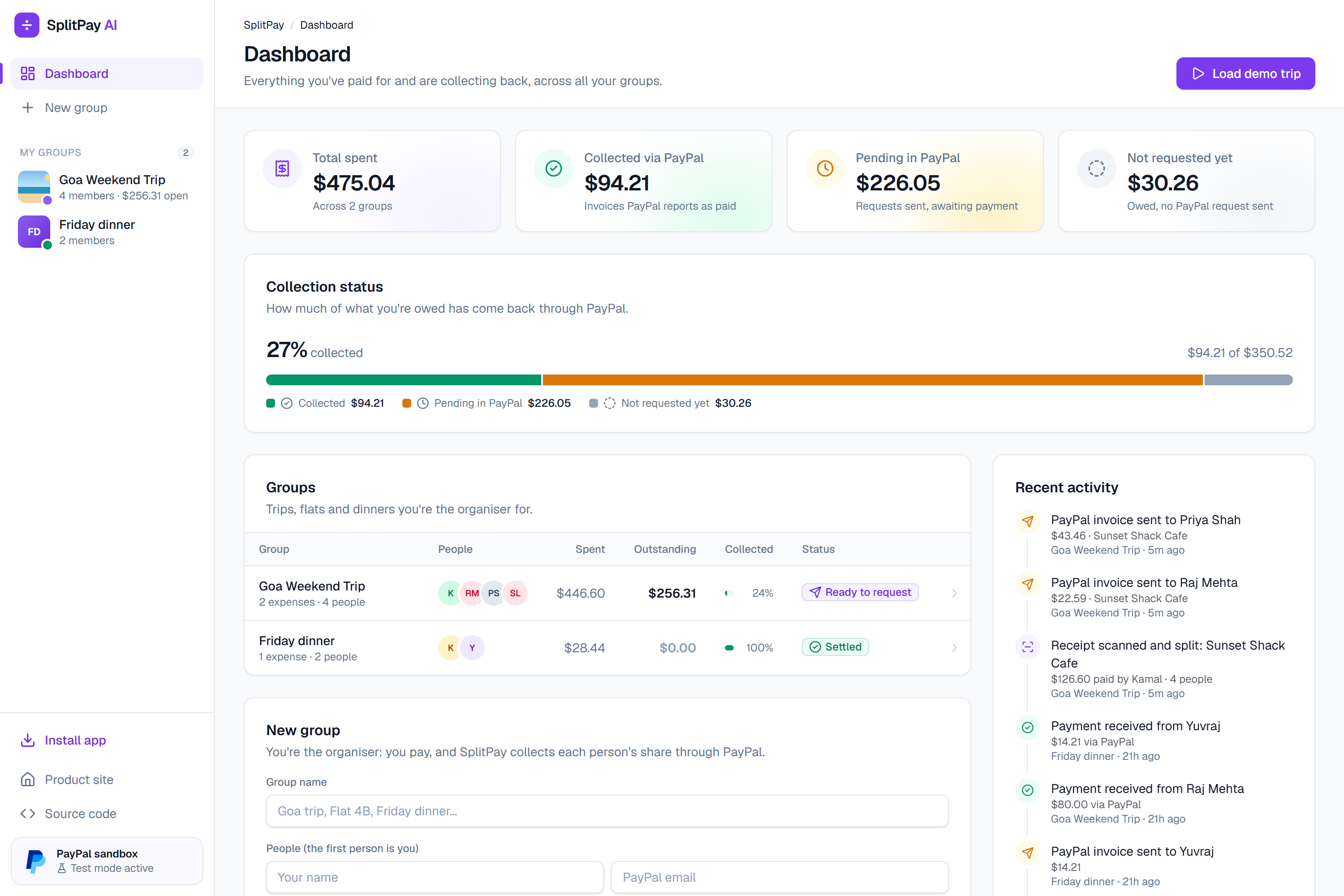
All groups, what's collected via PayPal, and what's still pending.
Inspiration
Every group trip, team booking or dinner has one person who pays and then spends days chasing everyone else. Splitting apps tell you who owes what, but collecting the money is still manual, awkward and easy to forget. We built SplitPay AI for that person: the community organiser who is tired of chasing money.
What it does
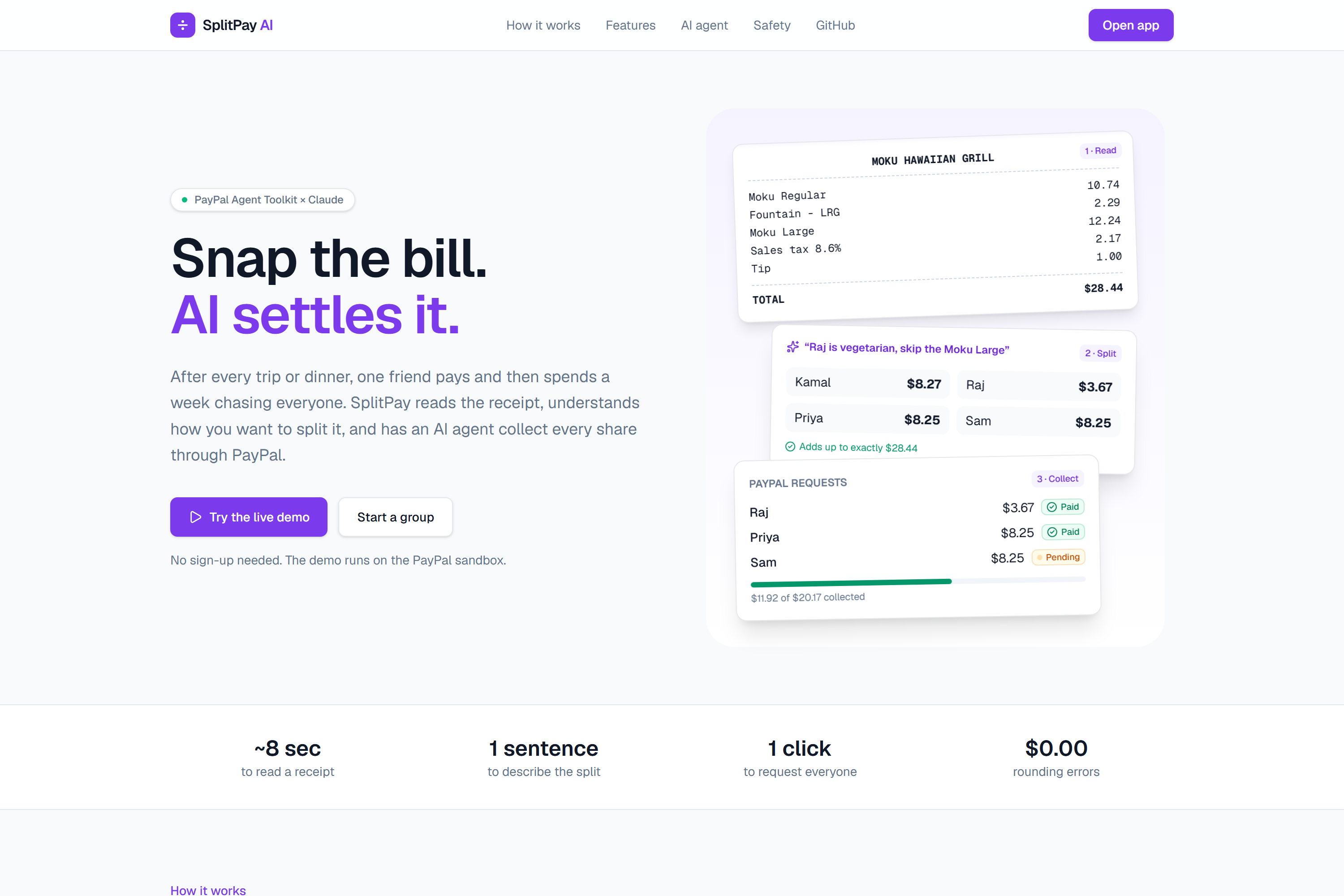
SplitPay AI turns a bill into collected money in three steps.
- Snap the bill. Upload or photograph a receipt. Claude reads every line, the tax, service charge and tip, and checks they add up to the receipt total. You can also paste a WhatsApp group chat: Claude finds who paid for what, skips plans and person-to-person paybacks, and flags names that aren't in the group.
- Say how to split it. "Raj didn't drink, Priya had both brownies, tip split equally." The AI decides who shares each item; deterministic code turns that into exact cents, so the shares always add up to the total. You can adjust any item by tapping avatars.
- The agent collects. One click sends each friend a PayPal invoice with one line per receipt. A verified PayPal webhook updates the status the moment someone pays. Autopilot follows up with whoever hasn't, on a schedule the organiser sets, and hands back to the organiser after the last reminder. Also included: • AI assistant that works on the group's real data: "Who still owes me?", "Send PayPal requests to everyone who owes", "Remind whoever hasn't paid". • Private link for every member (no account needed): their balance, every receipt with the photo and their part of each item, and a choice to pay everything at once or receipt by receipt. • Audit log of every action, labelled by who did it: the organiser, the agent, Autopilot, a member, or PayPal. • Installable app with a share target: on Android, share a WhatsApp chat export or a receipt photo straight into SplitPay.
Guardrails, because an agent that moves money needs them: • The AI never sets amounts; every request comes from the ledger. • Nobody can be asked twice for the same receipt. • Requests above a per-person cap are blocked. • Every send and cancel asks for confirmation; Autopilot checks PayPal before reminding anyone. • Webhook calls are verified with PayPal before anything changes.
How we built it
• Next.js 15, React 19, TypeScript and Tailwind CSS, deployed on Render. • Claude (Anthropic API, claude-opus-5-5) with structured outputs (Zod schemas) for receipt reading, split planning, chat import and reminder wording, and the SDK's tool runner for the agent. • PayPal Agent Toolkit for every PayPal action: creating, sending, checking, reminding and cancelling invoices in the sandbox. The agent's tools wrap the toolkit, so Claude acts on PayPal through it. • PayPal webhooks with signature verification through PayPal's verify-webhook-signature API. The handler re-reads the invoice from PayPal rather than trusting the event body. • AG Grid for the full group ledger. • A deterministic money layer: largest-remainder rounding so no cent is lost, and minimum-transfer settlement.
Challenges we ran into
• Keeping AI away from the arithmetic. Early splits drifted by a cent. We moved all money maths into deterministic code; the model only assigns items to people. • Names that aren't in the group. "Kamal is vegetarian" in a group without Kamal used to be quietly mapped to someone else. The model now reports unmatched names and the app blocks saving until they're resolved. • Never asking twice. Supporting both "pay all" and "pay this receipt" meant every request records exactly which receipts it covers. • Payment status without polling. We added PayPal webhooks with signature verification, and kept a scheduled check as a fallback.
Accomplishments that we're proud of
• The whole loop works end to end on the PayPal sandbox: receipt → AI split → PayPal invoice → payment → status updates by itself → Autopilot follows up. • Receipts are read in about 8 seconds, and every split adds up to the cent. • Autopilot ran unattended in testing: requests, two reminders with escalating wording, then a clean hand-off.
What we learned
• Agentic payments are about guardrails as much as intelligence: let the model decide wording and assignments, and let rules decide money. • PayPal invoices are a good fit for groups, because friends can pay with PayPal or a card without installing anything.
What's next for SplitPay AI
• Log in with PayPal so organisers and members have accounts instead of private links. • PayPal Payouts to pay back members who paid more than their share, so multi-payer trips settle fully. • Organisers invoicing from their own PayPal accounts through partner onboarding. • Recurring splits for flatmates and clubs, multi-currency trips, and a persistent database. • A WhatsApp or Telegram bot front end for the same agent.
Built With
- ag-grid
- anthropic
- claude
- next.js
- paypal
- paypal-agent-toolkit
- paypal-invoicing-api
- paypal-webhooks
- react
- render
- tailwindcss
- typescript
- zod
