-
-
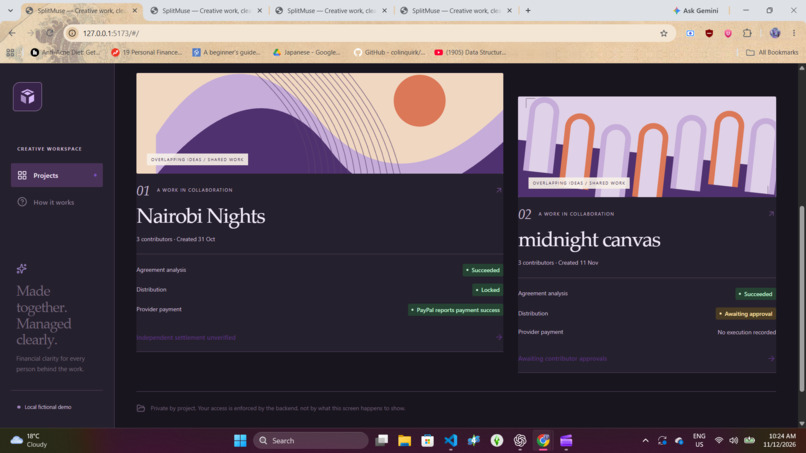
split muse - dashboard
-
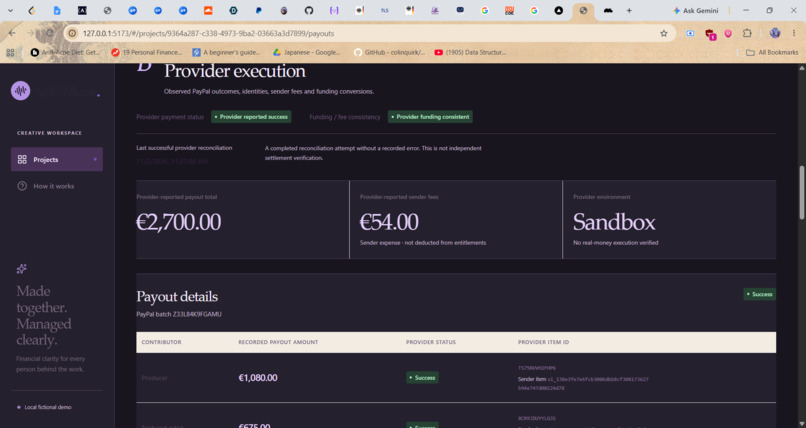
splitmuse- revenue sharing
SplitMuse — Creative Work Deserves Financial Clarity
An AI-powered financial operations platform that helps creative collaborators turn agreements into transparent, approved, and traceable payouts.
Inspiration
Creative collaboration is beautiful, but the business side of making art can get complicated.
A songwriter, producer, featured artist, or designer might work together on something incredible, only to encounter disagreements later about ownership, revenue percentages, deductions, and compensation.
I became interested in what happens after the creative work is finished. Who gets paid? How much? What happens when the original agreement is ambiguous? And how can everyone be confident that the amount being distributed is what they actually agreed to?
I also questioned why creative teams should spend so much time interpreting agreements, calculating revenue splits in spreadsheets, requesting approvals, and coordinating individual payments when technology could handle much of that administrative work.
That question inspired SplitMuse.
I wanted to build something more meaningful than an AI chatbot that simply suggests how revenue should be shared. I wanted an application that could help people move from an agreement to an actual payment workflow, while keeping financial decisions in human hands.
My guiding principle became:
Automate the routine. Explain the exceptions. Never manufacture consent.
What I Built
I developed SplitMuse, an AI-assisted financial operations application designed for independent creators, musicians, producers, studios, and collaborative teams.
SplitMuse connects five important stages of creative financial collaboration:
1. AI-powered agreement interpretation
Using Google's Gemini models, SplitMuse analyzes natural-language collaboration agreements and extracts financial information, including revenue percentages, deductions, fixed fees, and compensation conditions.
Rather than inventing missing terms, the system identifies ambiguities and contradictory obligations that need human clarification.
2. Deterministic revenue calculations
I built a Python financial-validation and calculation pipeline using decimal arithmetic to avoid floating-point precision errors.
The AI interprets the language, but Python—not the language model—calculates financial obligations.
This separation is essential because a plausible AI response is not necessarily a financially correct one.
3. Contributor approval and consent
SplitMuse maps contributors to authenticated identities and allows each person to review and approve a specific version of a distribution.
Approvals are tied to immutable financial snapshots and content hashes. If a distribution changes, it requires fresh approval.
An agreement cannot be locked when unresolved financial contradictions remain.
4. PayPal sandbox payout integration
I integrated PayPal's Payouts API to demonstrate how an authorized distribution can become an actual sandbox payment batch.
Payment initiation requires separate authorization, beyond contributor approval.
The backend also implements durable idempotency protections to prevent duplicate payout batches during retries or uncertain network outcomes.
5. Payment evidence and reconciliation
SplitMuse retrieves PayPal batch and individual payout statuses, verifies them against the original approved distribution, and maintains an audit history.
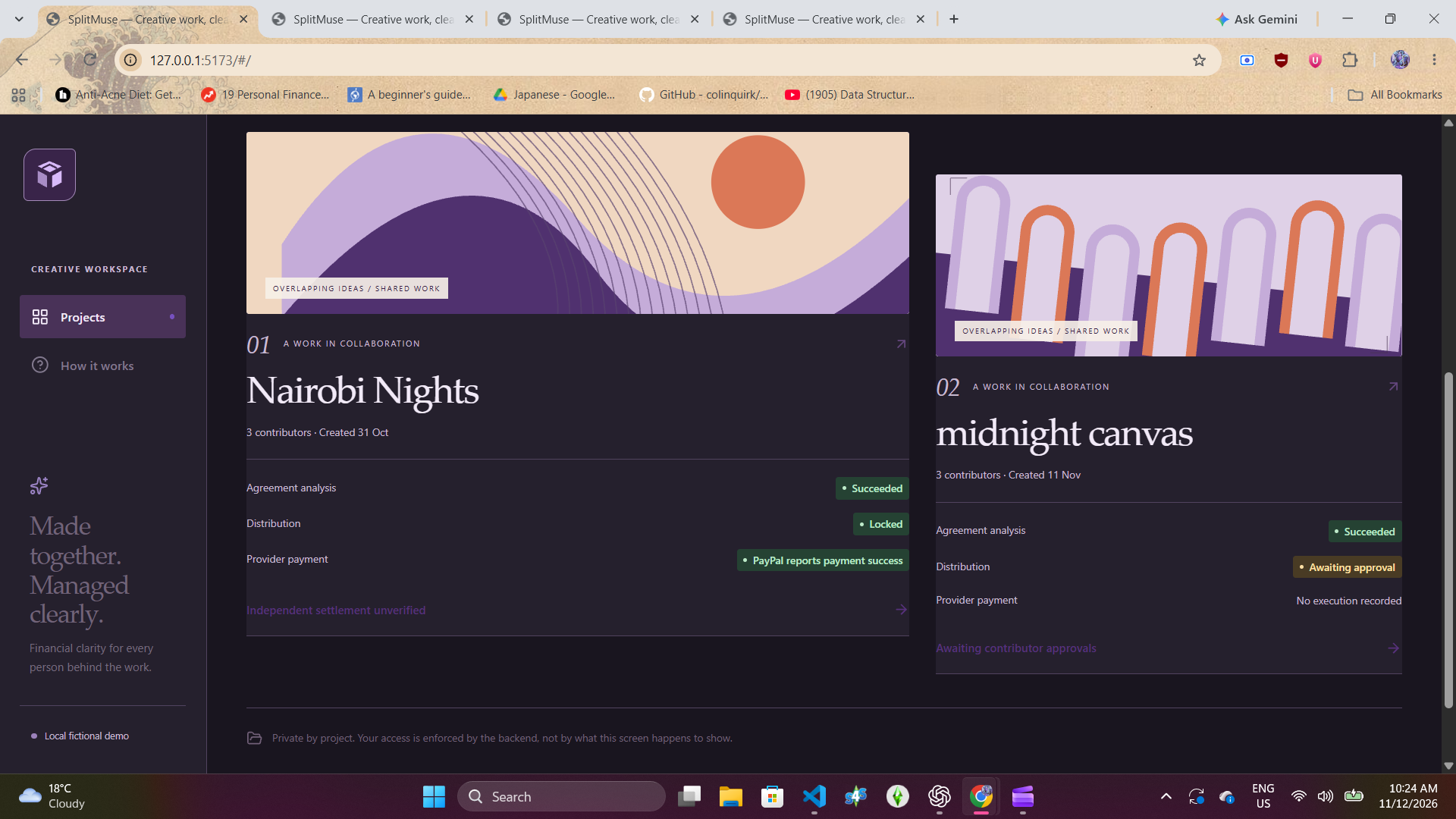
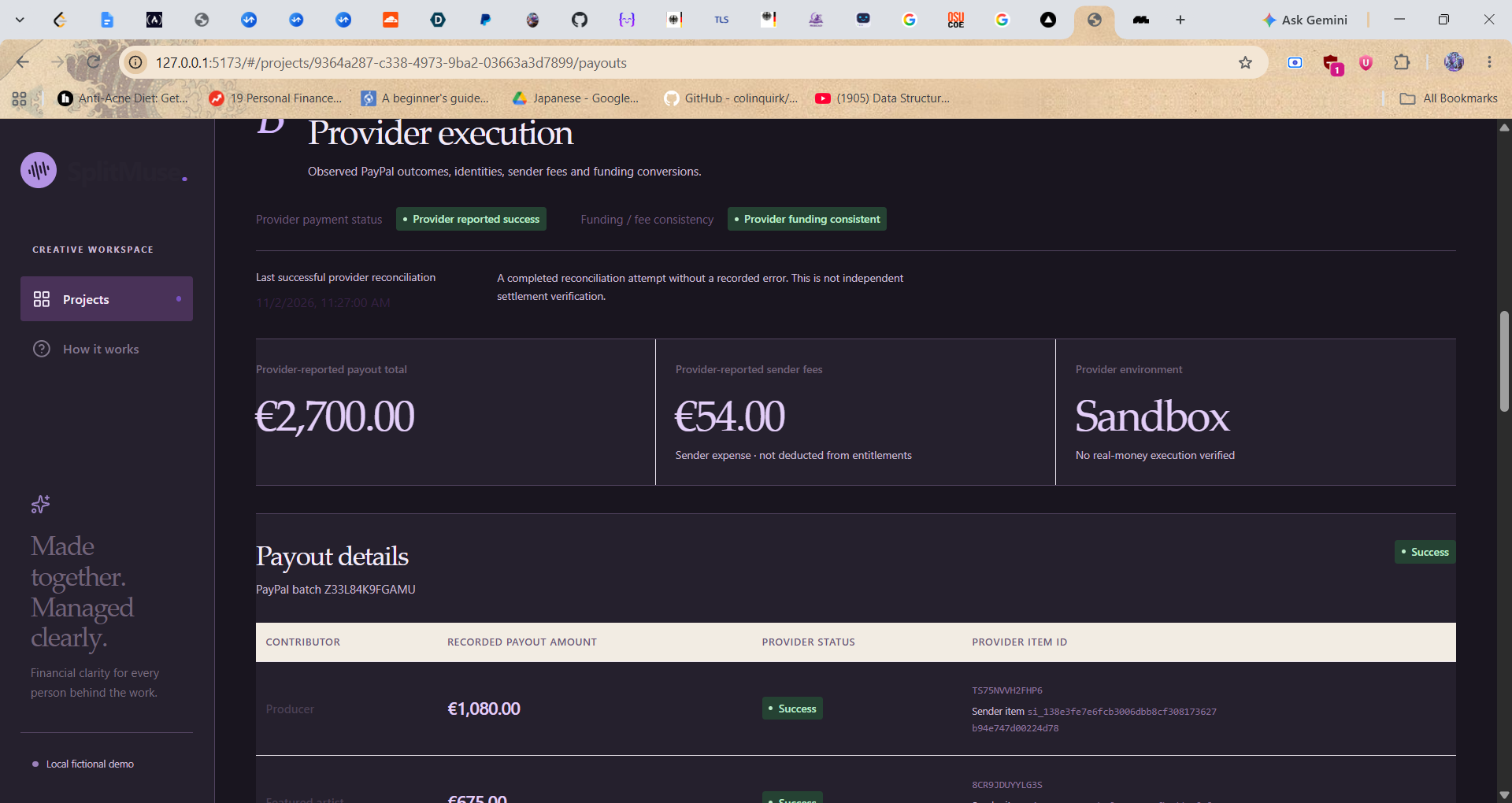
For my fictional Nairobi Nights demonstration, SplitMuse prepared and submitted EUR 2,700 across three contributors.
PayPal subsequently reported all three payouts as successful.
During reconciliation, I discovered that PayPal had applied funding-side currency conversion and reported EUR 54 in sender fees. Instead of ignoring the discrepancy, I investigated the provider's conversion and fee records and built validation that keeps payment success, funding consistency, and independent settlement verification distinct.
This became one of the most important aspects of the project: a payment provider reporting success does not mean every financial question has been independently verified.
How I Built It
I developed SplitMuse using a combination of AI, backend engineering, database design, and frontend development.
AI and financial interpretation
- Google Gemini for structured agreement extraction
- Pydantic for typed validation
- Python's Decimal for deterministic financial calculations
- Evidence-backed validation and contradiction detection
Backend and data integrity
- Python and FastAPI for the application API
- PostgreSQL for persistent financial records
- SQLAlchemy and Alembic for data modeling and migrations
- Authenticated, agreement-scoped access controls
- Versioned distribution snapshots, contributor approvals, and database integrity safeguards
Payments
- PayPal REST Payouts API in sandbox mode
- OAuth 2.0 for PayPal authentication
- Idempotent payout submission
- Batch-level and item-level reconciliation
- Audit records for provider statuses, fees, and currency conversion
Frontend
- React and TypeScript
- Tailwind CSS and Vite
- A creative workspace for managing projects, agreements, contributors, distributions, and payment evidence
I designed the system so that each component has a clear responsibility: Gemini interprets, Python validates and calculates, PostgreSQL preserves state, contributors authorize decisions, and PayPal processes sandbox payouts.
Challenges I Faced
Handling ambiguity without allowing AI to make financial decisions
One of my earliest challenges was distinguishing between what an agreement explicitly stated and what the AI inferred.
For example, a contract might describe a percentage split while also including a fixed buyout or an unspecified sub-allocation.
I learned that extracting percentages is not enough. The system must understand whether those percentages are compatible, what deductions apply, and whether it is safe to calculate a distribution at all.
I built validation rules and regression tests to prevent contradictory agreements from proceeding to unauthorized payouts.
Separating authentication, approval, and payment authority
I had to think carefully about security boundaries.
An authenticated contributor should not automatically be allowed to manage an entire agreement, and approving a revenue split should not automatically authorize a payment.
I implemented agreement-scoped permissions, separate contributor approvals, immutable versions, and an independent payout-authorization stage.
Making PayPal integration reliable
Integrating a payment provider required more than sending a POST request.
I had to account for duplicate submissions, uncertain network responses, asynchronous payout statuses, and differences between batch-level and individual payment outcomes.
The most instructive challenge came when PayPal reported successful sandbox payouts but returned currency-conversion information that initially conflicted with my strict validation rules.
Instead of removing the checks, I investigated the actual PayPal response, reconciled its fee and conversion figures, and refined the accounting model.
Building a usable experience around a complex backend
Another challenge was translating a security-sensitive backend workflow into an interface that creative teams could understand.
I wanted the application to feel artistic and approachable while keeping financial calculations, approval statuses, and payout evidence precise and transparent.
What I Learned
Building SplitMuse taught me that AI is most valuable when it performs a specific responsibility within a reliable system, rather than being trusted to make every decision.
I strengthened my understanding of:
- Structured LLM outputs, evaluation, and validation
- Financial modeling with deterministic arithmetic
- Relational database design and transactional integrity
- Authentication, authorization, and data isolation
- Idempotency and external API failure recovery
- Payment processing, reconciliation, and auditability
- Designing interfaces for complex workflows
- Separating provider-reported information from independently verified financial facts
Most importantly, I learned to think beyond whether the code works and ask whether the product meaningfully reduces work for its users.
What's Next
My long-term vision for SplitMuse is a creative financial workspace that can support recurring royalty distributions, more nuanced collaboration agreements, and integrations with the tools creators already use.
I would like to explore conversational interfaces that allow creators to initiate administrative workflows naturally, while preserving the same strict financial validation and human authorization rules.
I am also interested in voluntary solidarity contributions that could help creative communities support colleagues experiencing financial hardship, without compromising anyone's contractual earnings.
Before any real-money release, SplitMuse would need additional identity verification, operational controls, compliance review, and production payment safeguards.
The goal is simple: help creators spend less time managing the business of collaboration and more time creating together.
Built With
- alembic
- fastapi
- google-gemini
- oauth-2.0
- paypal-payouts-api
- paypal-sandbox
- postgresql
- pydantic
- python
- react
- sqlalchemy
- tailwind-css
- typescript
- vite
