Inspiration
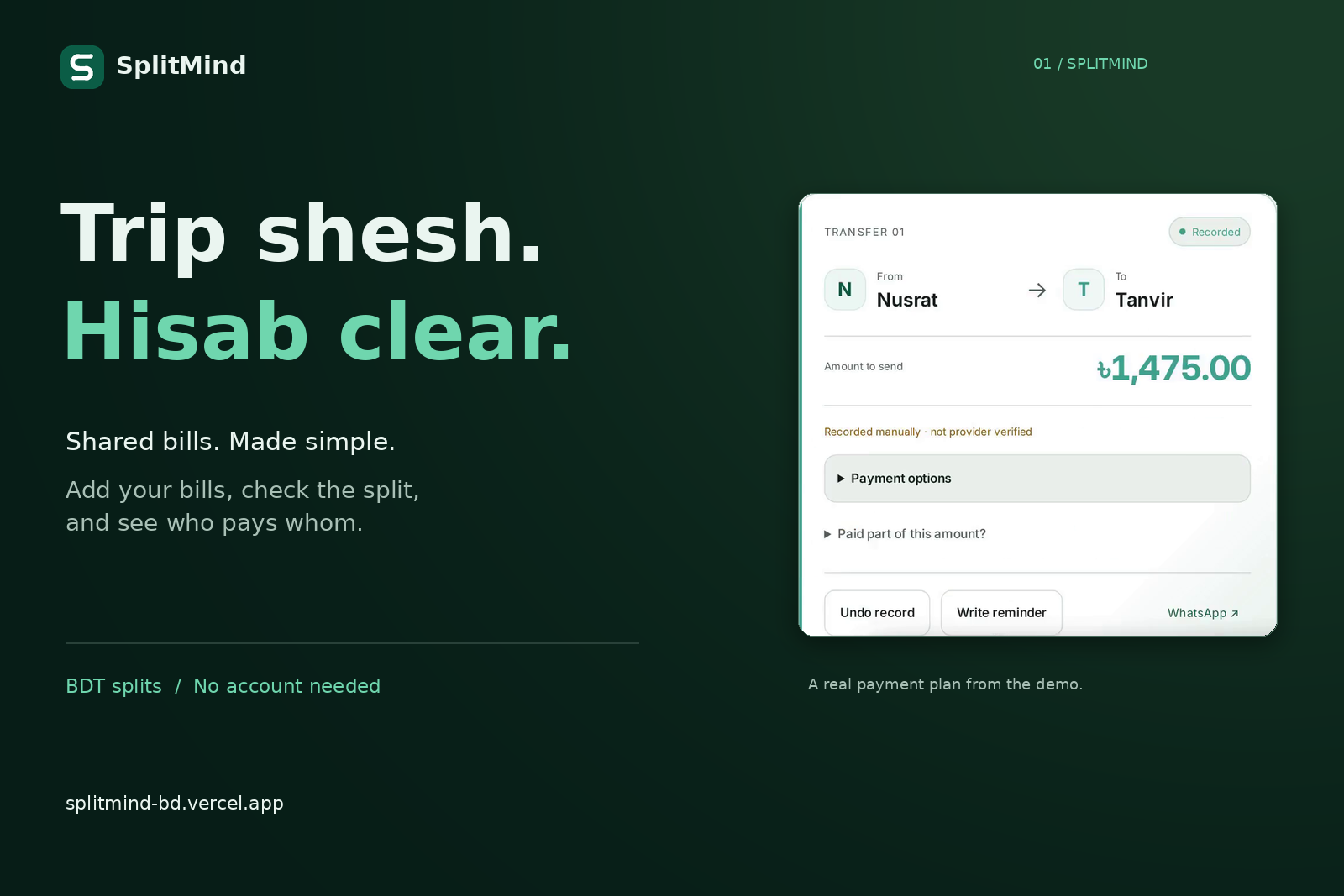
“Ke kake koto dibe?”—who owes whom?
That question often outlasts the dinner or trip itself. One friend pays for transport, another covers food, and someone still owes money from last week. The details end up scattered across messages, receipts and memory.
I built SplitMind to bring those details into one place and make the final calculation easier to understand, especially for people who naturally write in Bangla or Banglish.
What it does
SplitMind helps groups track shared expenses and work out who pays whom in Bangladeshi taka.
The app follows four steps: create a group, add expenses, review the entries and settle up. Users can enter bills manually, paste expense notes or upload a receipt. Gemini assists with text and receipt extraction, while local note parsing and on-device OCR offer alternatives.
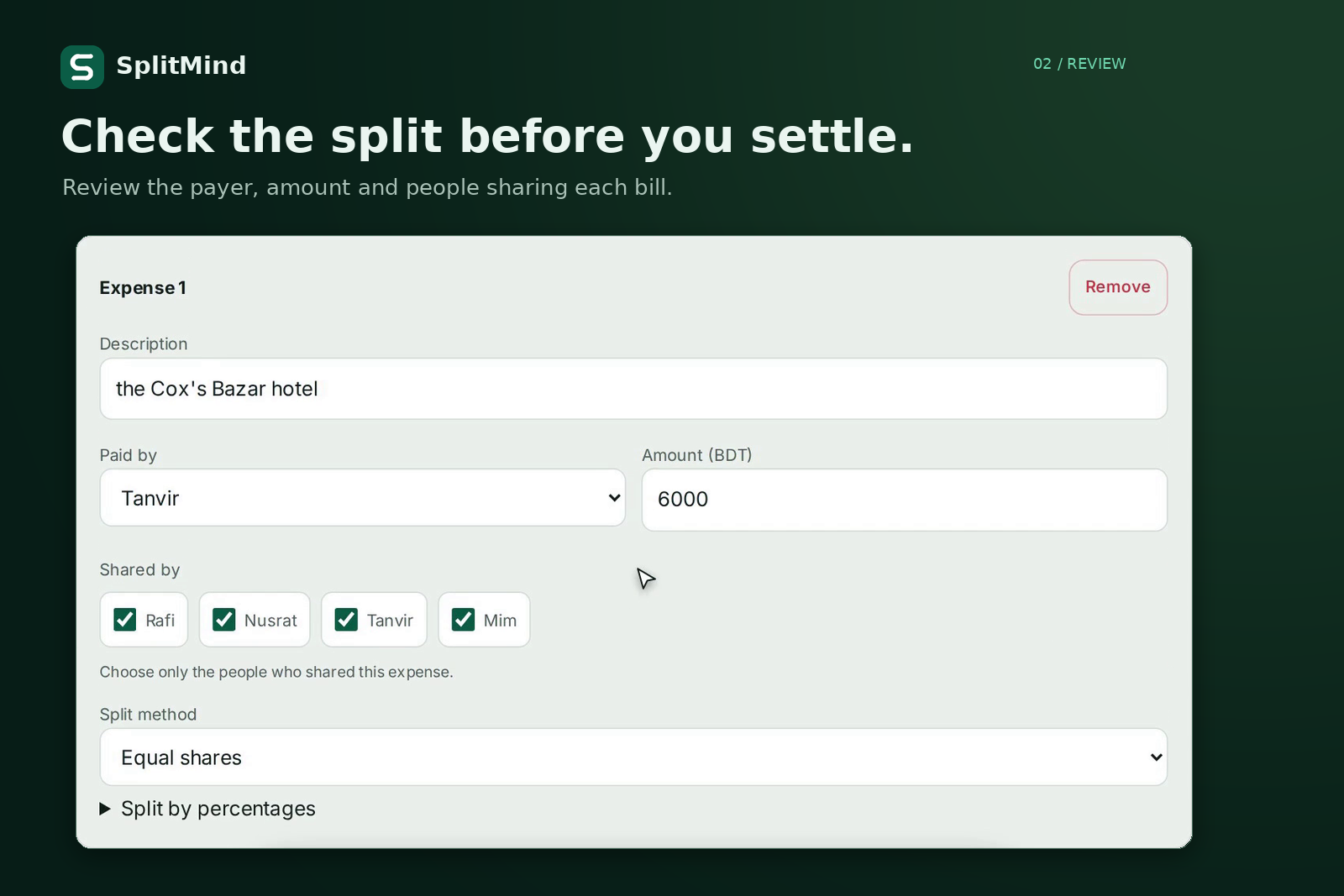
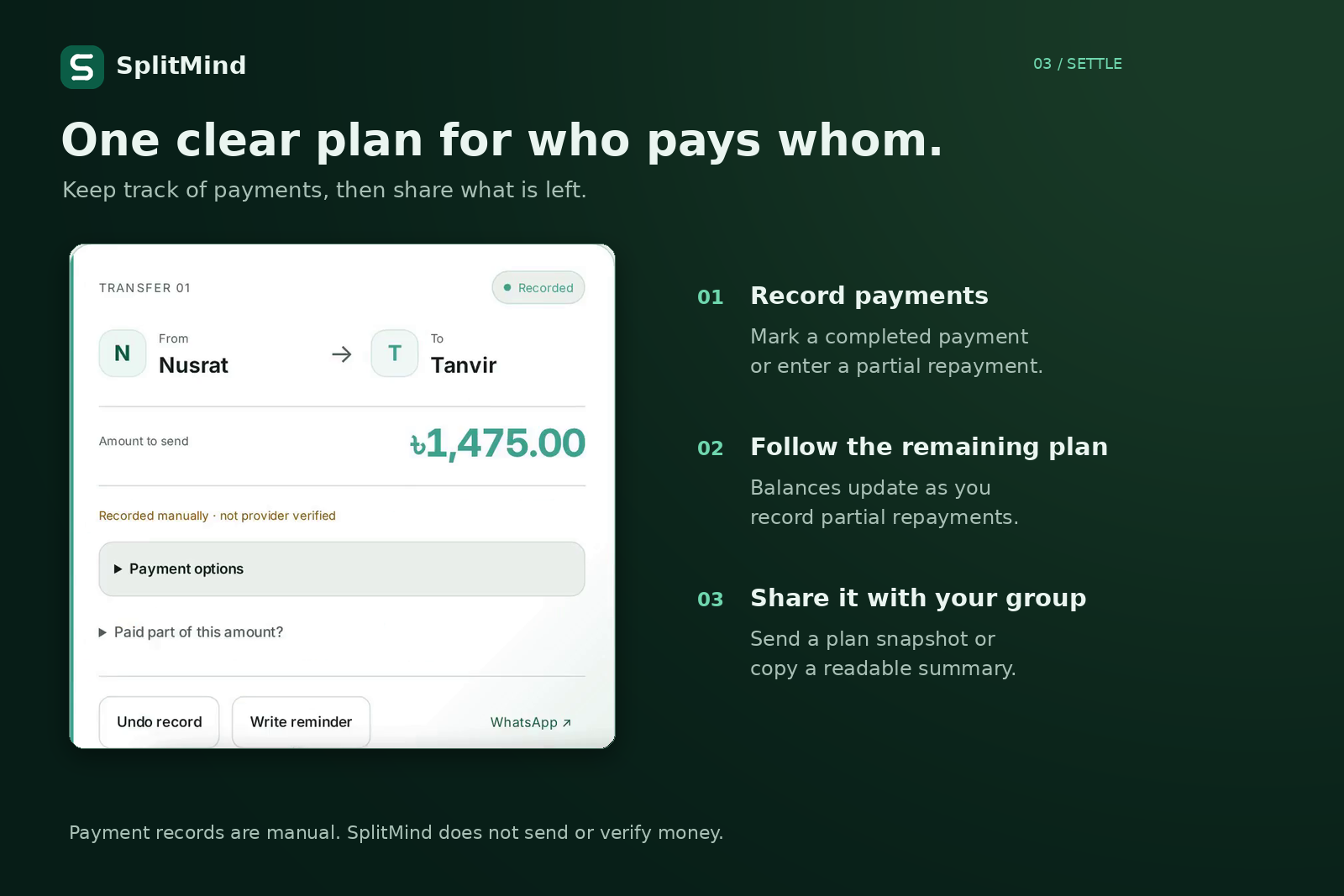
Users review the payer, amount and participants before calculating a plan. They can choose equal or custom shares, add previous debts, record partial repayments and share the remaining settlement plan.
SplitMind does not move money. Payment links and recipient details help users pay through external services, and recorded payments are clearly marked as manual records.
How I built it
I used HTML, CSS and JavaScript for the interface, with a Node.js-compatible API deployed on Vercel. Gemini runs through the server so the API key stays out of the browser. Tesseract.js provides on-device receipt OCR.
The accounting uses integer poisha to avoid floating-point rounding errors. Settlement calculations are deterministic; AI helps interpret the input, but does not decide the final balances.
Optional browser saving, downloadable backups and shareable snapshot links let users keep or share their work without creating an account.
Challenges I ran into
The hardest part was understanding what a short message actually means. “Raju Riya ke 500 dise” could describe a repayment, a shared expense or another transfer. Guessing would make the result look complete while getting the money wrong.
I addressed this with a review step. Unclear entries can become an editable bill or previous debt, or be explicitly excluded.
Another challenge was keeping the interface simple on phones while supporting detailed splits and payment records. I also worked through input-focus bugs, AI timeouts and mobile navigation issues.
Accomplishments that I am proud of
I’m proud of the complete flow: a group can enter several bills, correct the results, calculate a settlement, record a partial repayment and share what remains.
The current build passes 112 automated checks covering calculations, review flows, backups, API validation and other interactions. Those checks support reliability, but they do not replace testing with real receipts and first-time users.
What I learned
For an expense app, showing a number is only part of the job. People need to understand where it came from and have a clear way to correct it.
I also learned that AI is most useful here when it reduces typing while leaving the important decisions visible to the user.
What's next for SplitMind
My next priorities are testing with first-time users on their phones, measuring performance on real Bangladeshi receipts and improving Banglish interpretation based on those results.
I also want to strengthen shared AI usage limits before a wider launch and explore synchronized groups, so friends can follow the same plan rather than separate snapshots.
Built With
- css3
- github
- google-gemini-api
- html5
- javascript
- node.js
- tesseract.js
- vercel

