Inspiration
Startups are built on decisions, but most decisions are made with incomplete information and false confidence. Founders constantly face high-impact choices—hiring, launching, raising, spending on growth—while cash and milestones move in opposite directions. Existing AI tools usually return one fluent answer: hire two engineers, ship on the date, spend more on ads. That advice rarely asks the only question that matters: does this plan keep you alive past the milestone? We wanted an AI system that thinks more like a careful founder: explore more than one future, attack your own plan, and refuse to trust a number it can’t prove. SplitHorizon exists because a chatbot gives you advice. Founders need a date.
What it does
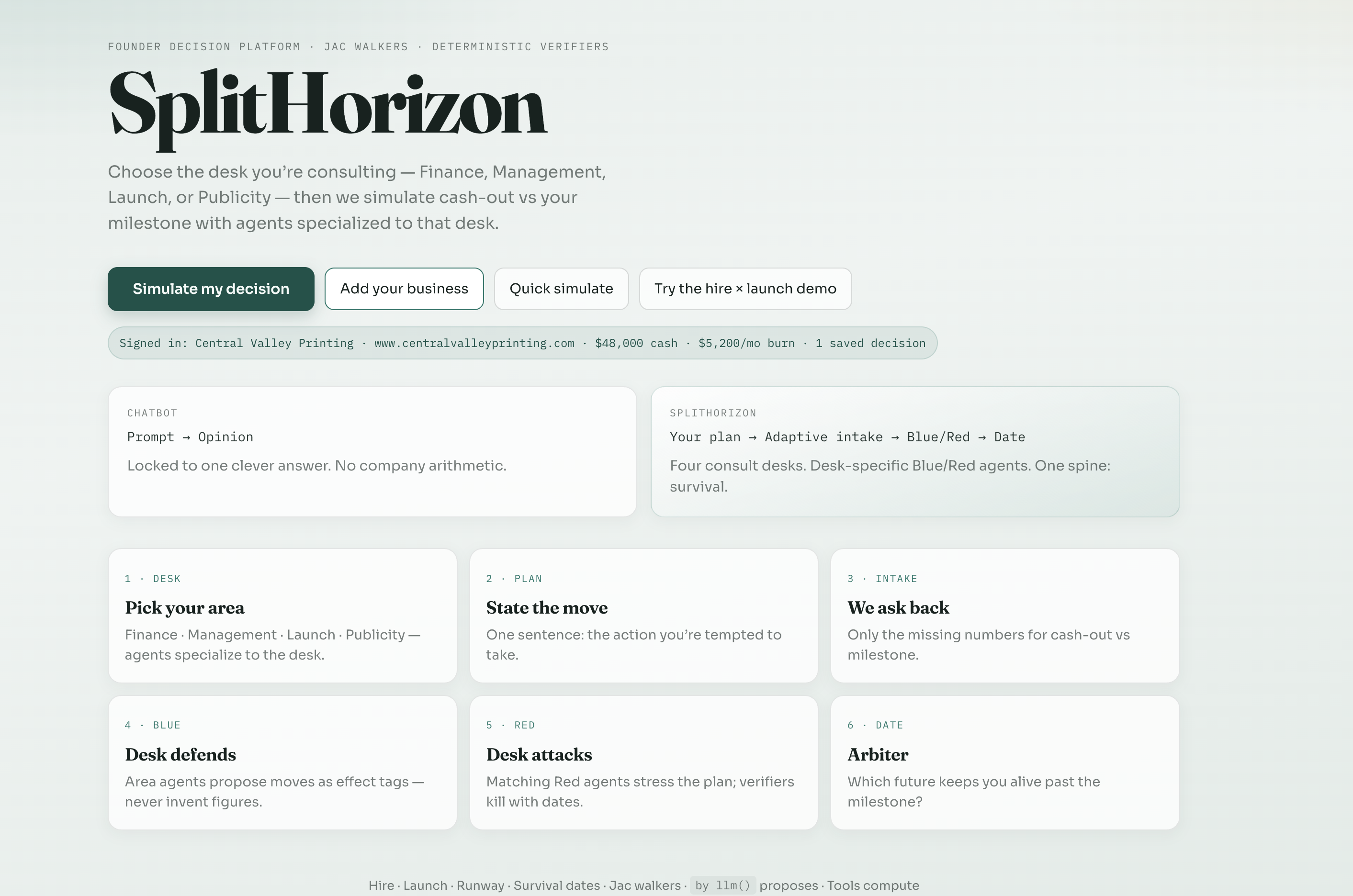
SplitHorizon is an AI startup decision simulator. You give it a company state—cash, burn, MRR, headcount, milestone—and a decision. Instead of one recommendation, it builds a graph of futures. Blue agents propose strategies that try to make the plan work. Red agents attack those strategies with failure modes and stress. Deterministic verifiers then compute runway, burn, costs, and cash-out dates, and kill futures that fail hard arithmetic, such as cashing out before the launch date. An arbiter ranks the survivors by survival and returns a clear date line plus what to actually do. Optional paths include adaptive intake that asks only the missing numbers, consult desks for finance, management, launch, and publicity, business profiles with saved decisions and follow-through, and a chatbot foil that answers the same question as a one-shot LLM opinion with no Red team and no math. SplitHorizon doesn’t just tell founders what to do. It shows where each decision leads, and which futures die on a number.
How we built it
SplitHorizon is built in Jac, with a thin Python UI bridge for the war room. Every agent is a walker and every future is a subgraph. ProtocolWalker runs the protocol, then role walkers—Seed, Blue, Red, Score, and Arbiter—visit a live OSP graph of CompanyState, Branch, Attack, Evidence, Memo, and Tool nodes. Creative work uses Jac’s by llm() path: Blue and Red propose moves and attacks as typed drafts, claims and effect tags, never final dollars. The moat is verifiers.jac: plain deterministic Jac code owns cash-out, runway, hire burn, and alive-at-milestone checks. engine.jac forks state, applies attacks, kills failing branches, and ranks survivors. The UI shows the futures tree, kill shots, straight answer, and plan of action. The hire × launch demo can run from cached drafts so judging doesn’t depend on API quotas, while live mode can call models for custom founder plans. The division of labor is intentional: AI generates possibilities; Jac tools determine the numbers and outcomes.
Challenges we ran into
The biggest challenge was making AI reasoning reliable. Large language models are strong at generating ideas and weak at respecting constraints—they invent burn rates, ignore runway, or soft-pedal a plan that should die. We solved this by hard-separating creative reasoning from verification so agents explore while verifiers validate, and so no score figure ever comes from the model. Another challenge was representing complex startup decisions as a branching graph without making the product slow or unreadable. Deep forks explode; shallow forks feel fake. We bounded rounds, specialized desks, and always returned a founder-facing spine: cash-out date versus milestone, with a kill callout when a branch fails. A third challenge was the demo versus live gap. Live LLM paths flake on quota and latency, so the judged path had to stay offline and deterministic for the brutal date story to land every time.
Accomplishments that we're proud of
We shipped a working prototype that turns one startup decision into an interactive map of futures. Our biggest accomplishment was combining AI collaboration with deterministic verification so the system does more than generate advice. SplitHorizon can identify failing strategies, eliminate impossible futures, and highlight the plans that survive, with visible brutal kills grounded in arithmetic, a survivor date line instead of a fake confidence score, real Jac walkers and OSP nodes rather than JSON dressed up as agents, and adaptive intake plus business profiles so custom founder plans can run the same protocol. The chatbot foil makes the contrast clear: opinion versus a verified date.
What we learned
We learned that reliable AI decision-making is not a smarter model alone. The strongest systems come from multiple perspectives, structured state, and verification. Models are excellent at exploring what might happen; real decisions need systems that challenge assumptions and prove outcomes. We also learned that Jac’s strengths—walkers, graphs, and typed LLM drafts—matter most when tools stay deterministic. If the model owns the dollars, you get theater. If Jac owns the math, you get a date.
What's next for SplitHorizon
We plan to expand SplitHorizon into a complete AI decision platform for founders and businesses. Future versions will add live progress while futures fork, founder dollars hard-bound into verifiers so spend and hire cost actually move cash-out, sensitivity and what-if tools on the date without re-running Blue and Red, replayable decision history with stateful follow-through, desk-specific brutal checks for ads, raise timing, and launch slip, and deeper simulations tied to real company data and historical outcomes. Our goal is an AI co-founder that helps people understand not only what decision to make, but what the future consequences of that decision will be.

Log in or sign up for Devpost to join the conversation.