Splat-n-Treat → WorldNotes
A Notion for AI 3D Spatial Worlds: A spatial CMS powered by client-side AWS + Gaussian splats + Kiro-assisted architecture refactoring.
🧠
Inspiration
2026 will be the first year where AI-generated 3D scenes become widespread:
Gaussian splats from mobile photogrammetry
AI world models capable of generating indoor/outdoor scenes
Neural rendering pipelines that output full environments
But nothing exists today that lets ordinary users annotate, explain, or build meaning inside these worlds.
There is no equivalent of Notion or WordPress for 3D spaces.
Our insight:
The world can stay static — but the layer of meaning placed inside the world must be dynamic.
WorldNotes is that dynamic layer.
🧩
What It Does
WorldNotes lets anyone:
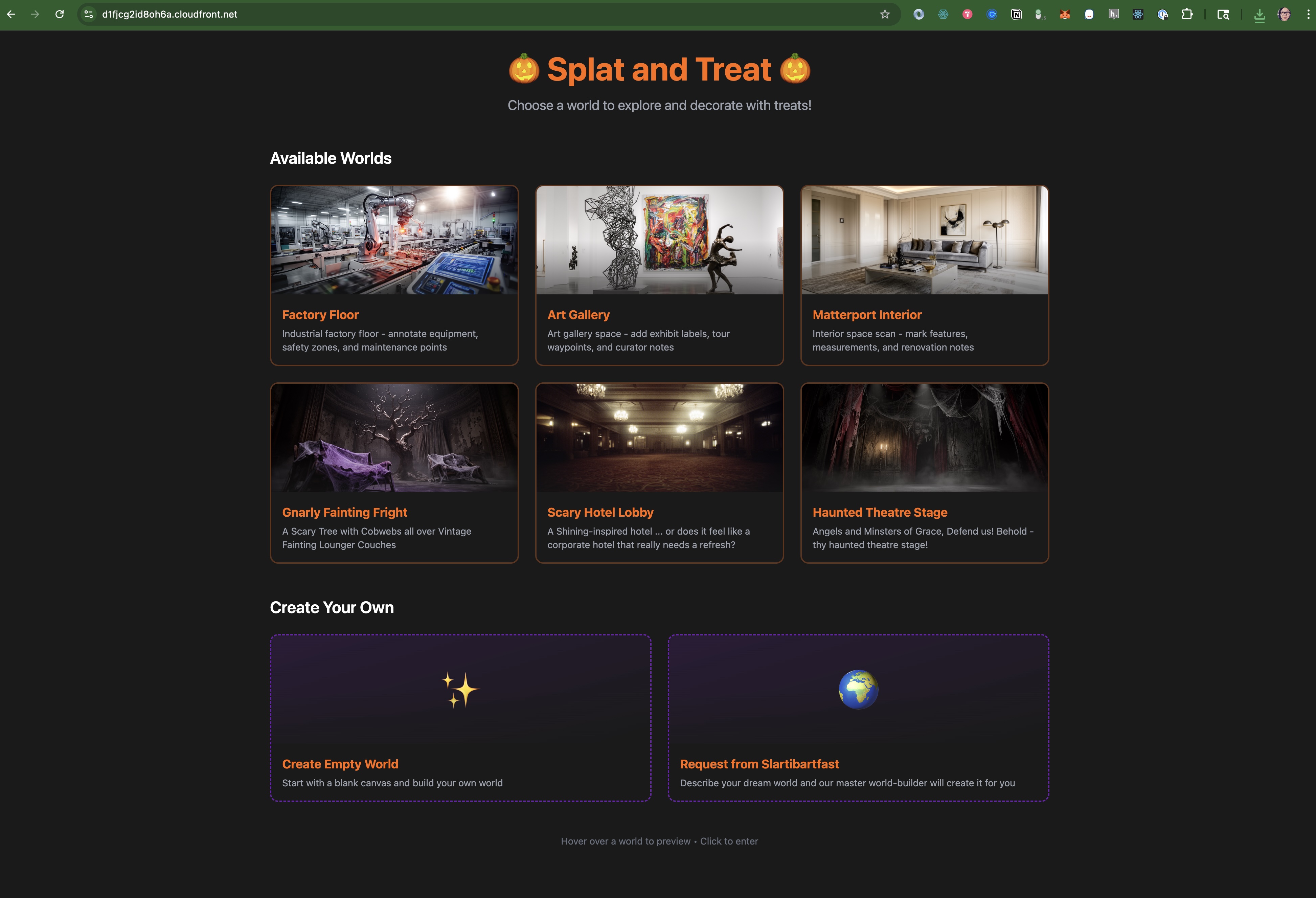
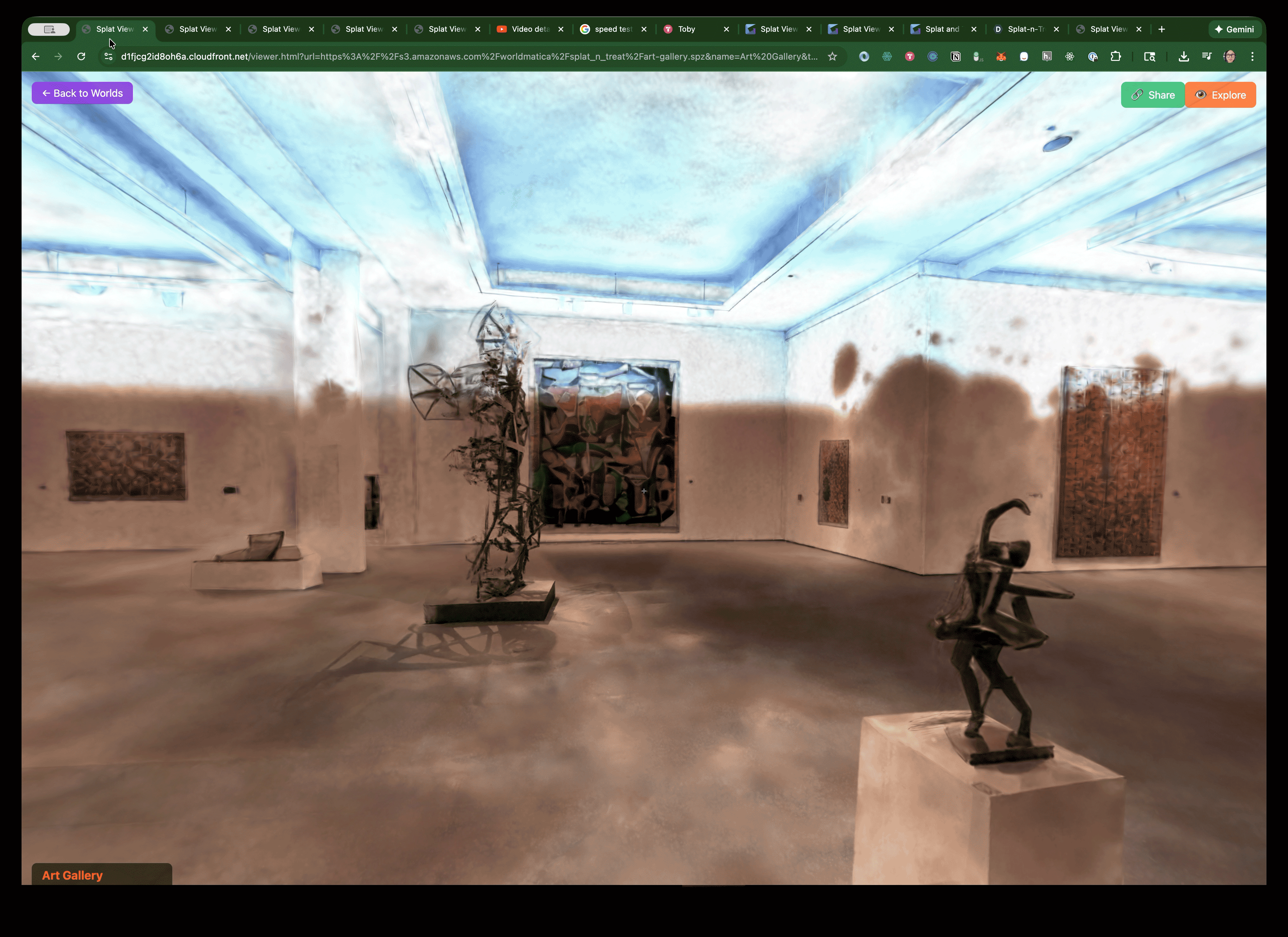
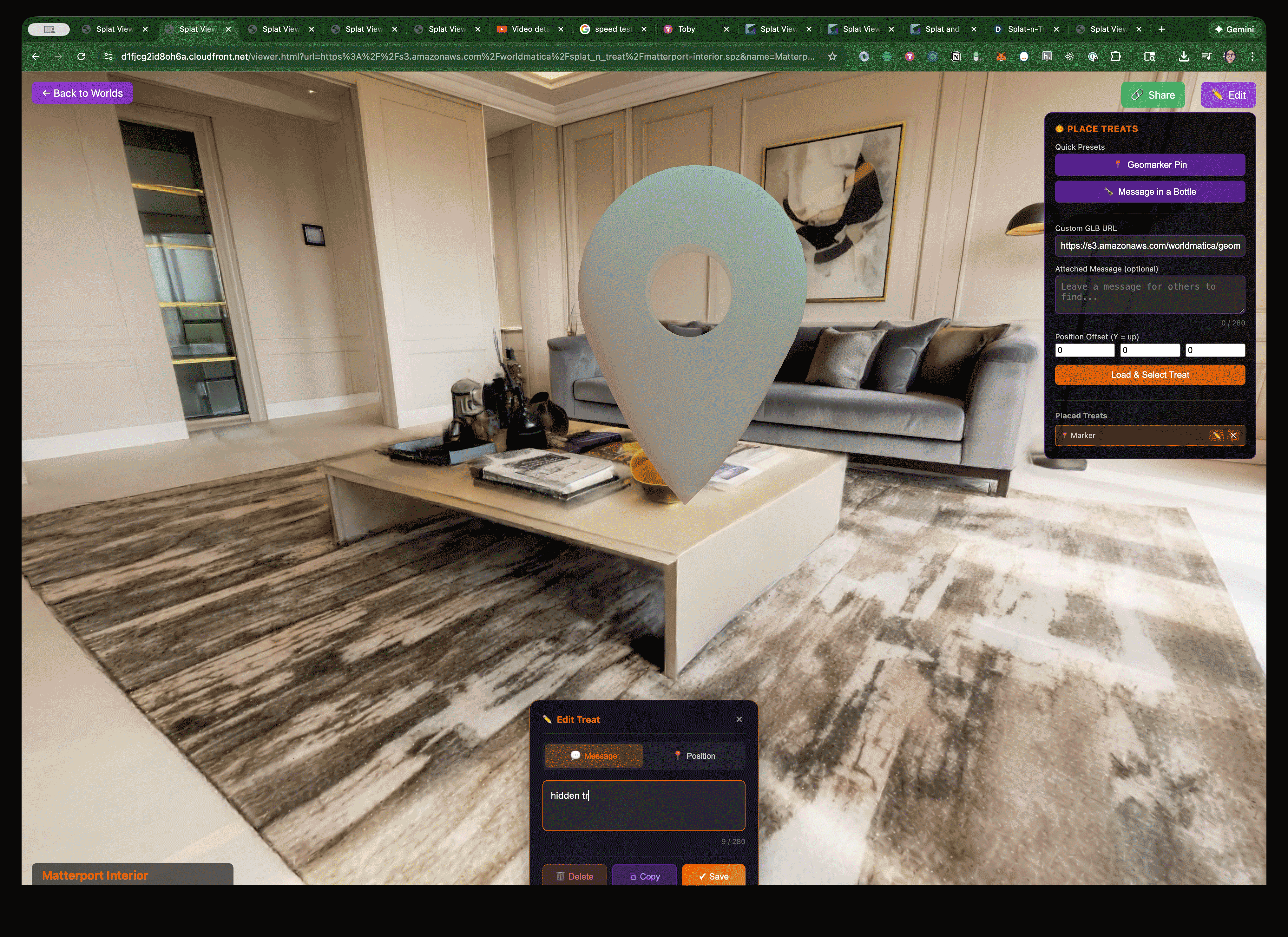
Load a .spz Gaussian splat world
Walk through it (WASD + mouselook)
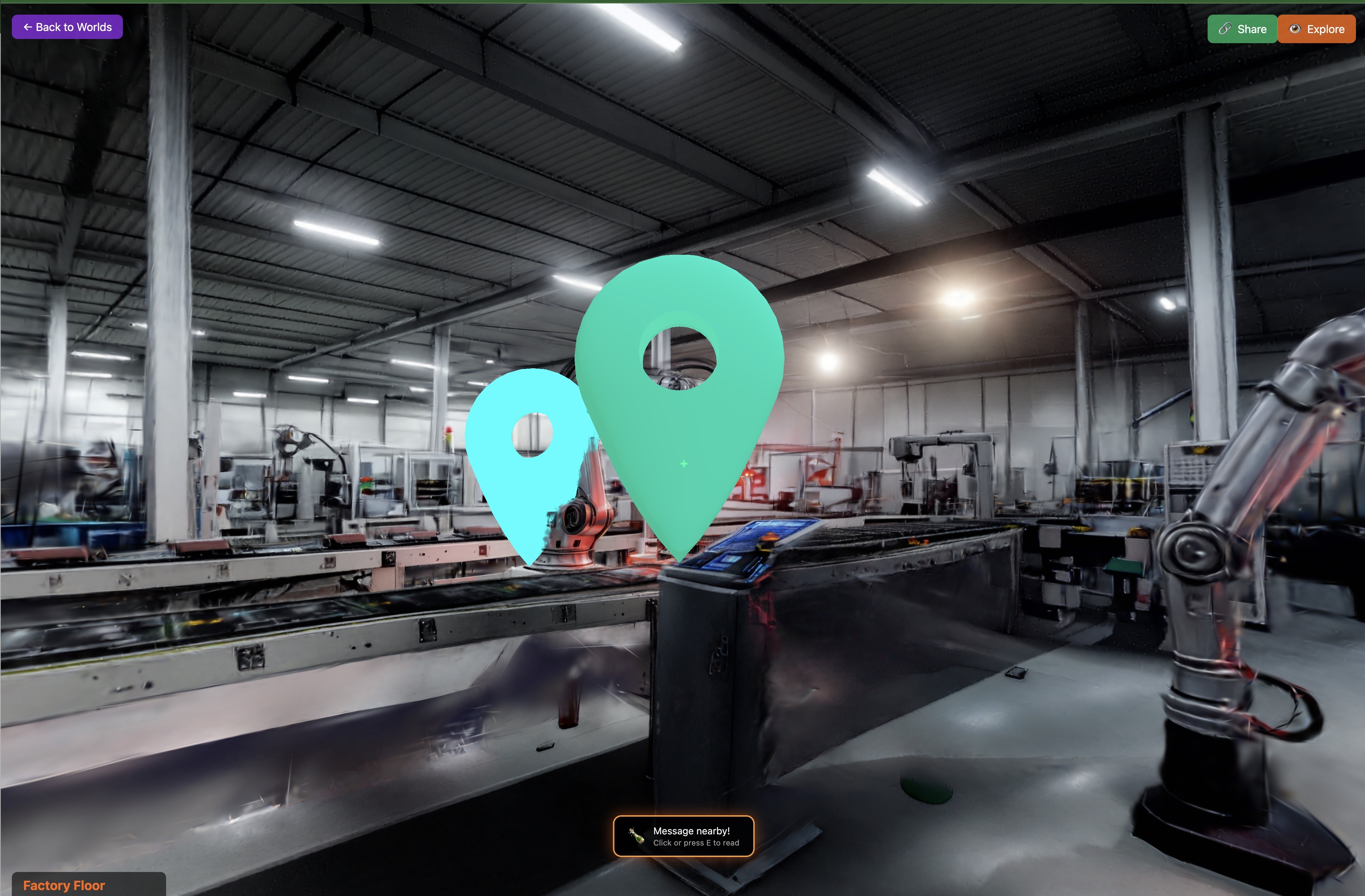
Click to place 3D “Treats” (GLB objects) inside the scene
Add messages, notes, metadata
Reposition, rotate, edit, delete
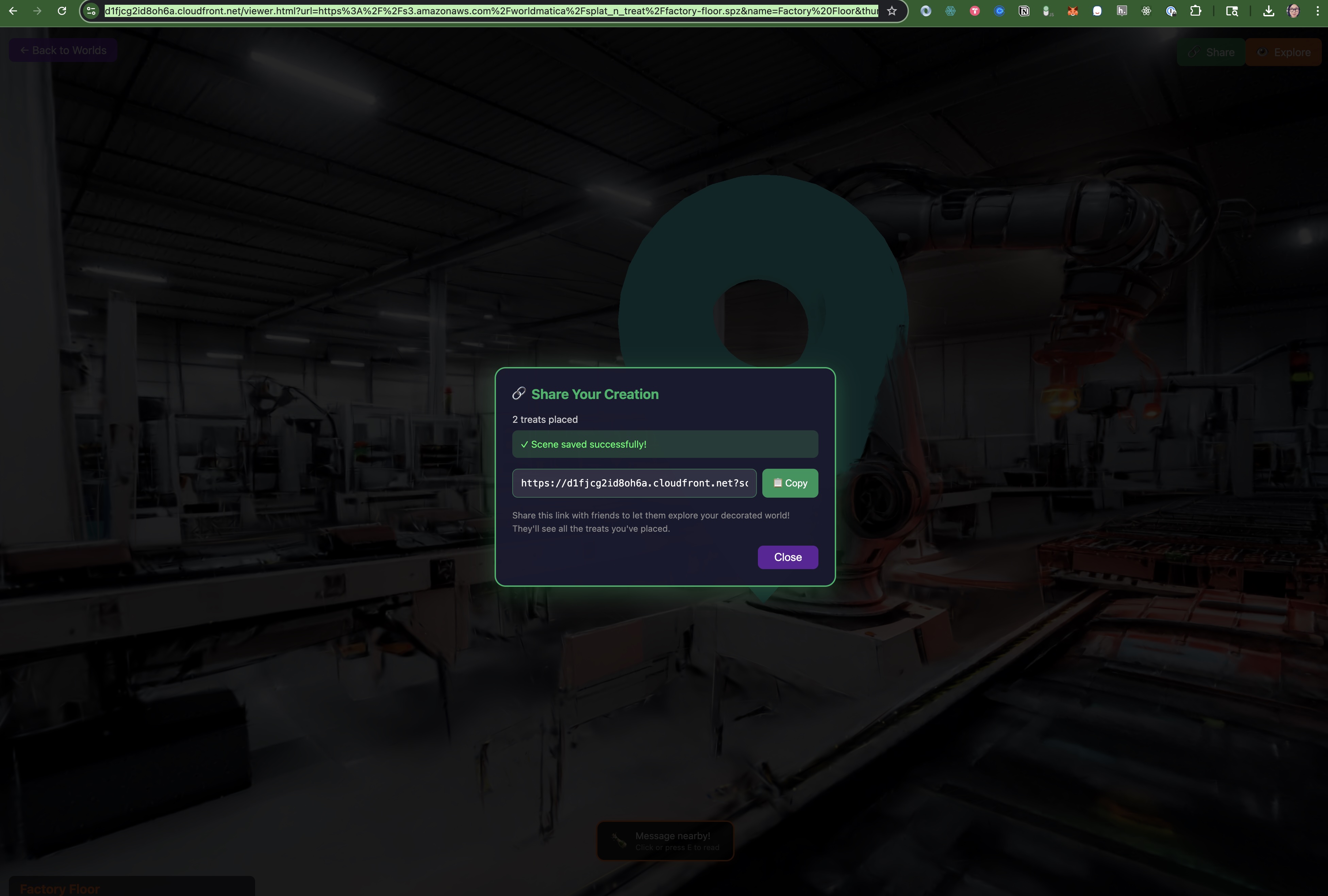
Press Share, which:
- serializes the scene as JSON
- uploads it to S3 using client-side Cognito credentials
- generates a shareable viewer URL hosted on CloudFront
Viewers can:
Explore the world
Interact with the placed notes
No login, no install, no editor UI
This is effectively Notion for 3D worlds, built on fully client-side, credentialed AWS access.
🛠
How We Built It (Technical Detail that Wins Points)
1. Rendering Core — Spark.js + GLB integration
We built a unified WebGL pipeline that merges:
Gaussian splat rendering (Spark.js)
GLB treat rendering (THREE-style transforms mapped into Spark coordinate space)
Scene graph overlays
Technical features implemented:
camera calibration panel with live pose export
forward-vector math for treat placement
raycasting into splat space
deterministic placement on uneven surfaces
cross-origin GLB loading with correct CORS settings
2. Treat Engine — the core abstraction
A minimal but expressive schema:
{
  "world": {
    "name": "Factory Floor",
    "splat": "factory-floor.spz"
  },
  "treats": [
    {
      "id": "uuid",
      "url": "geomarker_animated.glb",
      "pos": [x, y, z],
      "rot": [pitch, yaw, roll],
      "message": "string"
    }
  ],
  "camera": {
    "pos": [...],
    "rot": [...]
  }
}
Why this matters:
Supports arbitrary 3D annotations
Stable across worlds, splats, NeRFs, and AI-generated scenes
Extensible (scale, custom metadata, typed treat classes)
Can be diffed or streamed later (for multiplayer editing)
3. Backend Architecture — Client-Side AWS (NOT zero-backend)
AWS S3
hosts:
- splat files
- treat-layer JSON
- GLBs
- thumbnails
public READ for viewer
Cognito-authenticated PUT for editor
AWS Cognito Identity Pool
Client-generated AWS STS credentials.
We used:
unauthenticated identities
IAM roles scoped to exact prefix paths
Kiro to debug “resource prohibited” field issues in IAM
CloudFront
viewer + editor static hosting
fast global caching
URL parameter routing
CORS preflight compatibility
Why this wins points:
We are not using “no backend”;
We are using a real, production-grade distributed backend,
powered entirely through client-side AWS SDK — a modern pattern used by Figma, Framer, and other edge-native apps.
4. Kiro Usage — Strongest Implementation Score Section
We used Kiro aggressively and meaningfully:
Vibe Coding
rewrote S3/Cognito integration in minutes
generated IAM policies
repaired CORS configs
scaffolded viewer/editor split
Specs
defined treat schema
abstracted world loader contract
defined core module interfaces:
- addTreat, removeTreat, updateTreat, serializeScene, applyCameraPose
Hooks
autosave
treat UUID generation
scene validation
batch object cleanup
Steering
guided architecture refactor into a clean split
standardized naming conventions
removed accidental complexity
MCP
synced static assets
patched configs live
regenerated file trees for two separate repos
This demonstrates “above-and-beyond” Kiro usage — not just codegen, but system design, debugging, and refactoring.
5. Architecture Split — Skeleton Crew Category
We produced a shared core + two fully separate repos, in under an hour:
worldnotes-core
Splat loader
GLB loader
Raycaster
Camera calibrator
Treat manager
Scene serializer
URL config parser
worldnotes-editor (Repo 1)
full edit panel
treat placement
custom GLB loading
message editing
reposition/drag mode
S3 upload
Share modal
camera calibration UI
worldnotes-viewer (Repo 2)
read-only world exploration
treat display
message interaction
no S3 writes
lightweight, embeddable viewer
This satisfies — explicitly — the Skeleton Crew requirement:
One core, two meaningful, distinct applications.
😱
Challenges We Overcame (Technically Explicit)
1. Spark.js WASM fail on Vite
We had to remove Vite, switch to:
pure ES modules
predictable WASM loading paths
CloudFront-friendly asset resolution
2. IAM policy misconfiguration
Cognito complained: “resource contains prohibited field.”
Kiro helped us generate:
"Resource": "arn:aws:s3:::worldmatica/splat_n_treat/*"
for correct role delegation.
3. S3 CORS failures
Fixed:
Access-Control-Allow-Origin: *
GET, PUT
x-amz-acl
CloudFront invalidations
4. world-space vs splat-space mismatch
Solved by:
calibration panel
world origin reset
consistent meters-per-unit normalization
5. UX complexity inside FPS worlds
Resolved by:
drag-to-move mode
edit modal separation
treat highlight feedback
toggled cursor states
🏅
Accomplishments We’re Proud Of
Built a spatial CMS for the coming tidal wave of AI 3D worlds.
Designed a professional-grade client-side AWS backend.
Performed a complete architecture split in under 60 minutes with Kiro.
Created a standard for 3D annotation layers parallel to WordPress/Notion for 2D.
Fully open-source, easy for anyone to self-host on S3.
📚
What We Learned
Gaussian splats are stable foundations for mixed-reality UI.
Treat layers (GLB overlays + metadata) form a universal spatial data structure.
Kiro is exceptionally strong at refactors, debugging cloud configs, and structuring repos.
Client-side cloud architectures minimize operational overhead while preserving power.
🚀
What’s Next
1. Multi-user co-editing
(CRDT-based spatial deltas)
2. Semantic AI hotspots
(“suggest treat placement here”)
3. Plugin treat types
(scripts, interactions, metadata)
4. World model importers
(AI → splat → editable CMS)
5. Spatial RAG index
(embedding queries inside 3D environments)
🎯
Judges’ TL;DR
Splat-n-Treat becomes WorldNotes: a spatial CMS for 3D worlds, powered by Gaussian splats, a robust client-side AWS backend, and a Kiro-assisted architecture split into two real applications (editor + viewer).
It showcases advanced implementation depth, production thinking, and exceptional use of Kiro.
Powered by LiquidMetal AI Raindrop + Vultr Compute
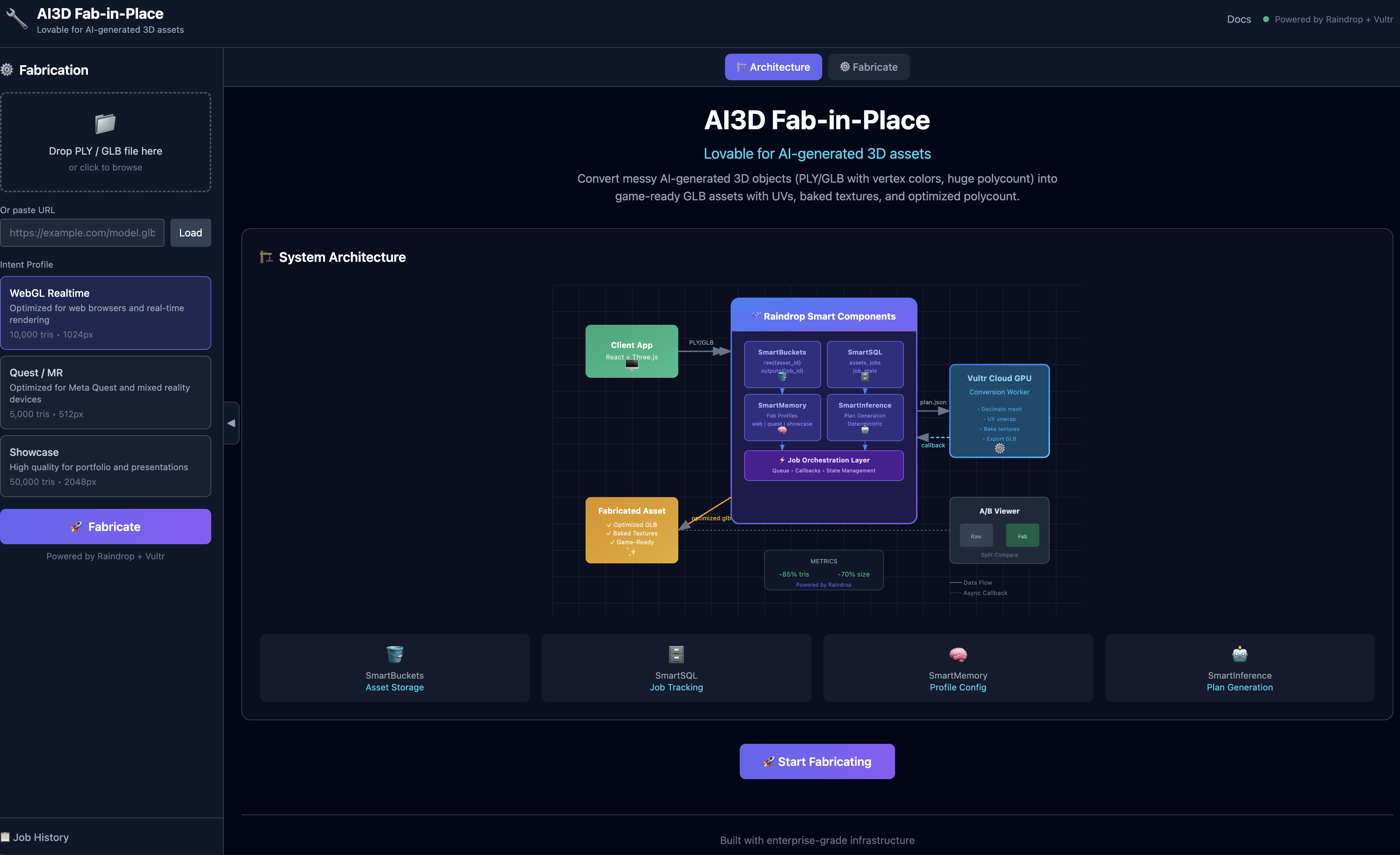
This project integrates LiquidMetal AI’s Raindrop platform as the orchestration layer for AI-generated 3D assets, using SmartBuckets for artifact storage, SmartSQL for job and provenance tracking, SmartMemory for reusable intent profiles, and SmartInference for deterministic fabrication planning.
Heavy 3D processing (mesh optimization, UV unwrapping, texture baking, and export) is executed on Vultr-hosted compute, allowing raw AI outputs to be converted into game-ready, production-usable assets.
Raindrop turns AI 3D from disposable output into an iterable, versioned fabrication pipeline, while Vultr provides the scalable compute needed to make the process fast and repeatable.
Built With
- amazon-web-services
- blender
- cloudfront
- cognito
- glb
- guassian-splats
- javascript
- kiro
- lamp
- liquidmetal
- python
- raindrops
- react
- s3
- sparkjs
- three.js
- uvicorn
- vultr
- worldlabs


Log in or sign up for Devpost to join the conversation.