-
-
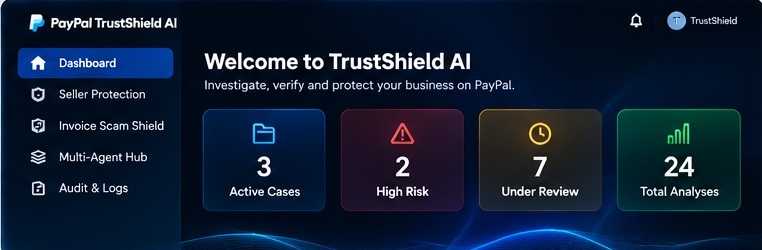
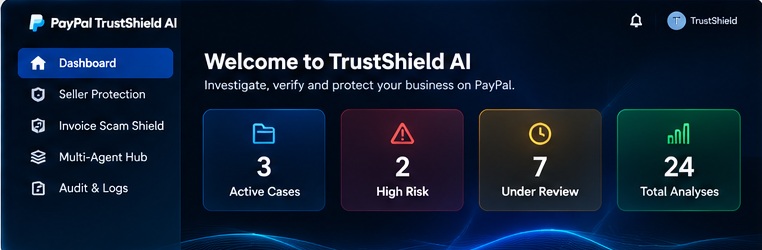
Unified merchant risk overview.
-
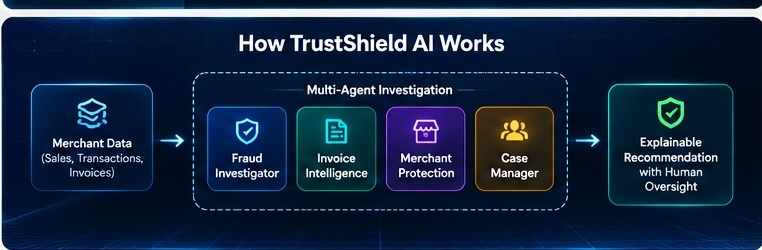
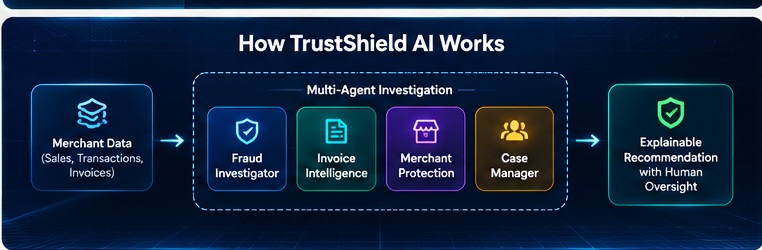
From merchant data to explainable decisions.
-
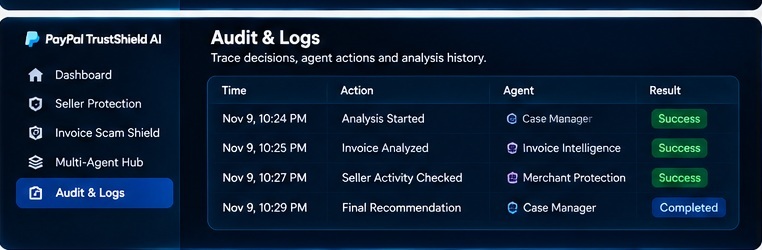
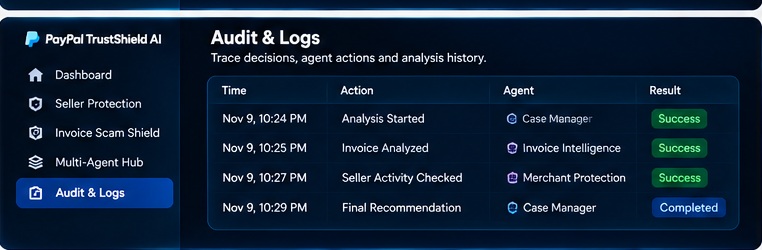
Traceable investigation activity and outcomes.
-
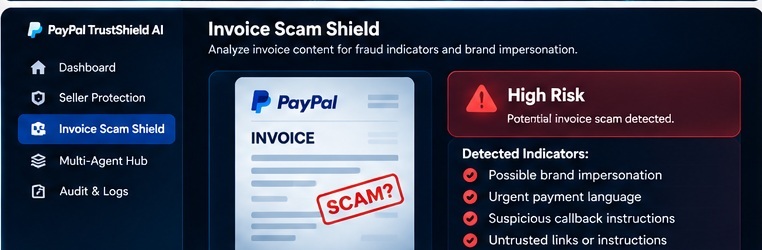
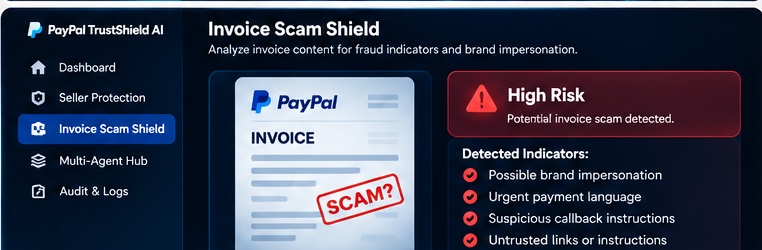
Detecting suspicious invoice patterns.
-
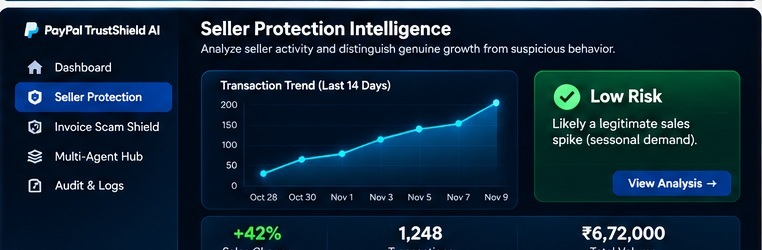
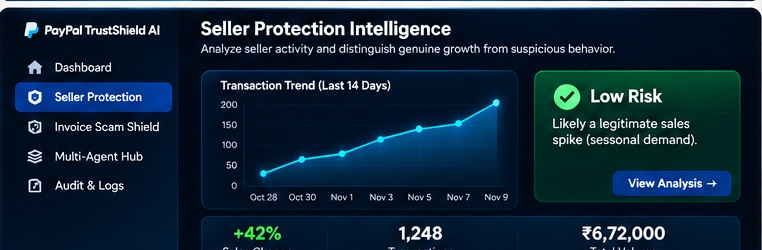
Distinguishing genuine sales spikes from suspicious activity.
-
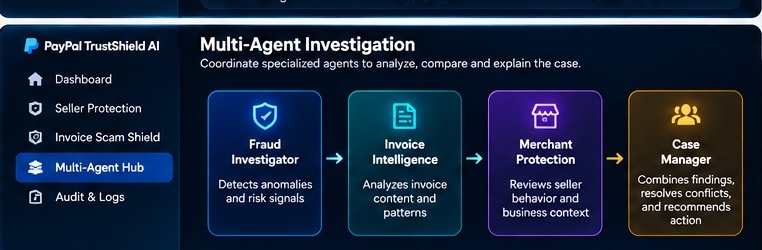
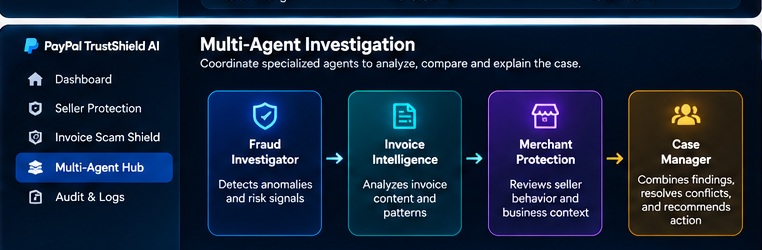
Four agents collaborating on fraud analysis.
-
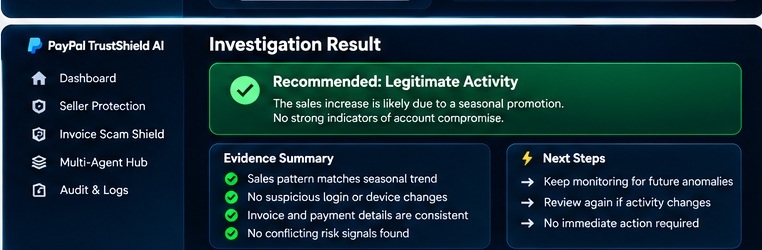
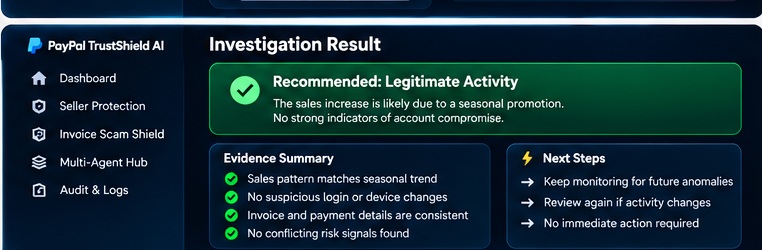
Evidence-based recommendations with human oversight.
-
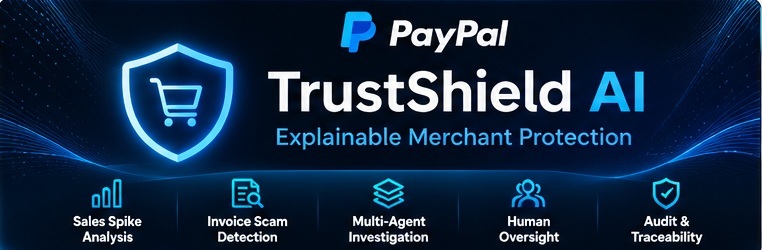
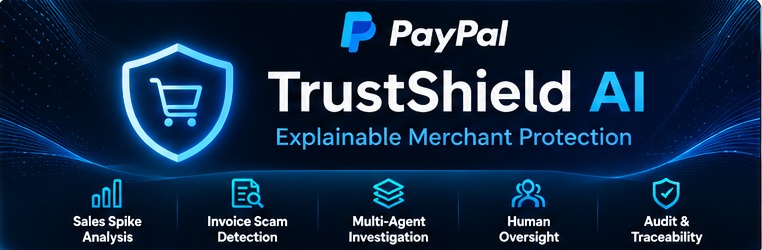
Introducing TrustShield AI.
Inspiration
Online merchants face a difficult challenge: a sudden increase in sales may indicate genuine business growth, but unusual activity can also signal account compromise. Meanwhile, scam invoices exploit brand impersonation, urgency, and misleading payment instructions.
We built PayPal TrustShield AI to address these challenges through contextual risk assessment, explainable investigations, and human oversight. Our guiding idea is simple: suspicious activity deserves investigation, not automatic judgment.
What it does
PayPal TrustShield AI is an explainable merchant protection prototype with four key capabilities:
- Seller Protection Intelligence: Examines seller activity scenarios to help distinguish legitimate sales spikes from potentially suspicious behavior.
- Invoice Scam Shield: Identifies warning signs such as brand impersonation, urgent billing language, suspicious callback instructions, and malicious instructions embedded in invoice content.
- Multi-Agent Investigation: Coordinates four specialized agents—Fraud Investigation, Invoice Intelligence, Merchant Protection, and Case Manager—to compare hypotheses, examine evidence, identify contradictions, and support human review.
- Auditability and Safety: Provides audit logging, security-conscious API handling, and evidence-based recommendations while keeping consequential decisions under human oversight.
How we built it
We built the application using React, TypeScript, Vite, and a Node.js backend. The dashboard brings seller risk scenarios, invoice analysis, multi-agent investigations, and audit information into one interface.
The investigation workflow uses specialized agents to examine different aspects of a case and organize supporting evidence, alternative explanations, and contradictions.
We implemented a server-side PayPal Orders API v2 Sandbox adapter and designed safe behavior for missing credentials and unavailable integrations. The current demo uses clearly labeled simulated scenarios; a successful live Sandbox transaction roundtrip has not yet been verified.
We also use GitHub Actions for automated testing, code-quality and security checks, production builds, and Docker build verification.
Challenges we ran into
One of our biggest challenges was distinguishing unusual activity from genuinely suspicious behavior. A sales spike alone does not prove fraud, so we designed scenarios that consider context and provide explanations rather than relying only on a risk score.
Another challenge was coordinating multiple investigation agents while making their reasoning and conflicting evidence understandable. We also worked on responsive dashboard layouts, safe API failure handling, and treating untrusted invoice content as data rather than instructions.
Accomplishments that we're proud of
- Built an integrated prototype combining seller protection, invoice scam analysis, and multi-agent investigation.
- Designed contextual scenarios for both legitimate sales growth and potentially compromised accounts.
- Added evidence comparison, contradiction detection, and human-review recommendations.
- Implemented audit logging and security-conscious handling of integration failures.
- Achieved 101 out of 101 passing automated tests in our reported test run.
- Verified successful frontend and backend production builds and a green GitHub Actions pipeline.
These results demonstrate the project's current implementation and automated checks, not proven real-world fraud-detection performance.
What we learned
We learned that effective fraud investigation is about more than detecting anomalies. A useful system should explain why an event deserves attention, consider alternative explanations, communicate uncertainty, and help people make informed decisions.
We also learned the importance of secure API handling, testing responsive interfaces, validating agent workflows, and being transparent about the difference between simulated demonstrations and verified external integrations.
What's next for PayPal TrustShield AI
Our next steps are to verify end-to-end PayPal Sandbox transactions, expand testing with representative and diverse fraud scenarios, evaluate detection quality using clearly defined metrics, and improve the reliability of multi-agent investigations.
We also aim to strengthen evidence traceability and provide investigators with clearer explanations and actionable recommendations.
Our long-term vision is to help merchants and investigators make better-informed decisions through contextual, explainable, and human-centered protection.
An unusual transaction is a signal, not a verdict.
