



Inspiration
Keeping pace with the rapid influx of arXiv preprints often leads to saving countless PDFs, browser bookmarks, and scattered notes. The core bottleneck consistently happens months later during retrieval: standard keyword searches completely break down when you only remember an abstract methodology, a theoretical concept, or an intuitive idea rather than the exact phrasing in the paper's title or author list. I wanted a personal, private research workspace where retrieving prior literature is as natural as describing the core concept itself.
What it does
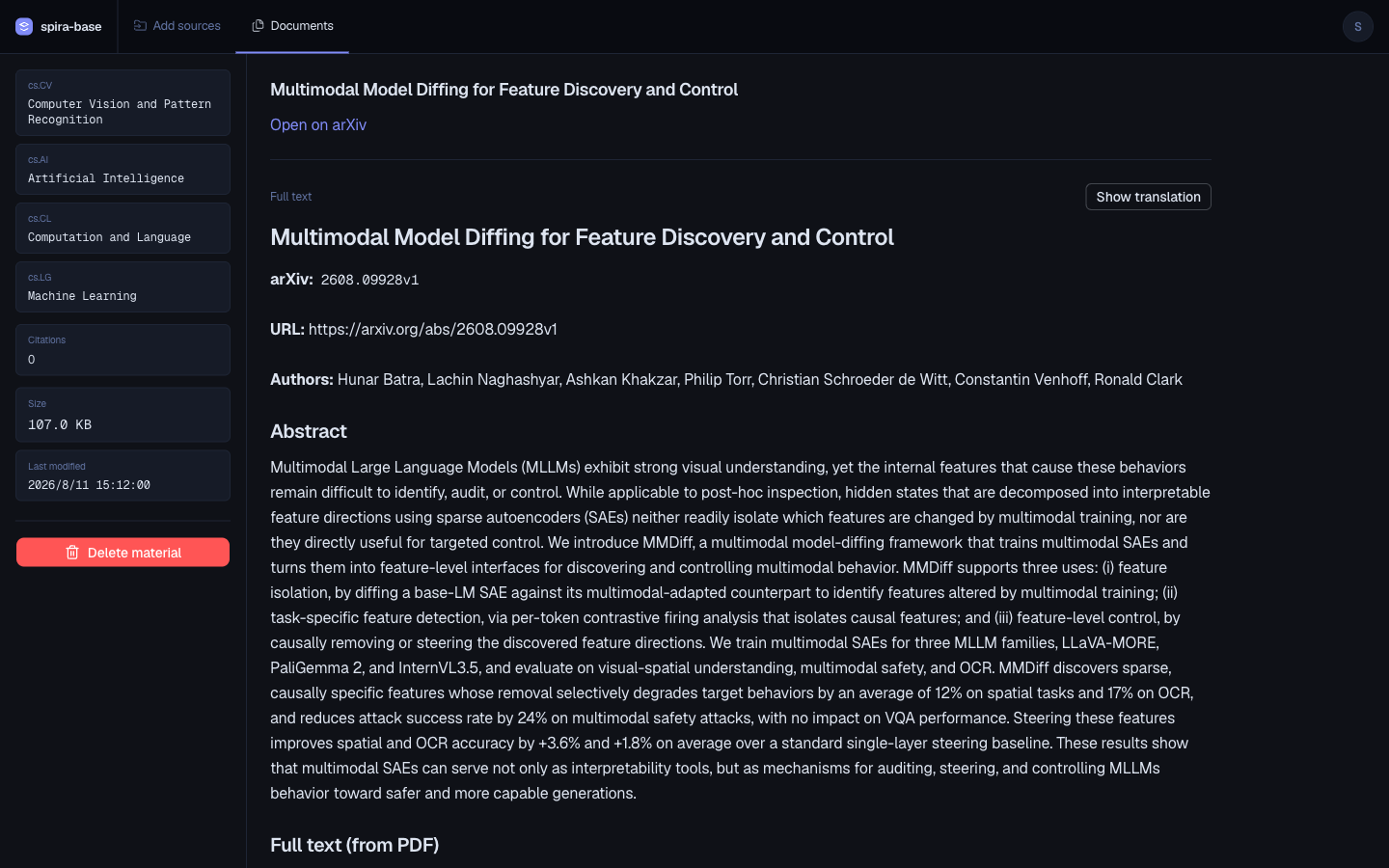
Spira Base is a self-hosted personal knowledge base and retrieval engine specifically built to stockpile, organize, and query arXiv papers using semantic vector search.
- Semantic Vector Retrieval: Searches through indexed paper abstracts and content based on conceptual context and natural language queries, moving beyond rigid exact-keyword matching.
- 100% Self-Hosted & Local-First: Runs entirely inside your own private infrastructure. Research interests, queries, and archives remain completely local with zero third-party tracking or cloud vendor lock-in.
- Structured Stockpiling: Consolidates metadata, paper abstracts, custom tags, and personal research notes into a unified, local database.
How I built it
- Vector & Embedding Pipeline: Engineered a streamlined indexing pipeline that converts arXiv metadata and abstracts into vector embeddings, optimizing similarity retrieval across dense academic texts.
- Backend Architecture: Built a performant local service layer to handle database storage, query processing, and vector search operations.
- Deployment & Containerization: Structured the entire environment for lightweight local deployment (via Docker), ensuring low resource overhead and friction-free setup on personal machines or home servers.
Challenges I ran into
- Retrieval Quality on Dense Academic Text: Fine-tuning embedding retrieval to distinguish subtle differences between highly specialized mathematical formulations and machine learning architectures.
- Keeping the Footprint Lightweight: Designing a local vector search pipeline that delivers sub-second query responses without demanding high-end enterprise GPU infrastructure.
- Structuring Metadata Ingestion: Handling variations in arXiv metadata formatting and structuring records for clean, deterministic querying.
Accomplishments that I'm proud of
- Building an end-to-end, functional self-hosted system that makes conceptual discovery across hundreds of academic papers virtually instantaneous.
- Delivering a clean, developer-friendly architecture that provides robust privacy without sacrificing retrieval power.
- Releasing the production-ready build for the developer and research community on Gumroad.
What I learned
- Best practices for designing local-first, privacy-centric data storage architectures combined with vector retrieval pipelines.
- Techniques for balancing embedding model dimensions with local memory and CPU execution constraints.
- Deeper insights into knowledge management patterns and retrieval friction experienced by technical researchers.
What's next for spira-base — a knowledge base for arXiv papers
- Adding export and bidirectional sync capabilities with local PKM tools (such as Obsidian vaults and BibTeX managers).
- Exploring local LLM integrations to allow automated literature summarization and cross-paper synthesis entirely on-device.
- Introducing automated topic clustering and citation graph exploration directly within the local workspace.
Built With
- fastapi
- next.js

Log in or sign up for Devpost to join the conversation.