
Inspiration
SpineOps AI was inspired by a real operational problem facing legacy industrial firms: many warehouses want to adopt robotics and AI, but they often do not know where automation should start first. In traditional warehouses, movement data is fragmented across spreadsheets, manual observations, barcode systems, and disconnected reports. This makes automation risky because companies may invest in robotics hardware before understanding the actual flow of goods, delay patterns, and labor bottlenecks. I wanted to build a practical AI-integrated operations system that helps firms move from automation hype to evidence-based decision-making. Instead of positioning robotics as the starting point, SpineOps AI starts with operational visibility.
What it does
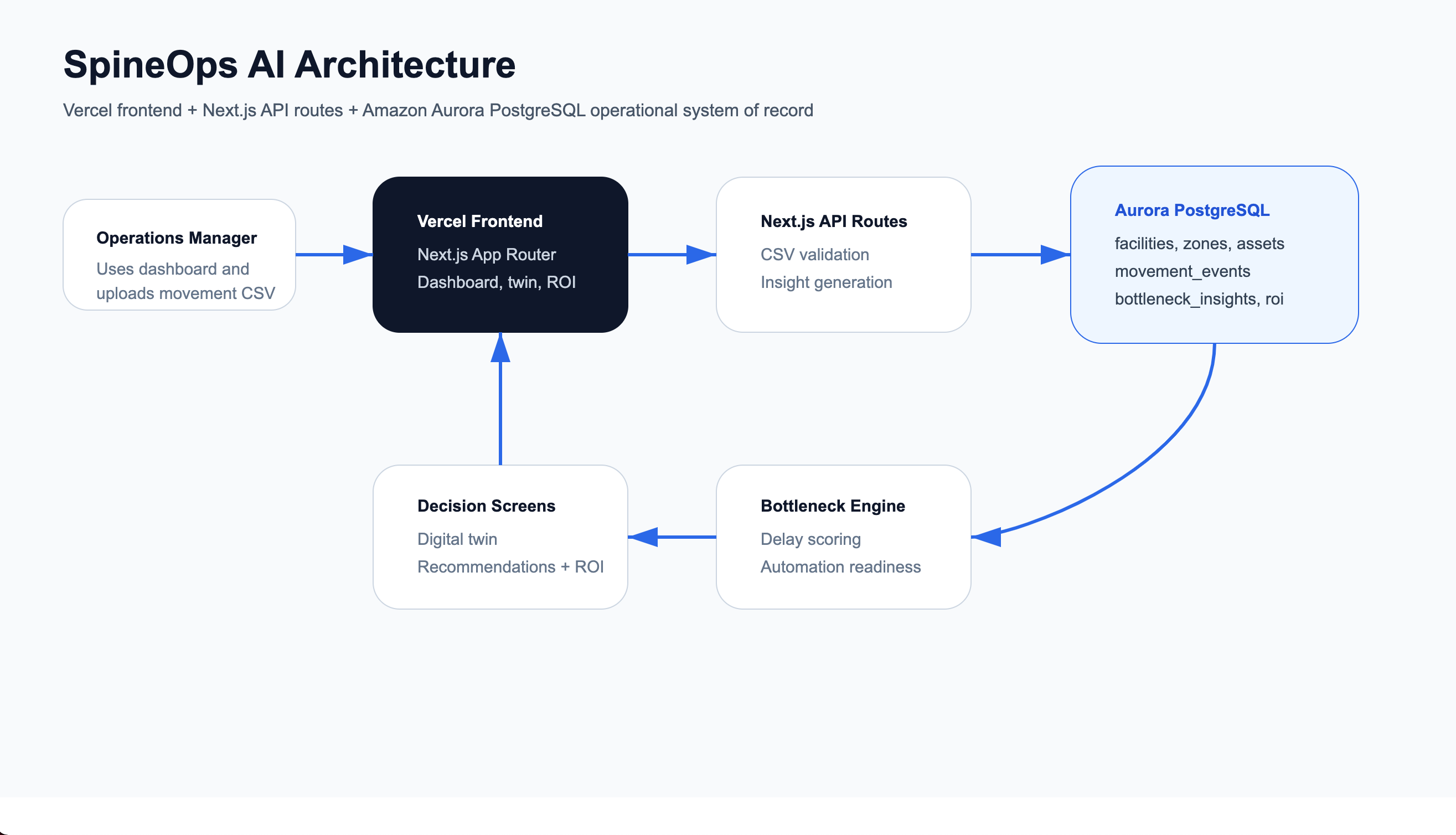
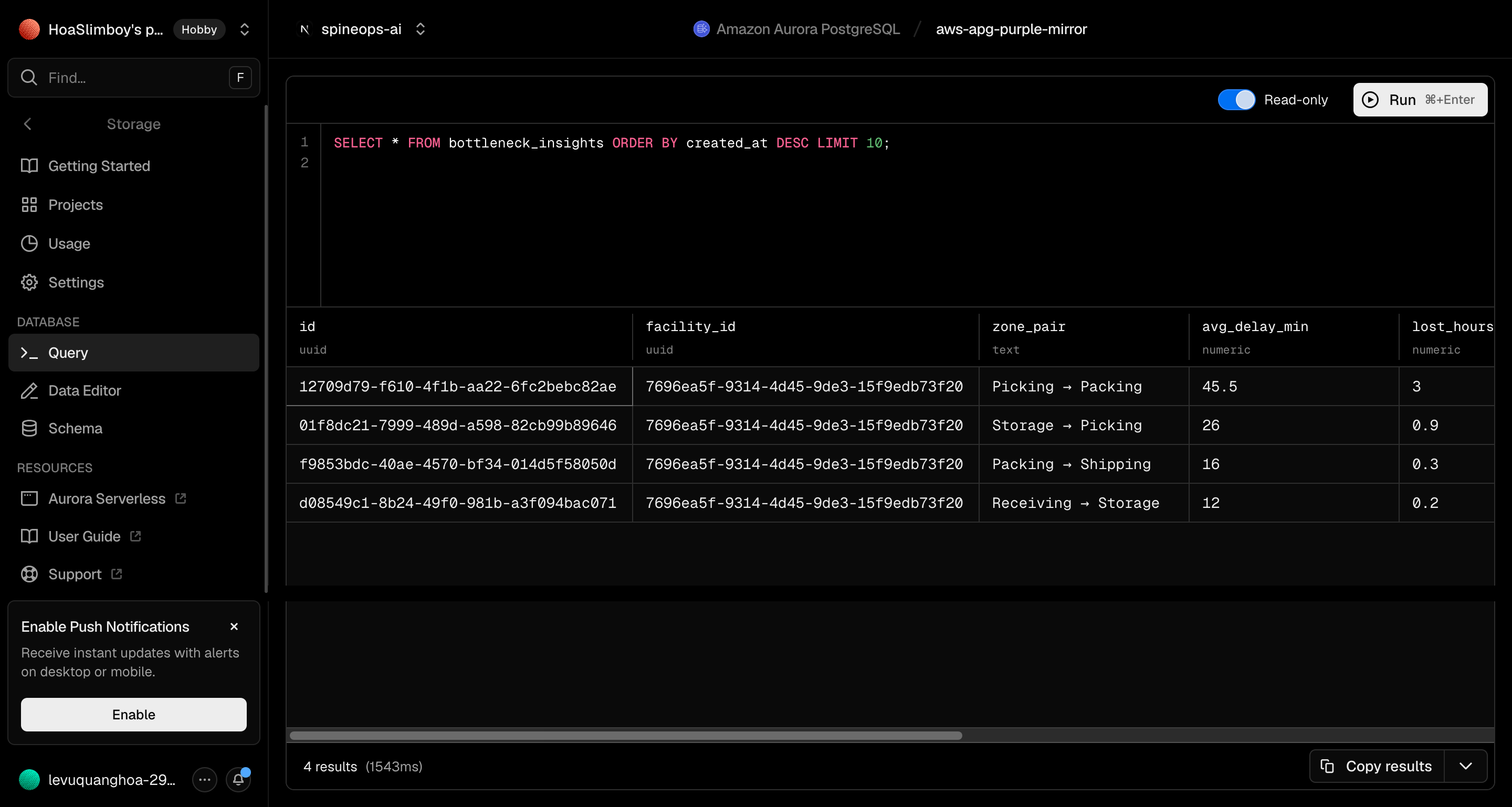
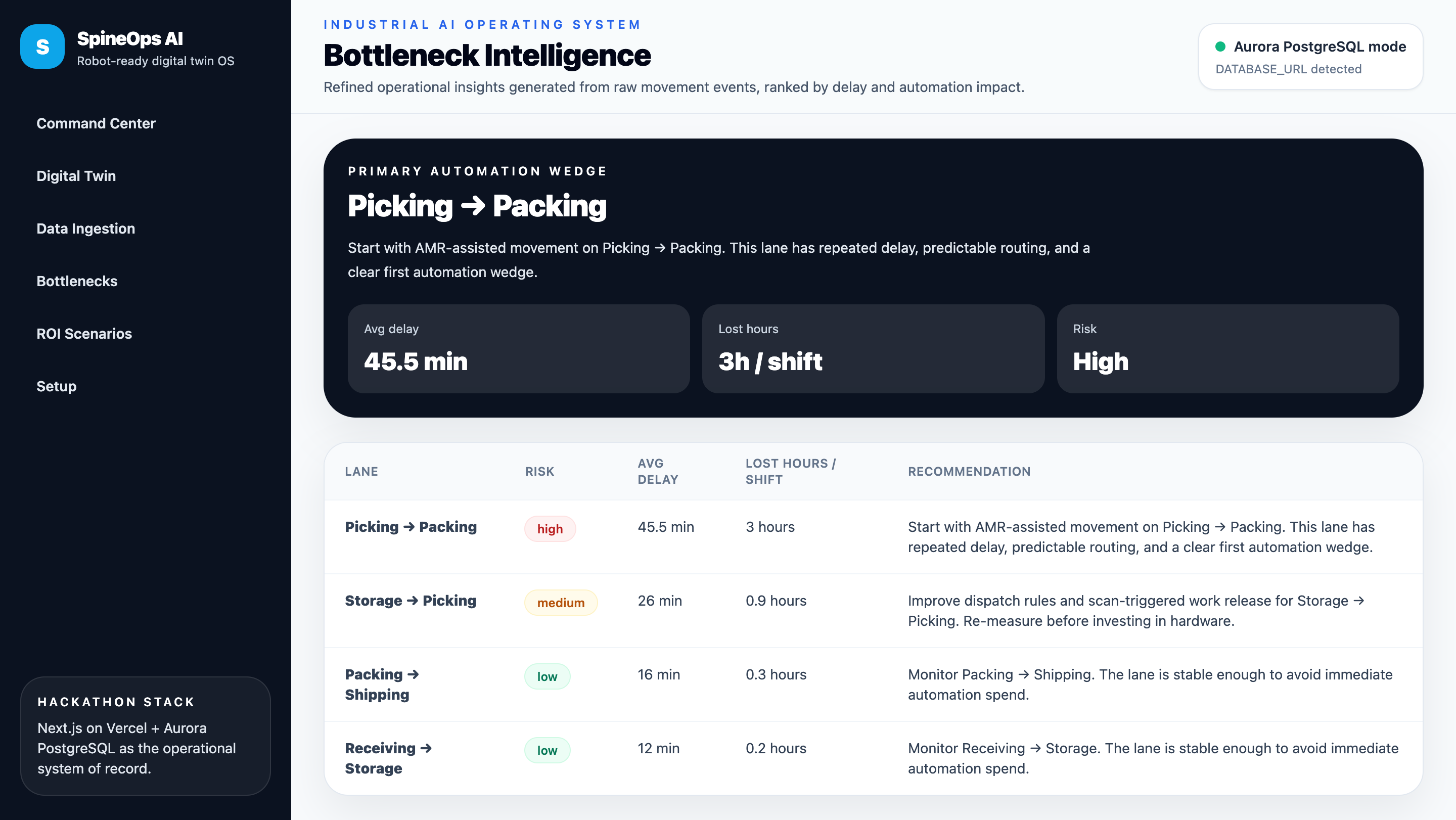
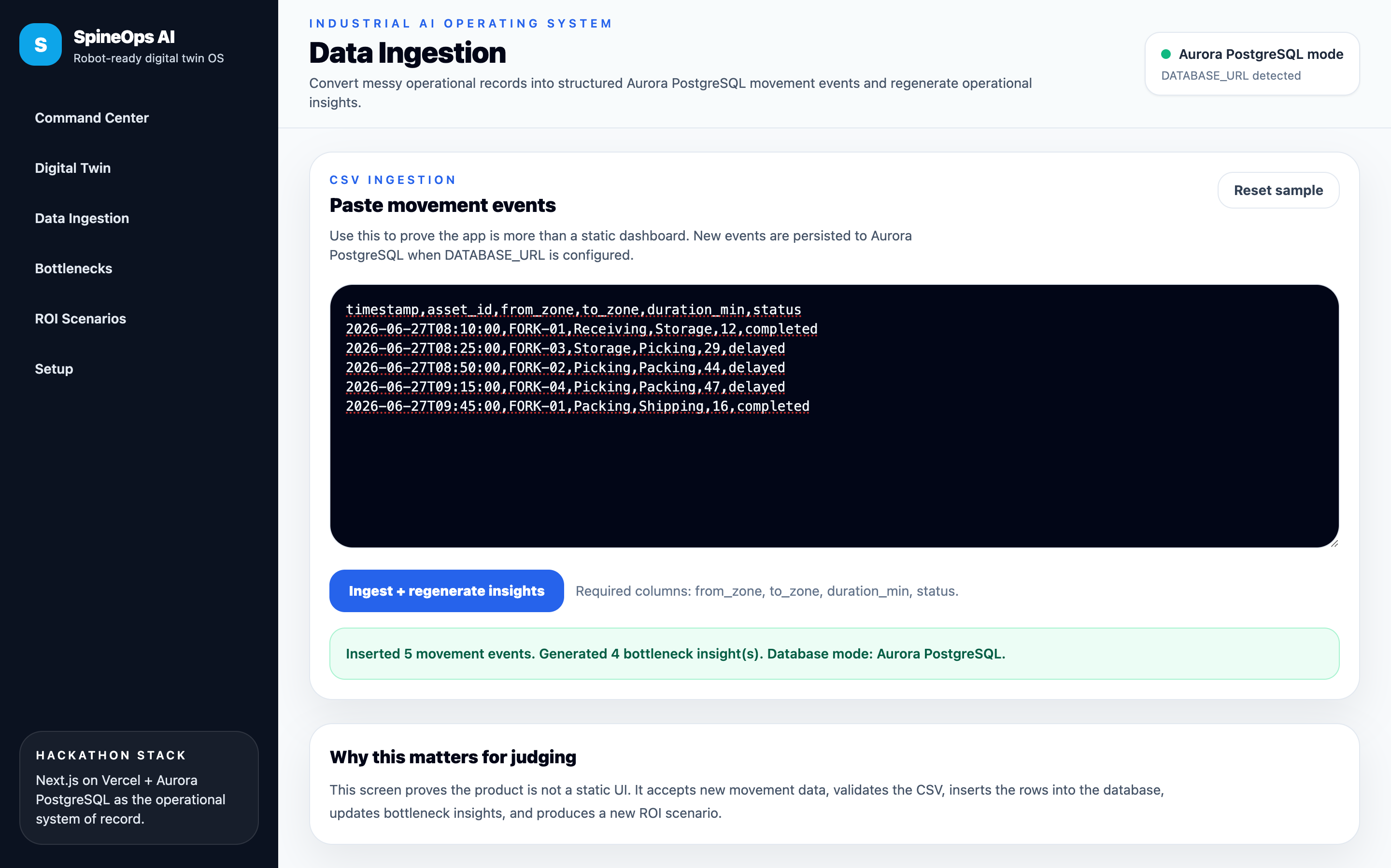
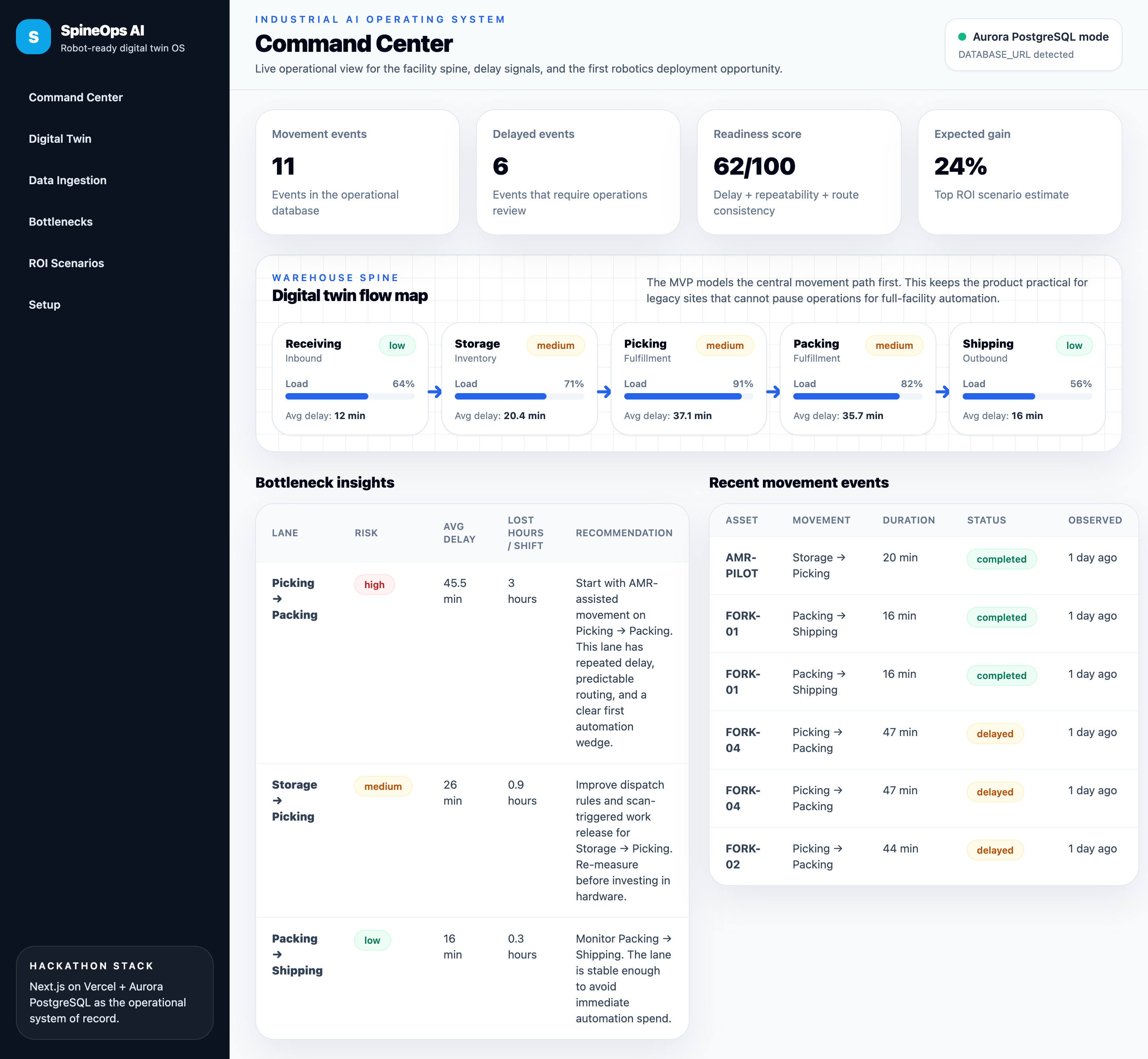
SpineOps AI turns warehouse movement records into a robot-ready digital twin and decision dashboard. A warehouse manager can paste movement-event CSV data showing how assets move between zones such as Receiving, Storage, Picking, Packing, and Shipping. The app validates the data, stores it in Amazon Aurora PostgreSQL, identifies high-delay movement lanes, calculates lost labor hours, and generates ROI scenarios for the safest first automation wedge. The product helps teams answer one key question: Where should automation start first to create measurable operational value?
How we built it
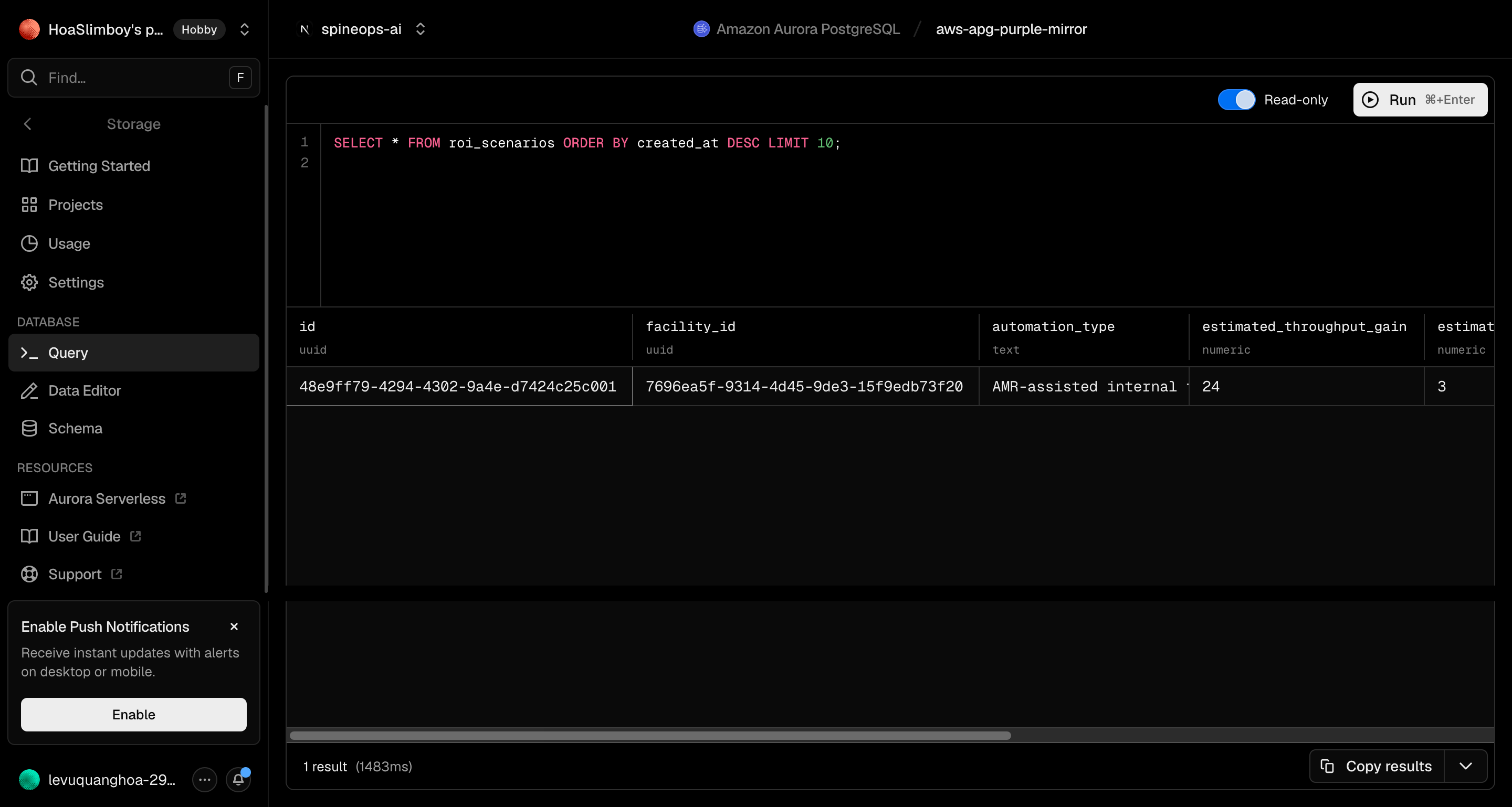
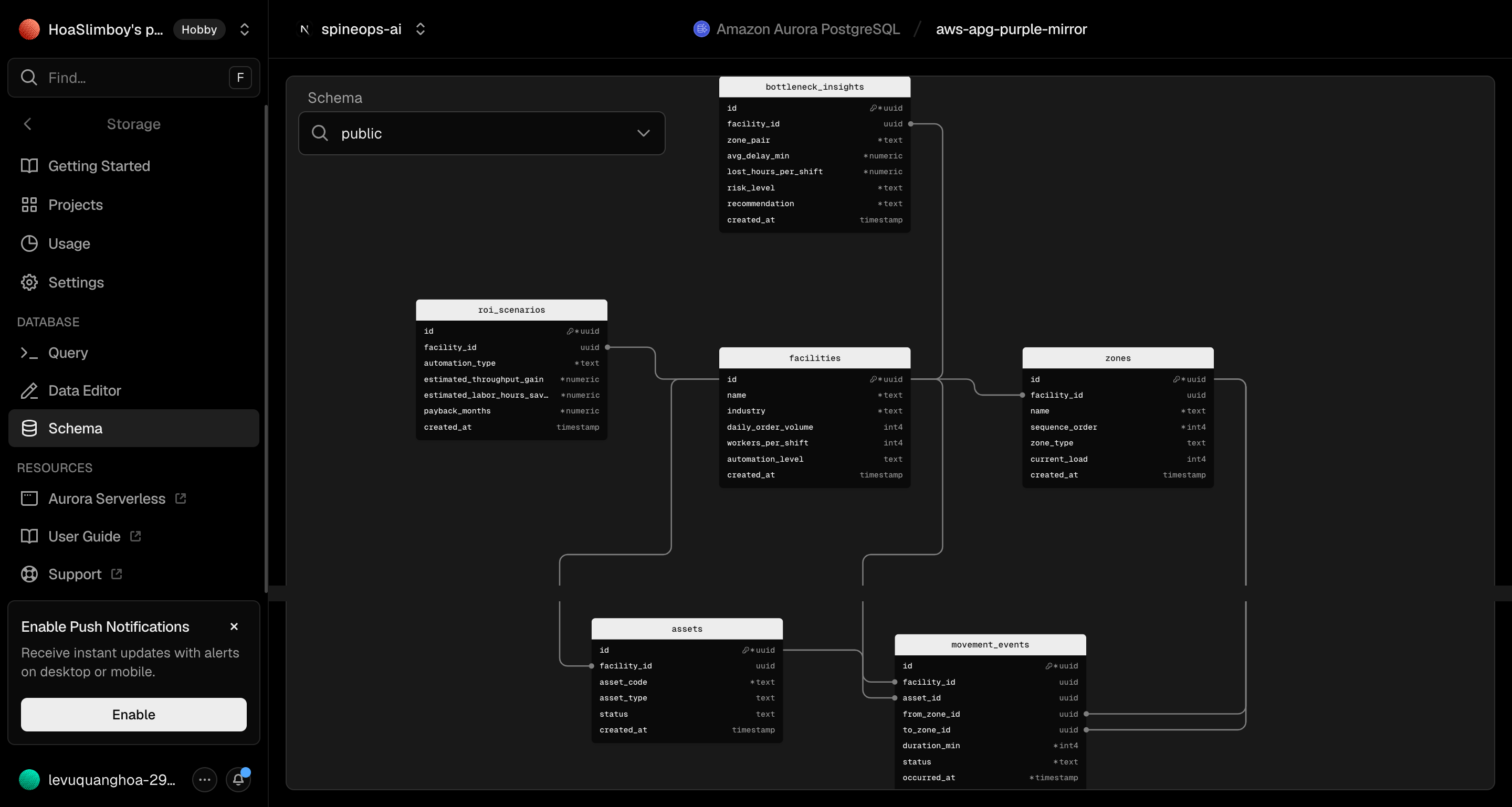
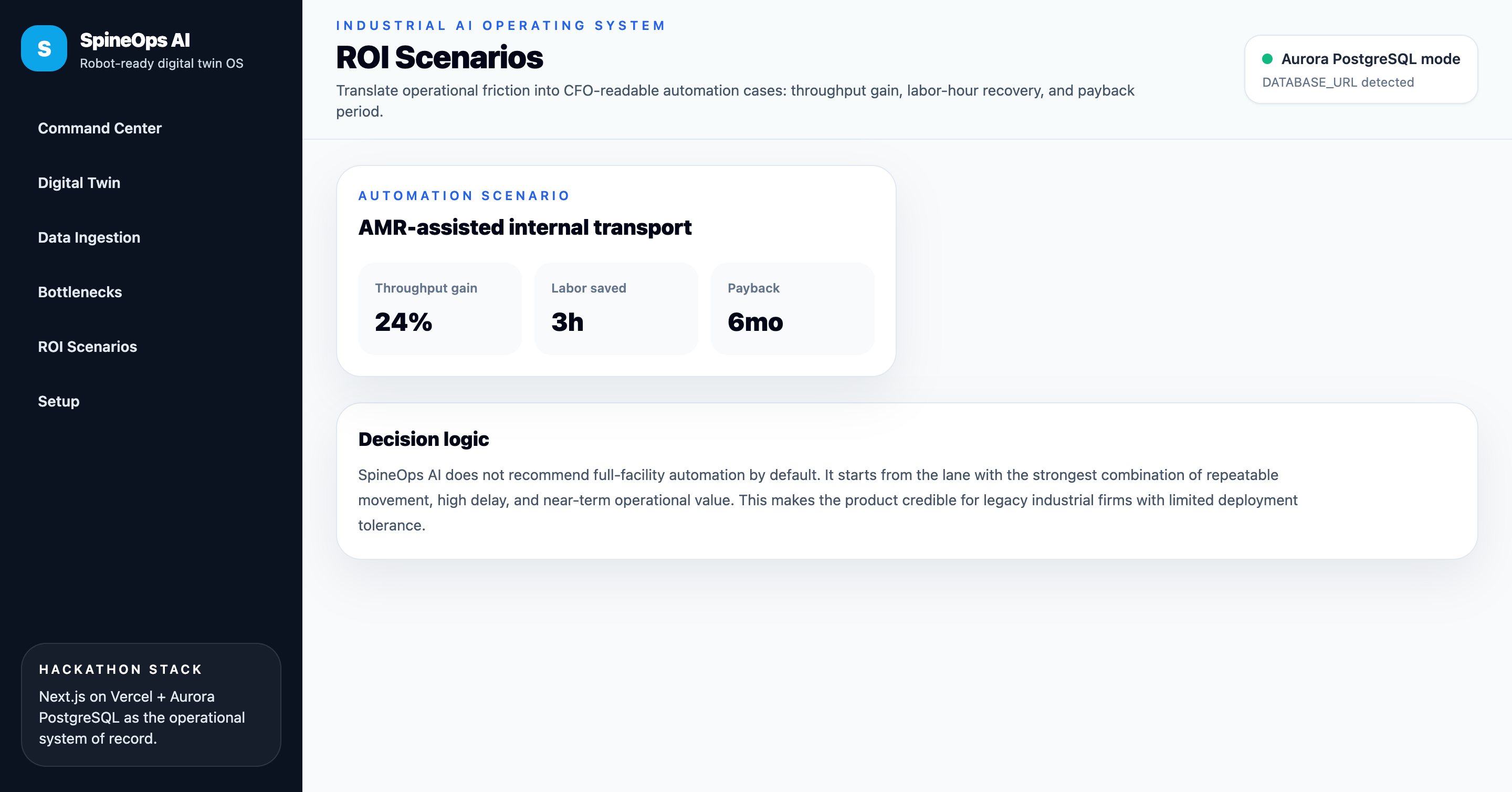
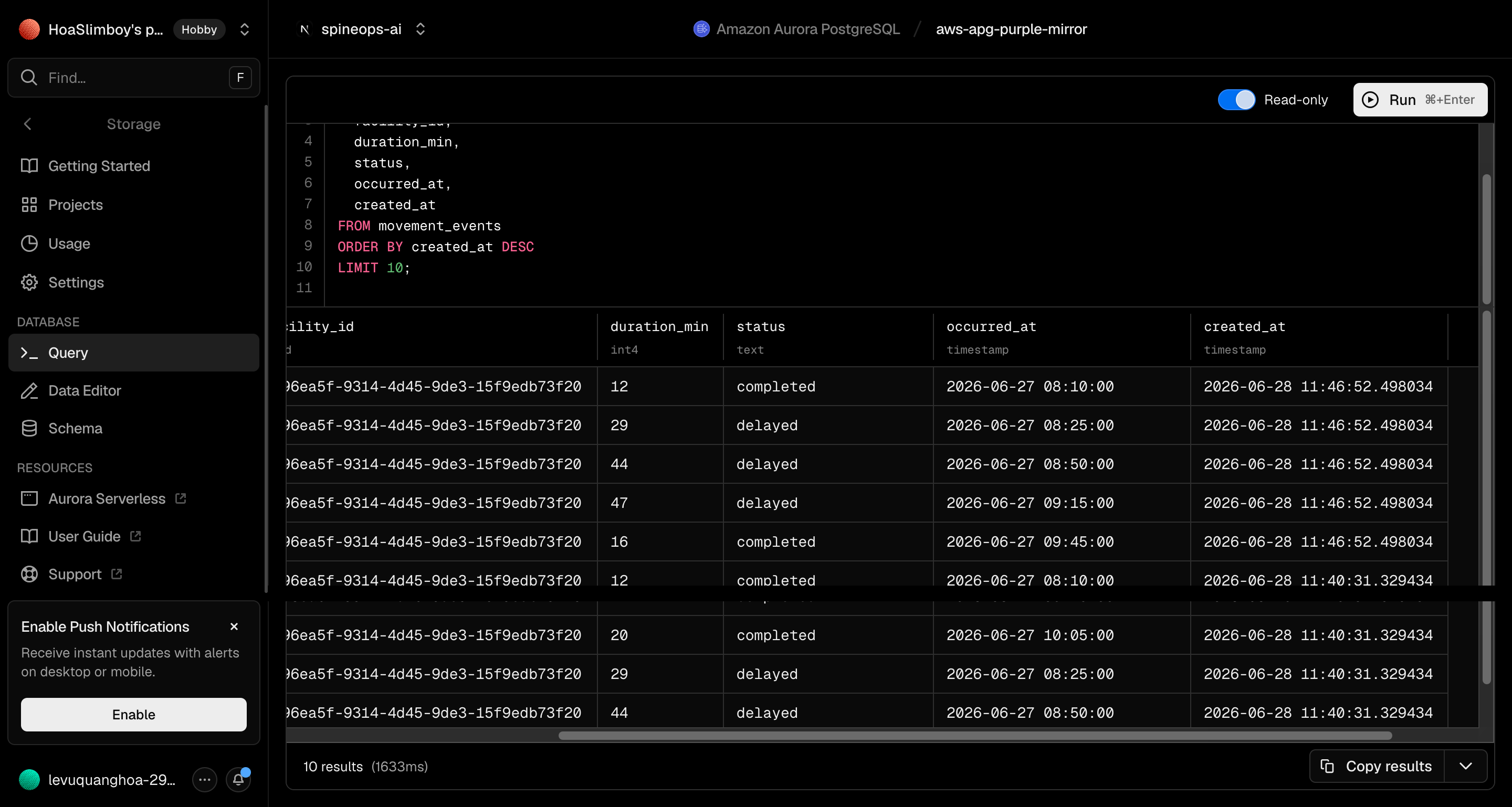
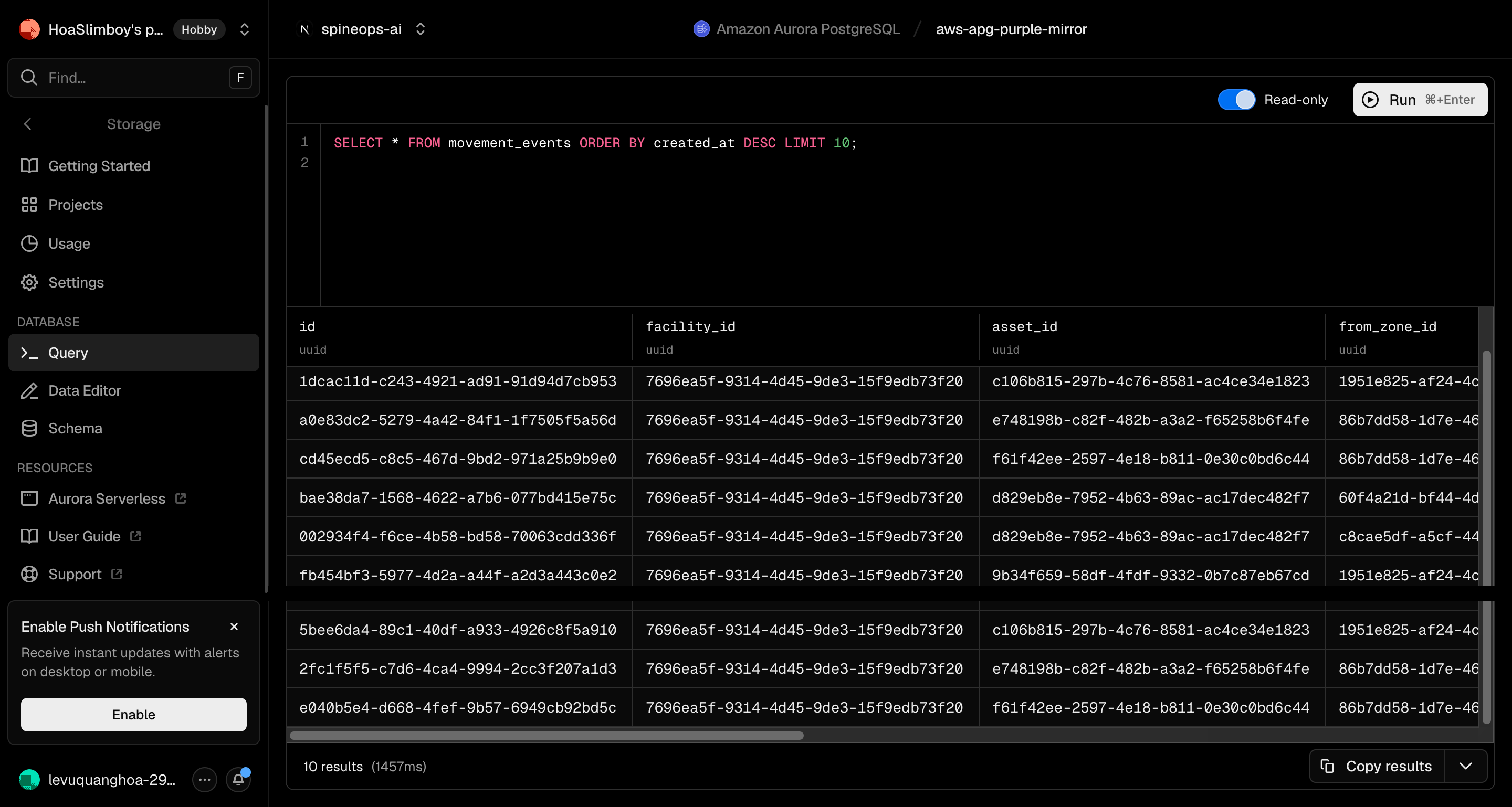
I built SpineOps AI as a full-stack web application using Next.js and deployed it on Vercel. The frontend includes a command center dashboard, digital twin view, data ingestion page, bottleneck insights page, and ROI scenario page. The backend uses server-side API routes to initialize the database schema, seed demo data, ingest CSV movement events, regenerate bottleneck insights, and retrieve ROI scenarios. I used Amazon Aurora PostgreSQL as the core database because the product depends on relational operational data. Facilities contain zones, zones connect movement events, movement events generate bottleneck insights, and those insights drive ROI scenarios. The main database tables are: facilities zones assets movement_events bottleneck_insights roi_scenarios A simplified ROI logic is: $$ \text{Automation Readiness} = f(\text{Average Delay}, \text{Repeated Delays}, \text{Route Consistency}) $$ and: $$ \text{Estimated Value} = \text{Recovered Labor Hours} \times \text{Throughput Gain} $$ This helped connect the interface to a business outcome, rather than showing operational data as static analytics only.
Challenges we ran into
One major challenge was making the product feel realistic within the time limit. A robotics-related app can easily become too abstract or look like a simulation. I avoided that by focusing on a practical workflow: ingest movement data, detect bottlenecks, and recommend the first automation opportunity. Another challenge was connecting the live Vercel app to Amazon Aurora PostgreSQL. The project needed to work beyond demo mode, so I had to verify database seeding, table creation, movement-event insertion, bottleneck generation, and ROI storage. I also had to confirm that the live deployment was writing to the real database, not only using local preview data. The third challenge was product scope. Industrial operating systems can become very complex, so I narrowed the MVP to the most judgeable workflow: one facility, one warehouse spine, movement-event ingestion, bottleneck insights, and ROI recommendations.
Accomplishments that we're proud of
I am proud that SpineOps AI became more than a static dashboard. It is a working full-stack product that connects warehouse movement data to operational decisions. The app can initialize a database schema, seed facility data, ingest CSV movement records, store them in Amazon Aurora PostgreSQL, and regenerate bottleneck and ROI insights from those records. I am also proud of how the product frames robotics adoption in a practical way. Instead of saying “add robots everywhere,” SpineOps AI helps operators identify the safest first automation wedge. This makes the product more realistic for legacy industrial firms, where reliability, workflow continuity, and measurable ROI matter more than novelty.
What we learned
I learned that a strong AI operations product should not only show insights. It should help users make a decision. For industrial firms, the most useful AI is applied AI: systems that improve uptime, throughput, labor allocation, and capital planning. I also learned how important database design is for full-stack products. Aurora PostgreSQL was not only a storage layer. It became the operational system of record that made the app credible. The relational schema helped connect physical warehouse entities to business logic and made the product easier to explain. Most importantly, I learned that good automation strategy begins before hardware deployment. SpineOps AI is designed to help firms understand their operational spine first, then make smarter robotics investments based on real evidence.
What's next for SpineOps AI
The next step for SpineOps AI is to move from CSV ingestion to real-time operational data streams. Future versions could connect with warehouse management systems, barcode scanners, IoT sensors, forklift telemetry, AMR platforms, and ERP systems. This would allow the platform to update the digital twin continuously instead of relying on manual uploads. Another important next step is multi-facility support. Enterprise customers often operate many warehouses, so SpineOps AI should allow regional managers to compare facilities, benchmark bottleneck patterns, and prioritize automation investments across locations.
Built With
- amazon-aurora-postgresql
- built-with-next.js
- csv-based
- data
- github
- node.js
- operational
- postgresql
- react
- serverless-api-routes
- sql
- tailwind-css
- typescript
- vercel

Log in or sign up for Devpost to join the conversation.