Inspiration
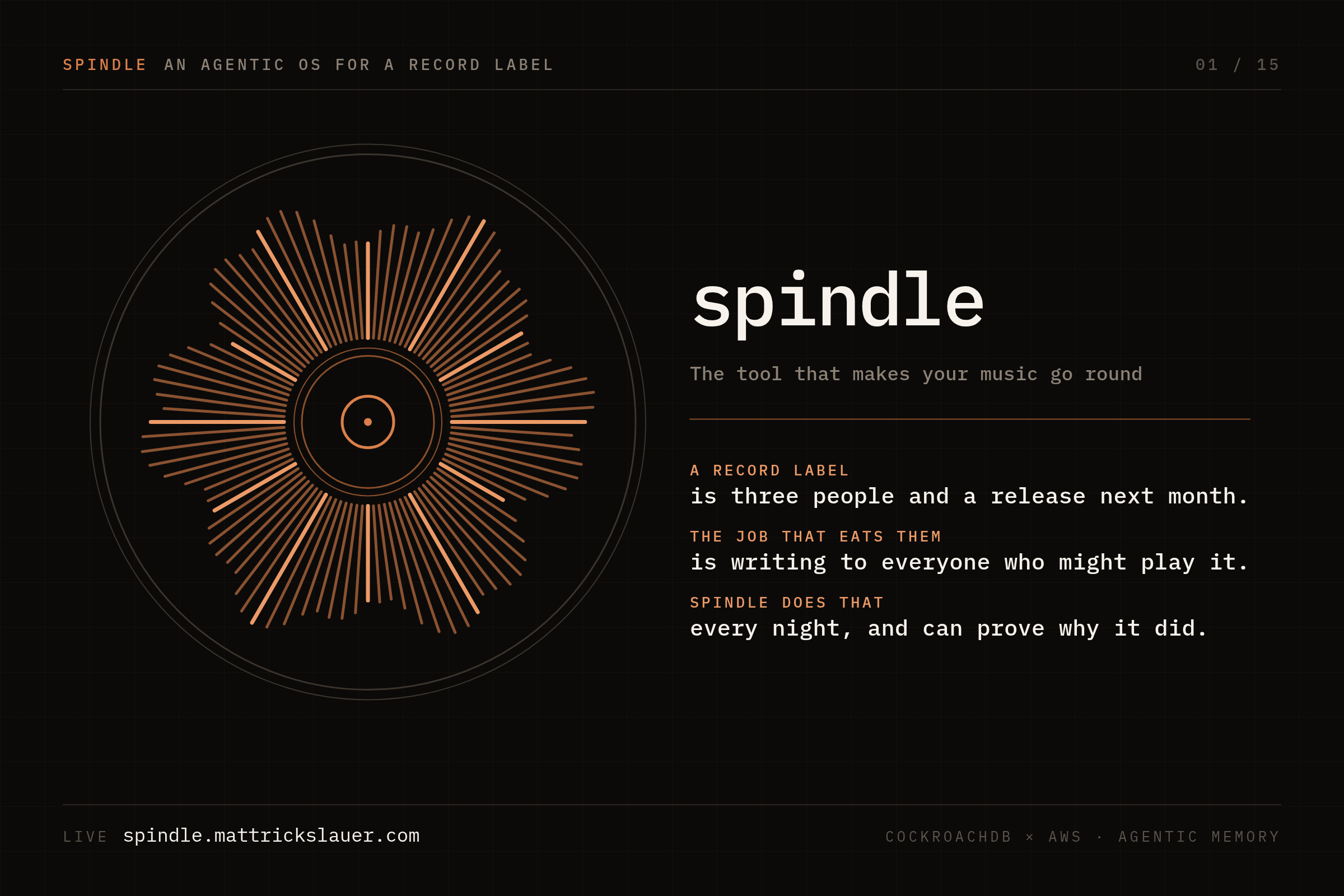
We run a small record label. Every release ends the same way. The song goes up on every service in the world, and then nothing happens.
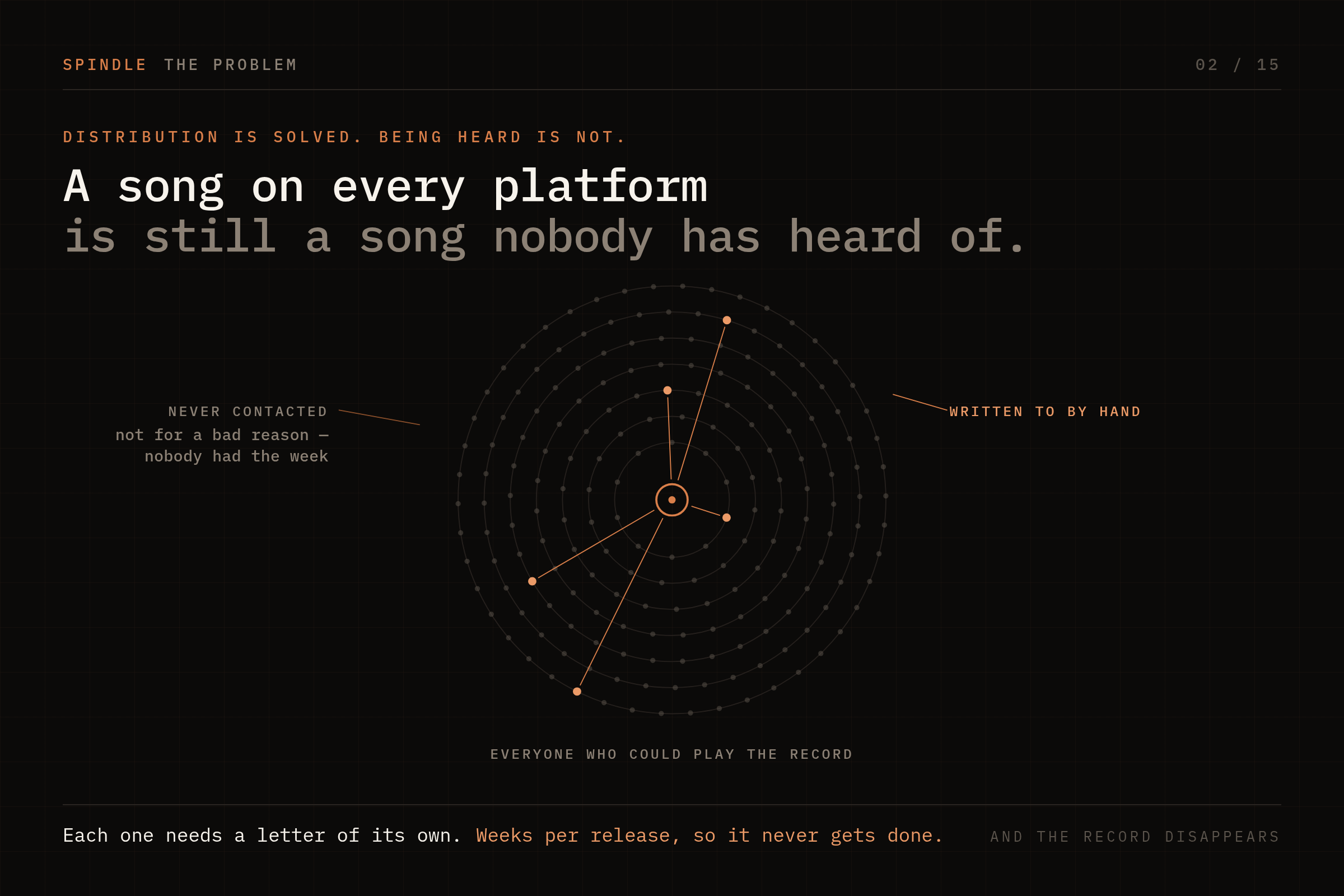
It took us a long time to understand why, because it looks like a distribution problem and it isn't. Distribution is solved — anybody can get a song onto every platform in an afternoon. What isn't solved is that a song sitting on a platform is a song nobody has heard of. Somebody still has to find the people who might actually play it — the radio programmer, the curator, the person who hosts a show about exactly this kind of music — and write to each one of them like a human being, about this specific record, with a reason they should care.
That's a letter-writing job. It takes weeks per release, and it never ends, because there's another release next month. Nobody at a label with three people on it has weeks. So it doesn't get done, and the record disappears, and everyone blames the algorithm.
We wanted to know whether that job could be handed to something that would actually do it — every night, for every artist on the roster — without turning us into the thing everybody in music hates. Because the failure mode here isn't "nothing happens." The failure mode is that you become spam, and burn a relationship the label needs for the next ten years, in a business that runs entirely on people picking up the phone to someone they already know.
What it does
Spindle is an agentic operating system for a record label, and the first job we gave it is that letter-writing one.
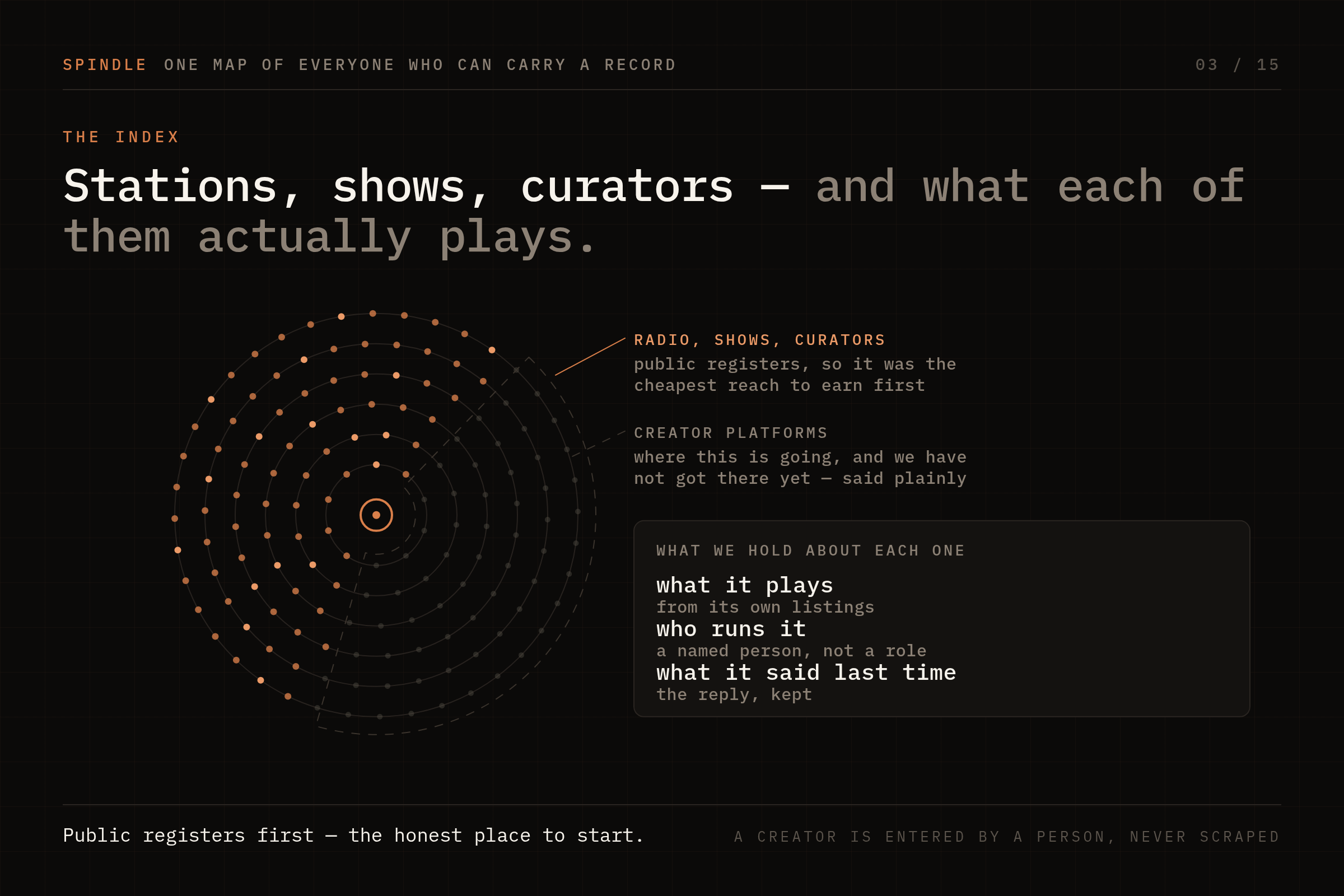
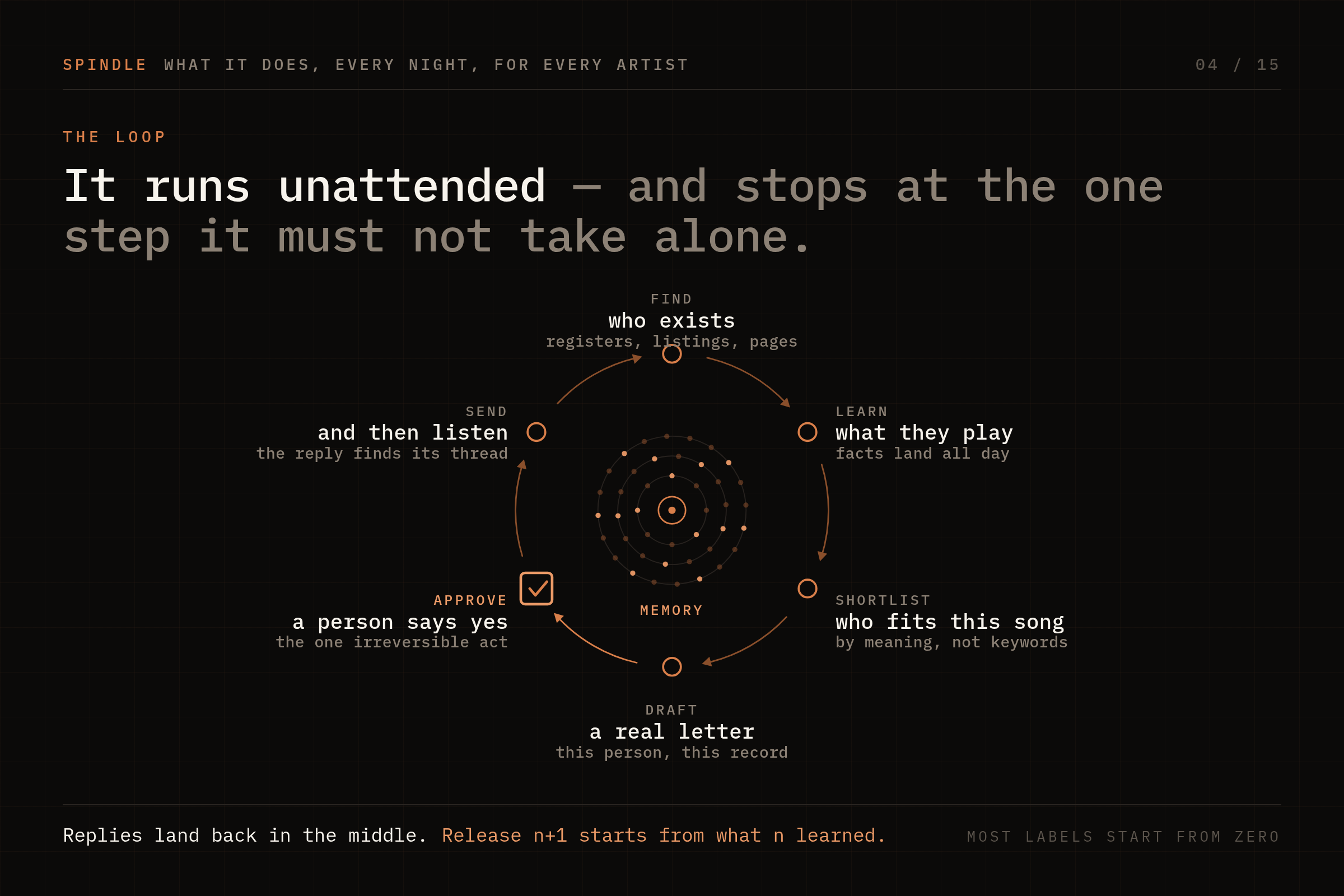
It builds and keeps one map of everyone in the world who can carry a record — stations, shows, curators, the people who program them — and what each of them actually plays. When the label has a new song, Spindle works out who among all of those people is genuinely right for that particular record, and drafts a real letter to each one: not a template with a name swapped in, but a pitch that knows what this person plays and why this song belongs on it.
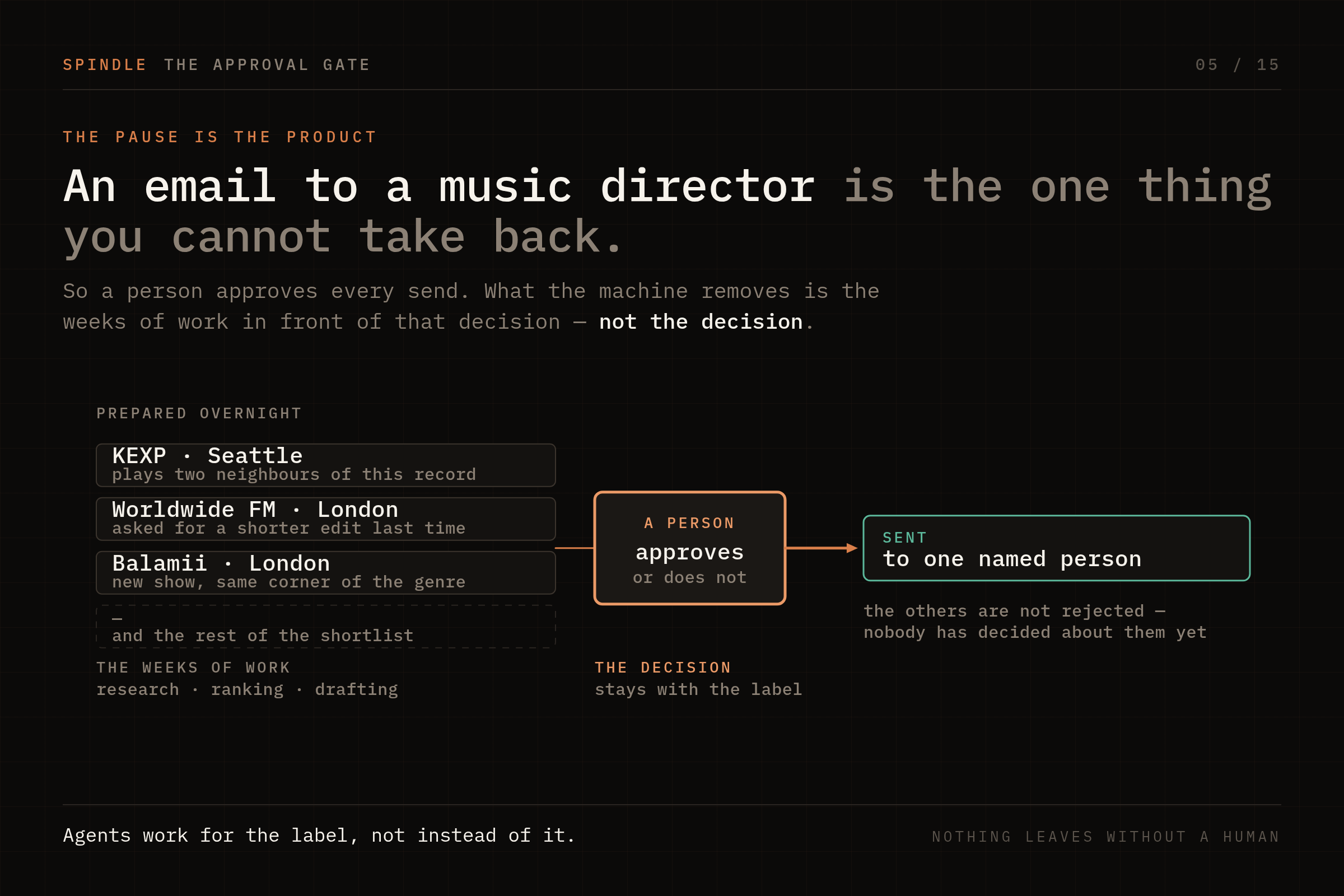
Then it stops and waits for a person to say yes.
That pause is the product, not a limitation of it. An email to a music director is the one thing in this business you cannot take back, so a human approves every send. What the machine removes is the weeks of work in front of that decision, not the decision.
What makes it worth having is what happens between releases. Every reply, every polite no, every "send me a shorter edit," every person who said this artist isn't for them but come back with the next one — all of it stays. So the next record doesn't start from nothing. It starts from everything the label has already learned about who says yes. That accumulation is the whole point. Most labels start every release from zero; the reason they do is that the knowledge lived in somebody's head or somebody's sent folder, and it left when they did.
It also spends the label's money on its own, within a ceiling the label sets, and comes back to ask when it wants to spend more.
Which raises the question the entire project is really about. If something is writing to real people and spending real money on your behalf, you need to be able to ask it, the next morning, why it did that — and get a true answer.
How we built it
The pieces are small and boring on purpose.
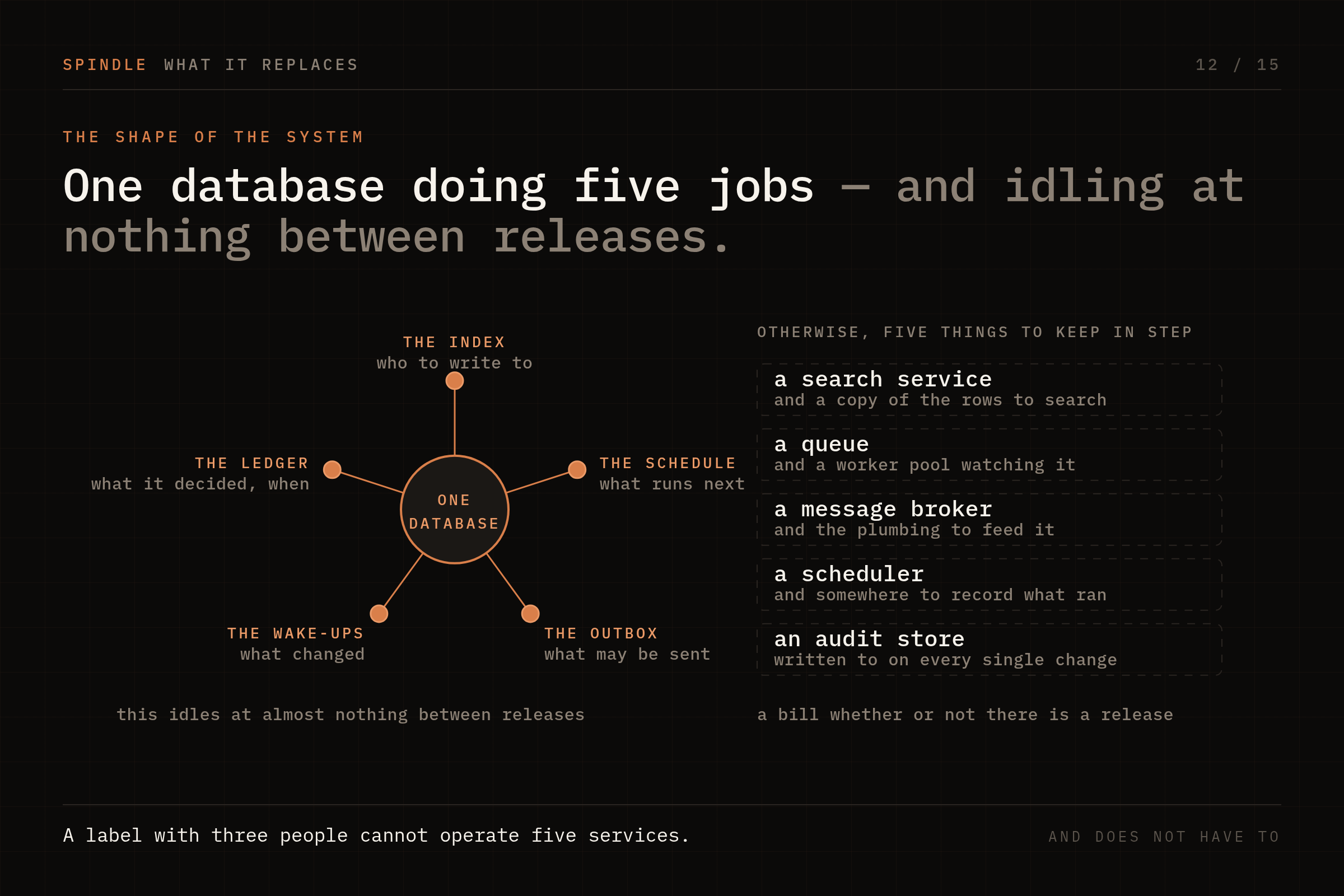
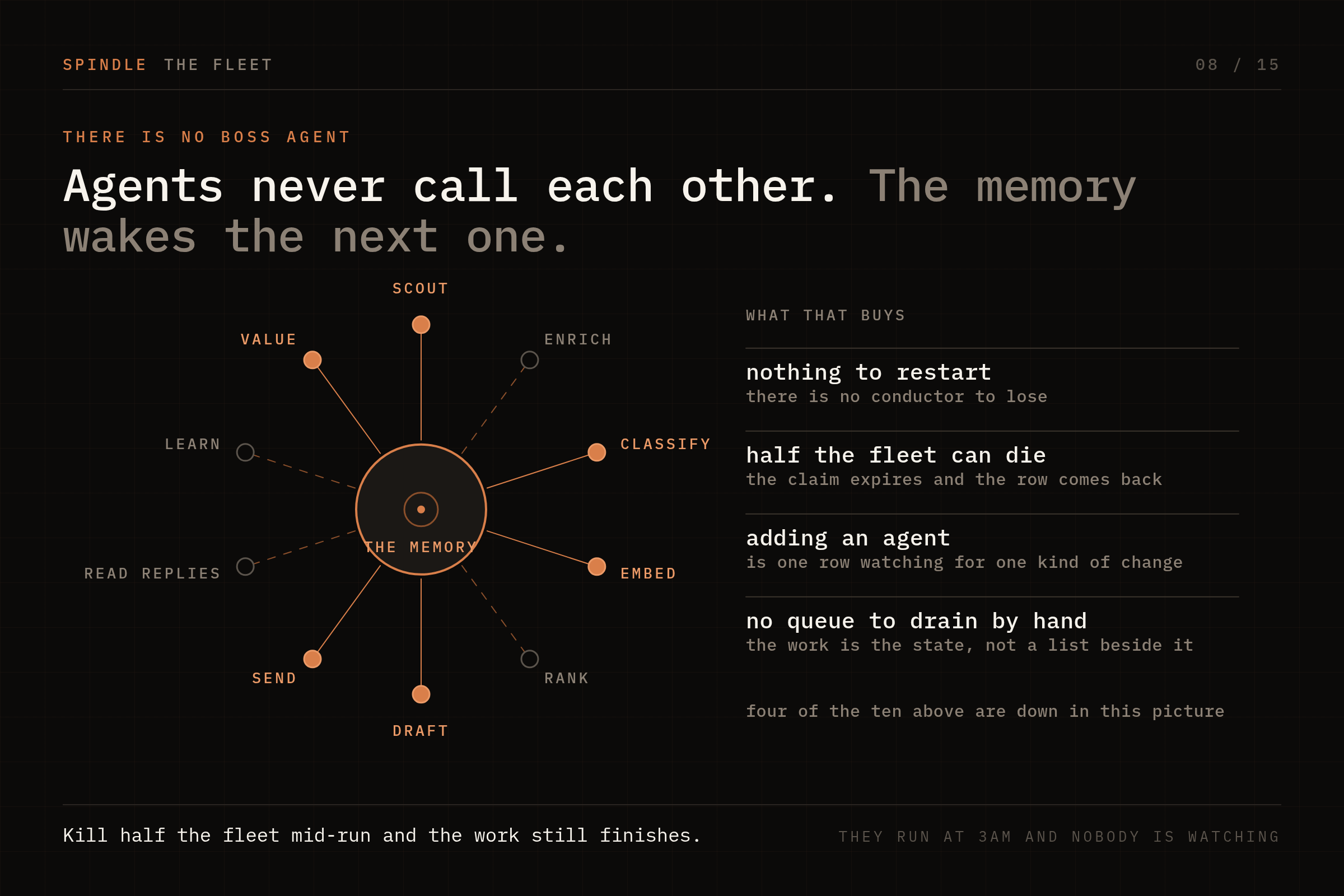
There is no boss agent directing traffic. Each agent does one narrow job — find people, learn about them, rank them for a song, write the letter, send it, read the reply — and none of them call each other. When one finishes, the change it made is what wakes up the next one. That means you can kill half of them in the middle of the night and the work still finishes when they come back, which matters, because they run unattended and nobody is watching at three in the morning.
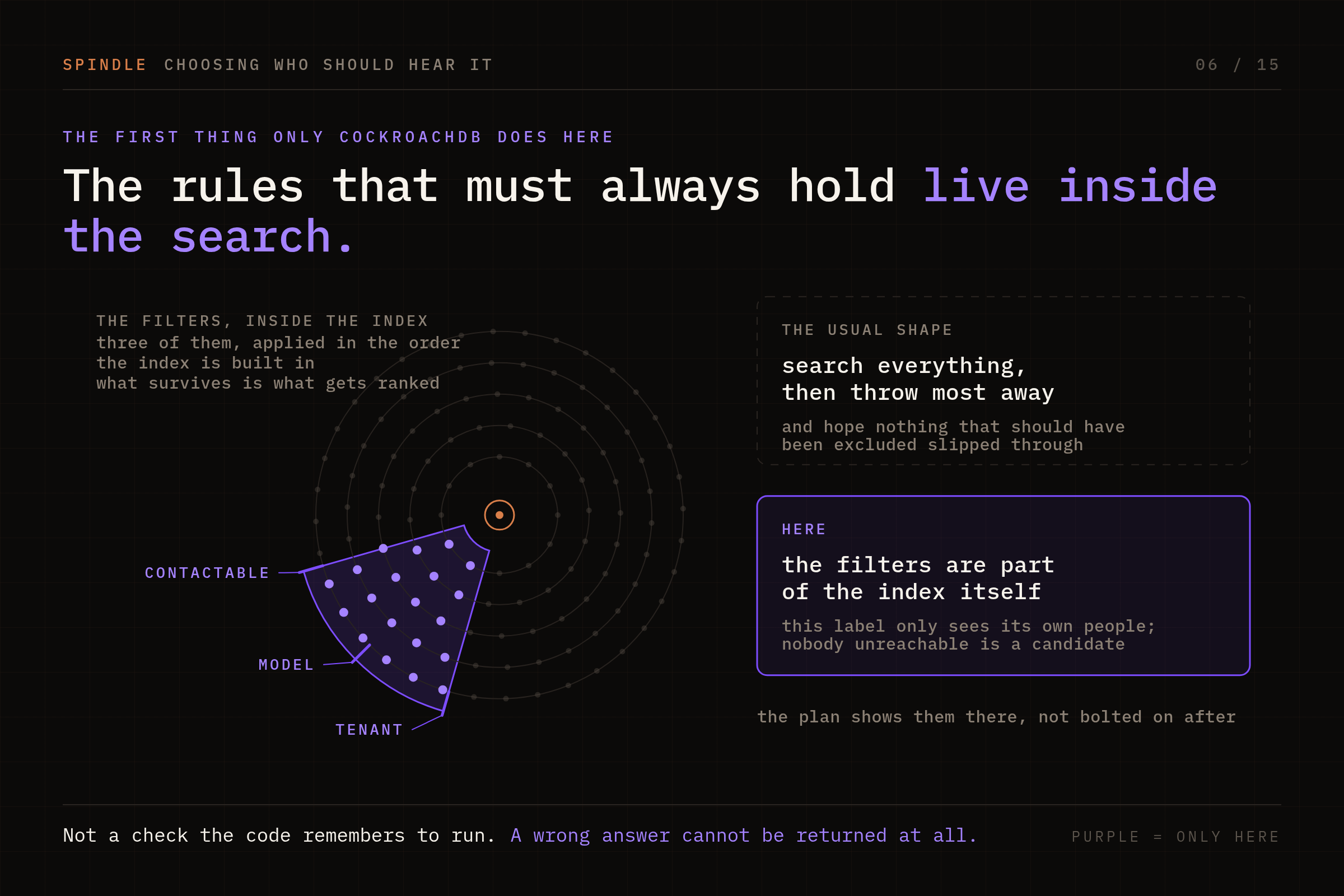
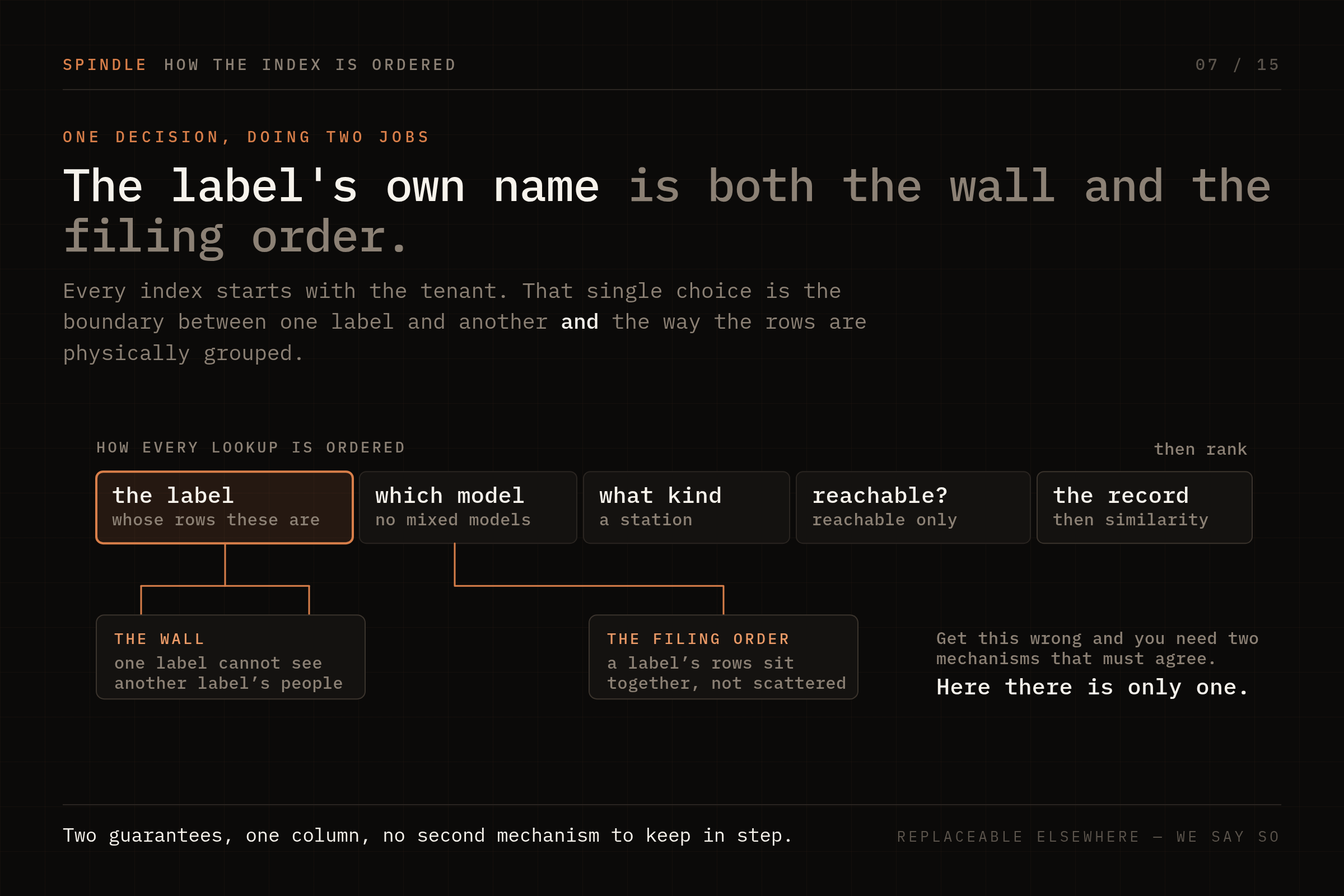
Choosing who should hear a record isn't keyword matching. The system compares a song and a person by what they're about, so a station that has never used the word we'd have searched for still surfaces if it's genuinely the right home. And the rules that must always hold — this label only ever sees its own people, only people who can actually be contacted are eligible — aren't checks written in code that somebody could forget to call. They're part of how the search itself works, so the wrong answer can't be returned in the first place.
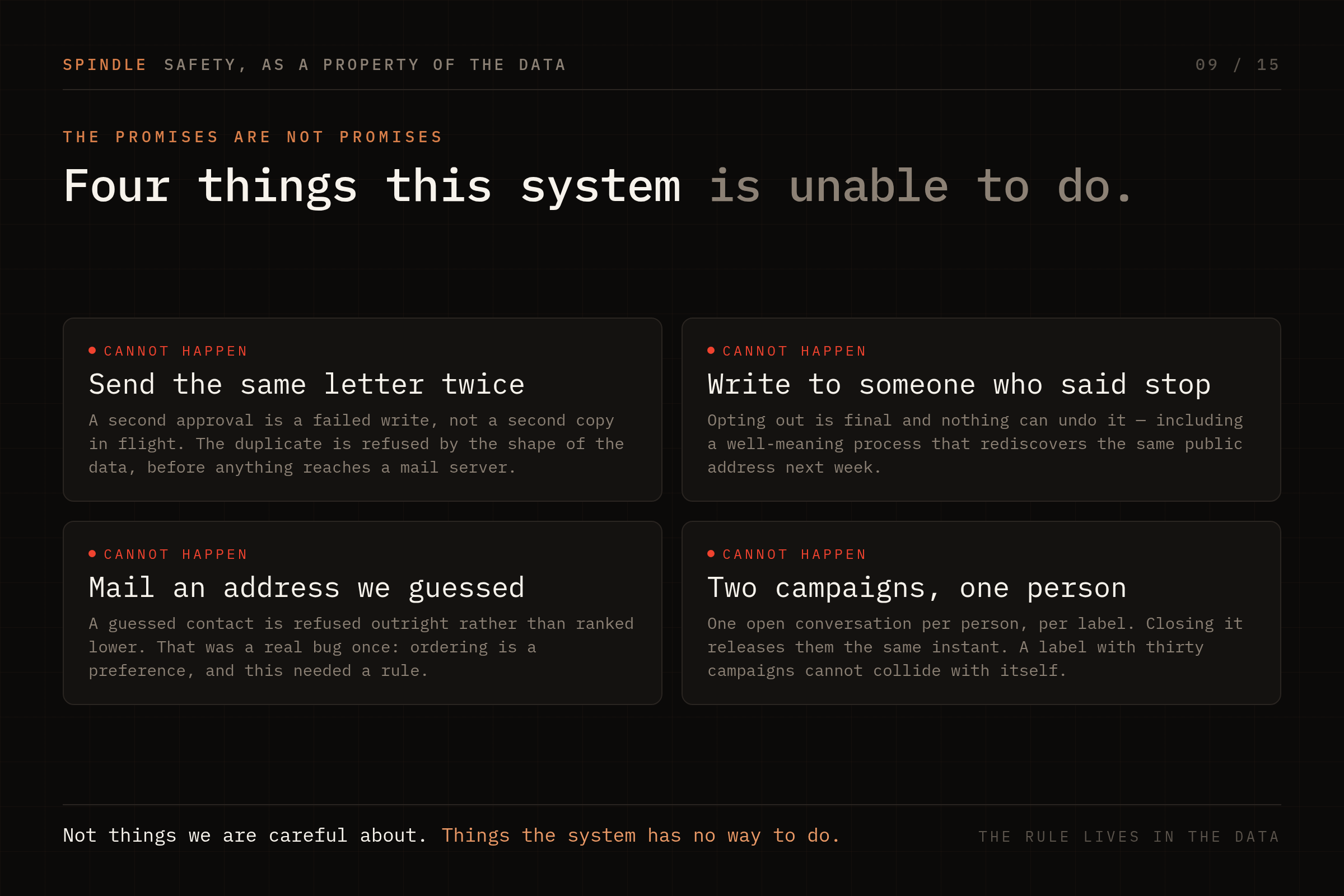
That's the pattern for the whole system: put the guarantees where they can't be skipped. Nothing can be mailed twice. Nobody who asked us to stop can be contacted again by anything, ever, including a well-meaning process that rediscovers their public address next week. Two campaigns can't work the same person at the same time. Nobody gets a letter at an address we guessed at rather than found. Each of those is a rule the database enforces rather than a habit the software has.
And everything an agent does is written down with the exact moment it did it. Not a summary of what it did — the moment. That turns out to be the key to the last part.
Challenges we ran into
The hard one was proving why.
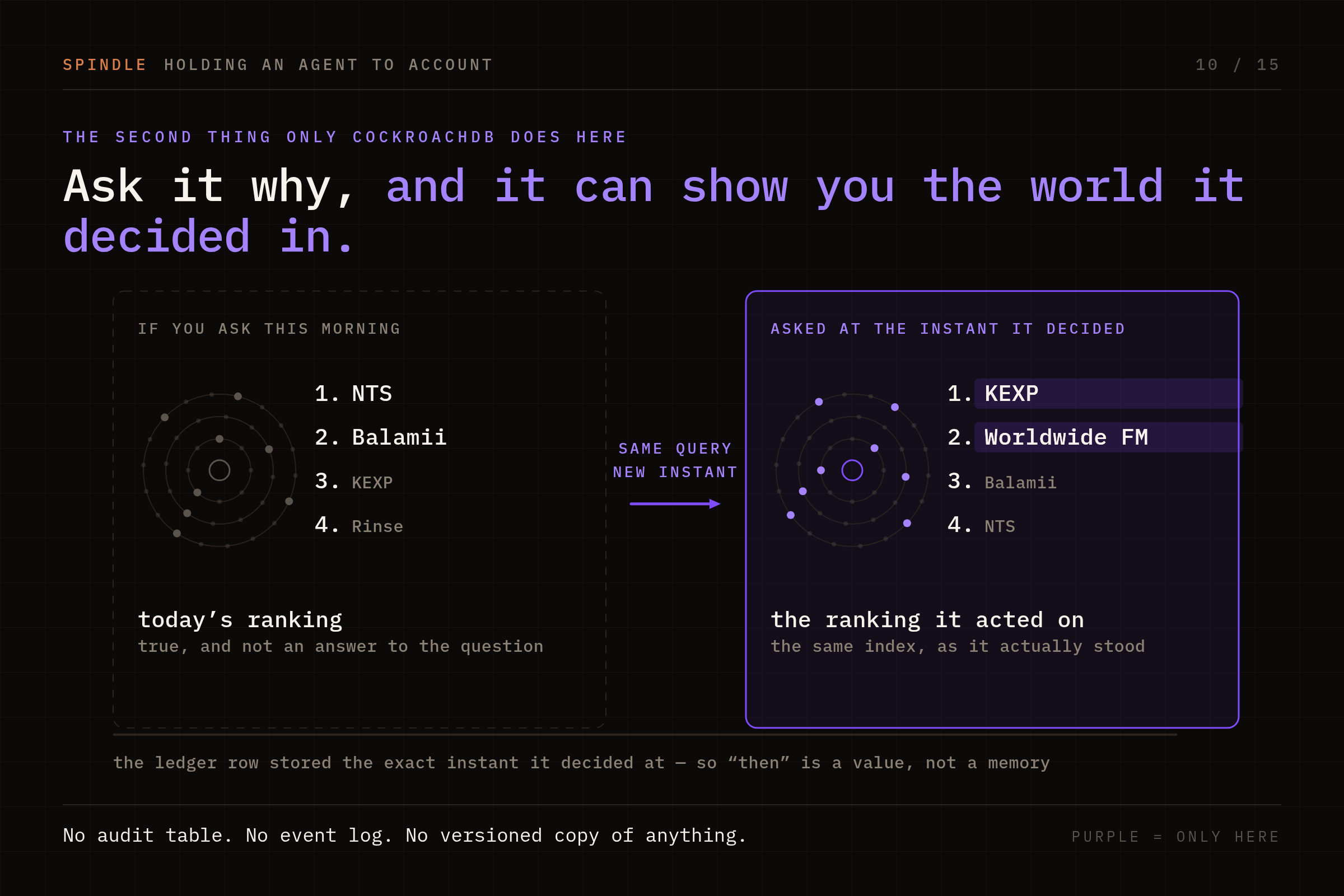
The system's memory is alive. It's learning all day: new people, new facts about them, conversations opening and closing, rankings shifting as it learns. Which means that by the time you want to ask "why did you write to this person," the world it decided in is gone. The numbers have been overwritten. The rankings have moved. Asking today's system what it was thinking last night gets you today's answer wearing last night's clothes — which is worse than no answer, because it's convincing.
The usual fix is to build a second system that photographs the first one constantly, and it's miserable: it slows everything down, it costs a fortune to keep, and it can only ever answer the questions you were clever enough to anticipate.
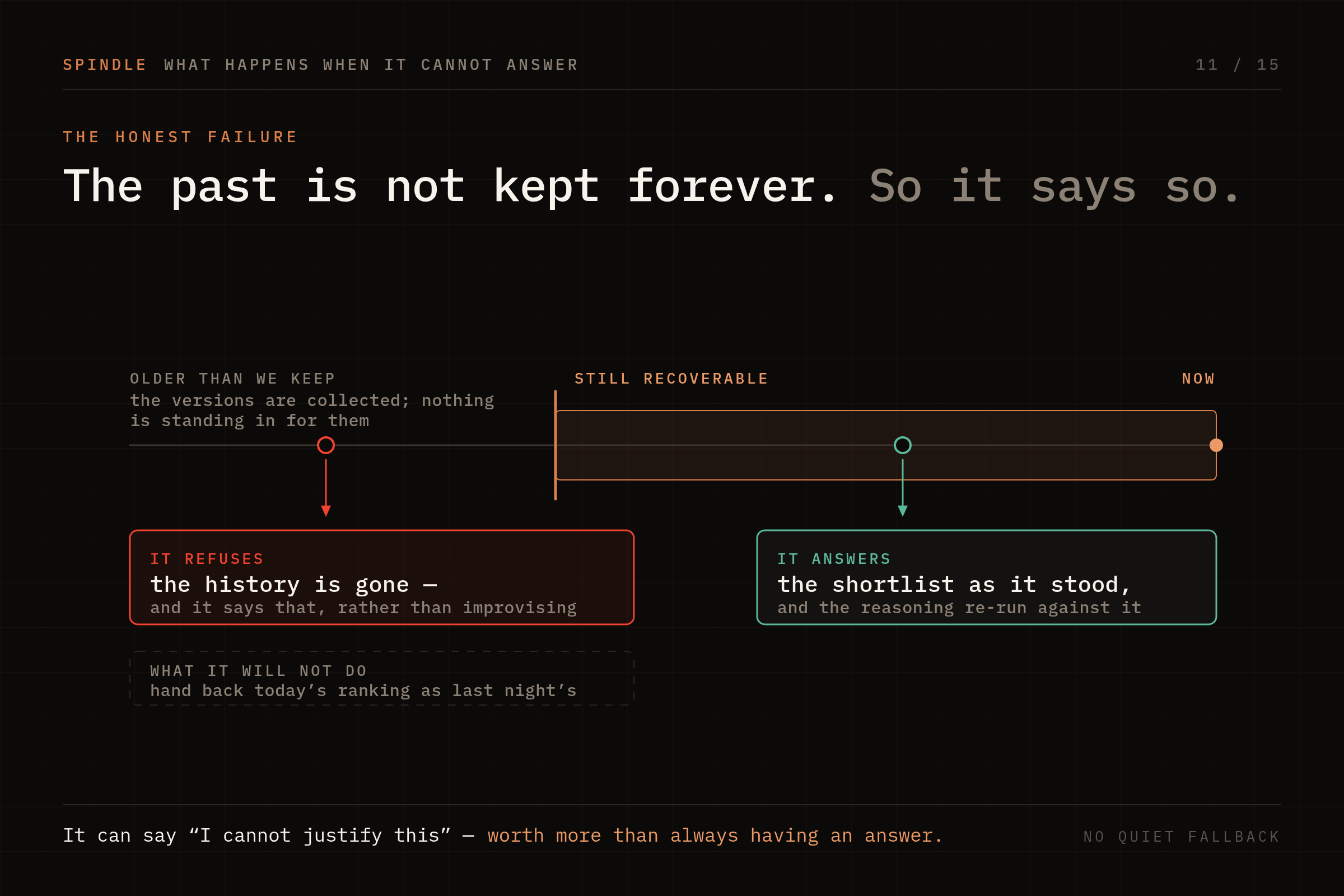
CockroachDB let us skip all of it. The database can be asked what it looked like at a moment in the past, and answer from the real thing rather than a copy. So every decision the system makes is stamped with the instant it was made, and asking why is just asking the same question again, pointed at that instant. It comes back with the world as it actually stood: the same people, ranked the way they were ranked, including the things it had learned by then and not the things it learned since. The system can even re-run its own reasoning against those old conditions and check that it still reaches the same conclusion it reached last night.
There is no separate history to build, keep, or trust.
The related challenge was resisting the polite lie. The past isn't kept forever, and when a decision falls off the far end of what's retained, the honest answer is that the history is gone. It would have been easy — and it would have looked better — to quietly answer with today's ranking instead. We made it refuse and say exactly why it can't answer. Something that can tell you "I can't justify this, and here's the reason I can't" is more trustworthy than something that always has an explanation ready.
The other real challenge was scope. This started as a much bigger idea and we cut it down repeatedly to the one job a label would actually miss if you took it away.
Accomplishments that we're proud of
That it does the letter-writing job, unattended, overnight — and still hands every irreversible act to a person before it happens.
That the promises we make about it aren't promises. Nothing sends twice. Nobody who opted out gets contacted. Nobody gets mail at a guessed address. Those aren't things we're careful about; they're things the system is unable to do.
That you can ask it why, about any decision it made, and get the truth rather than a reconstruction — and that when it can't tell you, it says so plainly instead of improvising.
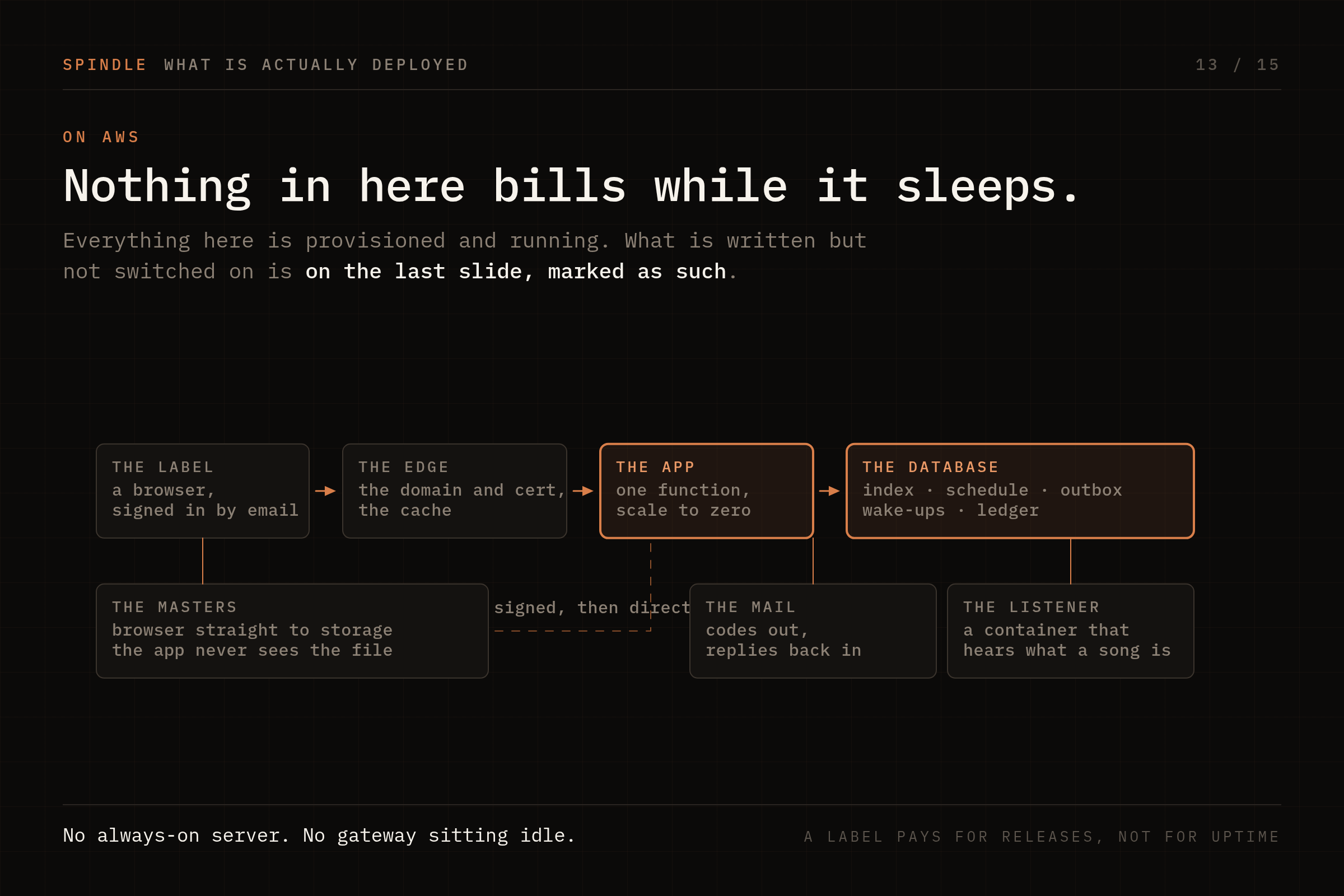
That it costs essentially nothing to keep alive between releases, which is the difference between a tool a small label can run and a tool a small label reads about.
And that the repository argues with itself in public. There's a document in it whose entire job is to attack our own claims and ask whether the database is really doing the work or whether we're name-dropping it. We shipped what survived that, and we're just as explicit about the parts that are written but not switched on. We'd rather a judge find the caveat already written down by us than find it themselves.
What we learned
That the hard part of letting software act in the world isn't making it capable. It's making it accountable. Capability is the easy half now.
That the right instinct, over and over, was to move a guarantee out of the code and into the data — from something the software remembers to do into something the system cannot do wrong.
And that speed was the wrong thing to optimize. We spent real time on how fast this thing could run before realizing the unit is wrong. It's writing to a person who opens their inbox on Tuesday. A curator replies when they reply. Programming meetings happen weekly. Running a thousand times a second doesn't get a record played any sooner — it just gets you blocked. So the system is paced to the rhythm of human correspondence, deliberately, and that turned out to be a design principle rather than a compromise.
What's next for Spindle
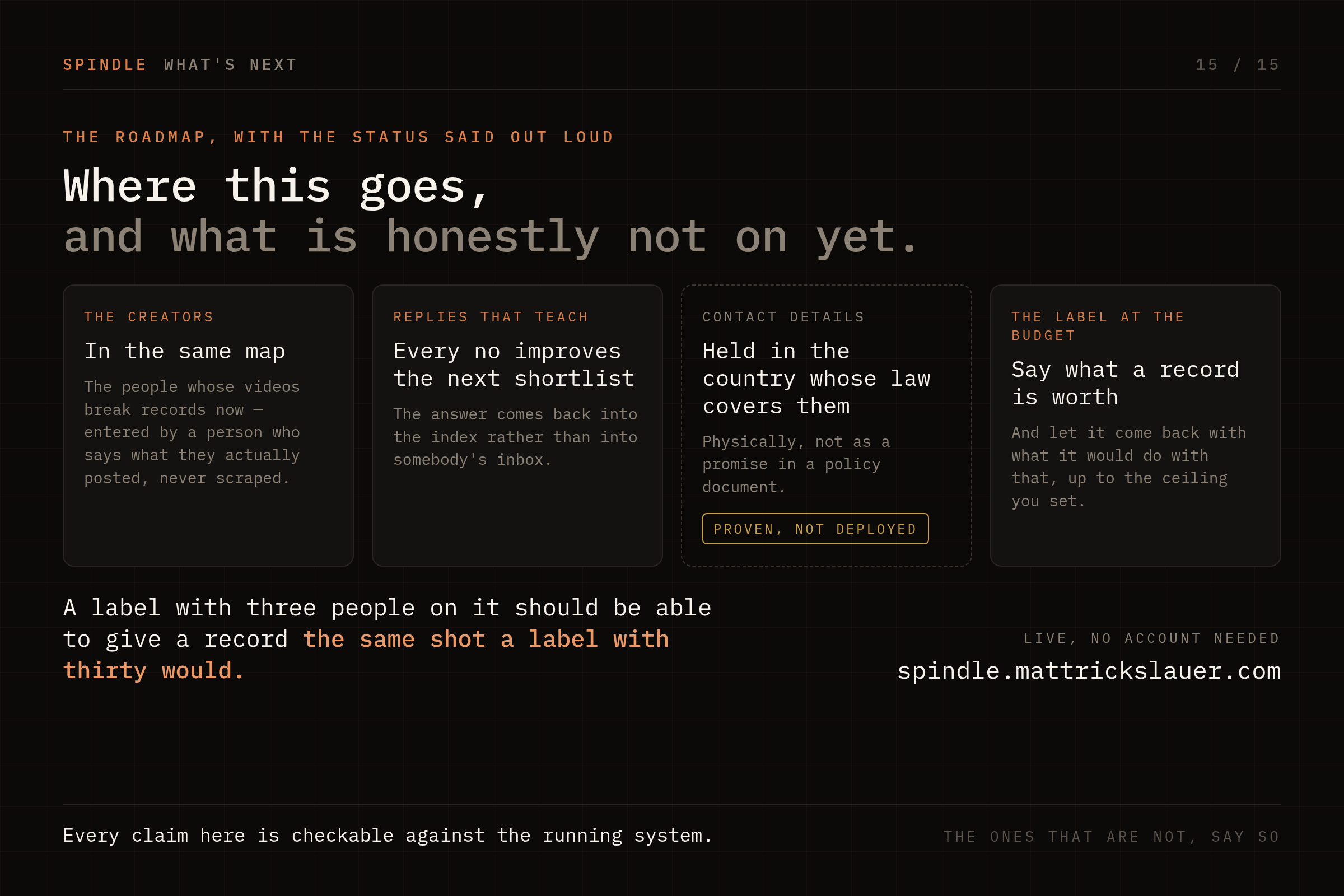
Radio and curators are where we started, because those registers are public and it was the honest place to begin. The bigger opportunity is the people making videos with music in them — the creators who break records now. We want them in the same map, entered by a person who tells us what they actually posted, never scraped, and treated with the same care as everyone else.
We're also working toward keeping each person's contact details in the country their own laws say they should live in — physically, not as a promise in a policy document — so a label can reach out across Europe without inheriting a legal problem. We've proven out how that works; it isn't switched on yet, and we say so.
After that: letting replies teach the system directly, so that every no makes the next shortlist better, and giving the label a real seat at the budget — telling Spindle what a record is worth to them and letting it come back with what it would do with that.
The goal hasn't changed since the first day. A label with three people on it should be able to give a record the same shot a label with thirty would.
Built With
- amazon-cloudfront
- amazon-cloudwatch
- amazon-ecr
- amazon-route53
- amazon-ses
- amazon-web-services
- aws-iam
- aws-lambda
- cockroachdb
- css
- docker
- essentia
- fastapi
- htmx
- javascript
- jinja
- openai
- psycopg
- python
- sql
- stripe
- tensorflow
- terraform

Log in or sign up for Devpost to join the conversation.