Inspiration
As a home cook who’s tossed expired spices and stared blankly at my pantry wondering what to pair with chicken, I knew there had to be a better way. Every week, I’d waste money on unused spices or ruin dishes with mismatched seasonings—so I set out to build a tool that turns chaos into flavor, rooted in the everyday struggles of home cooks like me.
What it does
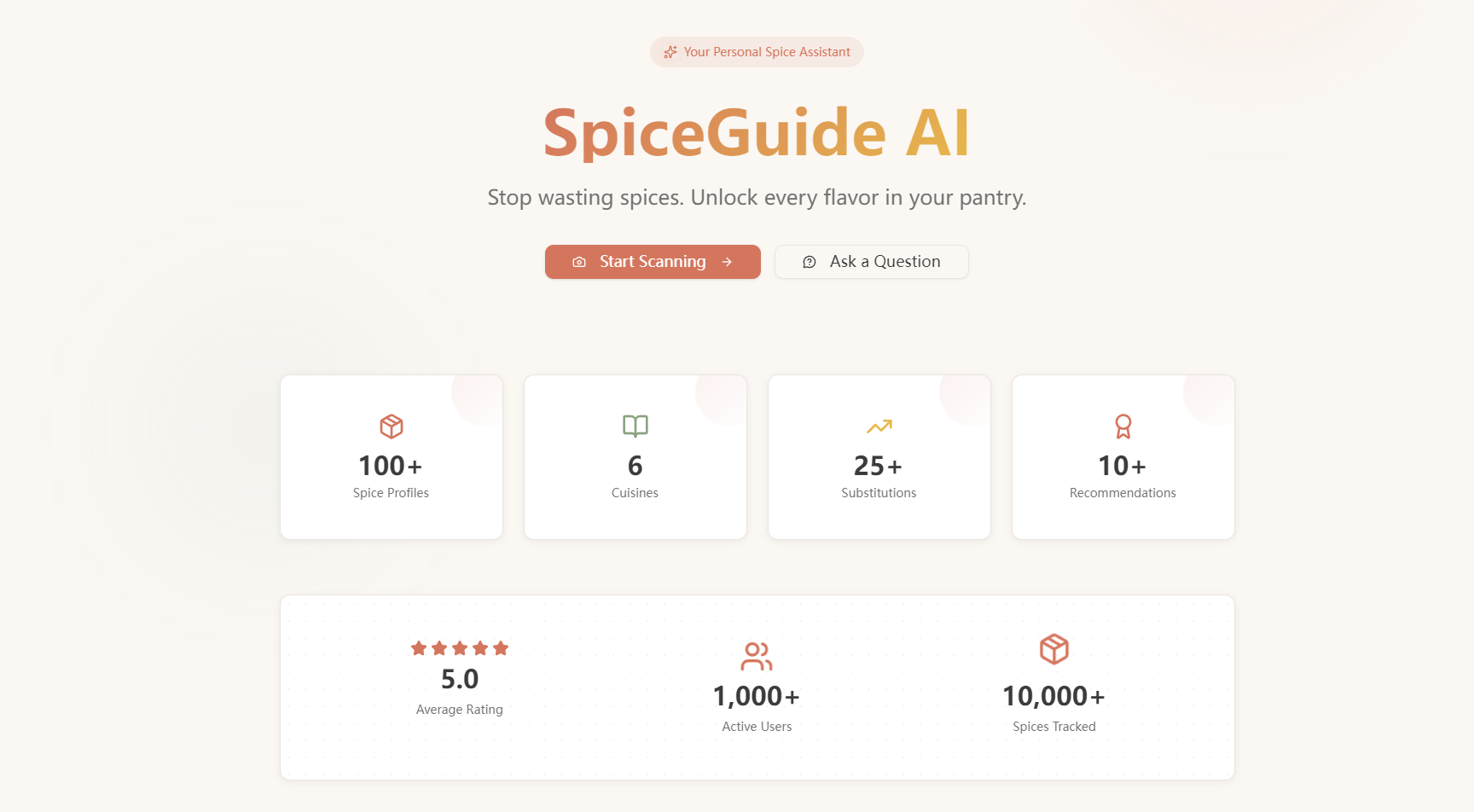
SpiceGuide AI is a mobile-first web app that lets you photograph your spice collection to build a digital inventory, get AI-driven pairing recommendations tailored to your pantry, track spice freshness, find smart substitutions, and explore global cuisine spice profiles—all to cut waste and elevate home cooking.
How we built it
I started by mapping core user needs (inventory tracking, recommendations, substitutions) and designing a mobile-responsive UI with warm, kitchen-inspired hues. I used React for the frontend, Python/TensorFlow for the recognition algorithm, and Google Cloud Vision API to power image processing. Firebase handled real-time data sync, and Stripe integrated premium subscriptions.
Challenges we ran into
The biggest hurdle was perfecting spice recognition—photos with multiple spices or blurry labels often misidentified items. I also struggled to balance algorithm accuracy with mobile load times, and had to refine the freshness calculation logic to account for different spice types (whole vs ground).
Accomplishments that we're proud of
We created a seamless photo-to-inventory flow that’s 85% accurate for common spices, built a recommendation engine that prioritizes what users already own, and designed a UX that feels intuitive for cooks of all skill levels—no tech expertise needed.
What we learned
I deepened my understanding of computer vision for real-world use cases, learned to balance AI complexity with user accessibility, and discovered how critical it is to center design around actual user pain points (not just features). I also mastered integrating payment APIs and tiered access logic for free/premium tiers.
What's next for this project
We’ll expand the cuisine library to include regional Western styles (e.g., Tex-Mex, Scandinavian), add batch cooking spice kits, refine the recognition model for rare spices, and test a barcode scanner for pre-packaged spices—all to make spice management even simpler for home cooks.
Built With
- amazon-web-services
- firebase
- python
- react
- tensorflow

Log in or sign up for Devpost to join the conversation.