-
-
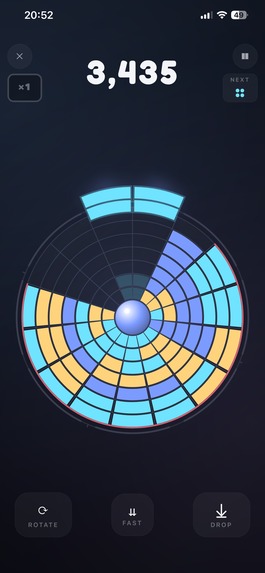
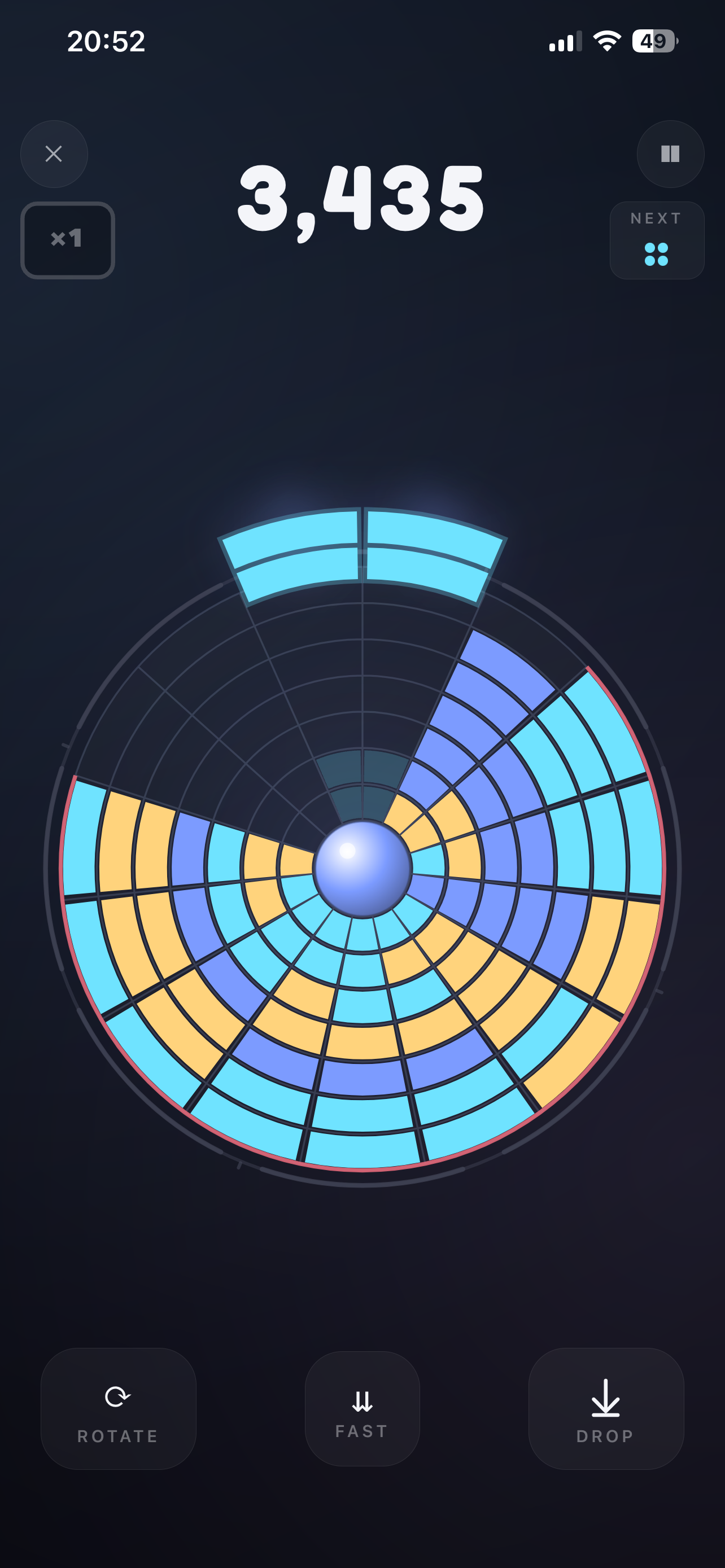
Classic 2D — Rotate the circular board, position incoming pieces, and complete full rings to clear space and keep the run alive.
-
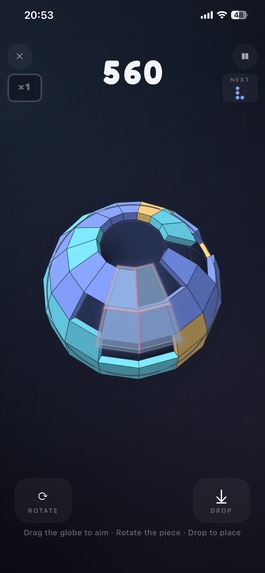
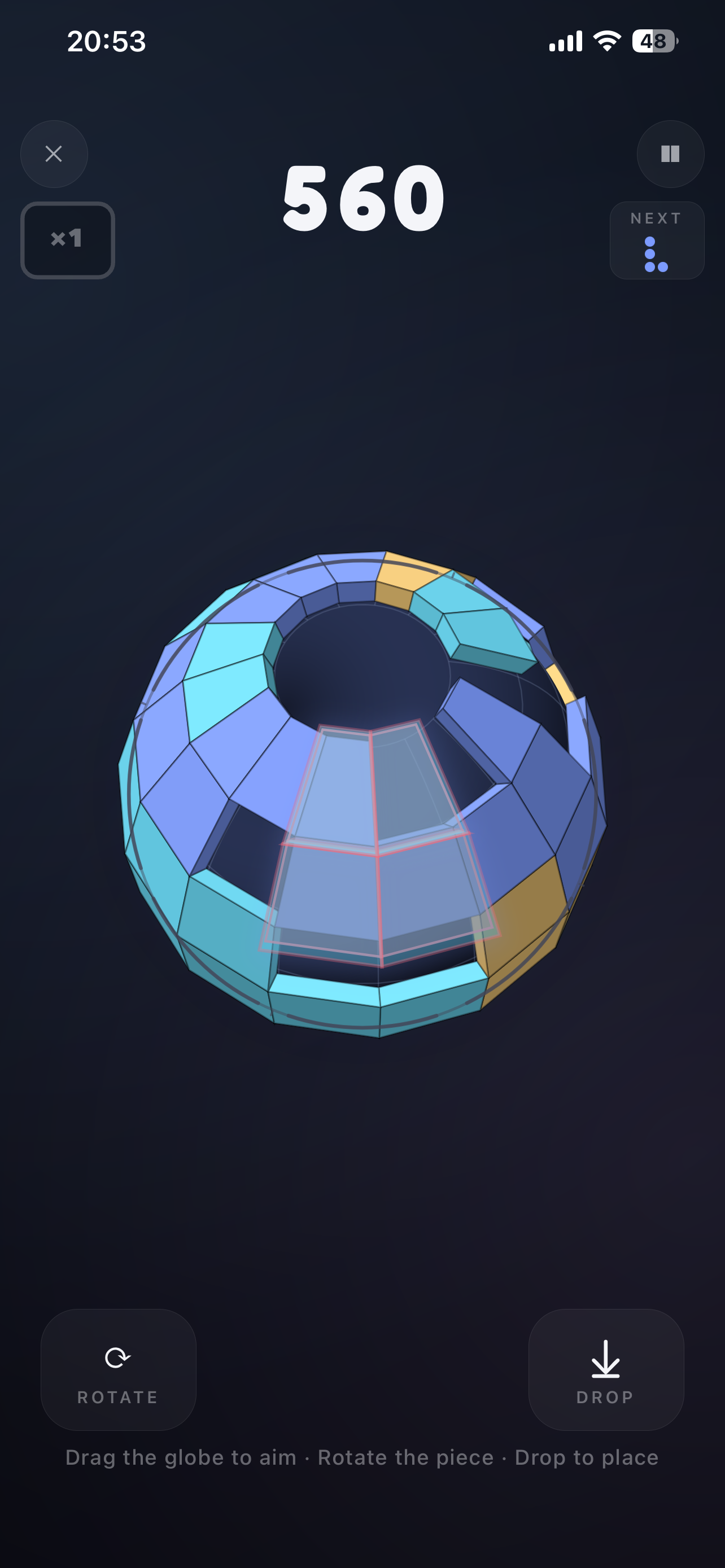
Classic 3D — Drag the globe to aim, rotate the incoming piece, and build around a fully three-dimensional playing surface.
-
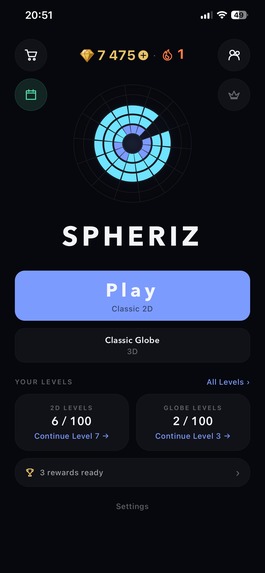
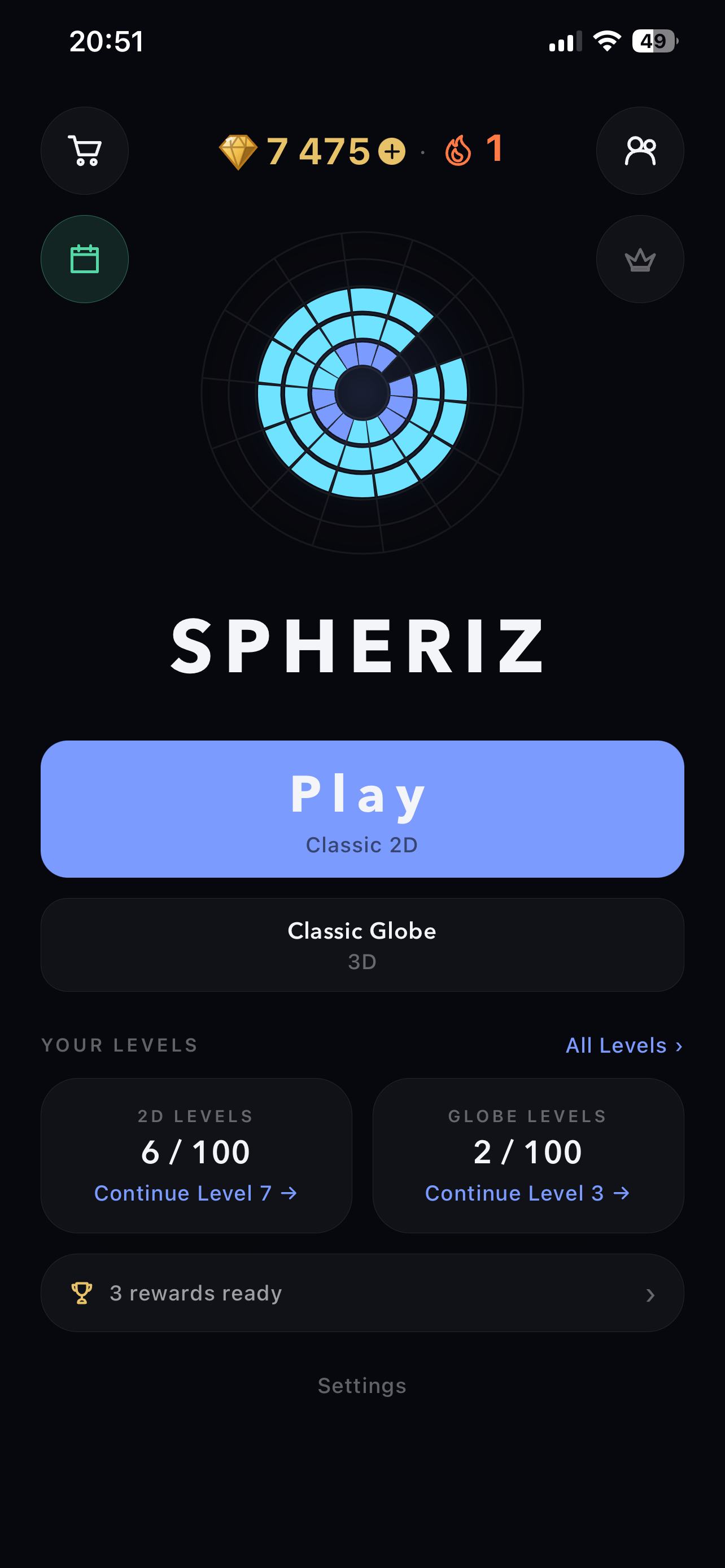
Home — Quick access to 2D and 3D Classic modes, two 100-level campaigns, rewards, progression, and player features.
-
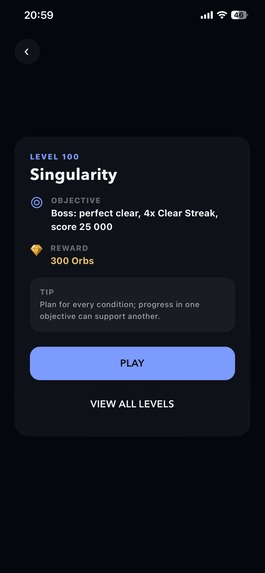
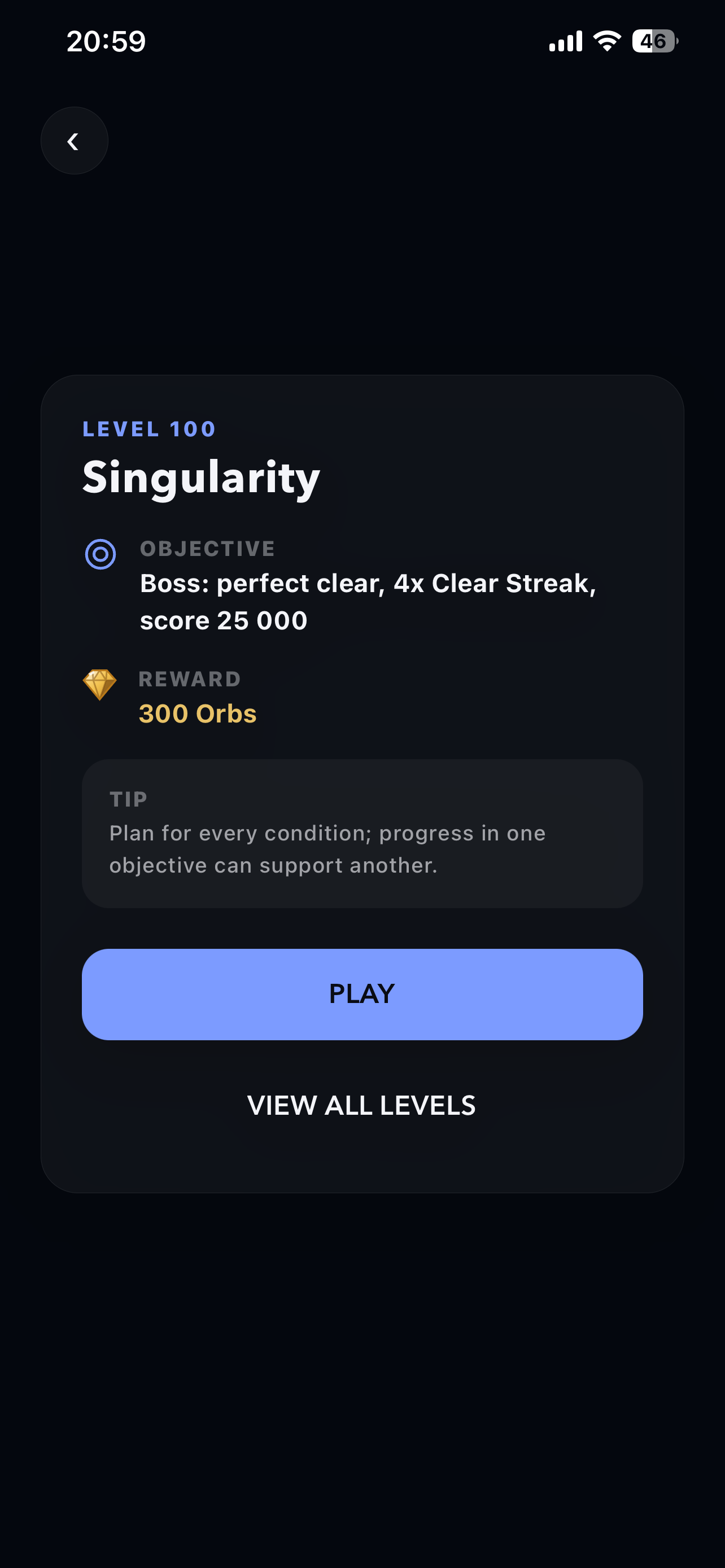
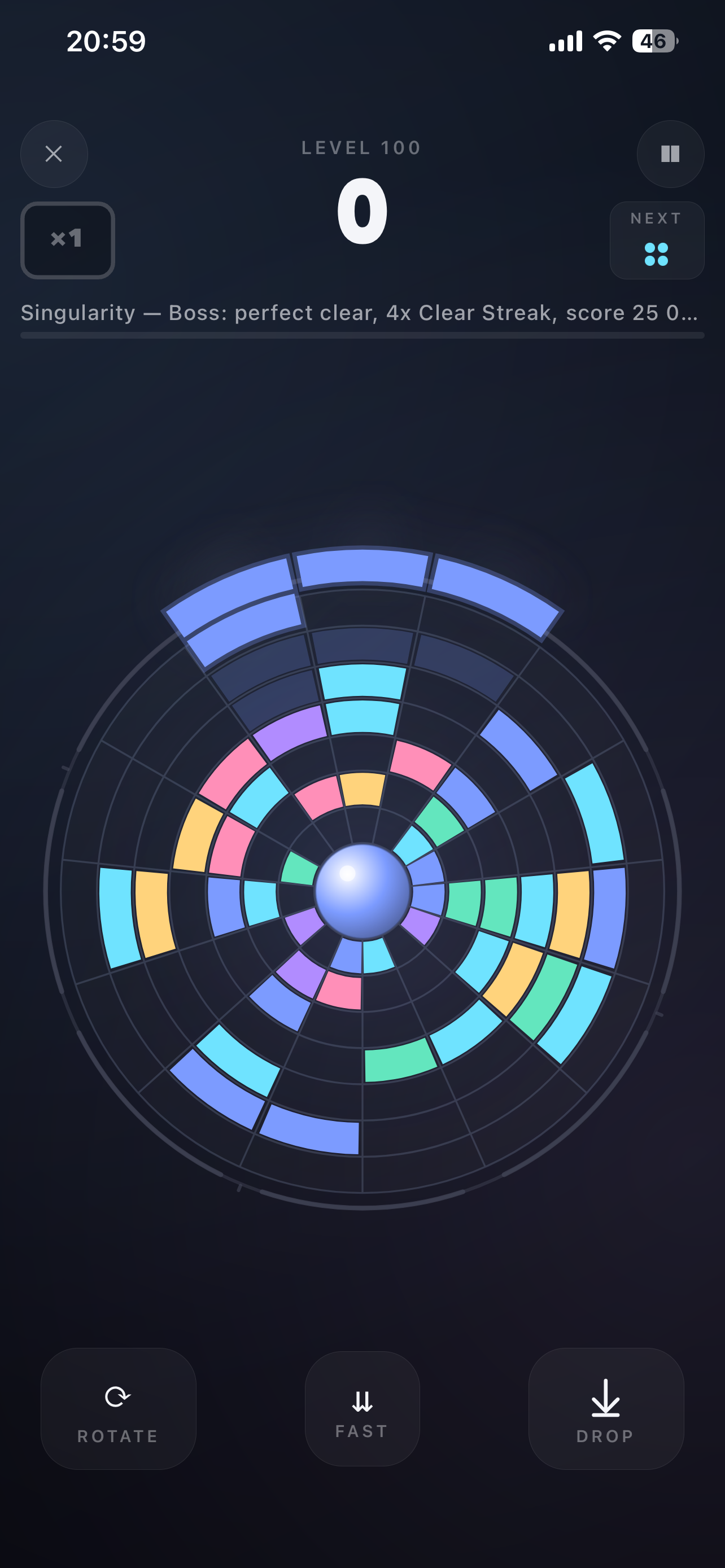
Level 100: Singularity — Late-game levels combine multiple objectives such as perfect clears, clear streaks, and score targets.
-
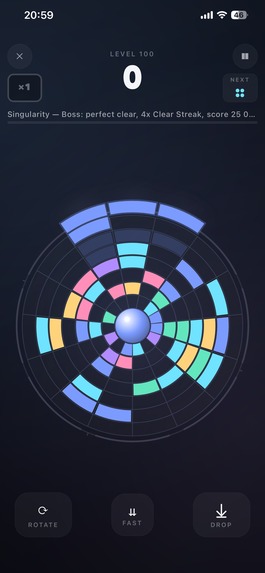
Campaign gameplay — Structured levels use custom board states and objectives instead of simply repeating the endless Classic mode.
-
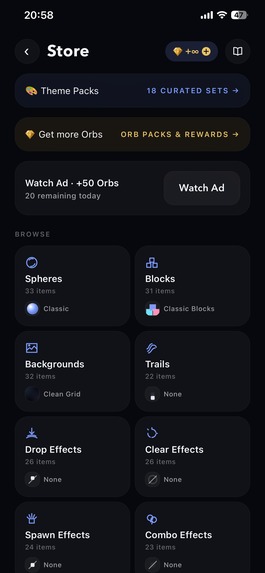
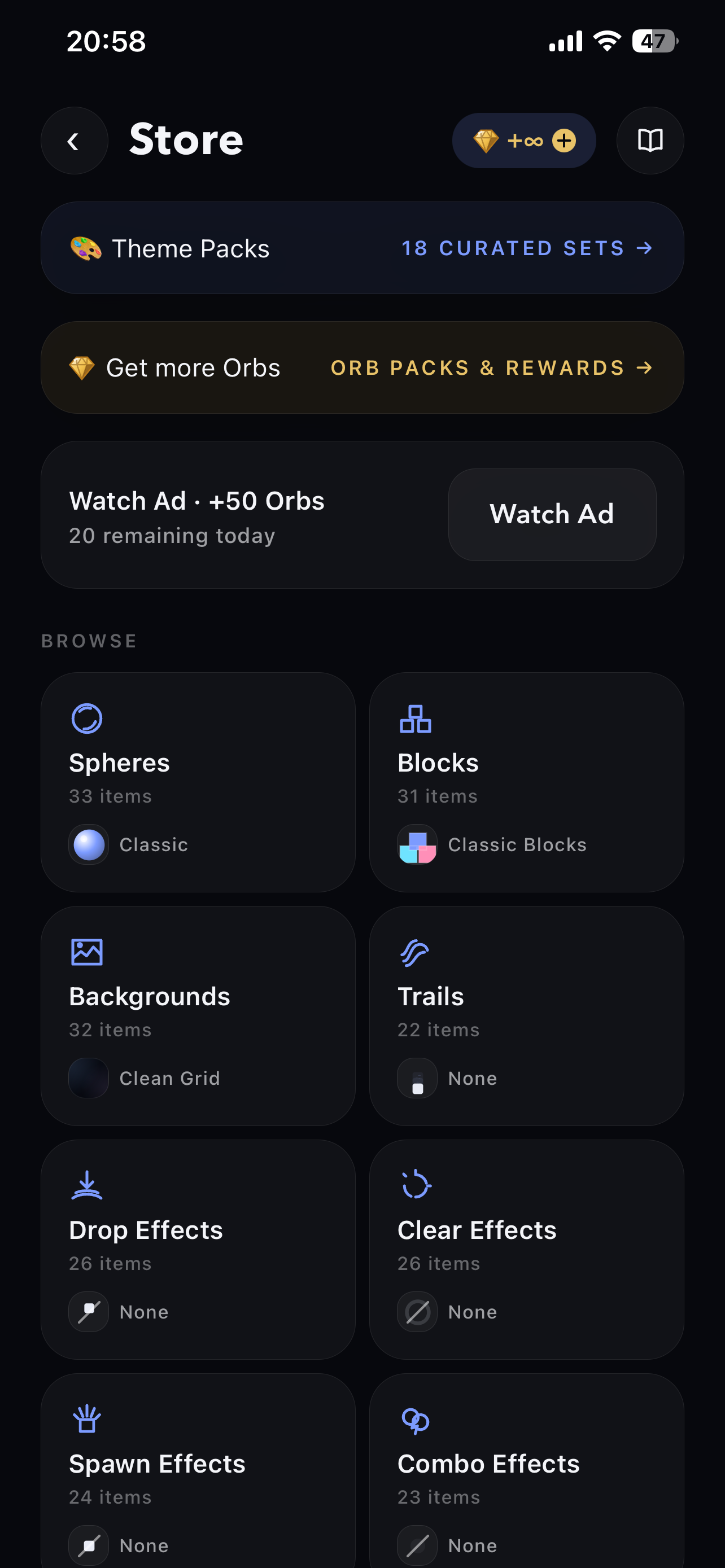
Customization — Unlock cosmetics and curated theme packs.
-
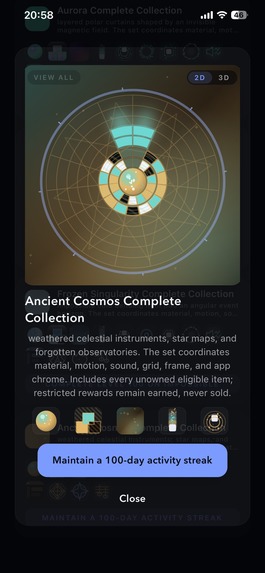
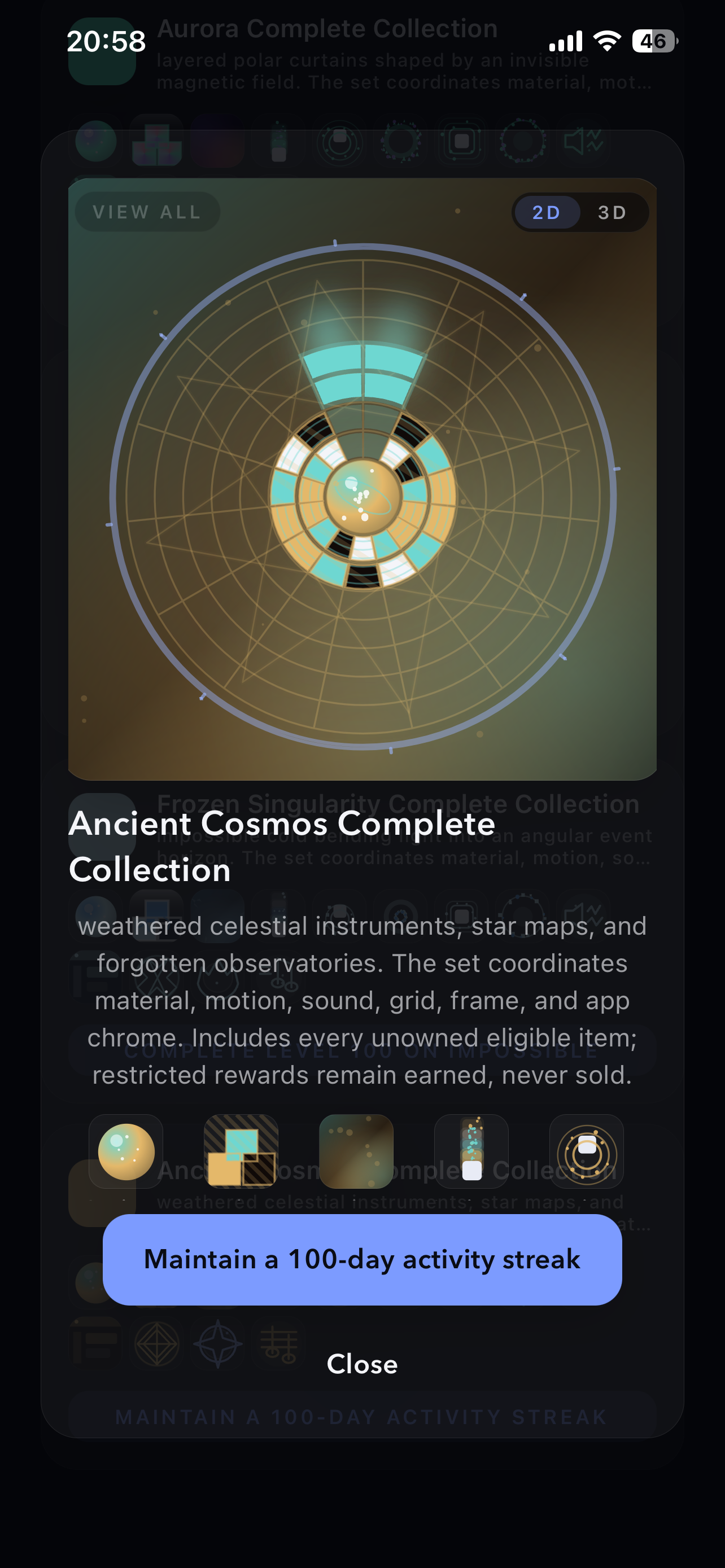
Earned cosmetics — Some collections must be unlocked.
-

Spheriz Premium — $4.99 lifetime unlock.
-
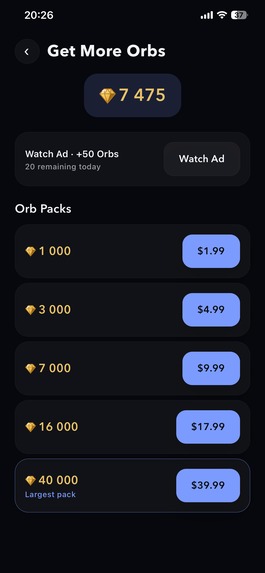
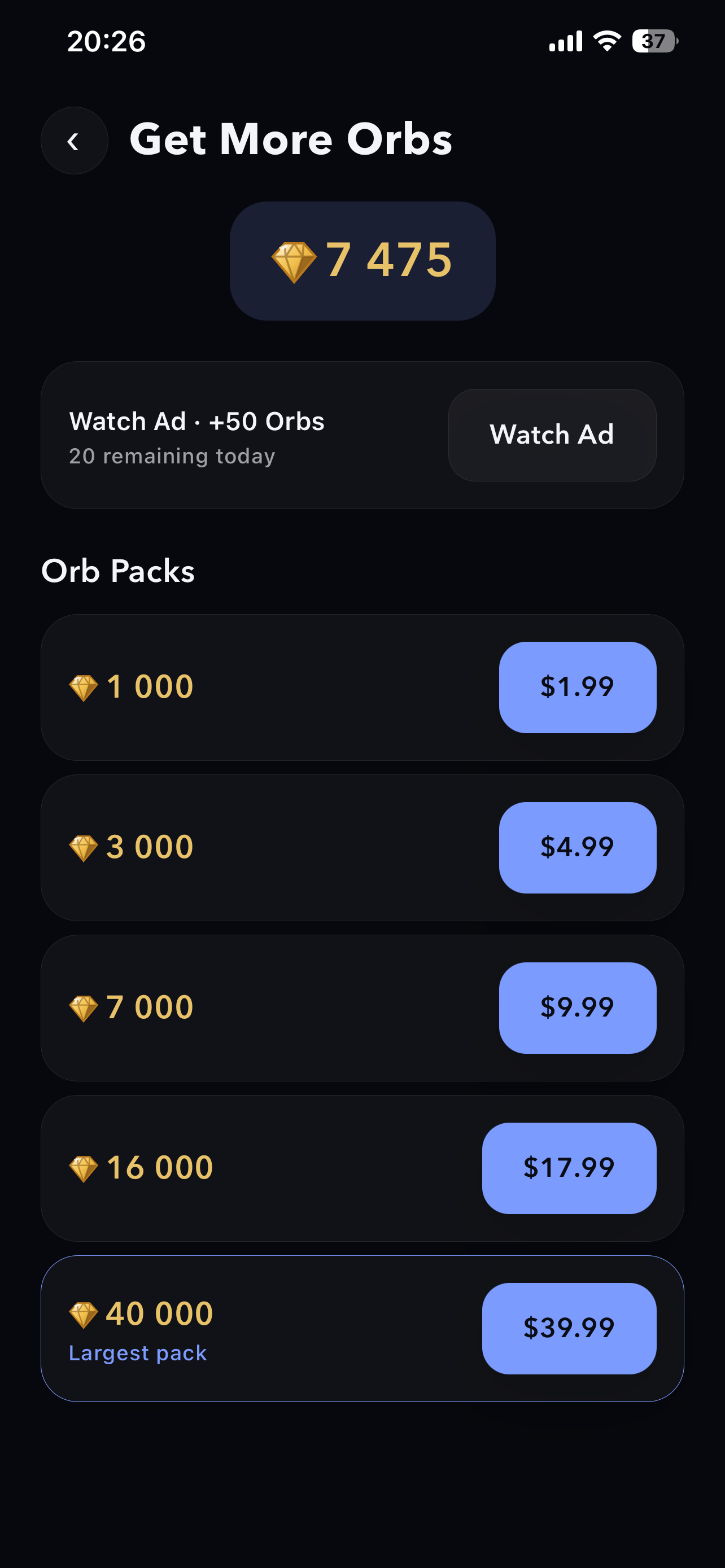
Orb economy — Optional Orb packs complement currency earned through gameplay, challenges, progression, and rewarded advertising.
-

App Store icon — A circular grid mark inspired directly by Spheriz’s core puzzle mechanic.


Inspiration
Spheriz started with one question:
What happens if a falling-block puzzle has no left or right edge?
Falling-block games are easy to understand for a reason. Pieces arrive, you decide where they belong, you clear space, and eventually the board overwhelms you.
I did not want to make another rectangular version of that idea with different graphics. I wanted to change the space itself.
In Spheriz, the traditional grid becomes circular. Pieces fall toward the center and the player rotates the board to decide where they land. Instead of completing horizontal lines, the goal is to complete rings.
Then I took the same idea one step further.
The board becomes a sphere.
That became the foundation of Spheriz: a mobile puzzle game built around circular 2D and spherical 3D gameplay.
What it does
Spheriz contains two interpretations of the same core mechanic.
Classic 2D
In 2D, pieces approach a circular board. The player rotates the board, adjusts the falling piece, and decides where it should land.
Completing full rings clears space and increases the score.
The basic loop is simple:
place, rotate, clear rings, survive, repeat.
But removing the traditional left and right edges changes how placements interact. Building too high in one part of the circle can create problems elsewhere, and planning becomes increasingly important as the board fills.
The rules should be understandable within seconds, while good placement takes much longer to master.
Classic 3D
The second mode takes the same idea onto a sphere.
It is not simply the 2D board rendered in 3D.
The player rotates the globe to choose a direction, rotates the piece itself, and places it onto a structure growing around a three-dimensional surface.
The underlying rules remain familiar, but the spatial reasoning changes substantially.
That contrast became one of the central ideas behind Spheriz:
learn the rules in 2D, then rethink them in 3D.
More than an endless puzzle
Spheriz is designed to work both as a quick score-based game and as something players can progress through over time.
Alongside the 2D and 3D Classic modes, the game includes two campaigns with 100 levels each, increasingly difficult objectives, daily challenges, achievements, leaderboards, statistics, cosmetics, and cloud-backed progression.
Levels move beyond simply reaching a score. Objectives can involve clearing rings, surviving for a set time, building clear streaks, fitting specific pieces into gaps, clearing the board, or combining several requirements in harder boss-style levels.
This creates several layers of play: surviving the current piece, improving a score, completing levels, mastering the two different board types, and gradually unlocking more of the game.
Designed around the geometry
The unusual board shapes affected much more than the gameplay logic.
Spheriz needed an interaction model that made circular and spherical movement understandable on a phone without covering the board with controls.
In 2D, rotating the board is the main way to aim the falling piece. The playing field stays centered so the player can quickly read its state.
In 3D, the interaction becomes spatial. The player needs to understand the orientation of the sphere, see where a piece is going, rotate it, and make a placement without the game turning into a camera-control exercise.
A large part of the design work went into hiding that complexity.
The player should feel like they are simply rotating, aiming, and placing pieces, even though the systems underneath are working with circular and spherical geometry.
Visually, Spheriz uses a dark and restrained interface around a much more colorful playing field. The board, pieces, Orbs, score feedback, and interactive elements carry most of the color so gameplay remains the focus.
Motion also serves a functional purpose. Piece movement, placement, clearing, score feedback, transitions, unlocks, and progression changes help communicate what just happened instead of relying only on text.
Customization and progression
Customization became another layer of progression.
Players can unlock different spheres, blocks, backgrounds, trails, drop effects, clear effects, spawn effects, and combo effects.
There are also 18 curated theme packs that combine multiple visual components into complete styles.
Not everything can simply be purchased.
Some special collections are tied to difficult accomplishments and must be earned through gameplay. I wanted those rewards to remain meaningful rather than making every cosmetic another item in a store.
Some things should still communicate:
I earned this.
Monetization that fits the game
Spheriz is free to download and play.
I thought about monetization while designing the product rather than attaching it after the game was finished.
The current model combines three main paths.
Free players can play with advertising, including optional rewarded ads that provide additional Orbs.
Players who want the full experience can purchase lifetime Premium for $4.99 USD in the US storefront. Premium removes interstitial advertising, doubles Orb rewards, unlocks the full campaigns, and includes Premium cosmetics.
I deliberately chose a one-time purchase rather than a recurring subscription because I think it fits this type of casual puzzle game better.
Players who care more about customization can also purchase optional Orb packs ranging from 1,000 to 40,000 Orbs.
Orbs are not purchase-only. They are also earned through gameplay, levels, challenges, rewarded advertising, and other activities.
The result is an economy built around different kinds of players: someone can play for free, permanently upgrade the game, purchase additional customization currency, or simply earn that currency over time.
The core game is not designed around pay-to-win advantages, and some of the most distinctive cosmetic rewards remain earned rather than sold.
RevenueCat
RevenueCat powers the purchase and entitlement layer behind Spheriz.
It manages the lifetime Premium entitlement and supports the in-app purchase flows around the Orb economy.
That is particularly useful because the game has to deal with permanent access, consumable purchases, restoration, verification, and different player states without spreading store-specific purchase logic throughout the rest of the app.
For a solo project, having that layer handled consistently made the monetization system much easier to build and maintain.
It also gives me a foundation for improving pricing, packaging, and purchase flows as Spheriz gets more real-world usage data.
How I built it
The current version of Spheriz is primarily built with:
- React Native
- Expo
- TypeScript
- PlayFab
- Cloudflare Workers
- RevenueCat
- Google AdMob
- EAS Build
The released version is currently available on iOS.
PlayFab handles major parts of player progression, statistics, economy, and cloud-backed data. Cloudflare Workers support secure server-side functionality, RevenueCat handles purchases and Premium entitlements, and AdMob provides advertising.
Spheriz was built primarily as a solo project.
Where Spheriz came from
The Shipaton version was built during 2026, but the idea itself is much older.
I first experimented with Spheriz almost two years ago in C++. Even in that early prototype, pieces were already falling toward a circular grid and completing rings instead of horizontal lines.
I later tried rebuilding it in Unity with some help from friends and started exploring the idea of eventually moving the mechanic onto a sphere.
That version stalled.
At the time, I was trying to learn the engine while simultaneously solving unfamiliar problems involving geometry, collision, rendering, rotation, and placement.
Spheriz remained unfinished for a long time.
In June 2026, I came back to it again.
By then I had much more experience building mobile applications and a better understanding of the difference between making a prototype and shipping a product.
Instead of continuing either previous implementation, I rebuilt Spheriz again.
This time, the goal was simple:
finish it and ship it.
The hardest problem
The biggest technical challenge has always been the geometry.
Traditional falling-block games benefit from a convenient rectangular coordinate system.
Circular and spherical boards do not.
Movement, neighbouring cells, piece rotation, placement, collision detection, clearing logic, rendering, and touch interaction all required solutions designed specifically for these board shapes.
The 3D mode made this particularly difficult because the calculations also had to remain fast and predictable enough for the game to feel responsive on a phone.
The challenge was never only making the mathematics correct.
It was making all of that mathematics disappear from the player's perspective.
From prototype to product
Once the puzzle itself worked, the next challenge was turning it into a real mobile game.
Spheriz needed cloud-backed progression, authentication, achievements, leaderboards, statistics, secure rewards, an in-game economy, advertising, consent flows, purchases, restoration, Premium entitlements, and production backend infrastructure.
That taught me one of the most important lessons from the project:
a working prototype and a released game are very different things.
Gameplay can work while a purchase fails.
A purchase can work while the reward never reaches the player's account.
A backend can behave correctly while an advertising provider returns nothing.
Systems that work in development can behave differently in a production build.
Finishing Spheriz became as much about solving those details as building new features.
Building with AI
AI was also a major part of the development process.
I used it as a coding and product collaborator for architecture, geometry, debugging, gameplay systems, backend design, monetization, UX, and testing.
It was particularly valuable for the circular and spherical mathematics that had made earlier versions difficult to finish.
But it did not remove the need to understand the project.
AI can produce a solution that looks completely reasonable while being subtly wrong. A large part of working effectively with it became providing precise context, testing implementations, challenging assumptions, and rejecting solutions that did not actually behave correctly.
It helped make a project of this scope realistic for one developer, while I remained responsible for what ultimately shipped.
What I am proud of
The biggest accomplishment is not any individual feature.
It is that Spheriz exists as a released game at all.
I had already tried to build this idea more than once, and it would have been easy to leave it as an old prototype.
The spherical mode is particularly meaningful to me because it was part of the concept long before I knew how I would actually implement it.
For a long time, it felt more like a future idea than something that would ever be playable on a phone.
Now it is part of the released game.
What I learned
Spheriz taught me that creating the central mechanic is often the easier part.
Shipping it is harder.
The project pushed me beyond game mechanics into mobile engineering, backend infrastructure, product design, monetization, App Store requirements, analytics, and user acquisition.
It also changed how I think about monetization.
Instead of asking how to make money from the game after it was finished, I started asking much earlier what players should pay for, what should remain free, whether a subscription made sense for the genre, and which rewards should be earned rather than sold.
Those decisions became part of the product itself.
What's next
The first goal was to stop rebuilding Spheriz and finally release it.
That part is done.
The next stage is learning from real players.
As usage grows, I want actual behavior rather than assumptions to guide decisions around progression, 2D versus 3D engagement, retention, cosmetics, the Orb economy, Premium, and performance across different devices.
Future updates can then focus on what players actually value, including more levels and challenges, new cosmetics and themes, seasonal content, stronger social and competitive systems, further performance improvements, new gameplay variations, and an Android release.
Longer term, multiplayer is something I would like to explore if the player base grows enough to justify the additional infrastructure.
Almost two years after the first prototype, Spheriz is no longer an unfinished idea.
This time, it shipped.
Built With
- admob
- android
- cloudflare-workers
- eas
- expo.io
- ios
- playfab
- react-native
- revenuecat
- typescript


Log in or sign up for Devpost to join the conversation.