-
-
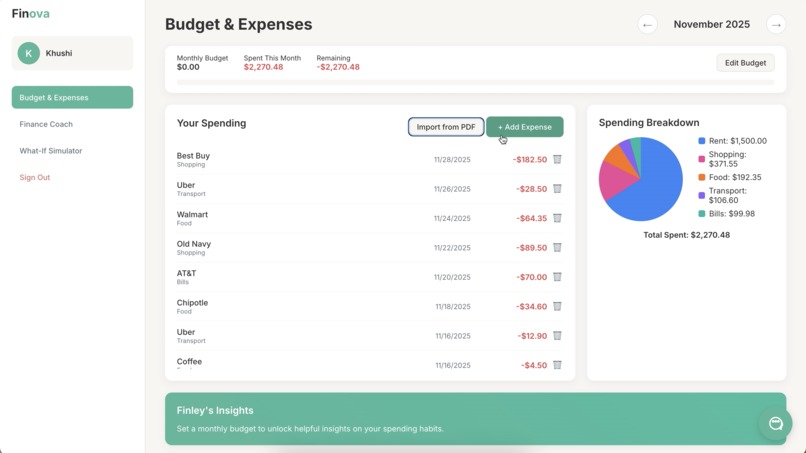
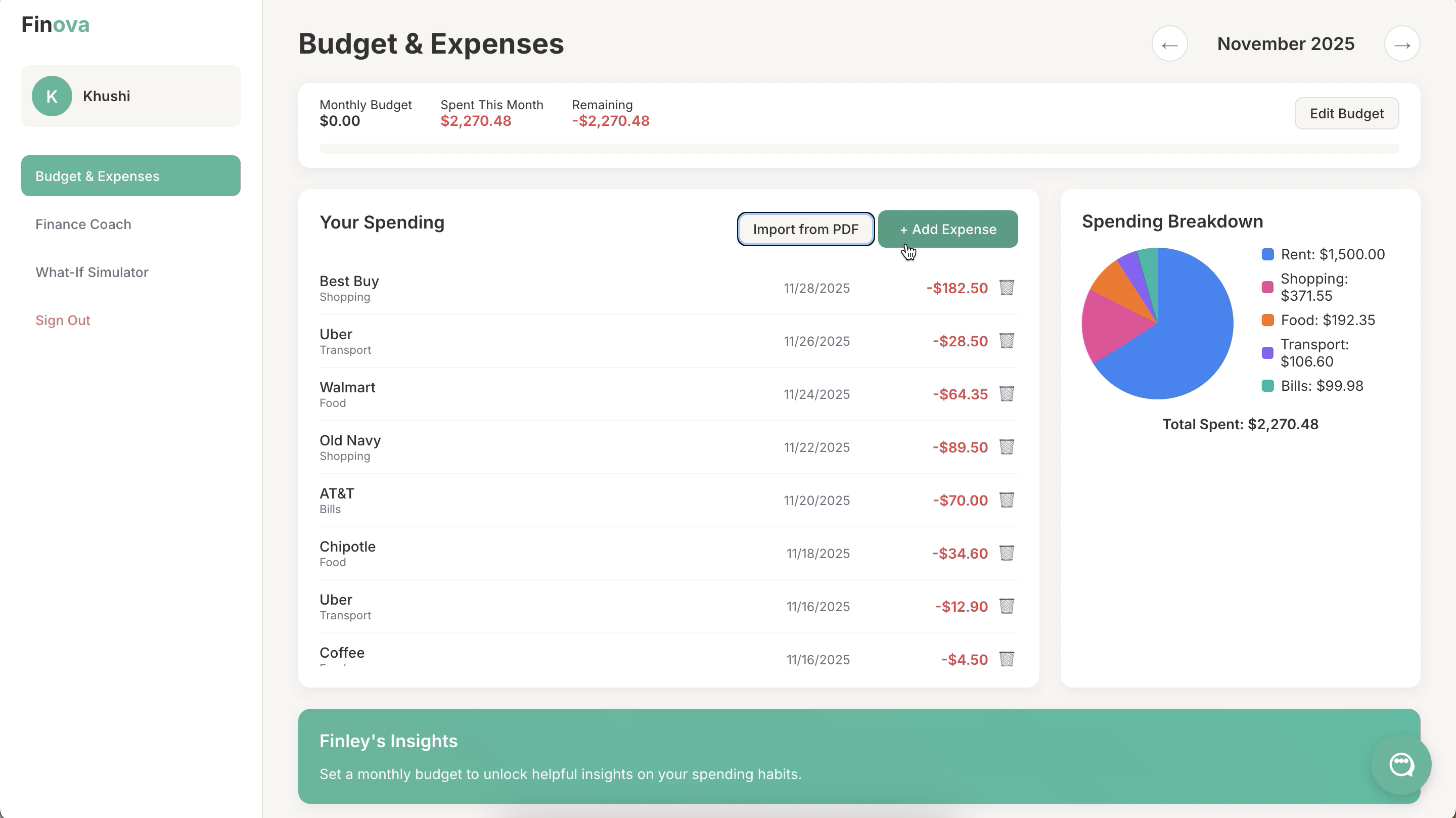
Spend analyzer
-
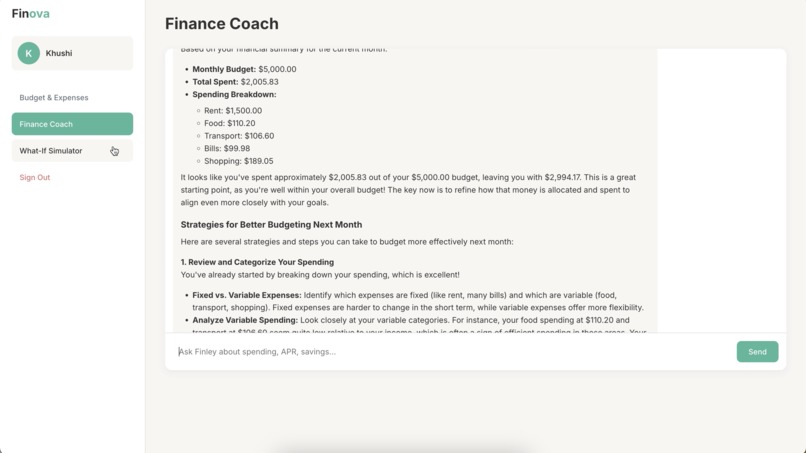
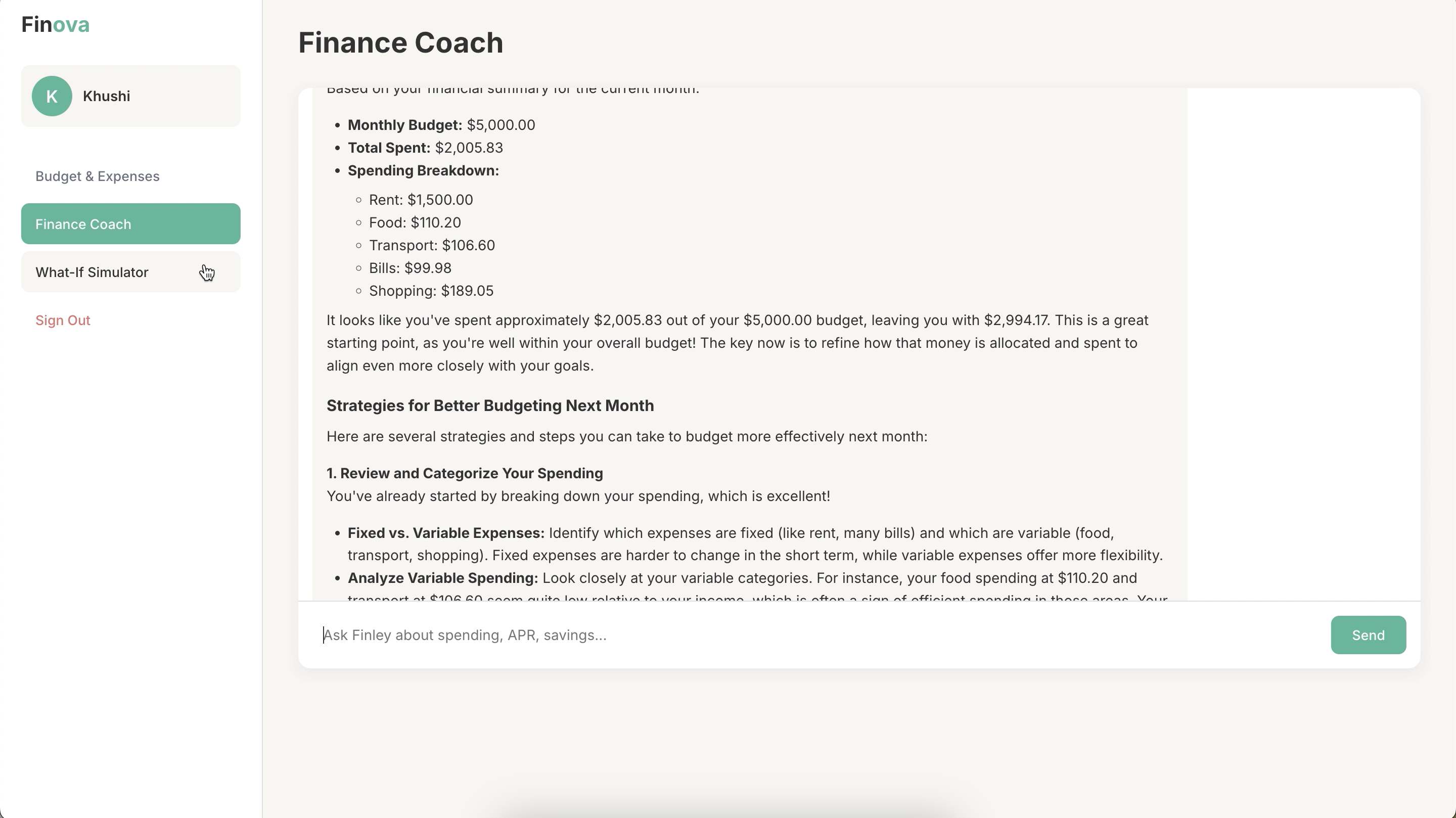
AI Finance Coach
-
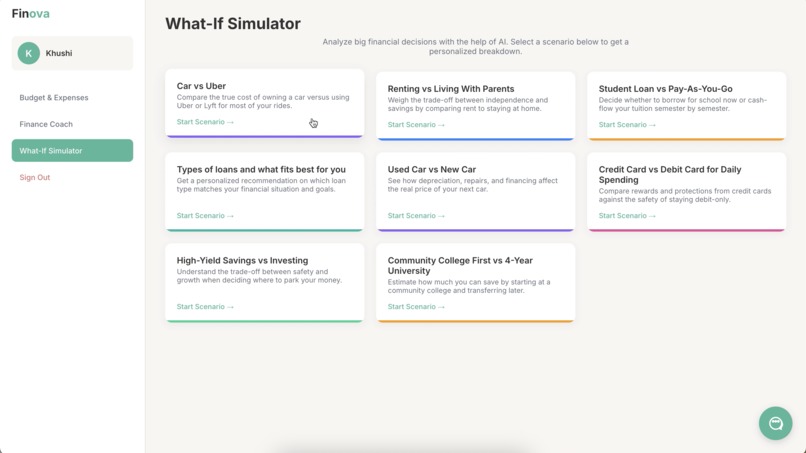
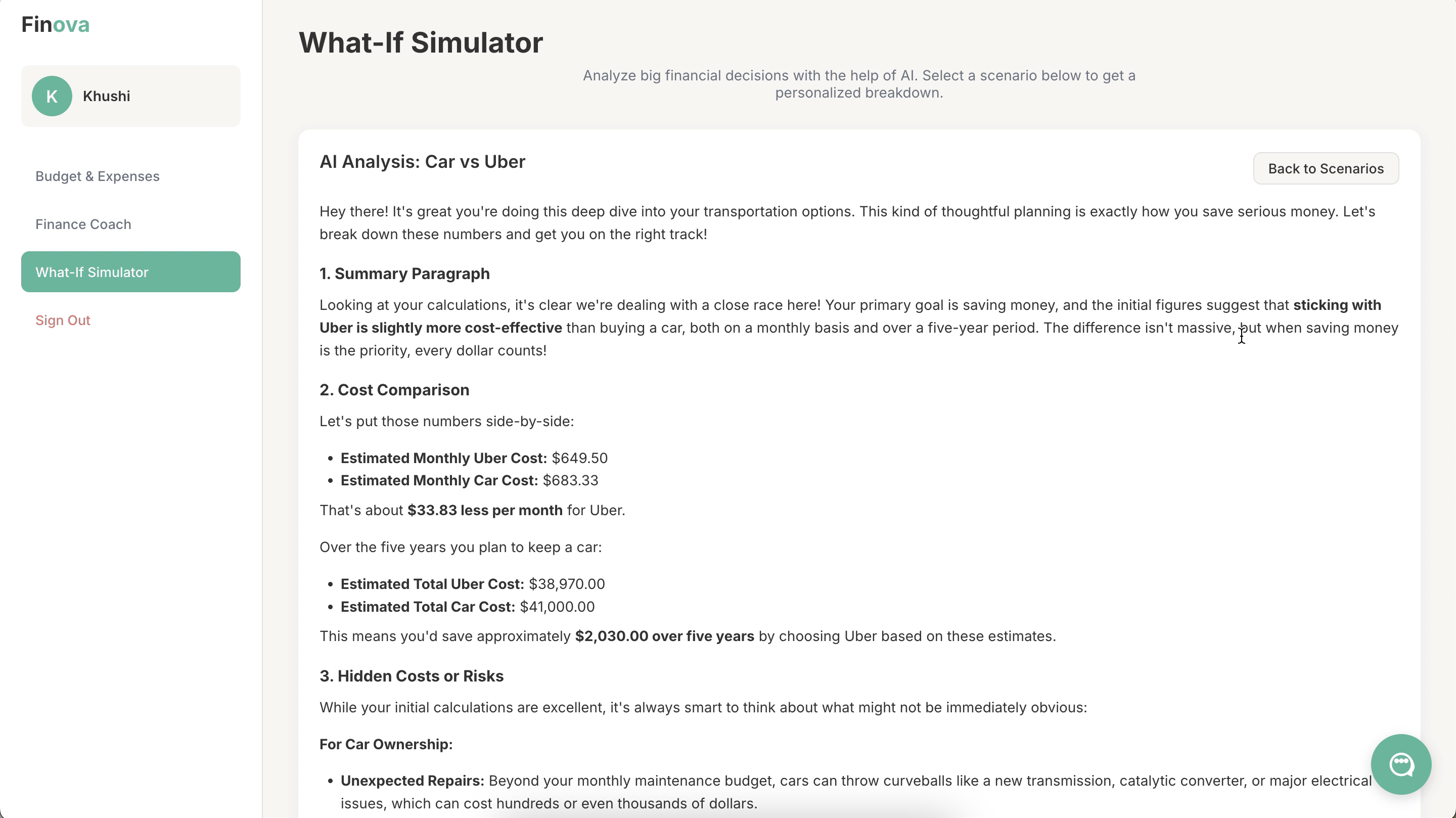
What-if Scenarios
-
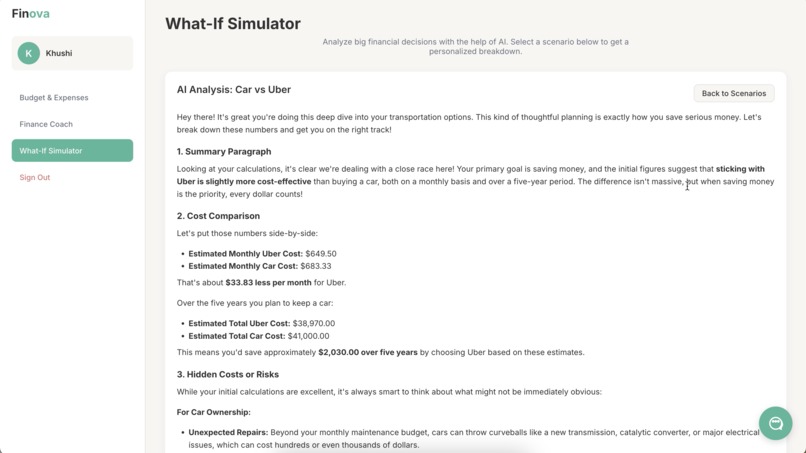
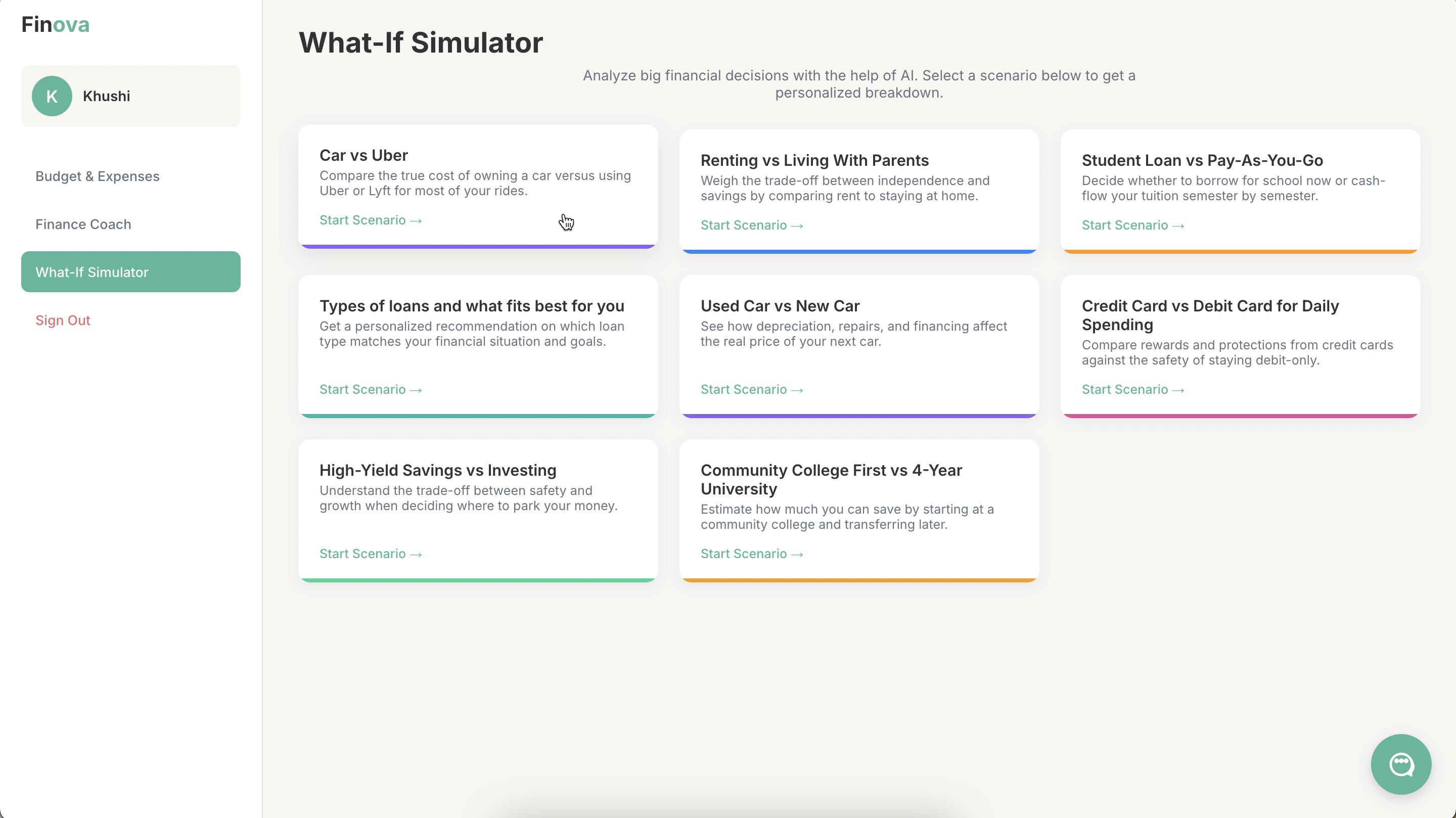
What-if Simulator
Inspiration
Our motivation for building Finova came from a very real, very common problem: as adults, we are expected to understand financial literacy — yet we’re never actually taught it.
Most of us graduate knowing how to write essays, do lab work, or analyze literature, but not how to read a credit card statement, budget properly, compare financial decisions, or plan for the future. Despite this, society assumes “you should already know this,” and as a result, many people quietly struggle.
With a rapidly changing economy, rising living costs, and talks of a potential recession, we realized how important it is for young adults to be financially prepared. But in reality, not everyone has access to financial advisors, family guidance, or clear, practical resources.
We wanted to build something that breaks those barriers.
Our goal with Finova was to create a platform that is:
- easy to use
- accessible to people from all backgrounds
- practical instead of theoretical
- supportive instead of overwhelming
And most importantly: to teach financial literacy without making users feel like they’re “studying.” Instead, we help them learn through their real spending patterns, real decisions, and personalized guidance — education disguised as simple, useful everyday tools.
Finova was built to give people the financial clarity we all deserved but never received in school. Our motto is simple:
Learn money by living it.
What it does
Finova teaches financial literacy through three experiential learning methods, grounded in real life instead of textbooks. Our focus is on 3 things:
- Learning From Your Own Data Finova helps users understand their money by looking at what matters most — their actual spending habits.
Users can upload credit card statement PDFs or manually log transactions. Finova then:
- Extracts and categorizes expenses
- Detects patterns, recurring charges, and red flags
- Highlights areas of overspending
- Generates a smart monthly budget
- Provides personalized insights based on real behavior Instead of abstract examples, users learn directly from their own financial lifestyle, making the lessons far more relevant and memorable.
- Learning By Experimenting Our What-If Simulator lets users explore major financial decisions in a safe, interactive way.
Scenarios include:
- Car vs Uber
- Renting vs Living With Parents
- Student Loan vs Pay-As-You-Go
- Used vs New Car (and more coming soon)
Users enter a few details (income, commute habits, expected costs), and Finova runs:
- Cost comparisons
- Long-term projections
- Hidden cost evaluations
- Pros and cons
- AI-powered recommendations based on goals
This method encourages hands-on learning where users test choices, compare outcomes, and learn the “why” behind smart financial decisions.
- Learning Through Personalized Coaching Finley, our AI finance advisor, is built to feel like a supportive friend who understands your financial life.
Finley can:
- Analyze your spending
- Suggest better habits
- Answer questions (“What is APR?”, “How do I build credit?”)
- Explain complex concepts in simple, real-life language
- Give guidance tailored to your personality, priorities, and goals With Finley, users learn in a conversational, stress-free environment that adapts to their comfort level.
How we built it
Frontend: HTML, CSS, JavaScript, with Gemini-assisted UI generation AI Logic: Google Gemini API for spending insights, scenario analysis, and Finley’s coaching PDF Processing: pdf.js to extract transactions from uploaded credit card statements State Management: LocalStorage for user budgets, spending history, chat logs, and preferences Design: A calm, welcoming UI intentionally built to reduce financial anxiety Extras: A floating Finley chat widget that follows you on key pages
Challenges we ran into
One of our biggest challenges wasn’t technical — it was conceptual. We knew exactly what we wanted to teach (financial literacy), but we struggled with how to teach it in a way that wouldn’t overwhelm users or feel like every other finance app.
Financial literacy is a huge topic. Budgeting, credit, loans, investing, savings, debt management… it’s enough to intimidate anyone, especially beginners. We wanted Finova to feel simple, friendly, and accessible — not like a classroom or a boring module. Finding the right approach took a lot of brainstorming, several rounds of user-centered thinking, mentorship and feedback, and a lot of trial and error.
We repeatedly asked ourselves:
- How do we make complex topics feel natural?
- How do we educate without lecturing?
- How do we avoid looking like just another budgeting app?
- How do we keep everything practical and personalized?
Eventually, the solution became clear: Teach through experience. Teach through the user’s own life. That’s how our three experiential pillars were born: learning from your own data, learning by experimenting, and learning through coaching.
other problems we ran into:
- Teaching AI to give advice based on real user spending rather than generic suggestions
- Parsing messy or scanned credit card statements with inconsistent formatting
- Ensuring the What-If Simulator’s AI sounded human, not robotic
- Preventing users from feeling overwhelmed by too many numbers
- Building a full learning platform inside a single HTML file as beginners
Accomplishments that we're proud of
- Turning a huge, intimidating topic like financial literacy into something simple, friendly, and interactive
- Creating a platform that teaches through real-life experiences, not lectures or modules
- Designing a clean, accessible UI that reduces financial anxiety instead of adding to it
- Building Finley, an AI advisor that gives truly personalized financial guidance
- Developing a PDF spending analyzer that handles clean, scanned, and noisy statements
- Creating the What-If Simulator, which helps users experiment with major financial decisions safely
- Finding the right educational approach after lots of brainstorming, mentorship, and trial-and-error
- Building all of this as beginners, learning AI integration, UI/UX, and prompt engineering along the way
What we learned
- How difficult financial education actually is — not because of the content, but because of how easy it is to overwhelm users
- The importance of choosing the right teaching approach, not just the right features
- How to simplify complex topics into clear, practical insights people can actually use
- The power of experiential learning — people understand money better when they learn through their own habits and decisions
- How to use AI responsibly — not to replace teachers, but to make learning more personalized and accessible
- How to design for beginners, keeping the product visually calm and unintimidating
- How essential UX is in building trust, especially for sensitive topics like money
- How to think like product designers, not just developers, by focusing on user emotions and needs
What's next for Finova
Finova is only the beginning. We plan to expand the platform into a complete financial wellness ecosystem with features such as:
• Bank + Credit Account Linking Securely connect bank and credit accounts so Finova can analyze spending in real time — no manual uploads required.
• Investment Portfolio Guidance Personalized investment insights for beginners, comparing options like HYSAs, ETFs, IRAs, and helping users understand risk, growth, and long-term strategy.
• Credit Score Coaching A dedicated module that explains your credit score, tracks the factors affecting it, and gives tailored steps to improve it month by month.
• Bill Negotiation Assistant An AI-powered assistant that helps users lower recurring bills (phone, internet, insurance) by identifying negotiation opportunities and crafting messages/script templates.
• Automated Saving Goals Smart savings plans that adjust based on your income, habits, and priorities, with nudges and monthly progress reports powered by Finley.
• Enhanced What-If Analysis More advanced simulations for major life decisions — mortgages, career changes, relocating to a new city — with deeper AI reasoning and long-term financial projections.
Built With
- cdn
- css3
- gemini
- html5
- javascript
- marked.js
- navigator.geolocation
- pdf.js

Log in or sign up for Devpost to join the conversation.