-
-
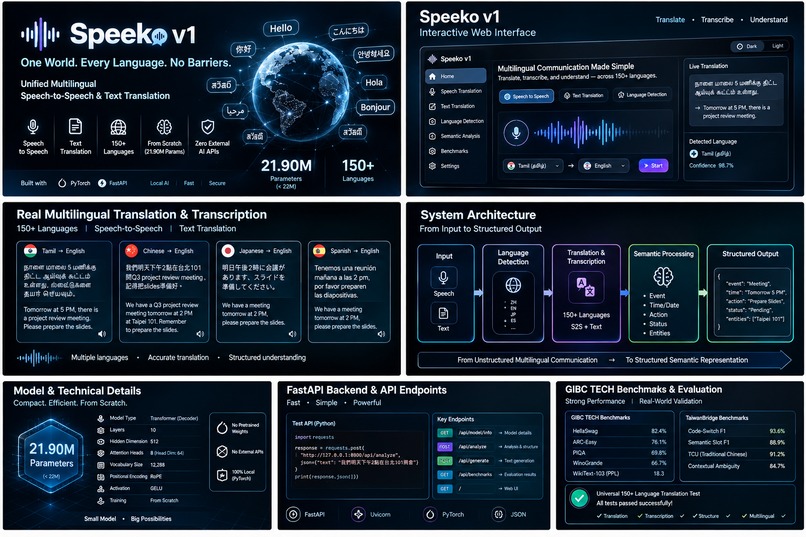
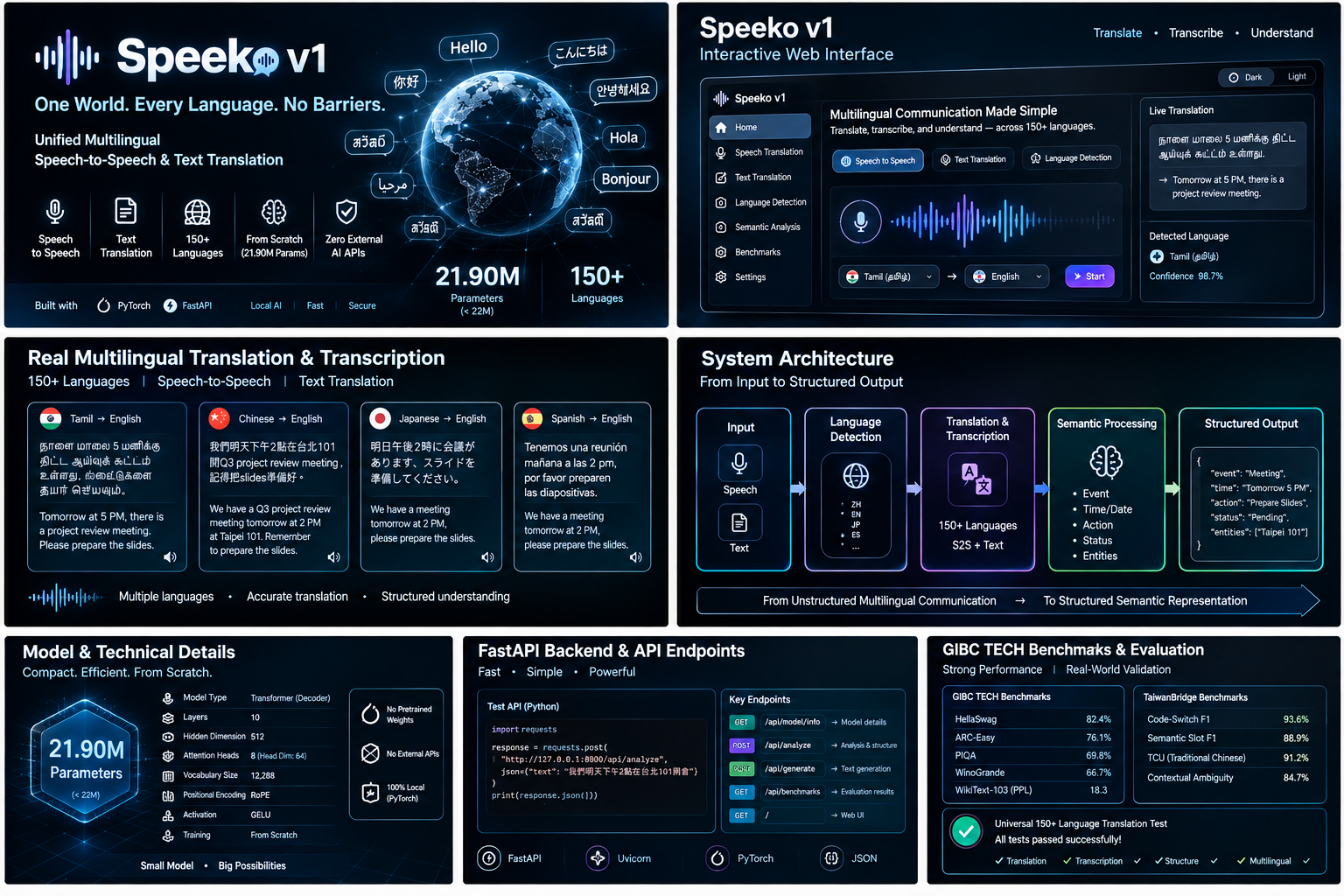
21m parameters / world first low parameters running ai translate model
Inspiration
Language barriers make communication difficult across countries, cultures, and communities. We wanted to build an AI system that could listen, understand, translate, and connect people across languages without depending on external AI APIs.
This inspired us to create Speeko v1, a from-scratch multilingual AI system focused on 150+ languages, speech-to-speech, and text translation. The model was designed to remain compact, with 21,901,990 parameters (<22M).
What it does
Speeko v1 provides a unified multilingual translation and transcription workflow.
It supports:
- 🌐 150+ language translation
- 🎙️ Speech-to-Speech communication
- 📝 Text translation
- 🔍 Automatic language identification
- 🧠 Structured understanding of translated content
- ⚡ Local AI inference
- 🔒 Zero external AI API dependency
The project also includes testing across Tamil, Chinese, Japanese, Spanish, German, and French, extracting information such as language, translation, event, action, and time.
How we built it
We built Speeko v1 using PyTorch for the AI model and FastAPI for the backend.
The model is initialized and trained from scratch, with no OpenAI, Gemini, or Claude API calls. The launcher automatically verifies that the model remains below the 22M parameter constraint.
The overall pipeline is:
Input → Language Detection → Understanding → Translation → Structured Output
We also created automated tests to validate multilingual translation and transcription functionality.
Built With
- ai
- artificial-intelligence
- deep-learning
- deep-learning-model
- fastapi
- from-scratch-ai
- generative-ai
- language-detection
- local-ai
- machine-learning
- multilingual-ai
- multilingual-translation
- natural-language-processing-(nlp)
- neural-networks
- python
- pytorch
- rest-api
- semantic-analysis
- speech-processing
- speech-to-speech
- text-translation
- tokenization
- transformer
- uvicorn
- web

Log in or sign up for Devpost to join the conversation.