-
-
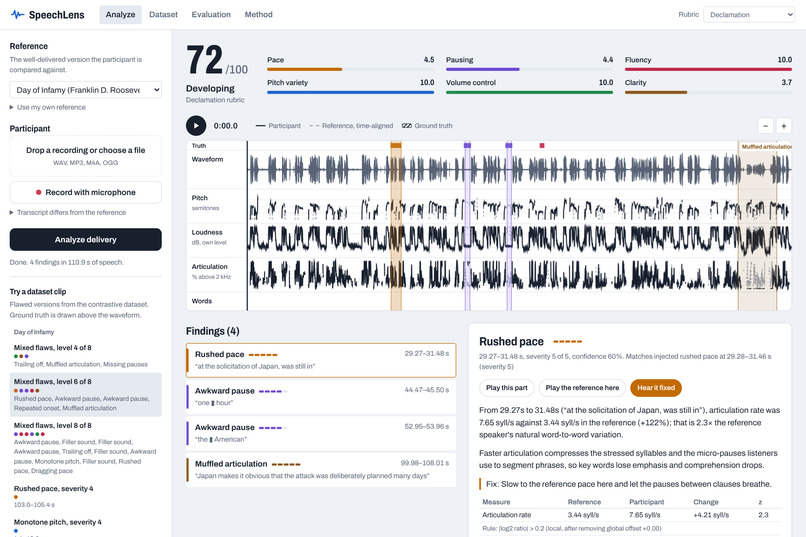
a full analysis with findings and the numbers behind one
-
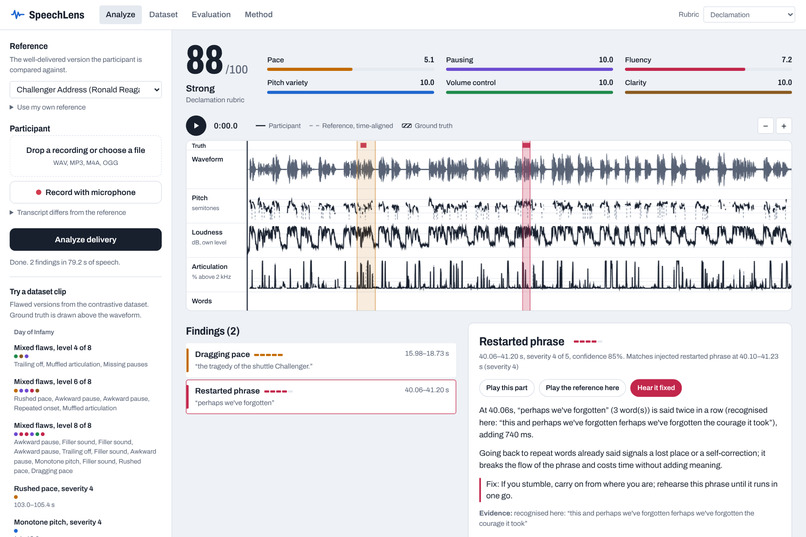
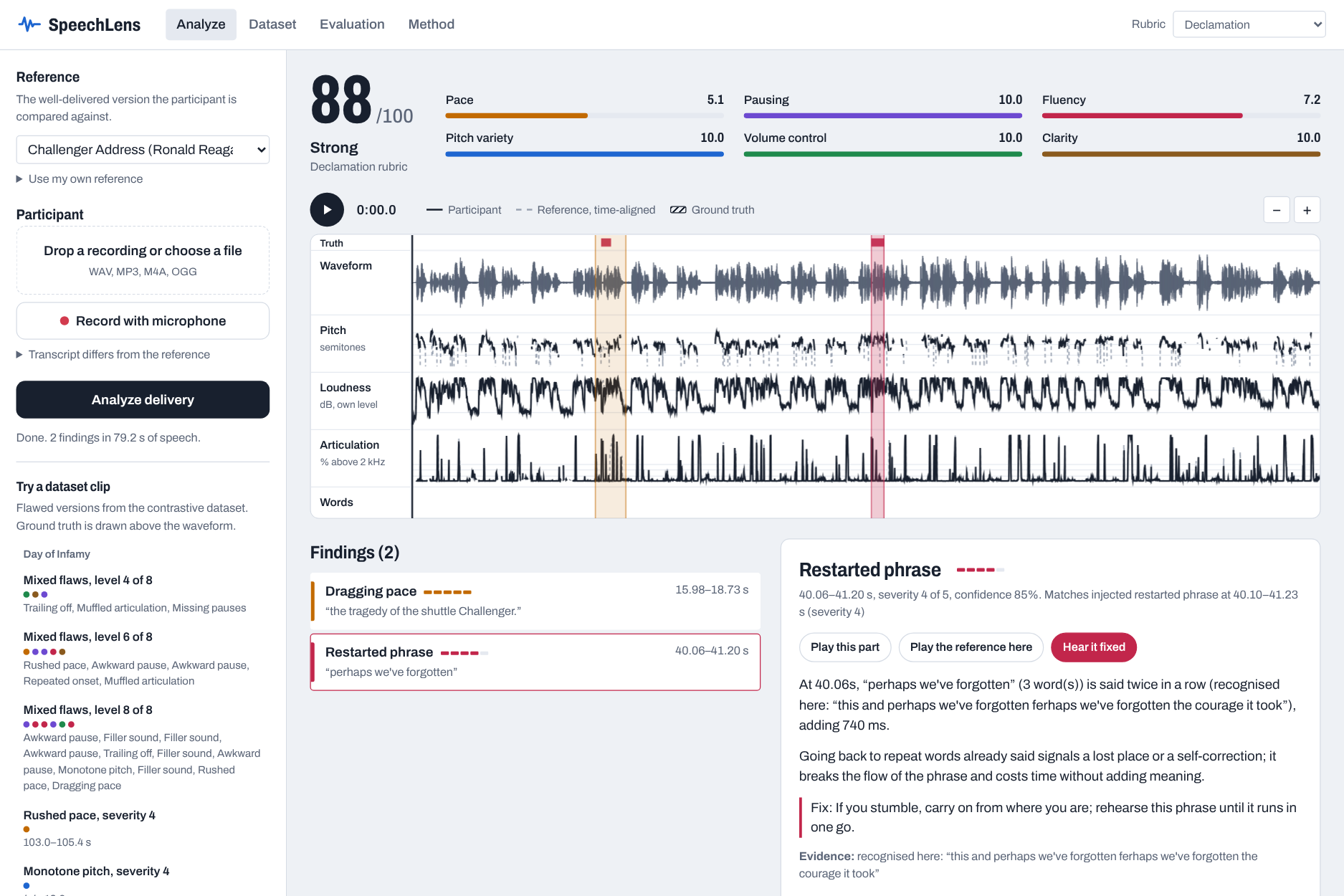
a restarted phrase caught, with what the recogniser heard
-
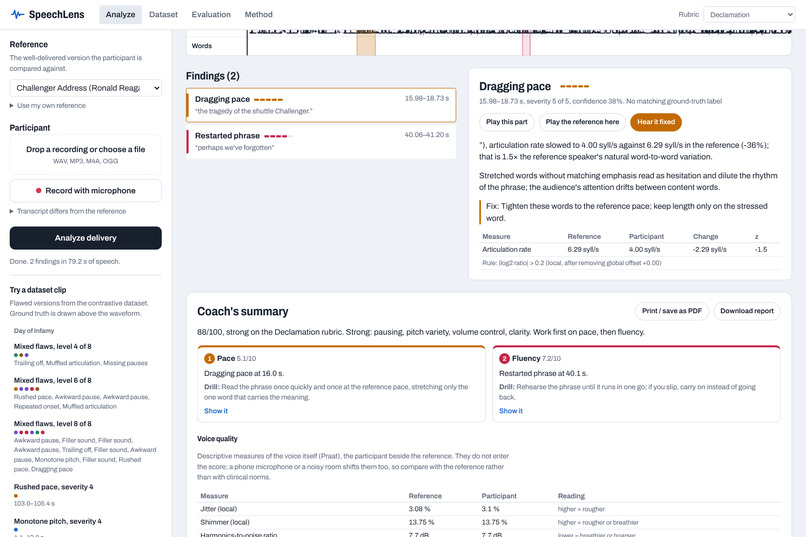
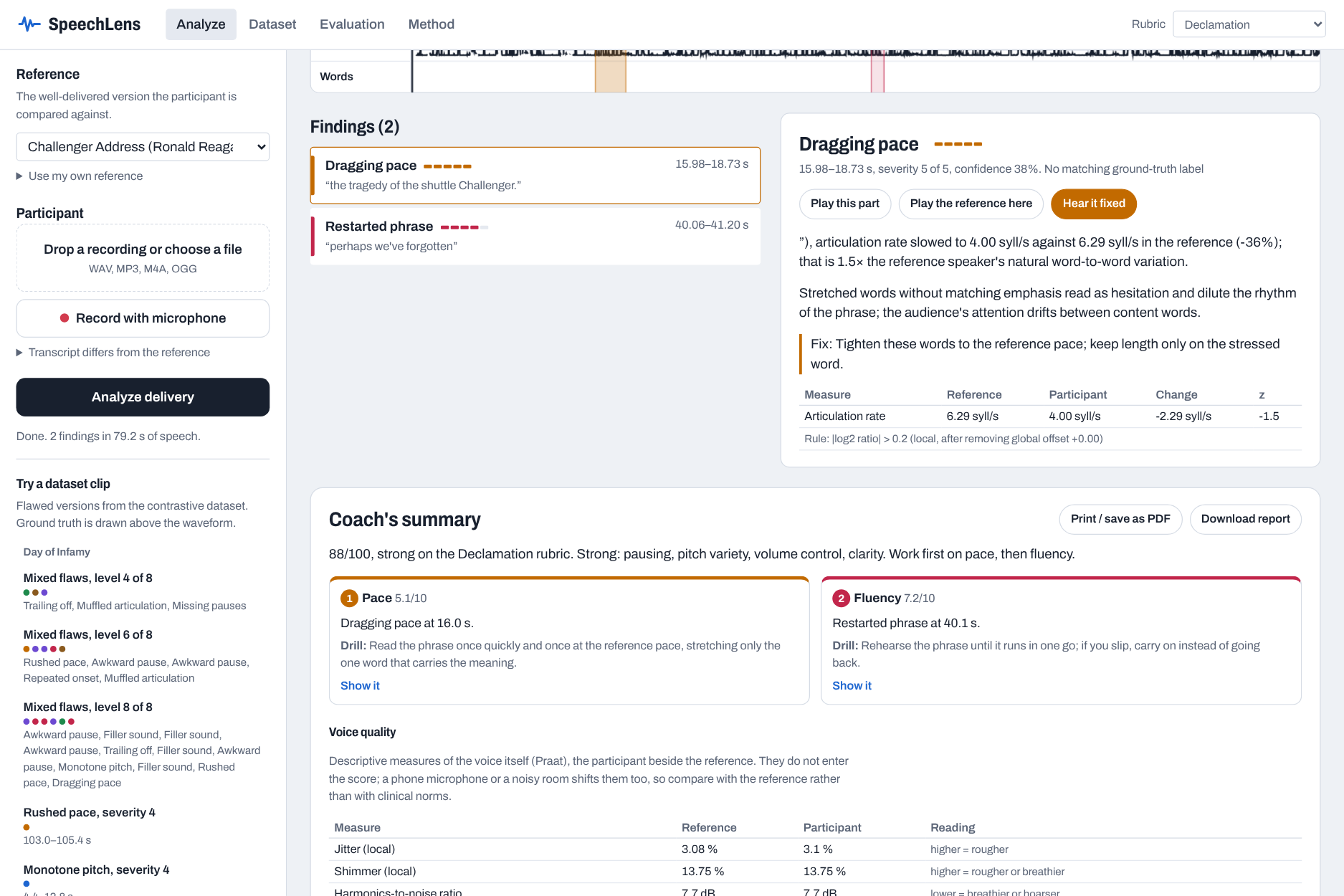
the coach’s summary with drills
-
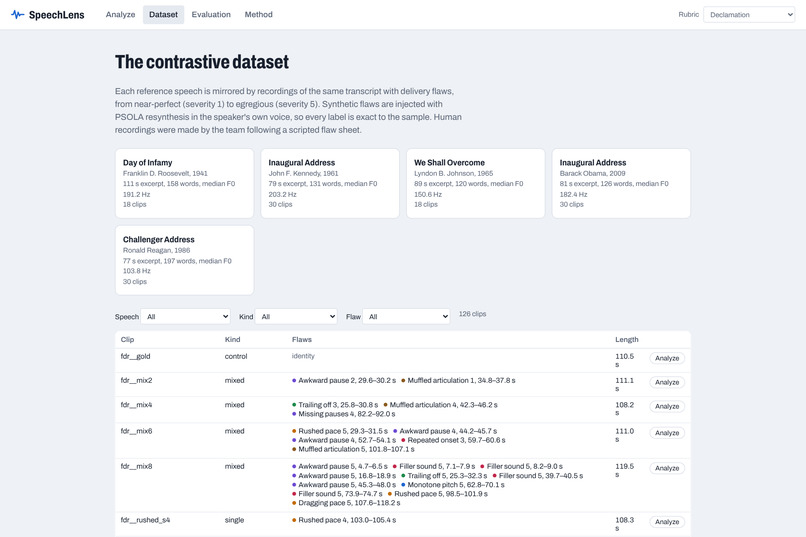
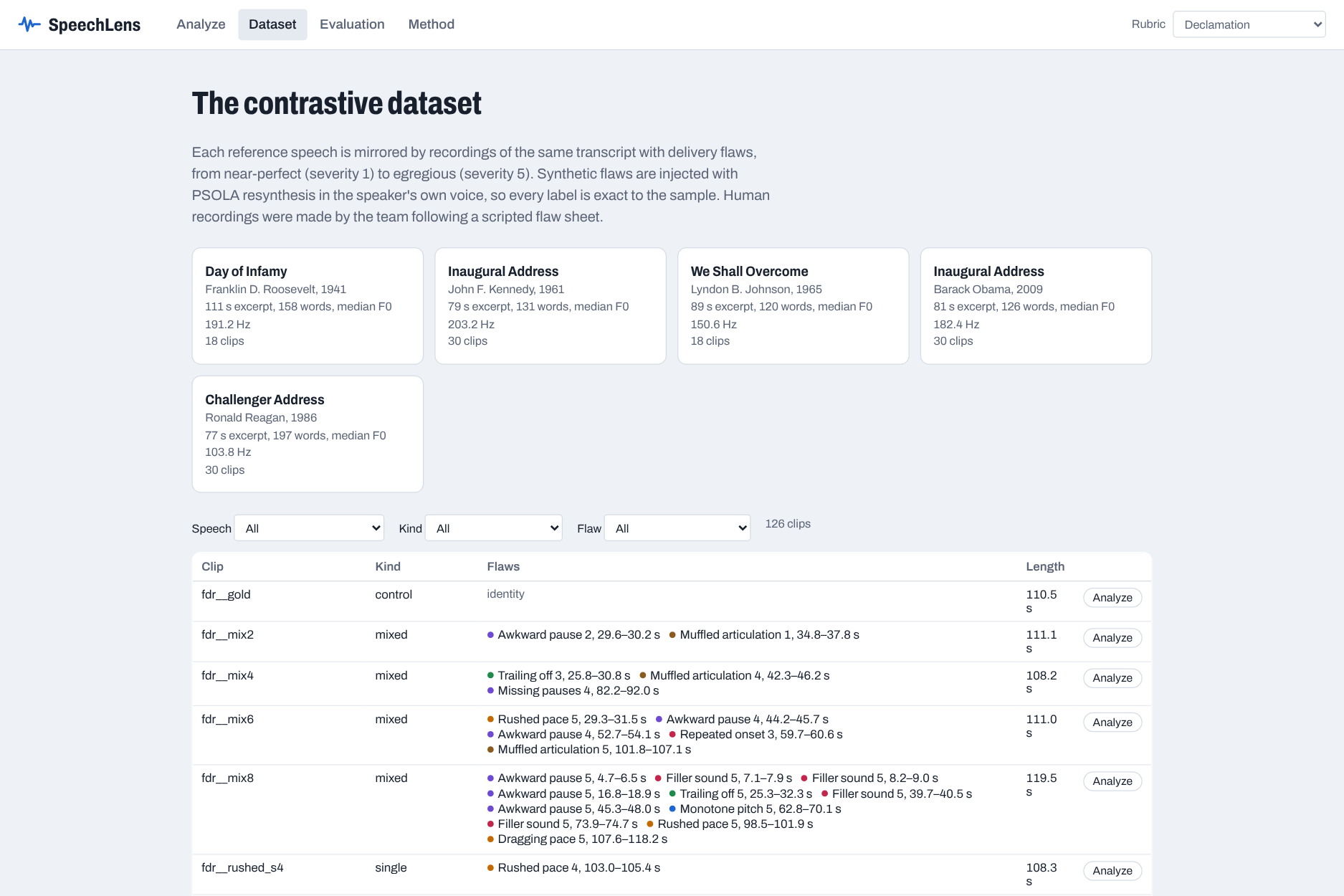
the dataset page
-
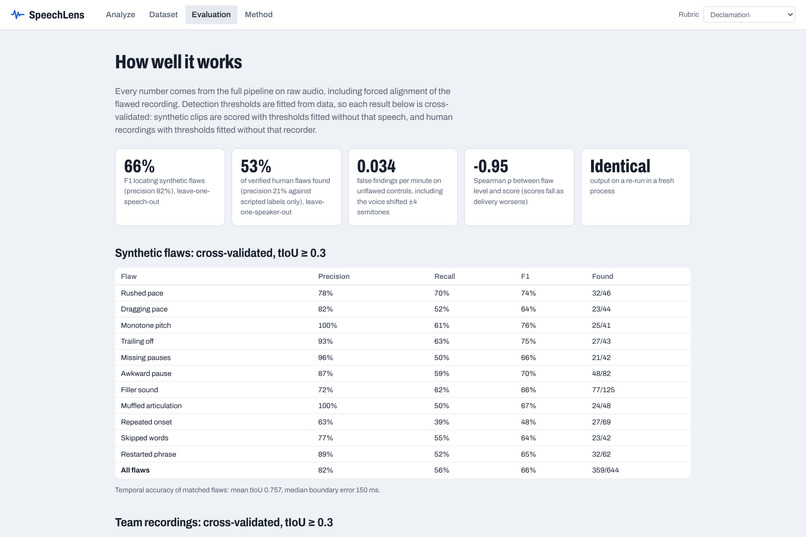
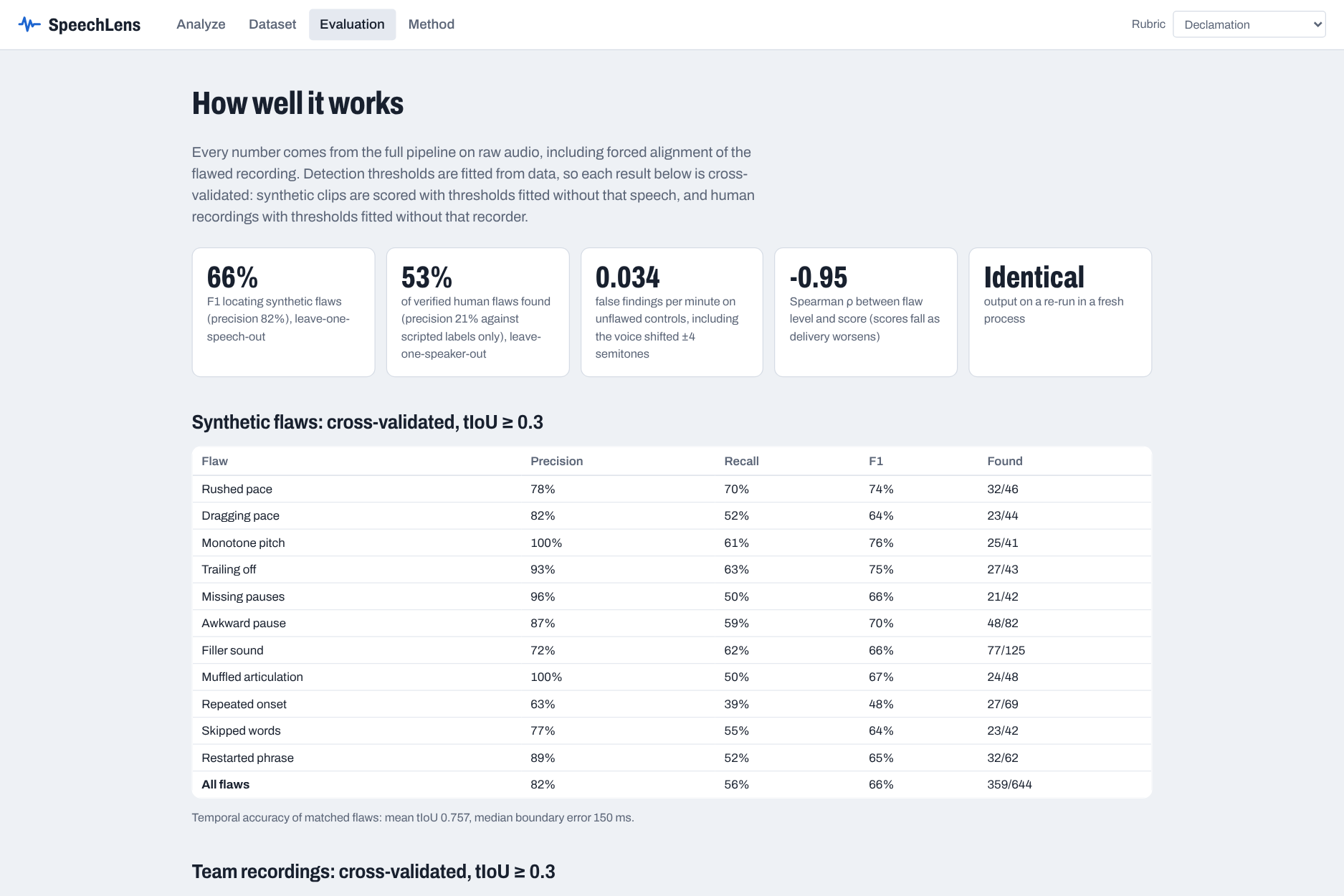
the evaluation results
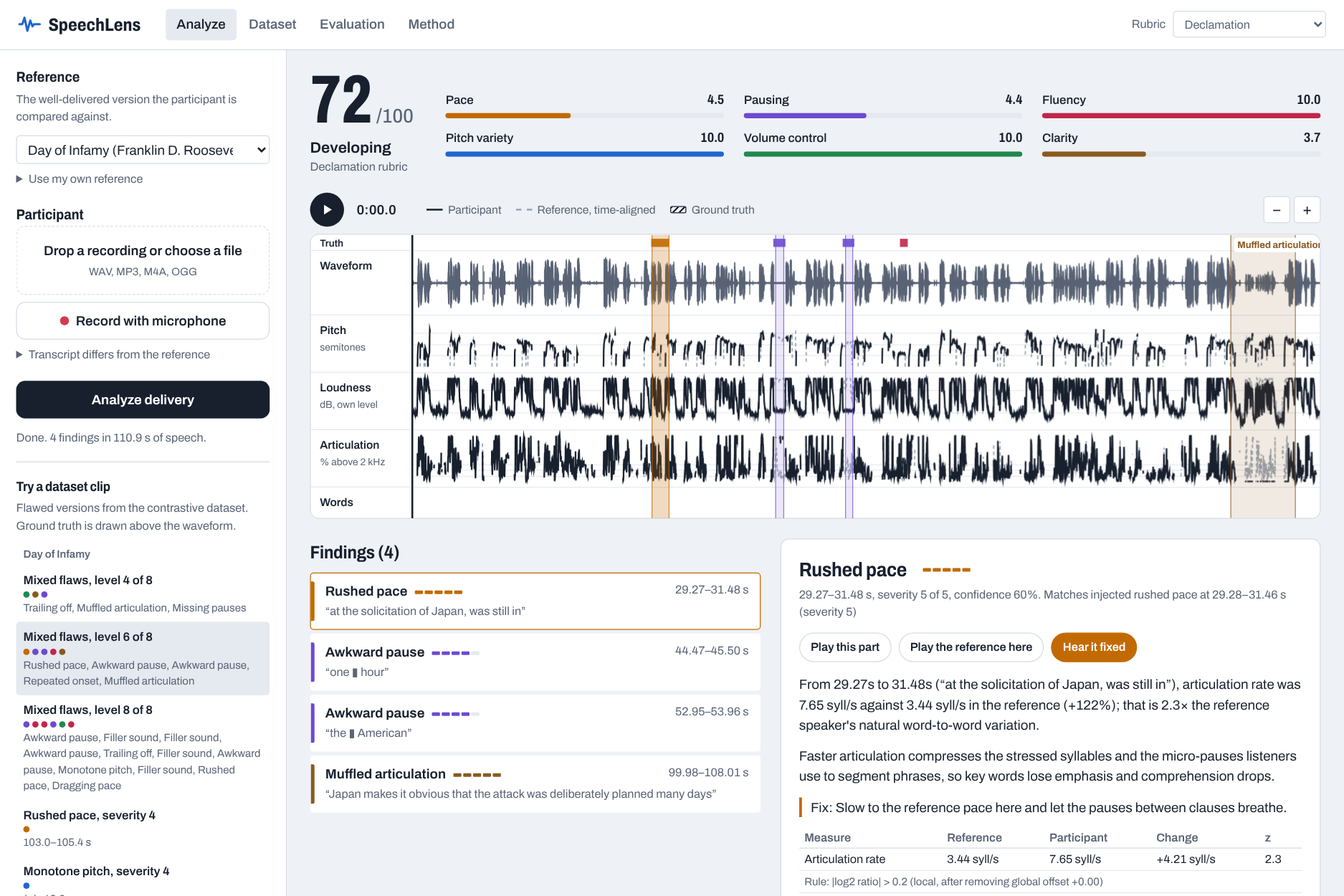
Hear exactly where a delivery goes wrong, why, and what it sounds like fixed.
Track C: Contrastive Speech Analytics & Temporal Flaw Grounding · Live demo · Code · Dataset
Inspiration
Every elocution or debate judge has said "work on your pacing" to a speaker, and every speaker has wondered where. Delivery feedback is subjective, late and vague, while the thing being judged, a voice reading a known text, is measurable. We wanted a system that listens like a coach who holds the reference recording in their head: it compares the two readings word by word and points at the exact second the delivery departs from it.
What it does
SpeechLens compares a participant's reading with a well-delivered reference reading of the same text.
- It aligns both readings word by word and measures pace, pauses, pitch, loudness, articulation and fluency on the same scale for any voice.
- It marks 11 kinds of delivery flaw with exact start and end times: rushed, dragging, monotone, trailing off, missing pauses, awkward pauses, fillers, muffled articulation, repeated onsets, and two reading errors, skipped words and restarted phrases.
- Every finding comes with the numbers behind it ("articulation 7.1 syll/s against 5.1 in the reference, +40 %, 1.6× the reference speaker's natural variation"), why it hurts the delivery, and a fix. No language model writes these, so the same audio always gives the same result.
- Hear it fixed: for any finding, SpeechLens plays the participant's own voice with only the named cause corrected. That is also how we prove the explanations are causal (see below).
- Practice this part: record a retake of one passage and get before/after numbers against the same reference.
- A coach's summary with priorities and drills, a voice-quality profile (jitter, shimmer, HNR, CPPS), a progress chart across takes, a printable report, four competition rubrics (Declamation, Interpretive Reading, Extemporaneous, Persuasive Oratory), microphone recording, and a warning when the recording is too noisy to trust.
How we built it
- Dataset. No public dataset pairs good and bad deliveries of identical text with time-exact labels, so we built one. Five public-domain presidential speeches are the gold standard. A Flaw Injection Engine edits them with Praat PSOLA in the speaker's own voice. 350 synthetic clips cover 11 flaw types × 5 severities, mixed-flaw gradients and unflawed controls (voice shifted ±4 semitones, 12 dB quieter), and every label is exact to the sample. Three of us also recorded 36 takes with scripted flaws.
- Pipeline. wav2vec2 CTC forced alignment (ONNX, exact Viterbi, CPU only) → speaker-normalised features on a 10 ms grid (Praat F0, intensity, HNR, STFT band energies, MFCC) → word-paired contrast that separates the speaker's overall habit from local deviations, scored against the reference speaker's own variability → data-fitted significance gates → template explanations → rubric score.
- Reading errors. A skipped word leaves the aligner squeezing letters into a few frames with near-zero confidence. A restart adds speech at one boundary. A short recognition pass over just that neighbourhood confirms each one and becomes the evidence shown to the user ("recognised here: to our secretary to our secretary of state").
- Stack. Python, FastAPI, numpy/scipy, Parselmouth (Praat), librosa, onnxruntime, and a no-build vanilla-JS dashboard with canvas timelines. Dashboard on GitHub Pages; live uploads analysed by the same pipeline in a Docker container on Azure Container Apps (image built by GitHub Actions). Runs locally with one command or Docker.
How we know it works
Every number runs the full pipeline on raw audio, and thresholds are cross-validated (leave-one-speech-out / leave-one-speaker-out).
- Locating synthetic flaws (11 types): F1 0.66 (95 % CI 0.62–0.70), precision 0.82; median boundary error 150 ms.
- Unflawed speech, even with the voice shifted four semitones: 0.03 false findings per minute.
- Score falls steadily with flaw level: Spearman ρ = −0.95; severity within one level 93 % of the time.
- Why the reference matters: the same detector without a reference reaches F1 0.07, and only 0.14 even with thresholds tuned on the test answers.
- Counterfactual test: repairing only the named cause makes the finding disappear in 91 % of cases, so the explanations name real causes.
- New voices: on 20 unseen LibriSpeech readers, 10 women and 10 men, with every threshold frozen: F1 0.85 (women 0.86, men 0.85).
- Feature evidence: each flaw is carried by exactly the signal its explanation names (e.g. muffled speech by high-frequency energy, Cohen's d = −5.1).
- Stress test: robust to MP3 compression, telephone audio, ±10 % tempo and moderate echo. Background noise is the honest weakness, so the app measures it, compensates partly and warns.
- Real people: on our own recordings it finds 53 % of verified performed flaws. A manipulation check and a blind listening audit show most "extra" findings are real slips (estimated precision ~0.80).
- Byte-identical results on every rerun; 25 unit tests and CI.
Challenges we ran into
- Natural take-to-take variation: a person never reads the same sentence twice at the same pace. We fitted per-type significance gates on data and cross-validated them, which doubled precision on human recordings.
- Phone recordings: automatic gain control erased our scripted fades, and "mumbles" were whispered instead. We added a manipulation check so we only score flaws that were really performed.
- Making the injection deterministic: Praat's overlap-add draws random numbers, so we seed its generator per call to make rebuilds bit-identical.
- Background noise breaks contrastive comparison. We found it with our own stress test, tried channel matching, and chose to warn honestly where the fix is partial.
Accomplishments that we're proud of
- An explanation you can listen to: "Hear it fixed" turns every claim into a testable intervention, and the test passes in 91 % of cases.
- A labelled contrastive dataset with exact ground truth, a datasheet, and a one-command rebuild.
- A system that runs on a laptop CPU with no cloud API and no language model, yet catches reading errors with readable evidence.
What we learned
Contrast is the signal: the same measurements without a reference are close to useless. And the evaluation design (controls, ablations, interventions, stress, listening audits) taught us more about the system than any single accuracy number.
What's next
Accent-diverse and spontaneous-speech evaluation, noise-robust features, more languages through multilingual alignment models, and a mobile practice app for speech coaches.

Log in or sign up for Devpost to join the conversation.