-
-
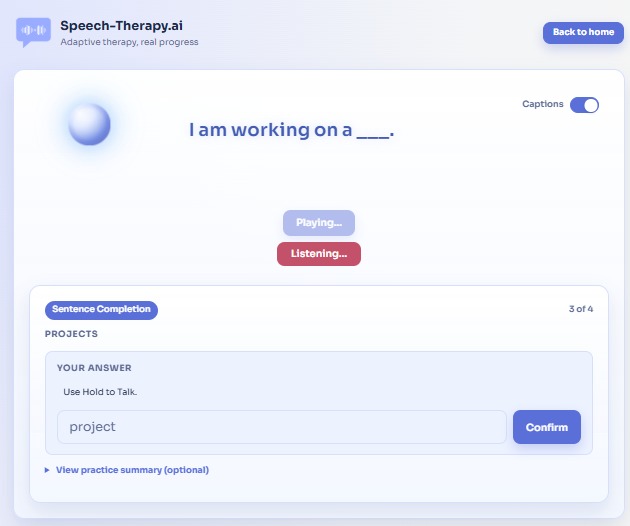
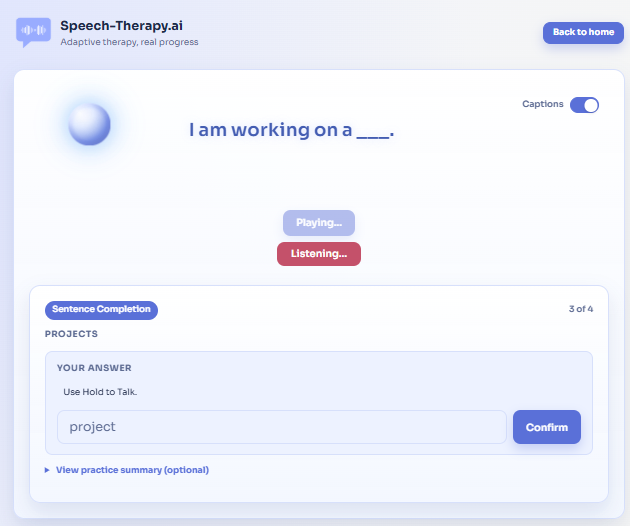
Sentence Completion Questions
-
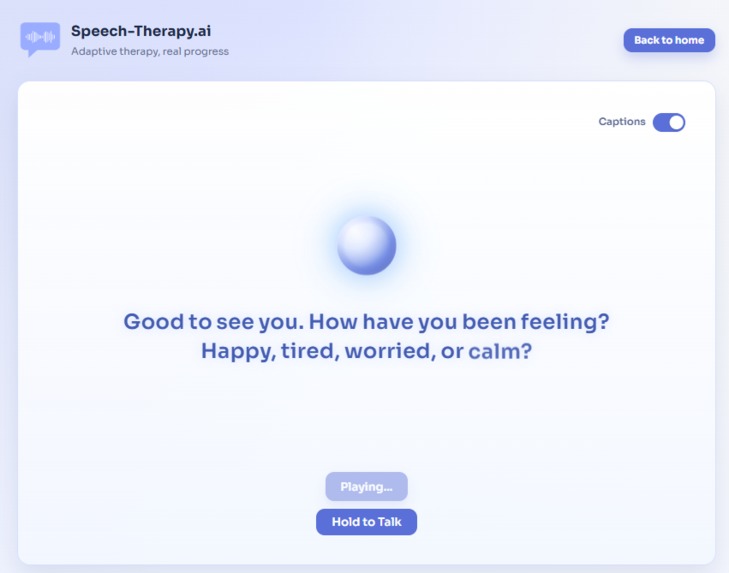
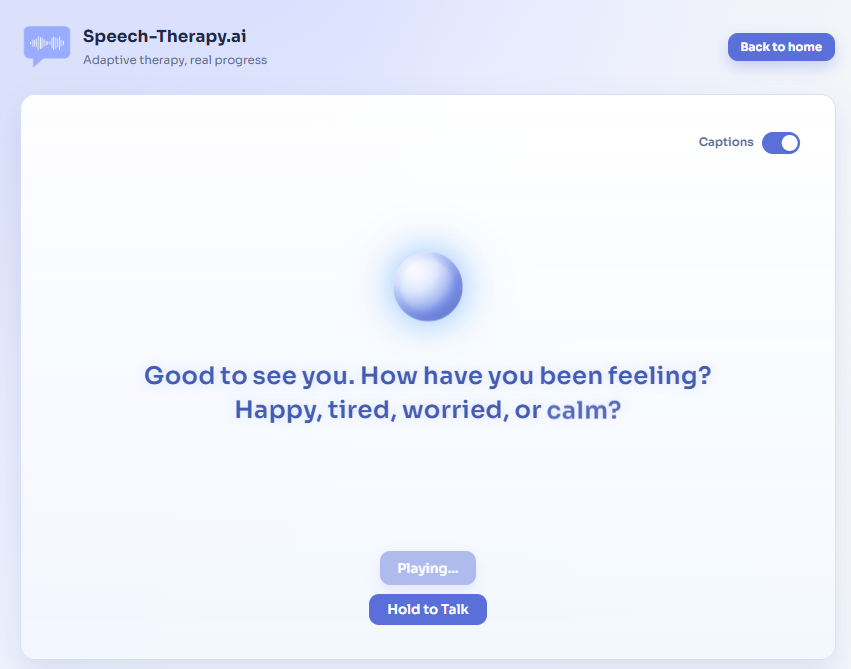
Check-In Session Agent
-
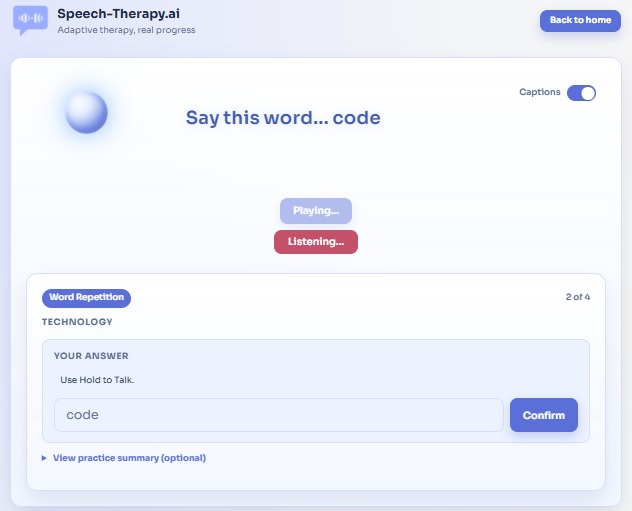
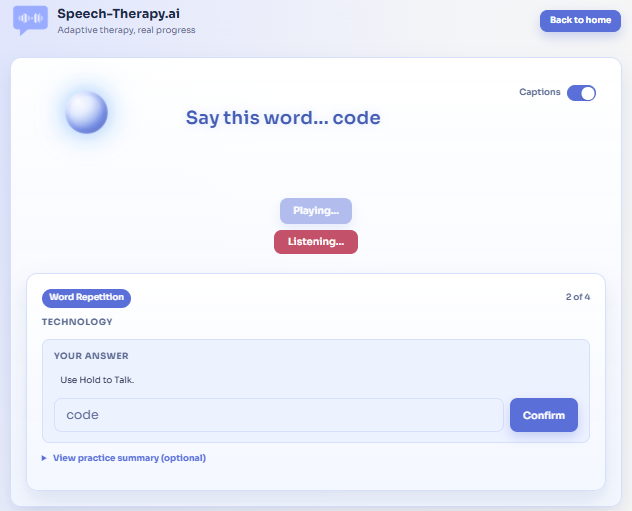
Word Repetition Questions
-
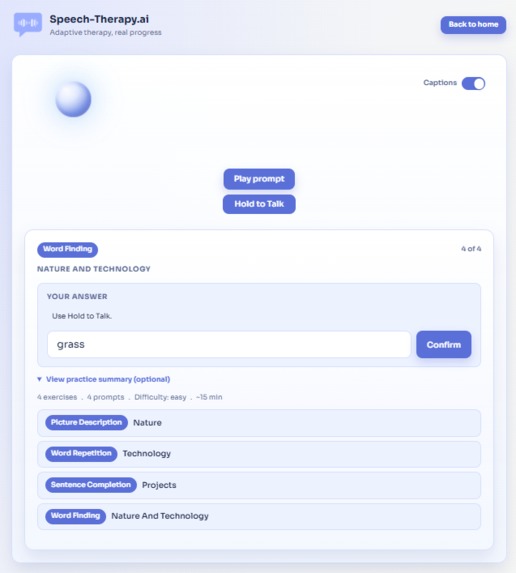
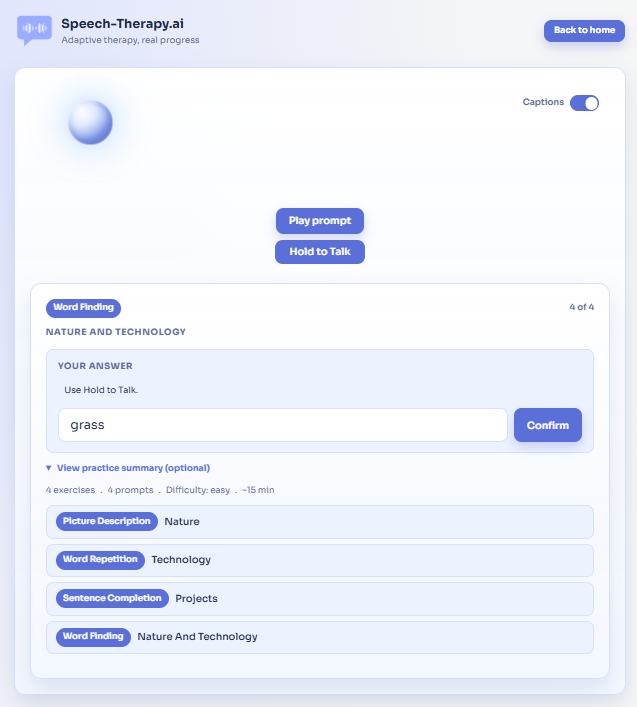
Word Finding Questions
-
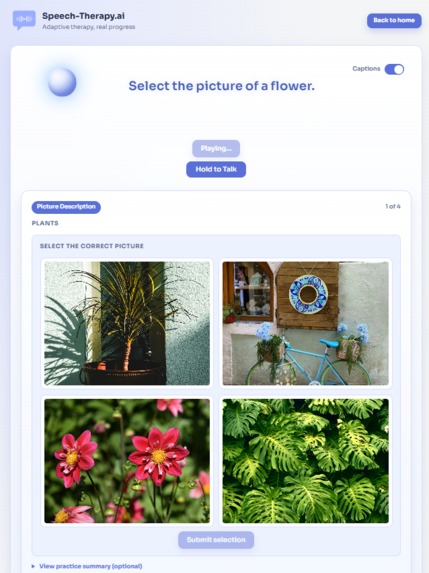
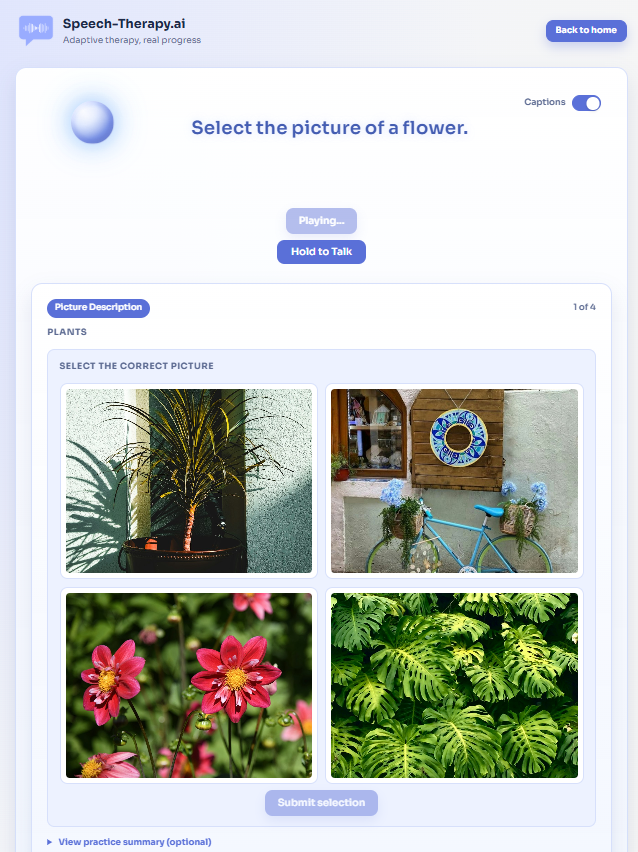
Picture Description Questions
-
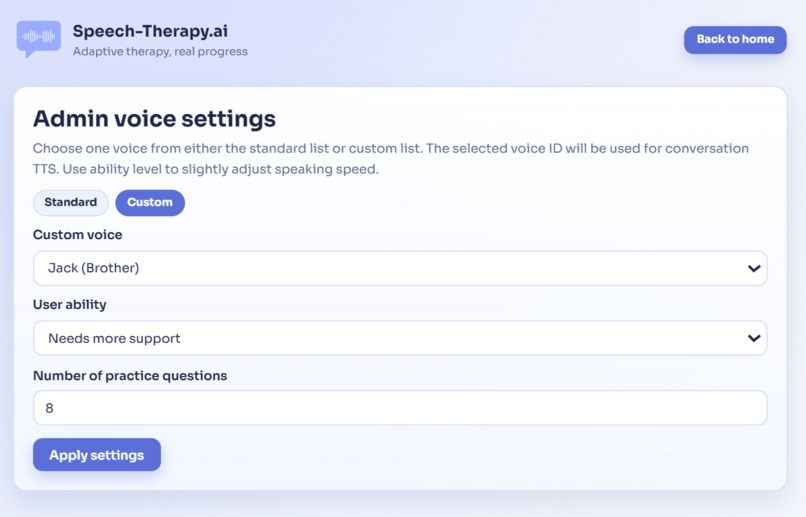
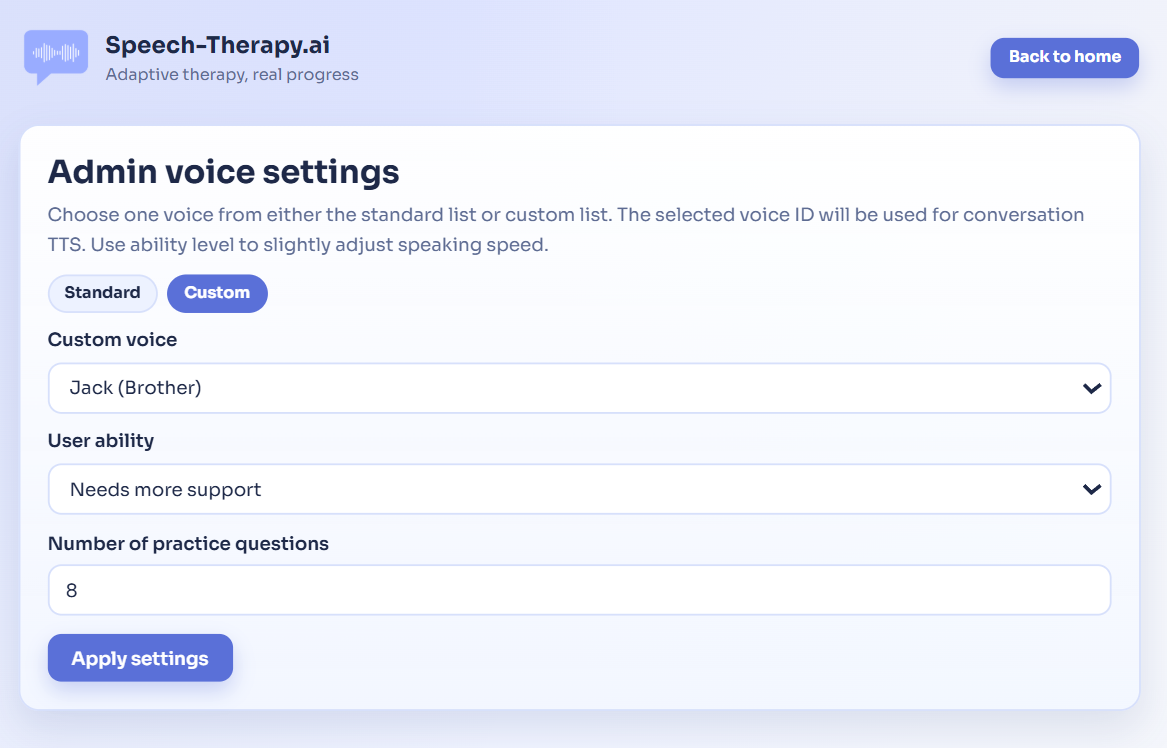
Admin Voice Settings
-
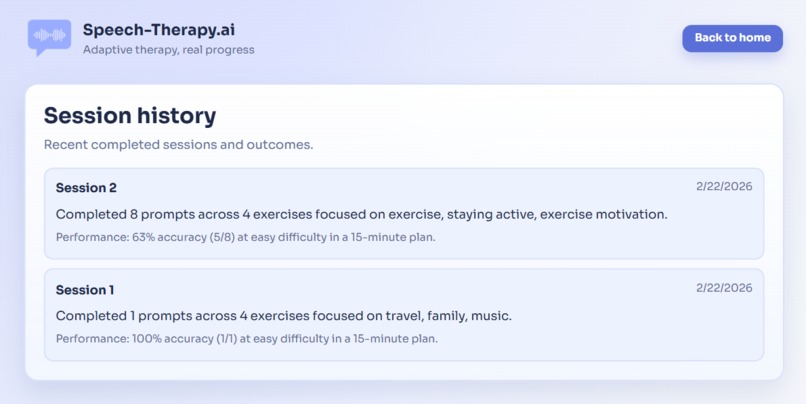
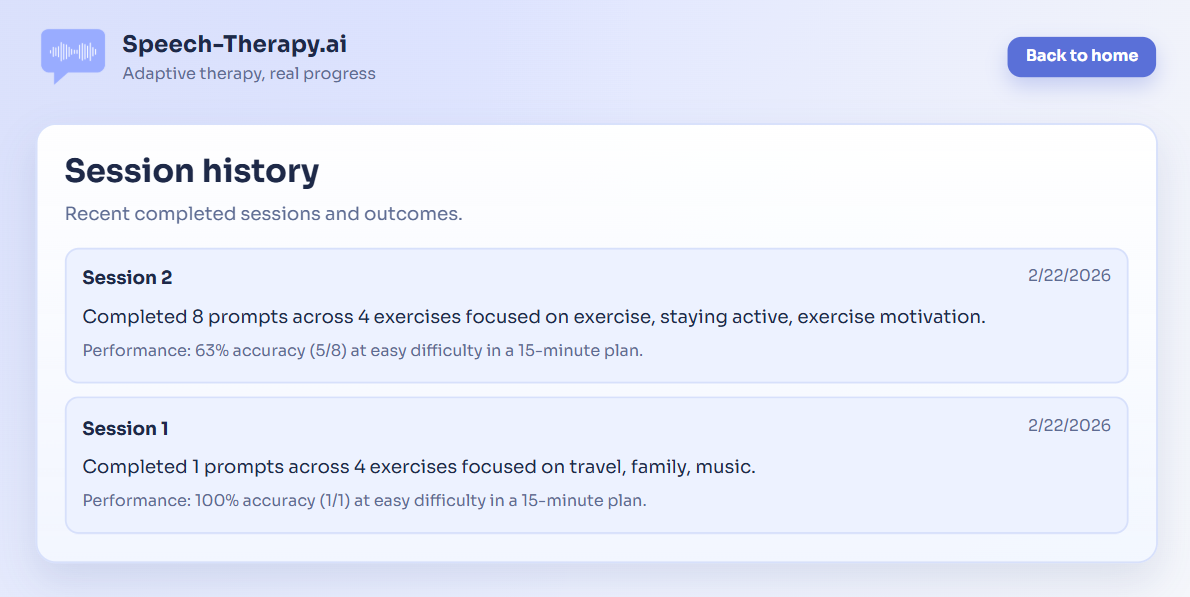
Session History
Inspiration
Having seen firsthand the challenges of stroke recovery, a member of our team knows all too well the shortcomings of today’s computer aided speech and language therapy. Existing apps have become a cornerstone of care, giving patients the independence to practise in their own time. However, they do not adjust to what individuals need to recover their ability to communicate in their daily lives. With modern AI, therapy can be tailored to the individual, with exercises that reflect their lives in content and delivery in a familiar voice.
With this as motivation, we built Speech-Therapy.ai to use modern AI for personalised therapy, offering exercises tailored to the individual’s goals and delivered in a familiar, natural voice that can be customised to reflect a particular accent or even adopt the voice of a family member.
What it does
Speech-Therapy.ai runs an AI-guided check-in conversation, then generates a personalized speech and language practice session. It supports multimodal therapy tasks (including picture-based prompts), voice interaction, and adaptive difficulty, with prompts spoken in regionally appropriate voices.
How we built it
We built Speech-Therapy.ai as a TypeScript + React web app with a TypeScript/Express backend.
- Claude powers the check-in agent, plan generation, and semantic answer evaluation.
- ElevenLabs provides high-quality text-to-speech with configurable voice options.
- Google Cloud Speech-to-Text REST API powers speech transcription for user responses.
- Unsplash (with Wikipedia fallback) provides image options for picture-description tasks.
- A therapy engine manages session flow, scoring, and feedback across question types.
- Session summaries/history are stored in a lightweight local JSON store for MVP iteration. This architecture lets us deliver a personalized, voice-first, and visually supported therapy experience.
Technologies Used (Full Stack)
- Languages: TypeScript, JavaScript
- Frontend: React, Vite, Vitest, Testing Library
- Backend: Node.js, Express
- AI/LLM: Anthropic Claude (agent/check-in, plan generation, answer evaluation)
- Voice: ElevenLabs Text-to-Speech API
- Speech Recognition: Google Cloud Speech-to-Text REST API
- Images: Unsplash API
- Storage: In-memory session store + file-based JSON persistence for practice history
Challenges we ran into
The biggest challenge was parallel development by four engineers in a fast-moving codebase. We resolved (pardon the pun) this with tighter branch discipline, clearer ownership, and explicit merge sequencing. In instances of conflicts we used coding agents to clean up the mess.
We also spent significant time iterating prompts to achieve the right therapeutic tone, structure, and tool-calling behavior from Claude.
Accomplishments that we're proud of
We’re especially proud that we integrated voice cloning under tight hackathon timelines, allowing stroke patient family members to clone their voice so that stroke patients can go through the rehabilitation program by learning their loved ones’ voices. More broadly, we built an MVP with real potential to help stroke survivors practice communication in a way that feels personal, practical, and dignified.
What we learned
We were all astonished by how much we achieved in the time frame. We’ll take it as a lesson in what’s possible when we stay focused and work well in a team. From talking to the very impressive builders and enthusiastic startup founders around us at this incredible event, we have learnt that by believing in an idea and persevering with it you can take something from a sketch to an MVP to eventually a business.
What's next for Speech-Therapy.ai
With more refinement and guardrails we will have an app ready to test with real patients. We will build relationships and in turn gain the trust of speech and language therapists in Ireland and the UK, from which they will feel confident in recommending our product. We will also contact researchers in stroke rehabilitation to run rigorous academic evaluations and build a strong evidence base. That clinical backing will give patients, clinicians, and healthcare providers the confidence to adopt our application, helping us to earn trust quickly and scale globally.
Built With
- claude-agent-api
- css
- elevenlabs-tts-api
- google-cloud-speech-to-text-api
- javascript
- node.js
- react
- typescript
- unsplash-search-api
- vite
- vitest
- wikimedia-image-api

Log in or sign up for Devpost to join the conversation.