-
-
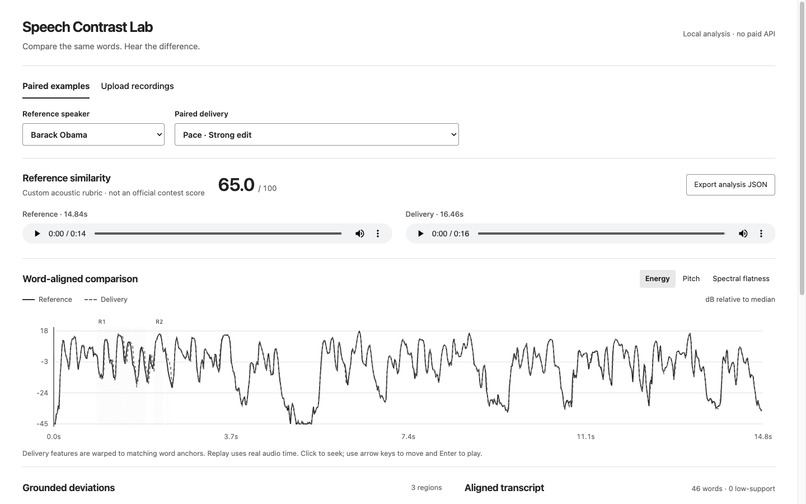
Paired recordings, reference similarity and word-aligned acoustic evidence.
-
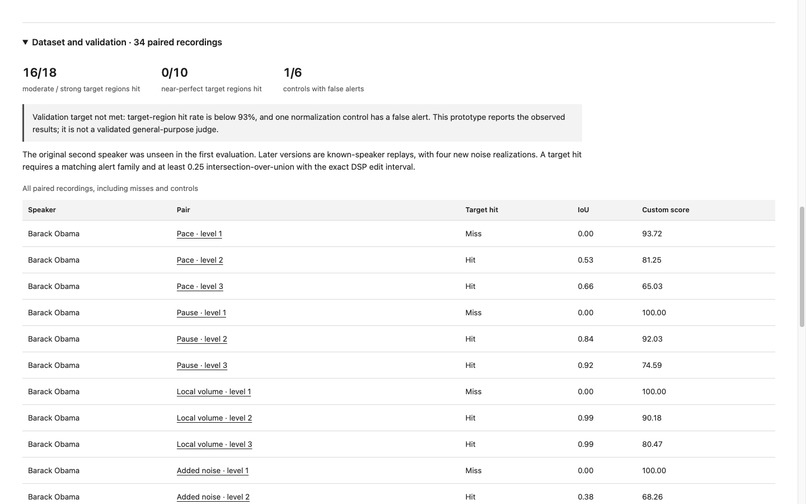
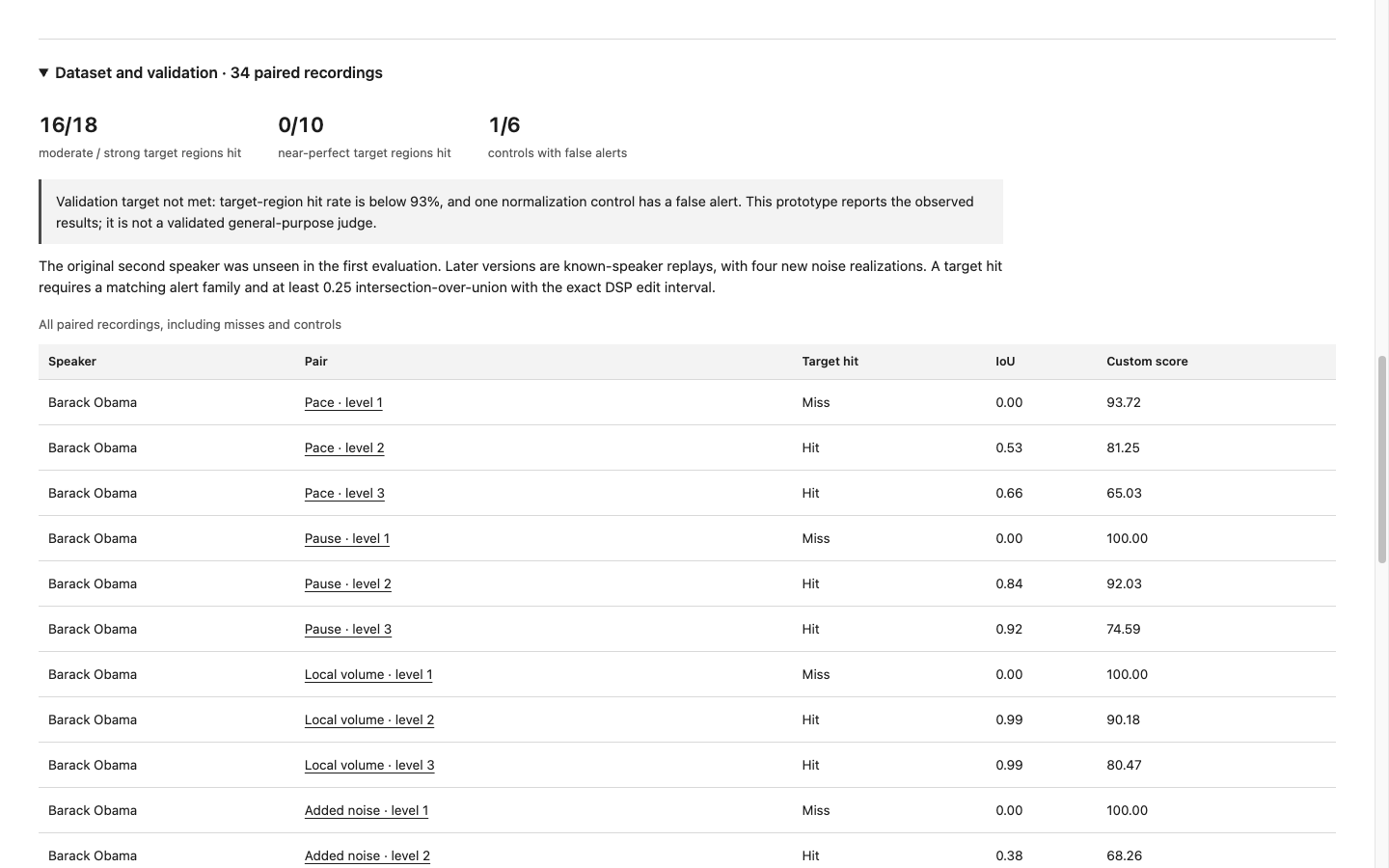
All 34 examples remain available, including the failed v2 gate.
-
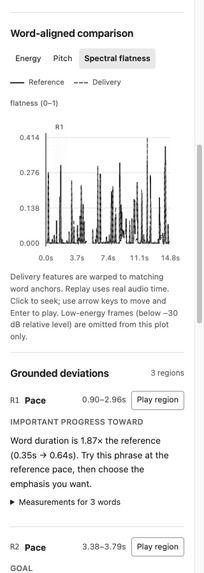
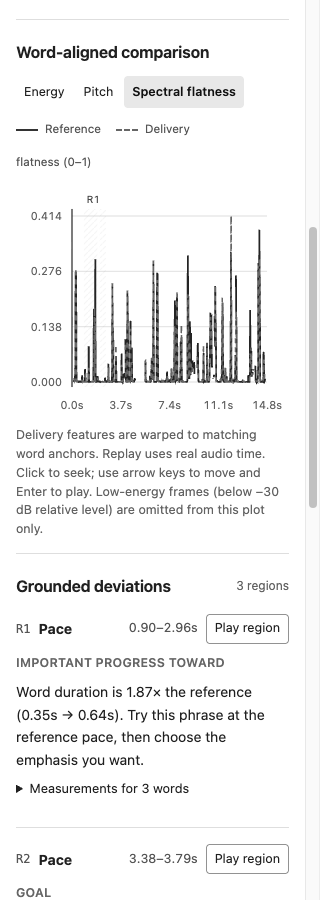
The word-aligned acoustic chart at a 320-pixel viewport.
Speech feedback often points to a whole performance: too slow, too quiet, too many pauses. Speech Contrast Lab makes a narrower claim. It compares two recordings of the same text, shows where their acoustics differ, and lets the speaker hear the interval behind each alert.
The dataset starts with short, public-domain weekly addresses by Barack Obama and Joe Biden. Local tempo changes, inserted silence, volume dips and added noise produce three edit levels per family. Unchanged audio, global-volume and global-pitch controls test whether normalization prevents obvious false alarms. There are 34 pairs, with transcripts, waveform hashes, edit intervals and frozen word-alignment estimates included in the repository.
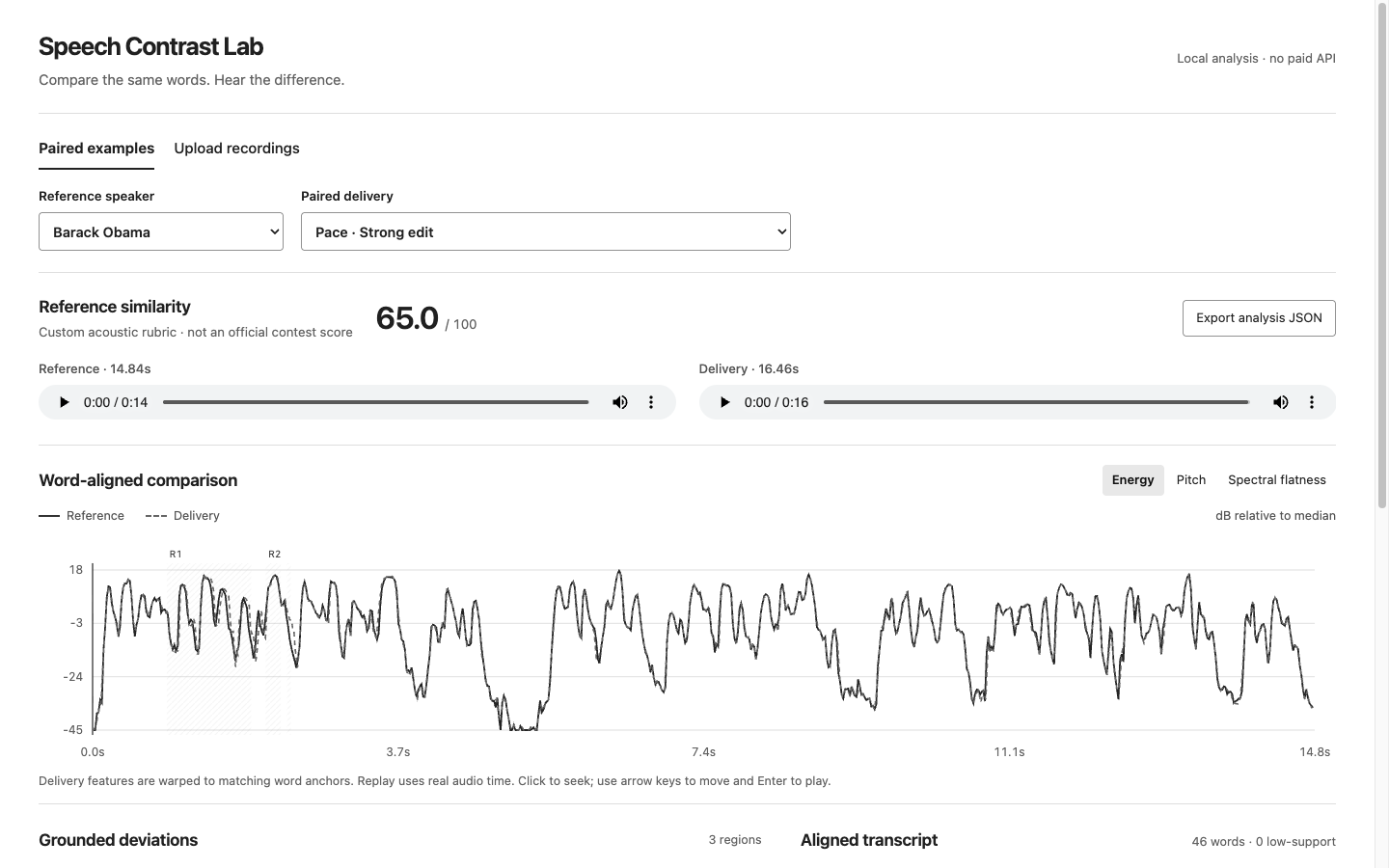
The dashboard accepts two audio files and a shared English transcript. Frozen Whisper checks the words before wav2vec2 CTC alignment estimates their times. FFT, MFCCs, autocorrelation pitch, relative energy, durations and gaps feed a fixed four-part rubric. Every alert contains a numerical explanation, word context and a button that replays the actual delivery interval. No audio goes to a hosted model service.
An early identical-audio false alarm exposed a crop/frame-origin mismatch. The reference fixture was repaired, and the original failure was preserved. The published v2 stress test located 16 of 18 moderate/strong target regions, missed all ten near-perfect targets, and raised one false alert among six controls. It failed the predeclared gate of at least 93% target hits and zero control false alerts. The interface shows the misses, controls and failed gate alongside the successful examples.
All 34 recorded analyses reproduce exactly from their frozen word times. That is a software-replay result, not evidence that the failed gate passed. Two speakers and synthetic edits also cannot establish broad rhetorical or cross-speaker validity. The score means acoustic similarity to the chosen reference, not persuasiveness or speaking ability.
The prototype runs locally with pinned dependencies, public model checkpoints and no paid API. The six-page report documents construction, equations, score weights and evaluation. The demo shows the source-to-pair process, contrasting edit levels, grounded playback, upload analysis and the known failure cases.
Materials
AI assistance
OpenAI Codex assisted with implementation, tests, documentation and demo assembly. The project uses frozen pretrained Whisper and wav2vec2 models; neither was trained or fine-tuned for this entry. Model times are identified as estimates, and failed validation results have not been removed.

Log in or sign up for Devpost to join the conversation.