-
-
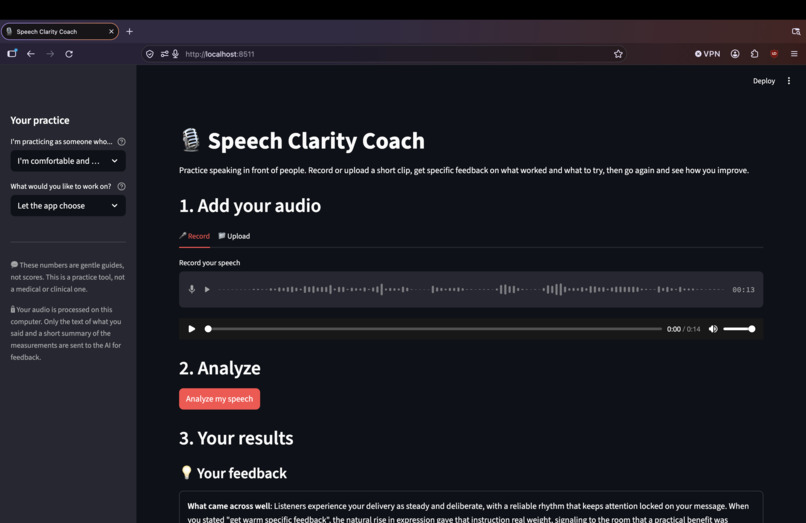
Website screenshot
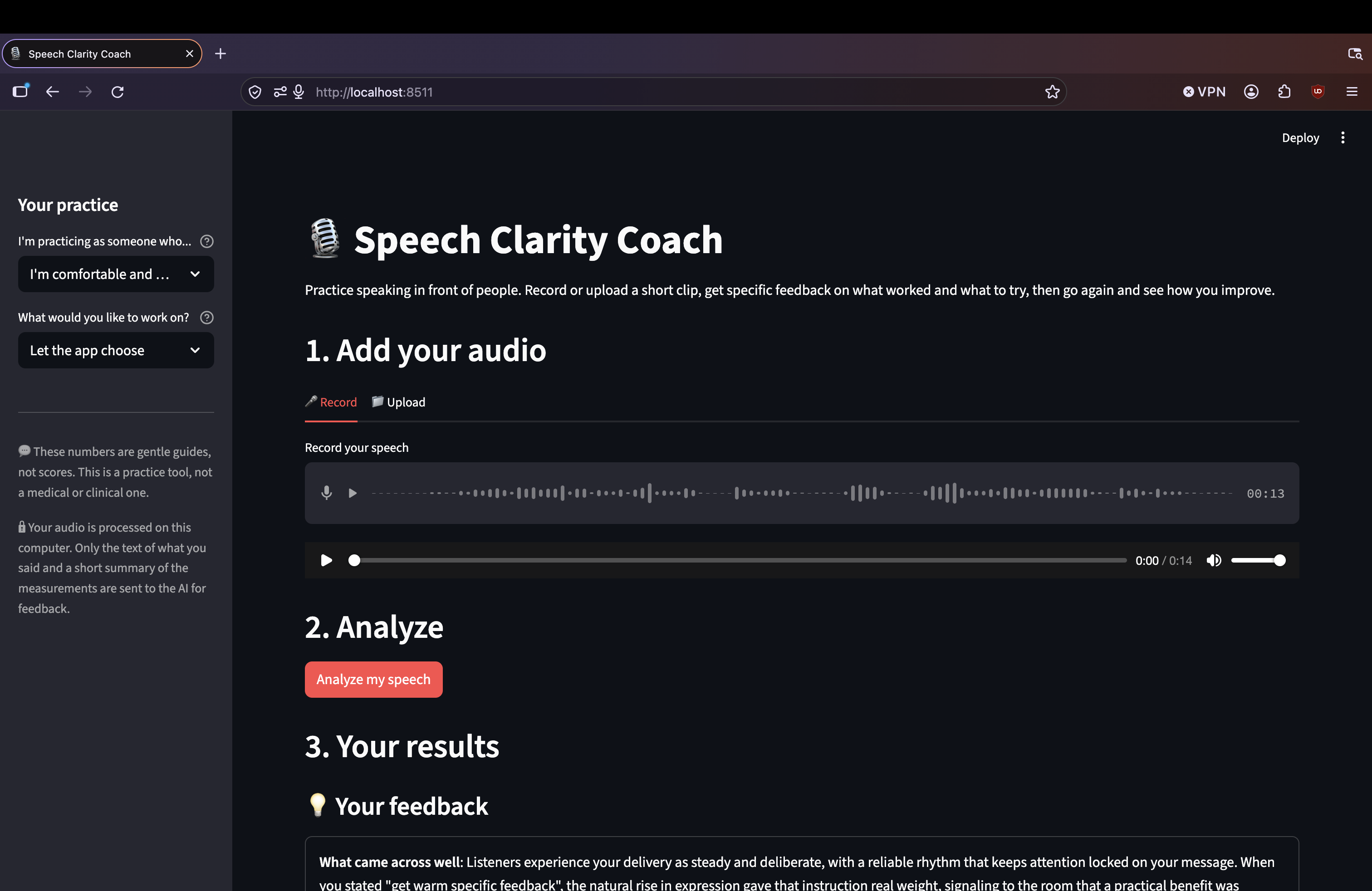
Speech Clarity Coach
What inspired us
We wanted to make it easier for people to practice speaking and get useful feedback without feeling judged. Whether you have social anxiety or get nervous while talking to other people or not. It can be hard to tell whether a talk is easy to follow when you’re the one delivering it. Speech Clarity Coach turns a short recording into a transcript, observations about delivery, and practical ideas to try next time.
We designed it as a practice aid, not a scorecard: the measurements are meant to prompt reflection, not judge someone’s voice or speaking ability.
How we built it
We built a browser-based app in Python with Streamlit. A user can record speech or upload an audio file, then review the transcript, feedback, and delivery measurements.
The analysis flow combines several pieces:
- Prepare and transcribe audio. FFmpeg converts audio to a consistent format, and the local
whisper-clitool transcribes it. - Measure delivery features. Librosa and NumPy help estimate pauses, pitch variation, and changes in volume.
- Choose a coaching focus. The app combines the transcript and audio measurements to describe areas such as pace, pauses, expression, volume, and wording. Users can choose their own focus or let the app select one.
- Generate feedback. Gemini turns those observations into plain-language suggestions, with different guidance for people who are nervous about speaking and those who want to refine their delivery.
- Support practice over time. Streamlit session state keeps results available across interactions, shows changes between attempts, and lets users download a report.
For example, the app distinguishes overall speaking rate from speaking rate while talking. The latter excludes estimated pauses:
$$ \text{speaking rate (WPM)} = \frac{\text{transcribed words}}{\text{recording duration} - \text{pause duration}} \times 60 $$
That distinction helps avoid treating deliberate pauses as if they necessarily mean someone is speaking too slowly.
What we learned
We learned that building a useful AI feature takes more than connecting a model to an interface. The surrounding workflow matters: preparing audio reliably, handling empty or inaccurate transcripts, explaining measurements clearly, and shaping feedback so it’s specific and supportive.
We also learned to be careful about what measurements imply. A number like pitch variation or speaking rate does not tell the whole story of a presentation. We treated measurements as rough signals to inform suggestions—not as definitive judgments—and made room for users to choose what they want to practice.
Challenges we faced
One challenge was making audio measurements useful across recordings that can differ in volume, background noise, and pauses. The project uses an adaptive loudness threshold to help identify pauses, and it ignores silence before the first and after the last stretch of speech. These are practical heuristics, though they can still be affected by recording conditions.
Another challenge was keeping the feedback consistent with the analysis. A suggestion to slow down would be unhelpful if the speaker was already speaking slowly, so the app chooses exercises based on the focus area and measured direction. We also added prompt guidance to keep recommendations constructive, avoid medical claims, and avoid treating accent or pronunciation as a problem.
Finally, the app brings together local tools and an external AI service, each with its own setup requirements. The prototype needs FFmpeg and whisper-cli for transcription, plus a Gemini API key for generated feedback. Making those pieces work together—and communicating their limitations and privacy implications—was an important part of the project.
Looking ahead
This hackathon prototype gave us a foundation to improve. Next, we’d like to add automated tests, make setup more reproducible, improve validation for missing tools and model files, and evaluate transcription and feedback quality across more recordings. We’d also like to keep refining how results are presented so people can use them to practice while retaining confidence in their own voice.


