-
-
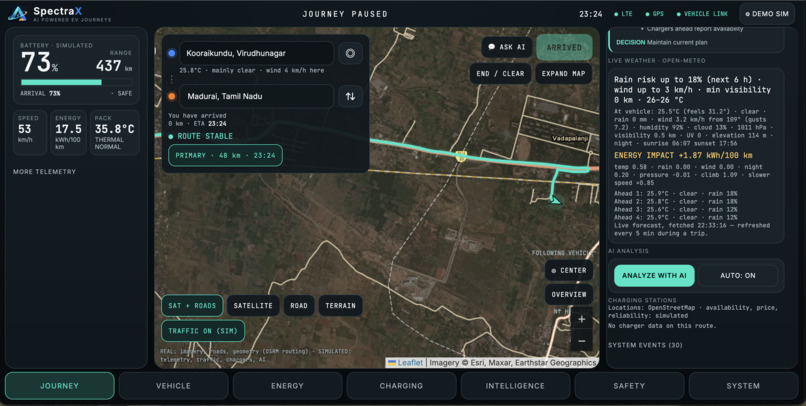
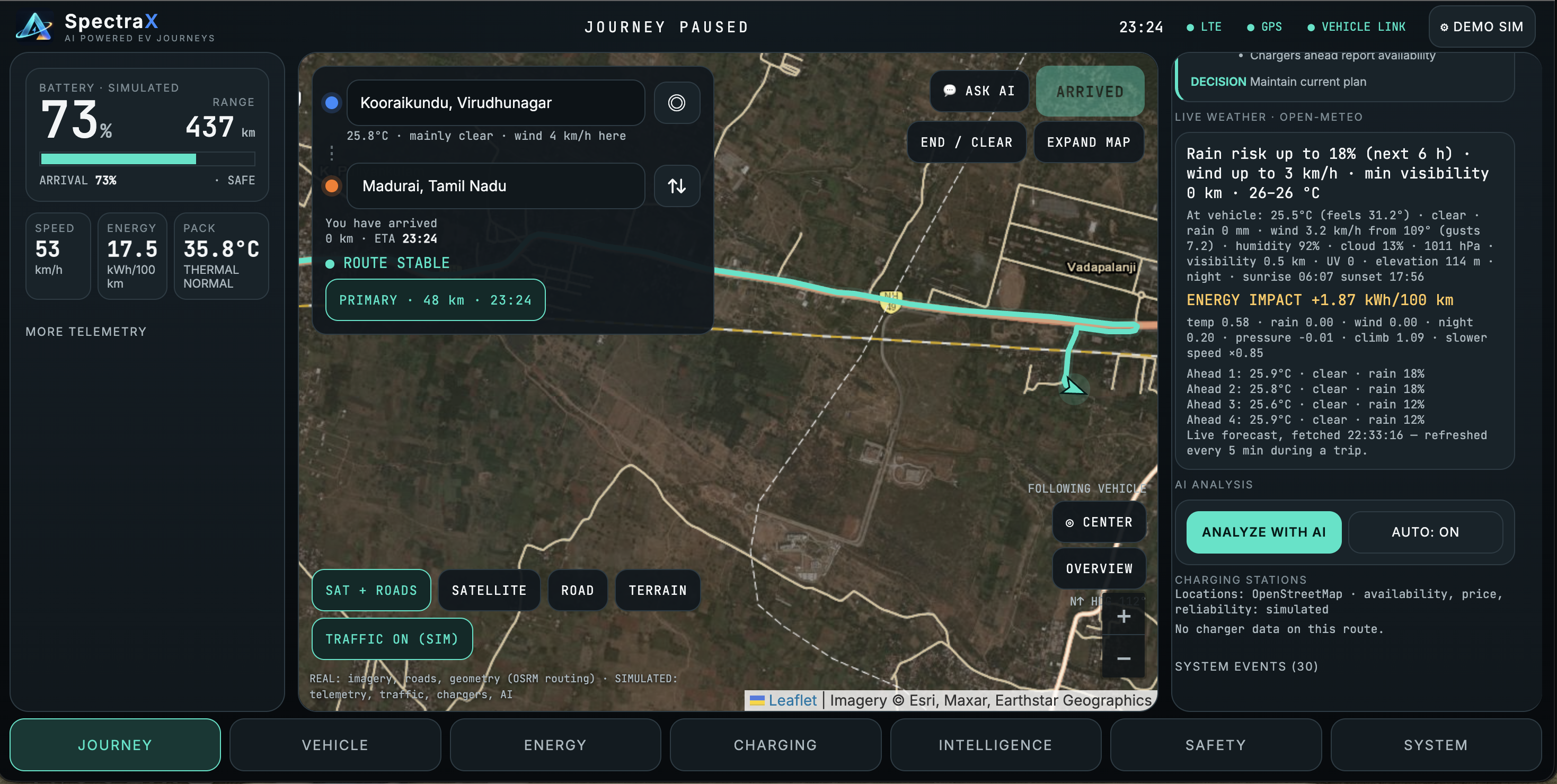
End journey
-
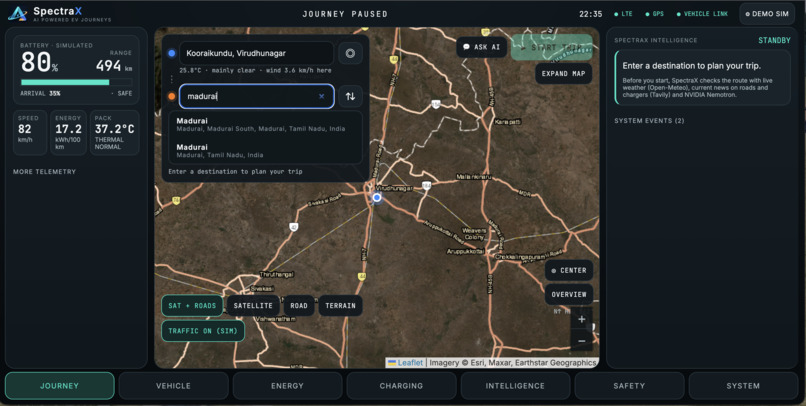
Start and end of trip declaration
-
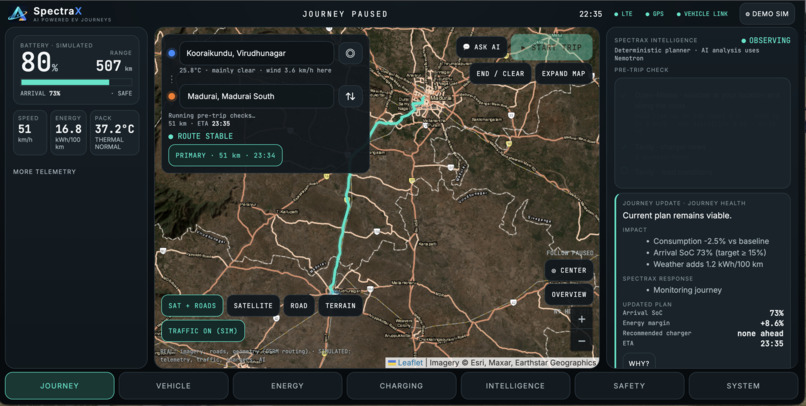
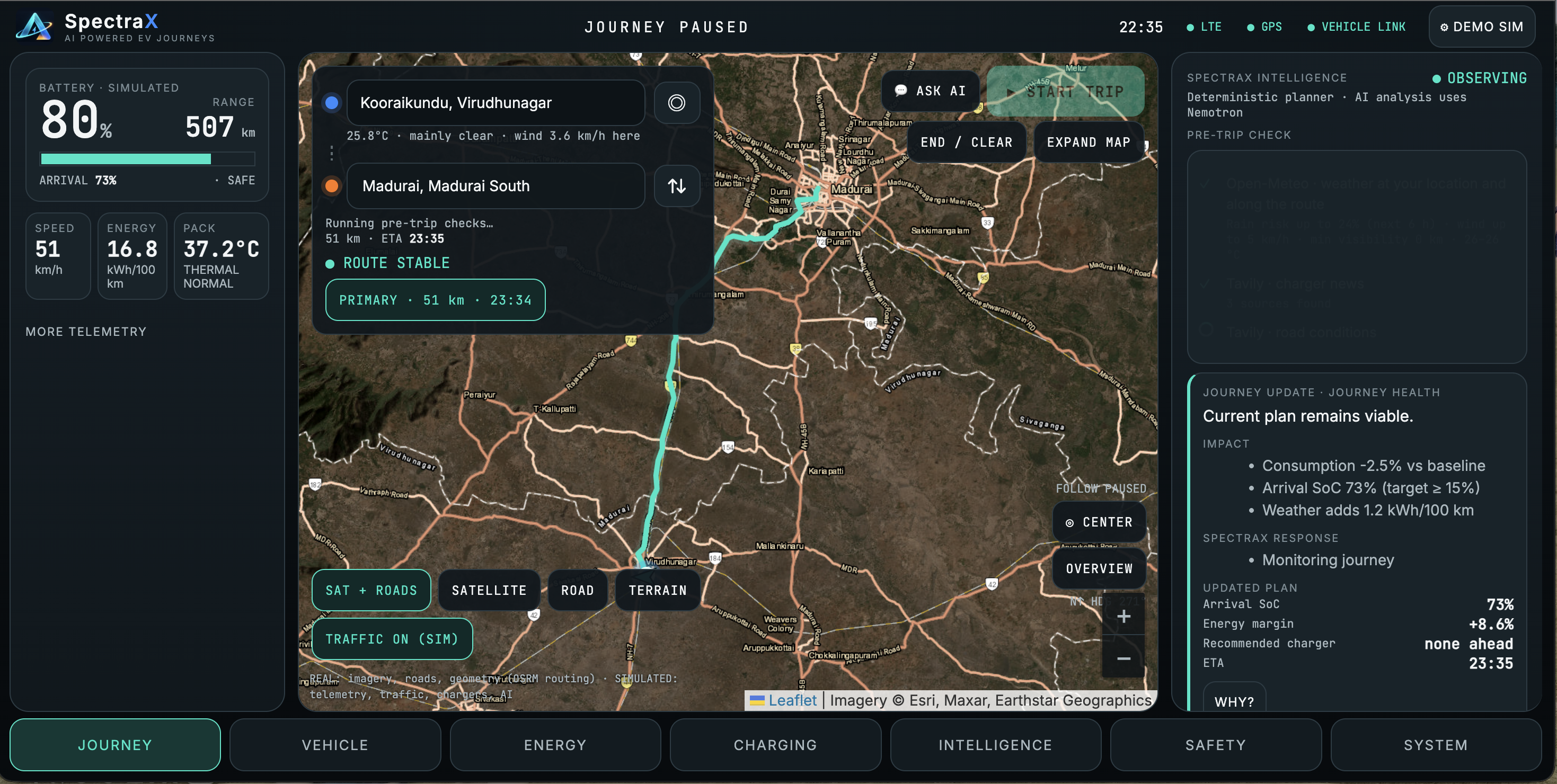
Nemotron working with Tavily and Open-meteo to design and plan the journey
-
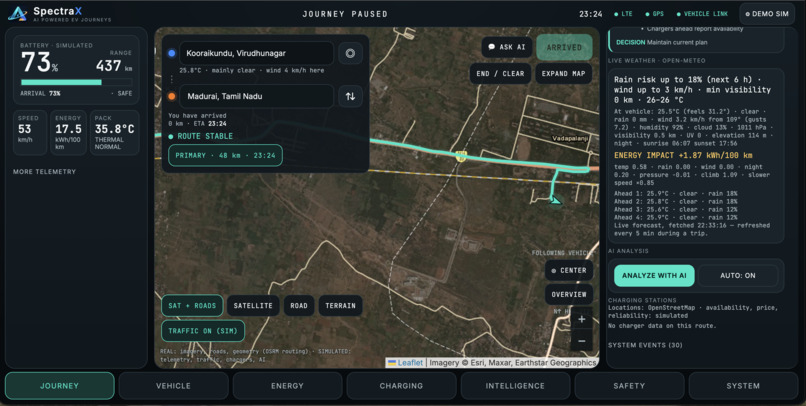
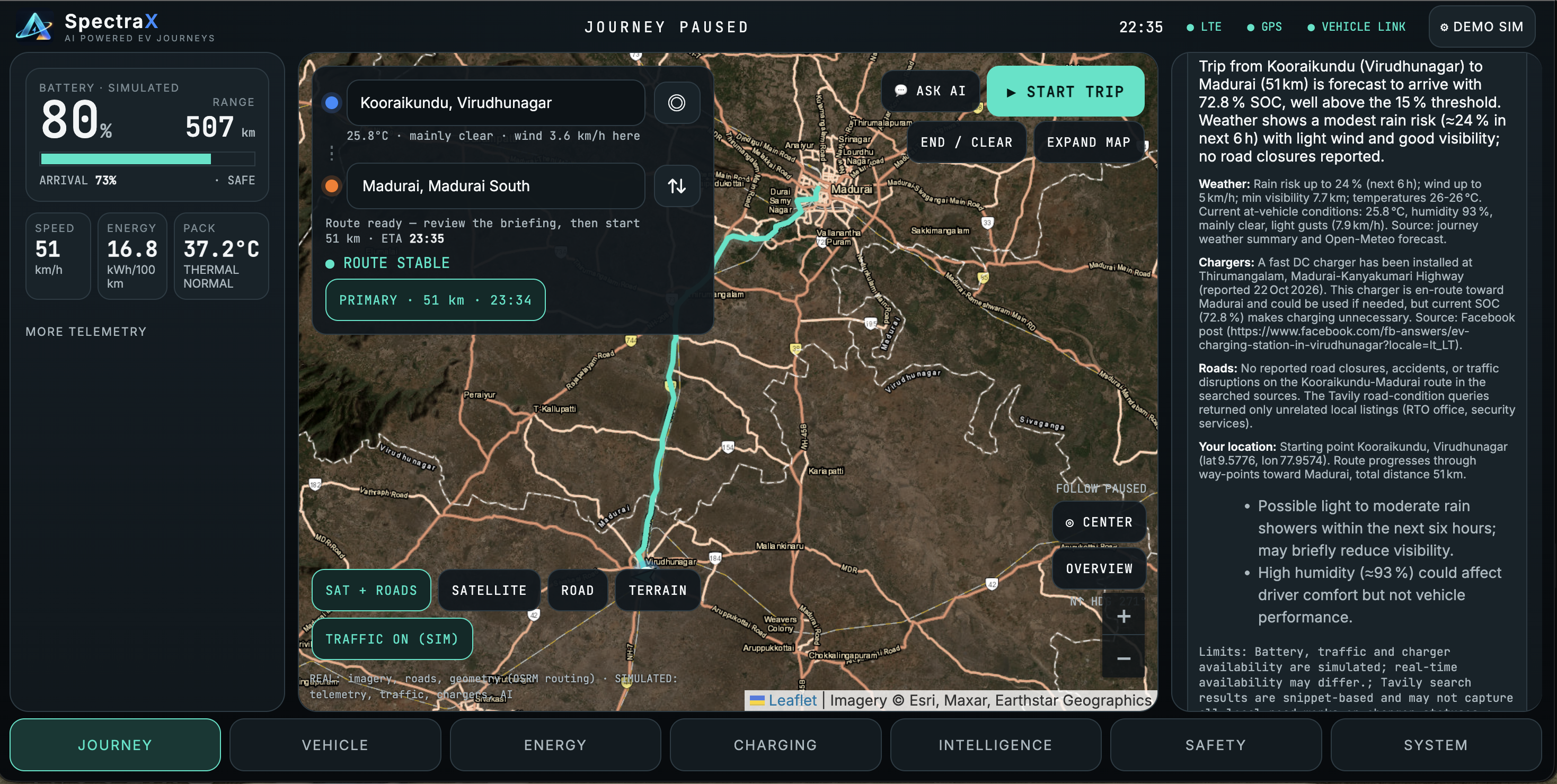
Ai route decision with route and reasons and sources
-
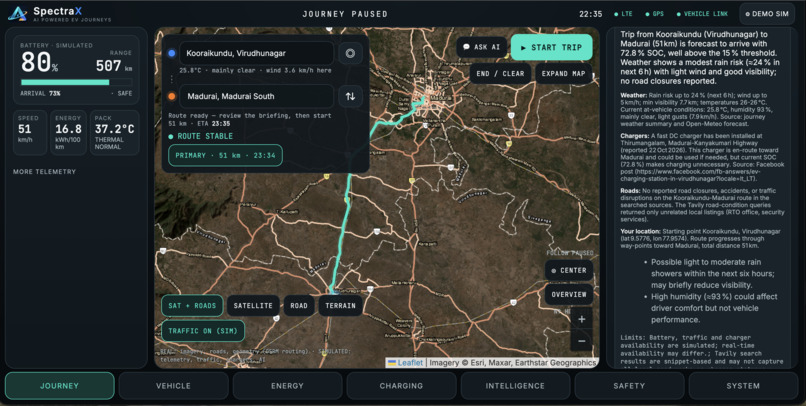
current route update
-
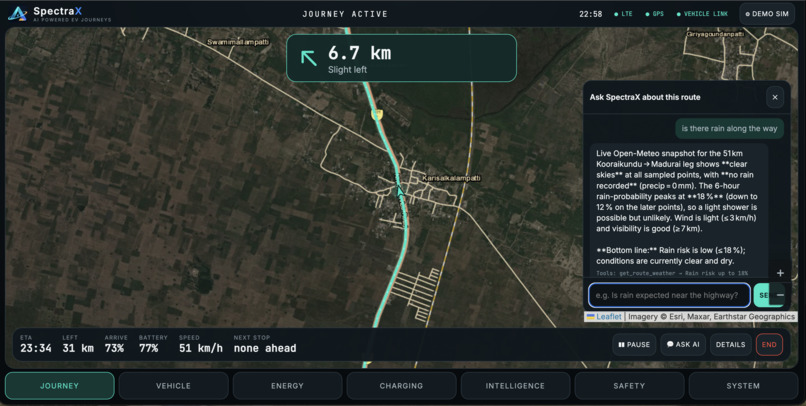
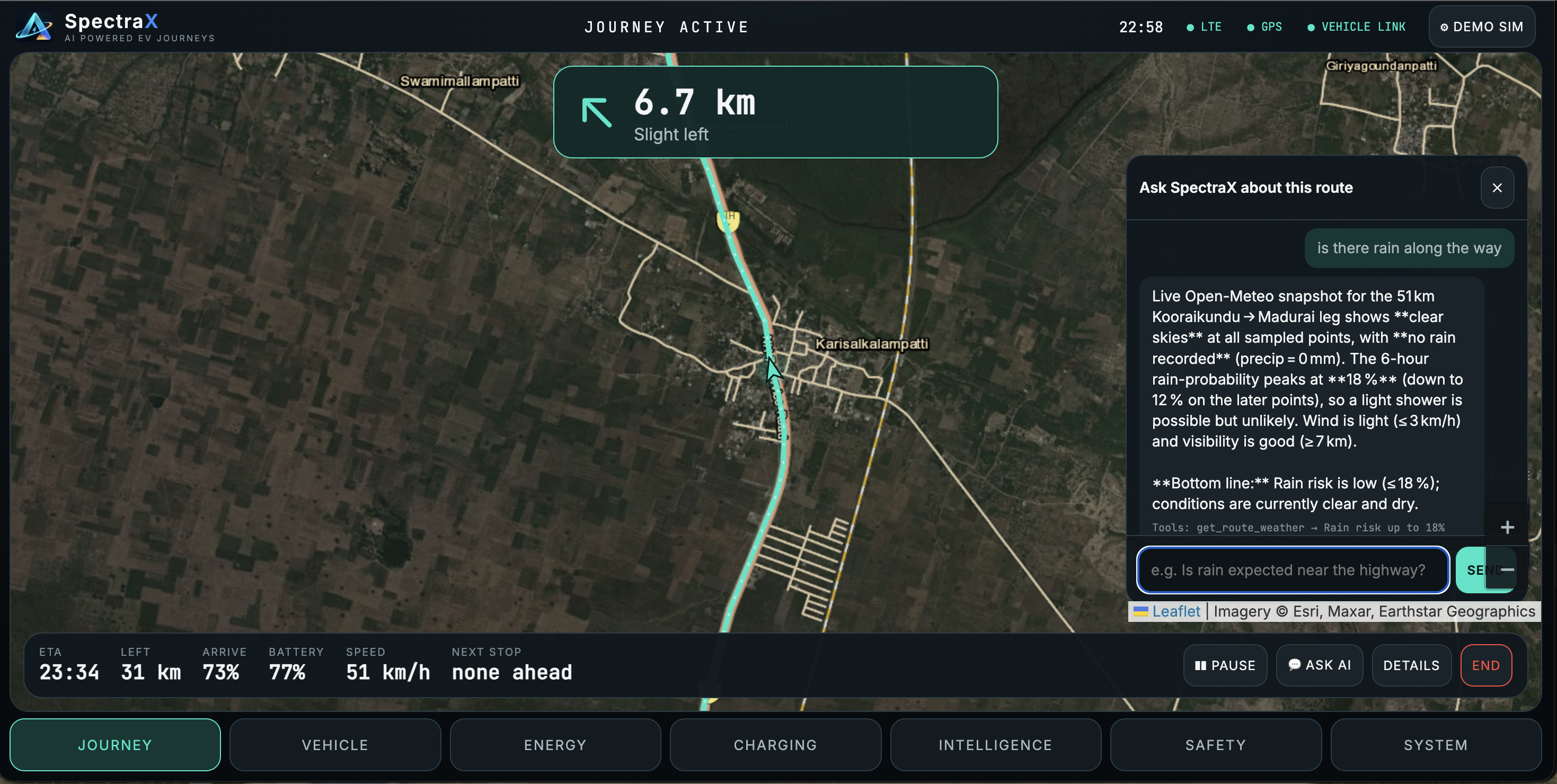
turn by turn navigation page with working ask ai feature
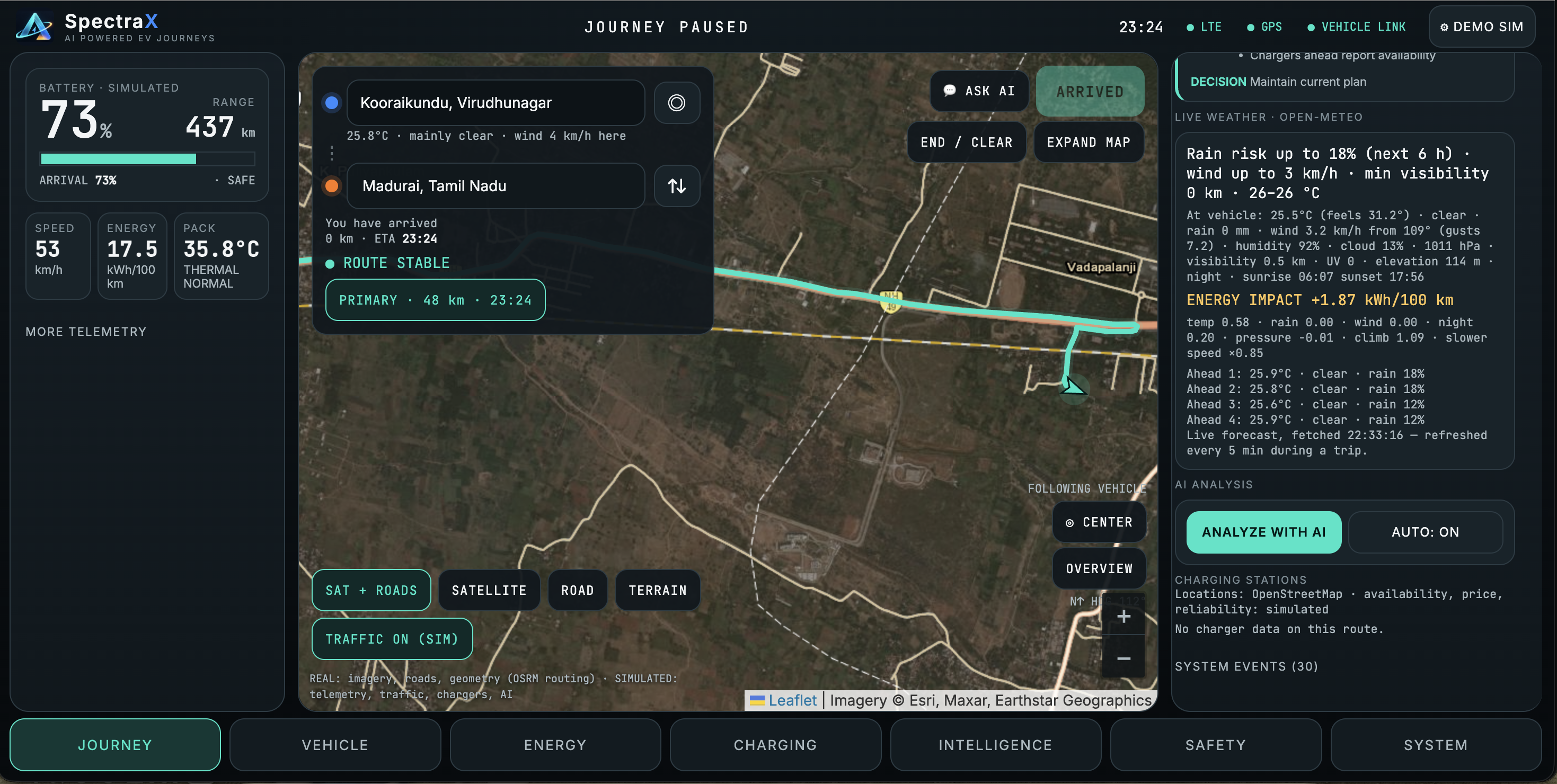
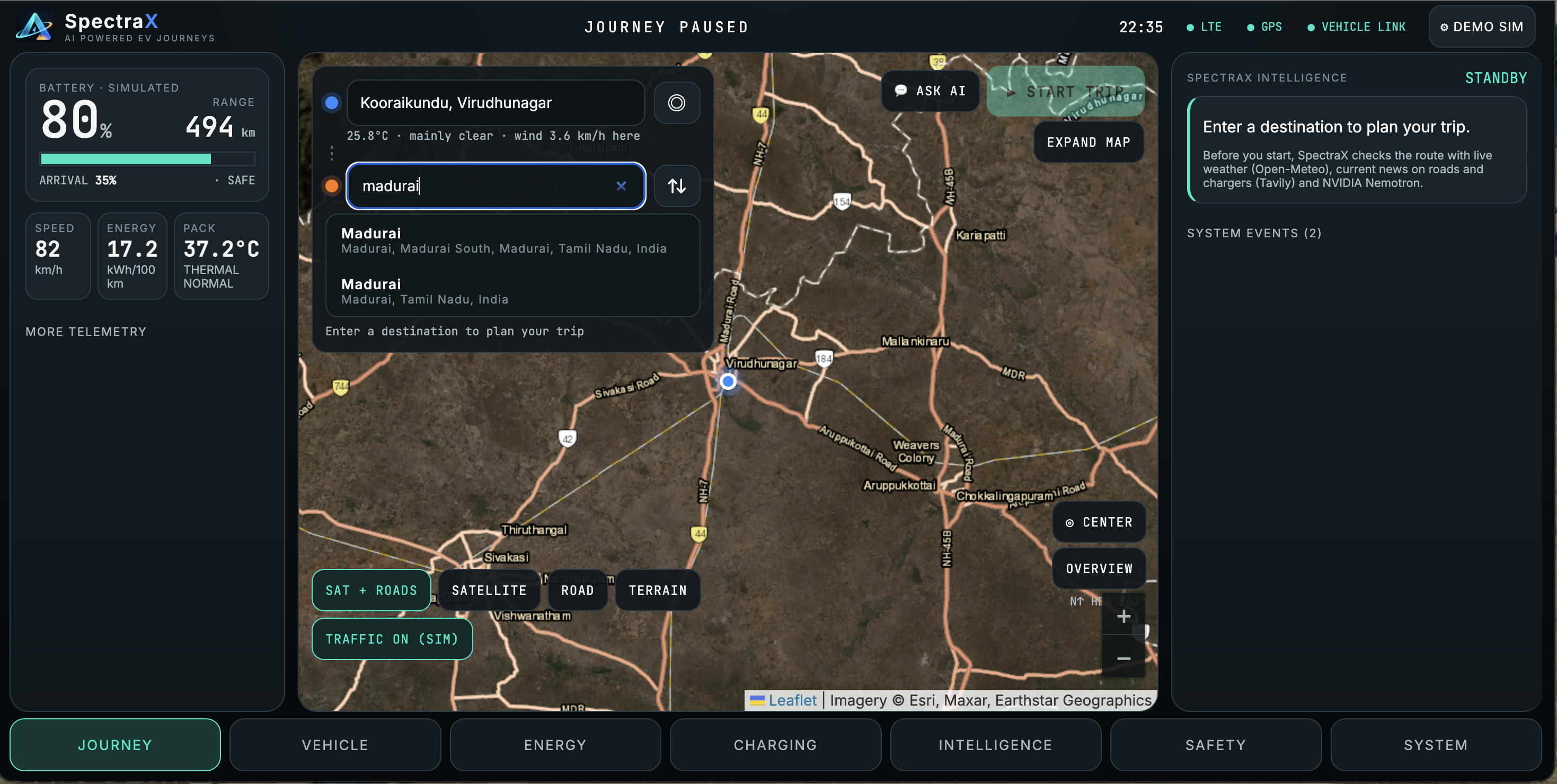
SpectraX: Smarter EV Journeys. Autonomous Decisions. Zero Range Anxiety.
Inspiration
Electric vehicles are changing how we travel, but long-distance EV journeys still involve uncertainty. Drivers must consider battery range, changing weather, traffic, charging-station locations, and the possibility that a planned charger may be unavailable.
A route that looks perfectly feasible at the beginning of a trip can become a problem when conditions change.
We wanted to explore a different approach: what if an EV travel assistant could do more than display information? What if it could understand a developing situation, investigate alternatives, and help replan the journey autonomously?
That idea inspired SpectraX, an AI-powered EV travel intelligence platform designed to make electric-vehicle journeys more adaptive, informed, and reliable.
What It Does
SpectraX combines an interactive journey interface, weather information, EV energy estimation, charging infrastructure data, and an AI-powered journey agent.
Instead of treating navigation, battery range, weather, and charging as separate problems, SpectraX brings them together into a single decision-making workflow.
Its key capabilities include:
- Journey intelligence: Evaluates the current route and available journey information.
- Weather-aware planning: Retrieves weather forecasts for relevant locations along a route.
- Energy estimation: Estimates energy requirements and projected arrival battery state of charge using deterministic calculations.
- Charging assistance: Identifies and compares charging options based on available station information and journey feasibility.
- Agentic replanning: Uses an AI agent to investigate changing conditions, call relevant tools, compare alternatives, and request a validated journey-plan update.
- Transparent decisions: Presents important events, evidence, changes, and explanations through the user interface.
The goal is not simply to answer a driver's question. It is to help the driver understand what is happening, what might go wrong, and what the system can do next.
How We Built It
SpectraX is designed around a modular architecture that separates AI reasoning from calculations and external data retrieval.
1. Interactive Journey Interface
The frontend provides a map-centered experience for viewing the journey, vehicle telemetry, battery estimates, charging options, and journey status.
The interface is designed to make important information accessible without overwhelming the user with unnecessary technical details.
2. Weather and External Data
We use the Open-Meteo Forecast API to retrieve weather information, including temperature, precipitation, visibility, and other relevant forecast variables.
Weather information must be associated with the journey's geographic locations rather than treated as a single forecast for an entire route.
Tavily provides a search capability for retrieving relevant external information when structured data from existing services is insufficient.
3. Deterministic EV Energy Estimation
We separate numerical calculations from language-model reasoning.
For a basic energy estimate, the system can use:
$$ E_{\text{required}} = \frac{D \times C}{100} $$
where:
- ( E_required)is estimated energy consumption in kWh.
- (D) is journey distance in kilometers.
- (C) is baseline consumption in kWh per 100 km.
Additional adjustments may be incorporated when justified by the available vehicle and route information. These estimates are not a substitute for calibrated vehicle telemetry.
4. Agentic AI with NVIDIA Nemotron
SpectraX is designed to use NVIDIA Nemotron through Nebius Token Factory as its reasoning and tool-using AI component.
The agent receives structured journey information and can use backend tools to retrieve relevant data, inspect charging options, assess feasibility, and propose a plan update.
Crucially, the AI does not invent battery measurements or perform safety-critical vehicle control. Numerical estimates and plan changes are validated by the application before being accepted.
5. Journey Recovery
The central demonstration is a journey that encounters an unexpected problem.
For example, a charging station may become unavailable during a simulated trip. SpectraX can investigate alternative stations, compare feasible options, recalculate the expected journey state, and present a revised plan.
This scenario demonstrates the difference between a static dashboard and an AI system that can use tools to respond to changing conditions.
What We Learned
Building SpectraX highlighted several important lessons about applied AI engineering.
More data does not automatically mean better decisions. A large weather response is useful only when the relevant information is selected, interpreted, and connected to the actual journey.
AI reasoning and numerical computation have different responsibilities. A language model is useful for interpreting situations and coordinating tools, while deterministic code is better suited to repeatable energy calculations and validation.
An agent needs tools, not just a clever prompt. Meaningful agentic behavior requires access to structured information, well-defined actions, and feedback about whether those actions succeeded.
Trust depends on transparency. Live information, forecasts, estimates, and simulated events must be distinguishable. A system should acknowledge uncertainty rather than present assumptions as facts.
These principles shaped our approach to building SpectraX as an integrated decision-support application rather than a standalone chatbot.
Challenges We Faced
Bringing Different Data Sources Together
Weather APIs return structured data rather than ready-made journey insights. The challenge is to transform that data into route-specific information that the application can use.
Our approach is to normalize API responses, associate forecasts with relevant route locations, and pass only useful information into the decision-making workflow.
Reasoning About EV Range
Battery consumption depends on more than distance. Driving conditions, weather, elevation, vehicle characteristics, and auxiliary loads can all matter.
We address this by separating the energy-estimation engine from the AI agent and making assumptions explicit. Better calibration and real vehicle data remain important areas for improvement.
Making AI Actions Reliable
An AI-generated recommendation is not automatically a feasible journey plan. A suggested charger may be incompatible, too far away, or have outdated availability information.
SpectraX therefore uses backend validation and explicit data provenance to constrain proposed actions and communicate uncertainty.
Building a Complete System Under Time Constraints
A convincing application requires more than a polished interface. APIs, state management, agent orchestration, error handling, and repeatable testing must work together.
We prioritize a complete journey-recovery workflow over a large number of disconnected features.
What's Next
Future development could include:
- Integration with more comprehensive charging-station and live availability providers.
- Improved route, traffic, and elevation data.
- Vehicle-specific energy models calibrated against real-world driving.
- Personalized charging and journey preferences.
- Improved handling of uncertainty and changing forecasts.
- Additional validation using real journeys and vehicle telemetry.
The Vision
SpectraX explores a future in which EV navigation becomes proactive rather than reactive.
Instead of leaving drivers to piece together battery estimates, forecasts, and charging options themselves, an intelligent journey assistant can bring the information together, investigate alternatives, and help adapt the plan when circumstances change.
SpectraX: Smarter EV journeys. Autonomous decisions. Zero range anxiety.
Our ambition is to make every journey feel more informed, adaptable, and dependable, one decision at a time.

