
Inspiration
In early 2024, a small health startup in Kenya faced a critical challenge. They had thousands of handwritten patient reports, voice memos from field doctors, and blurry scans of rural clinic records. They needed to extract this unstructured data to train an AI model that could predict disease outbreaks. But building a clean, structured dataset seemed impossible without a team of engineers and they had none. That’s where Spectra was born. Inspired by their struggle, we created Spectra, a Visual 3D AI tool that empowers anyone to reshape messy, real-world data into powerful, structured assets. Using Spectra, that same startup visually mapped handwritten reports with AI-powered OCR, converted voice notes into structured diagnosis data, and built an outbreak prediction model all without writing a single line of code. We realized the future of AI shouldn’t be gated by technical complexity. Spectra turns the most human forms of input sketches, speech, images into usable building blocks for AI development. It gives researchers, teachers, founders, and creators the tools to build powerful solutions visually. From crisis zones to classrooms, Spectra makes building with AI as natural as drawing a diagram or telling a story and that changes everything.
What it does
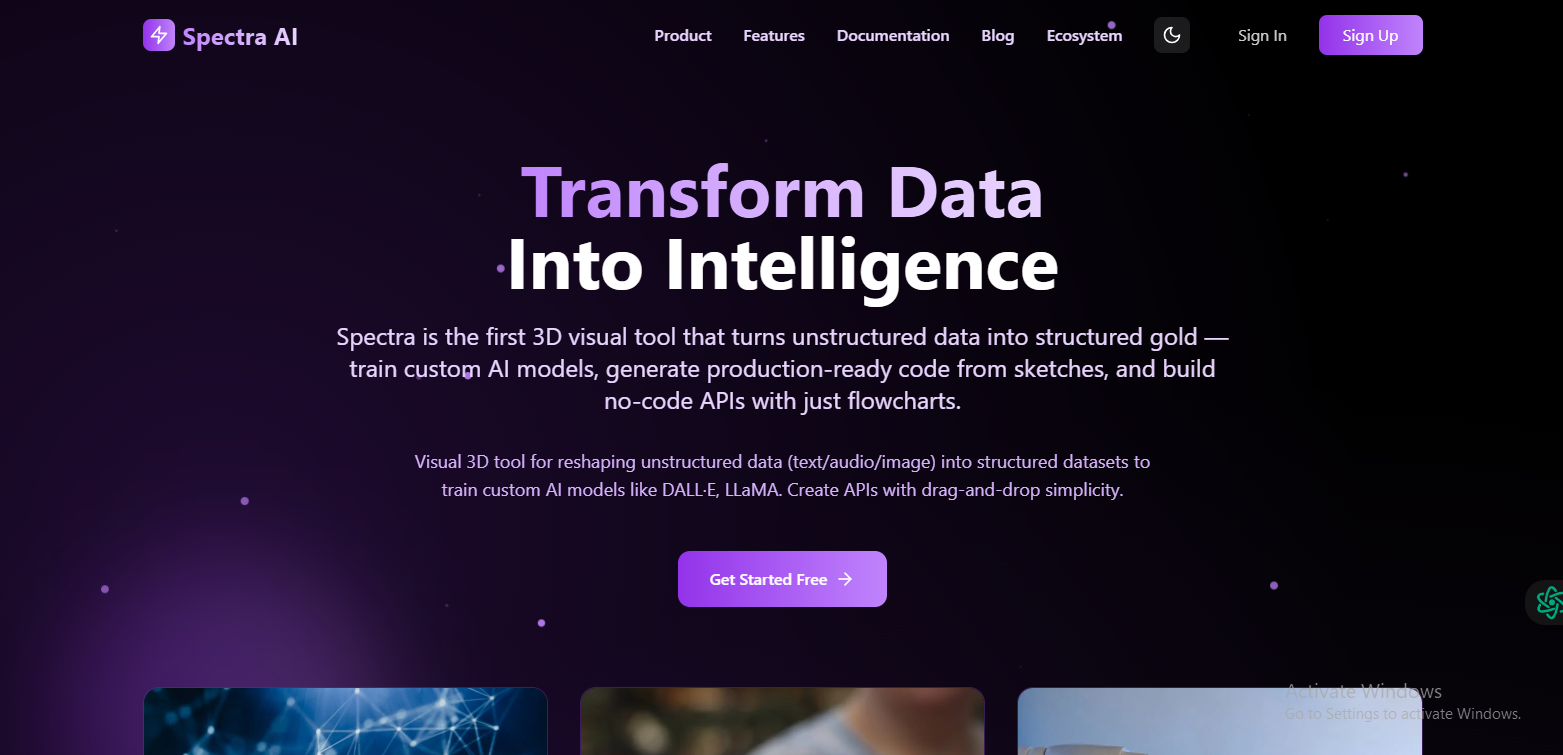
What the Product Does Spectra is a revolutionary Visual 3D AI development tool designed to simplify the journey from raw, unstructured data to deployable AI solutions. It allows users to transform complex data formats like handwritten notes, voice recordings, PDFs, and images into clean, structured datasets suitable for training AI models such as DALL·E or LLaMA. Spectra also empowers users to generate production-ready code from pseudocode, diagrams, or spreadsheet logic, using a powerful AI-powered visual transformer. Additionally, it offers a no-code flowchart-based API builder, enabling users to create and deploy custom model endpoints with a single click. Whether you're a developer, researcher, or no-code creator, Spectra gives you full visual control over data transformation, model building, and API deployment all without writing a line of backend code. It's the all-in-one visual interface for AI creation, deployment, and experimentation tailored for speed, simplicity, and accessibility across industries.
The Problem The world runs on unstructured data PDFs, audio files, scanned documents, diagrams, and fragmented notes. Yet, AI systems require clean, structured data to function effectively. Transforming unstructured data into usable datasets demands complex pipelines, advanced coding, and technical infrastructure that most teams or individuals can’t afford. This becomes a critical barrier for researchers in low-resource environments, startups lacking large engineering teams, and creators who have valuable data but no way to unlock its potential. Likewise, designing APIs or generating production-ready code requires specialized knowledge, slowing innovation and preventing many ideas from ever becoming real. In today’s fast-moving world, speed and accessibility are key but traditional AI workflows are slow, rigid, and reserved for elite developers. The gap between raw human input and structured machine intelligence is still too wide. There is no easy, visual, unified tool that empowers creators of all backgrounds to turn messy data into intelligent, actionable solutions.
The Solution Spectra bridges the gap between human creativity and machine intelligence by offering an intuitive, visual AI builder for everyone. It converts unstructured content audio, images, text into clean, structured datasets through a visual pipeline. With just a few clicks, users can visually connect data nodes like “Audio-to-Text,” “OCR,” or “Image Tagger” to structure their information. It doesn’t stop there Spectra also enables creators to draw diagrams, enter pseudocode, or upload sketches that are instantly translated into real, production-grade code. Finally, using an intuitive drag-and-drop flowchart builder, users can deploy working APIs for their models or datasets without writing backend logic. Spectra eliminates the need for multiple dev tools and teams. It democratizes AI development, making it accessible to researchers, teachers, startups, and innovators worldwide. The solution is visual, fast, and deeply flexible empowering people to go from raw data to working AI systems in a single visual environment.
Product Features
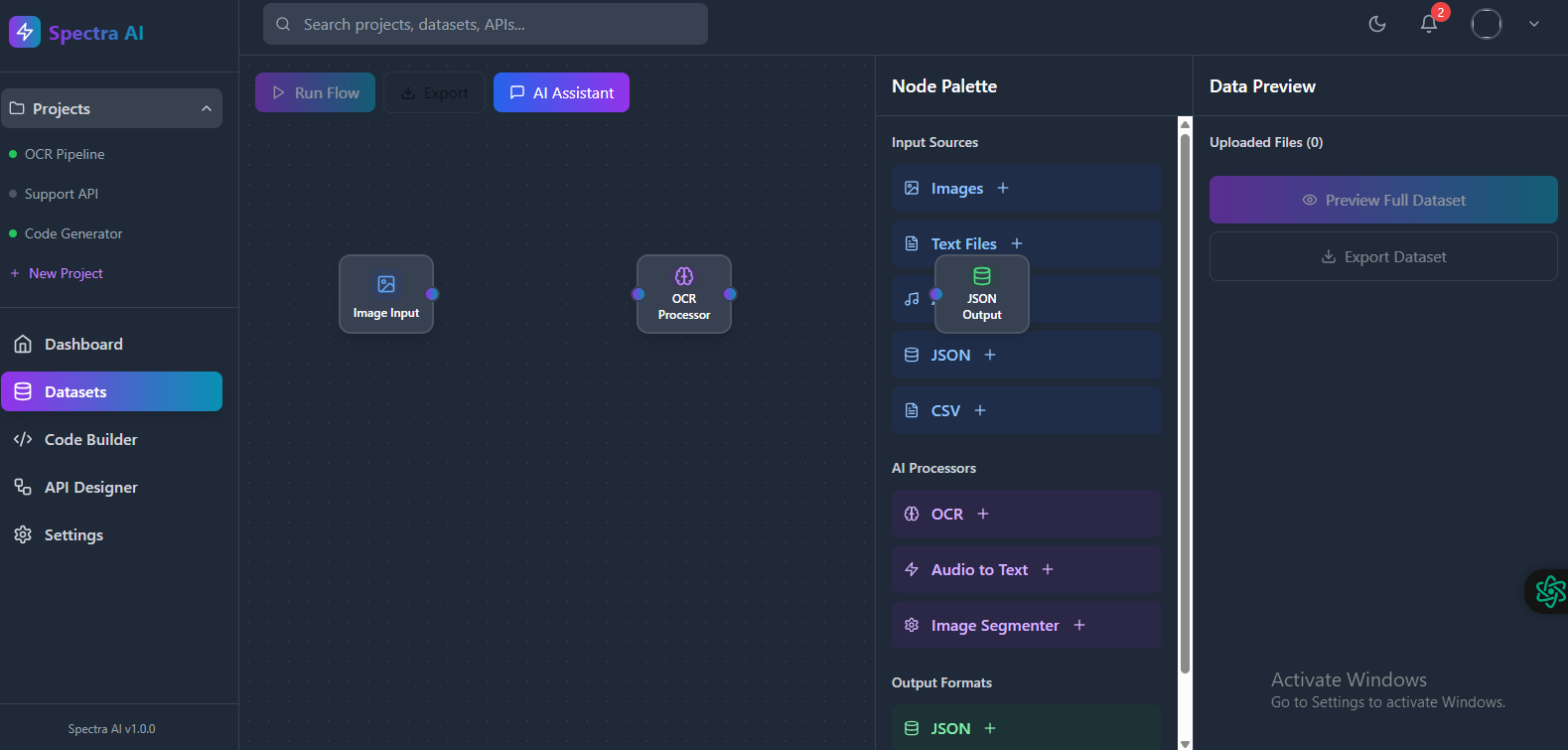
3D Visual Dataset Transformer A drag-and-drop interface where users upload unstructured data like audio, text, or images and connect them to AI-powered transformation nodes. Output is a clean, structured dataset ready for training.
AI Visual Code Generator Upload pseudocode, hand-drawn diagrams, or spreadsheet logic and Spectra transforms it into production-grade code in Python, JavaScript, or other languages. Includes a live code editor and export tools.
Flowchart-Based No-Code API Builder Users can visually build and deploy custom data or model APIs by connecting logical blocks (e.g., Input → Model → Output). Live preview and endpoint testing included.
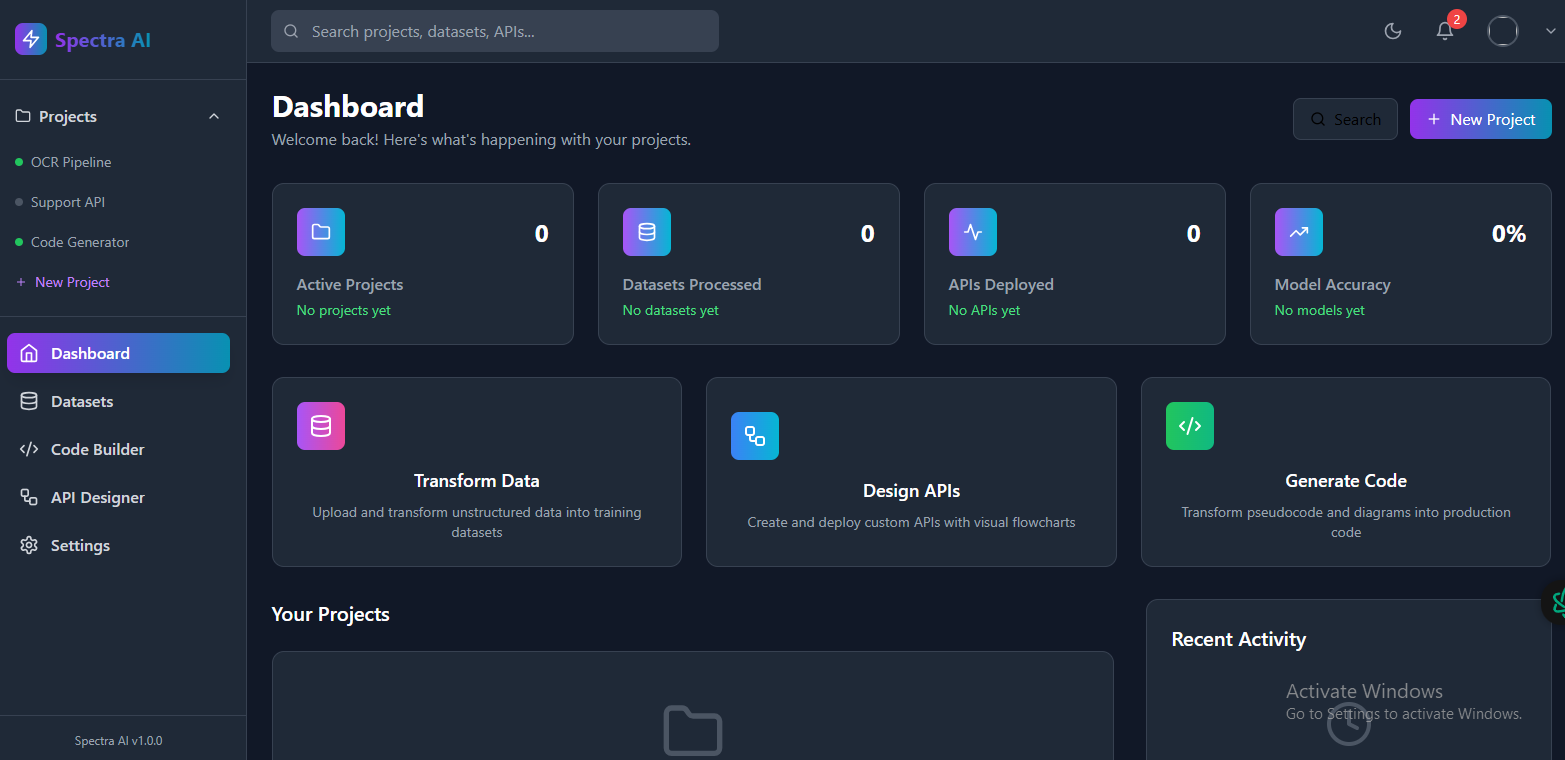
Unified Dashboard & Project Manager A single interface to manage datasets, code, APIs, and training history. Switch between projects, track progress, and collaborate in real-time.
Supabase-Powered Backend Spectra uses Supabase for file storage, real-time collaboration, authentication, and custom API deployment ensuring smooth scalability and security for all users.
How we built it
We built Spectra using a powerful combination of modern web and AI technologies, driven by the need to simplify complex AI development workflows. The frontend was designed with Boit AI, allowing us to visually prototype a responsive 3D interface, drag-and-drop flows, and real-time dashboards. For the backend, we integrated Supabase to handle user authentication, file storage, real-time collaboration, and secure database management. To power Spectra’s AI logic, we embedded pretrained models like OCR, audio-to-text, and custom transformers, allowing real-time data structuring and code generation. We used a modular node-based engine to allow users to visually connect data processing blocks. Each block interacts with AI functions or triggers backend jobs using Supabase Edge Functions. The code generator leverages fine-tuned LLM APIs to interpret diagrams or pseudocode and output clean, editable code. Everything was built with scalability, speed, and accessibility in mind—so anyone, anywhere, can build powerful AI systems without touching backend code.
Challenges we ran into
Building Spectra came with several complex challenges. First, designing a seamless 3D visual interface that feels intuitive across different skill levels was a major UI/UX hurdle. Balancing simplicity for non-developers with depth for technical users required constant iteration. Integrating multiple unstructured data types—audio, images, text—and ensuring accurate, fast AI transformation pushed the limits of real-time performance and model interoperability. Generating reliable, clean production-grade code from messy pseudocode or hand-drawn inputs also proved tricky, especially with ambiguous or incomplete logic. On the backend, coordinating real-time collaboration with Supabase across multiple projects while keeping everything responsive introduced sync and permission management issues. Deploying user-generated APIs securely using Supabase Edge Functions added another layer of complexity. Lastly, making all these advanced capabilities feel lightweight, beautiful, and accessible in a browser environment—without overwhelming new users—was a constant balancing act. But with iteration, testing, and user feedback, we overcame each obstacle to bring Spectra to life.
Accomplishments that we're proud of
Our proudest accomplishment is building Spectra into a fully functional, all-in-one visual AI development platform accessible to anyone, regardless of technical background. We took an ambitious vision and turned it into a seamless product where users can drag-and-drop unstructured data, generate usable code from sketches, and deploy APIs all within a single interface. One of the most rewarding milestones was watching a non-technical user, with zero coding experience, structure a messy dataset and deploy a working AI model in under 30 minutes using Spectra. That moment proved the product wasn’t just technically sound it was empowering. We also successfully integrated Supabase to manage authentication, real-time sync, and backend deployment, creating a scalable infrastructure with minimal friction. Creating a no-code tool that simplifies AI development, without sacrificing flexibility or power, was a huge technical and design victory. It’s more than a tool it’s a bridge between creativity and machine intelligence, and we’re proud to have built it.
What we learned
Building Spectra taught us that simplicity is the hardest feature to engineer. Making complex AI workflows accessible through visual tools requires deep empathy for users, continuous iteration, and smart abstractions. We learned how powerful low-code and no-code environments can be when paired with AI, and how real-time collaboration and visual programming can unlock innovation for non-developers. Integrating Supabase showed us the value of scalable, developer-friendly infrastructure. Most importantly, we realized that democratizing AI isn’t just a technical challenge it’s a design and accessibility mission. If people can build AI by simply thinking visually, the future of creation becomes limitless.
What's next for Spectra Ai
The future of Spectra AI is focused on scaling accessibility, intelligence, and integration. Next, we’re introducing pretrained visual templates for common AI workflows making it even easier to get started. We’ll launch collaborative multiplayer mode, so teams can build, train, and deploy AI systems together in real time. We’re also integrating custom model fine-tuning pipelines for LLaMA, Whisper, and DALL·E, directly from the visual interface. Our roadmap includes support for on-device inference, dataset marketplaces, and third-party plugin systems to expand Spectra's capabilities. Ultimately, we want Spectra to become the Figma of AI where anyone can design, build, and ship AI visually.
Built With
- database
- supabase

Log in or sign up for Devpost to join the conversation.