Inspiration
Coding agents are becoming incredibly capable software engineers, but they're still forced to reason over fragmented information. Existing tools work in isolation: some generate specifications, others retrieve code context, and others attempt repository indexing
I wanted to build a system that treats software projects as living knowledge graphs. Rather than reacting to prompts, Specta proactively plans projects, understands architecture, retrieves only the code that matters, and guides coding agents with approved scaffolded skeleton files. The goal is to make AI-assisted software development deterministic, scalable, and affordable.
What it does
Specta is a CLI for AI-first software development that combines specification-driven development with graph-based code intelligence to help coding agents make better decisions using dramatically smaller contexts.
Key capabilities include:
- Planner – Converts product vision into a structured development plan including constitutions, architecture, roadmaps, epics, and user stories.
- Design & Scaffolder – Generates approved project blueprints and implementation scaffolds that act as "ControlNet" for coding agents, reducing hallucinations and inconsistent project structures. This is what separates us from existing tools, a simple innovation that makes a huge difference
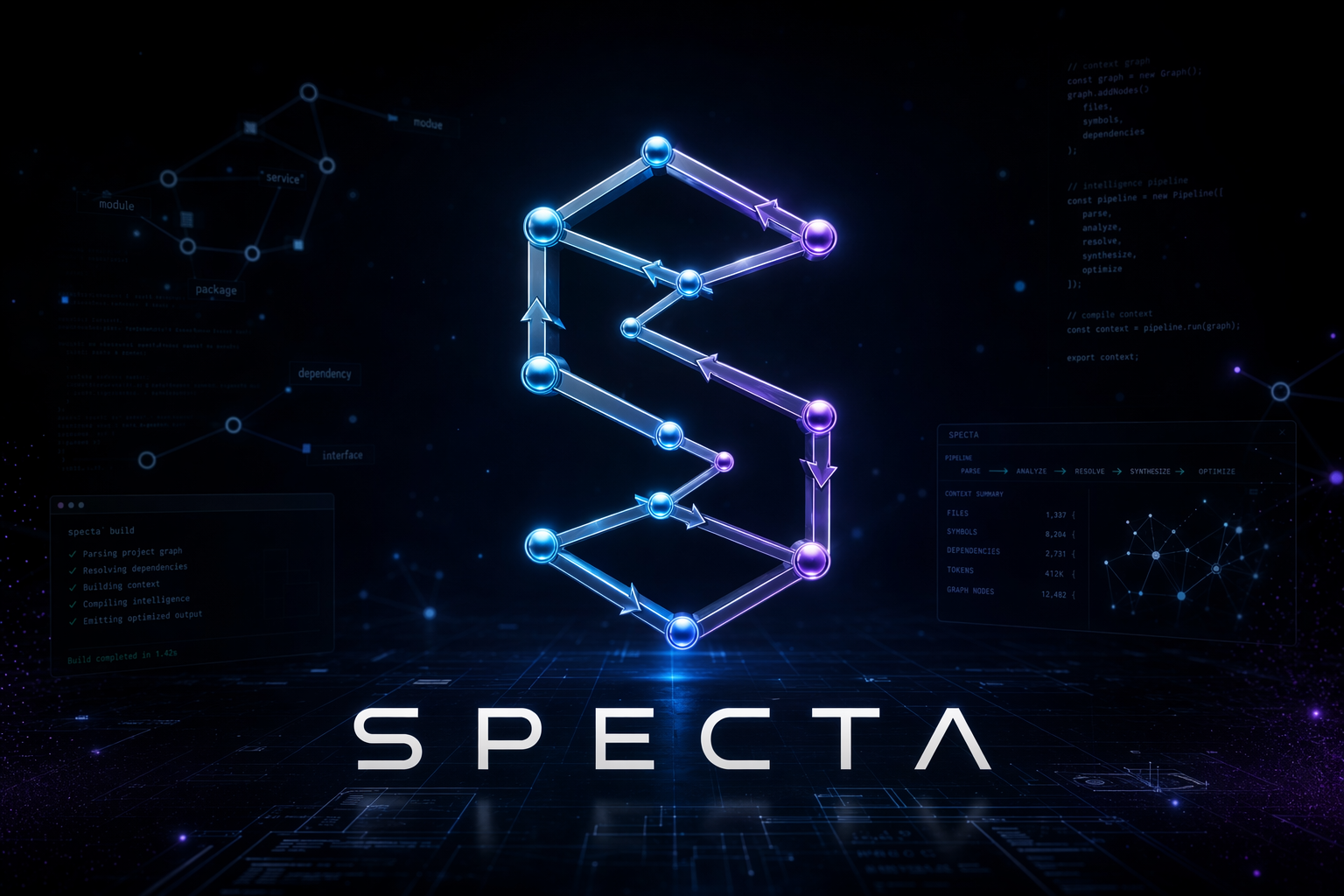
- Knowledge Graph Compiler – Parses the codebase into a graph representing files, symbols, dependencies, modules, APIs, and relationships.
- Context Engine – Uses graph traversal algorithms such as Breadth-First Search (BFS) to identify implementation blast radius and compile minimal context packets for LLM reasoning.
- Validation Engine – Validates generated code against the project graph, updates relationships, and helps ensure architectural consistency as the project evolves.
Instead of sending an entire repository or using grep to find the right files, Specta sends only the precise context required for a task, reducing token usage while improving output quality.
How we built it
Specta is built with TypeScript and uses TypeGraph with SQLite backend as its local graph database.
One of the core components is a custom TypeScript language parser that extracts symbols, imports, exports, dependencies, and project relationships to construct the knowledge graph.
GPT-5.6 sol was used to design the graph architecture, implement language parsing, generate graph compilation logic, refine retrieval algorithms, and iterate on the CLI architecture. It also helped explore different graph traversal strategies and improve the overall developer experience.
Challenges we ran into
The biggest challenge was designing a system that supports multiple AI coding agents working safely in the same repository. We had to think about graph consistency, concurrent updates, file ownership, and synchronization while using SQLite as the local graph store. We still a file locking mechanism
Supporting large monorepos and interconnected repositories also introduced complexity that was solved by organizing projects in a repo into workspaces and each workspace owning its own graph.
Accomplishments that we're proud of
- Built a custom TypeScript parser that constructs a structured software knowledge graph.
- Implemented graph-based context retrieval using BFS instead of relying solely on vector search.
- Reduced the amount of context sent to coding agents by 50-70%.
- Created a specification-driven workflow that guides AI code generation with approved architectural scaffolds that are compiled initially as "ghost nodes", making them available to graph search.
- Designed Specta as an agent-agnostic CLI that is exposed to coding agents as skills, current implementation targets codex.
What we learned
Building Specta reinforced that software repositories behave much more like graphs than document collections. Graph traversal combined with semantic retrieval techniques can outperform traditional repository search.
We also learned that autonomous AI development will require infrastructure beyond prompting such as file watchers, locking mechanisms, validation pipelines, and graph synchronization to enable multiple coding agents to collaborate safely in the same codebase.
What's next for Specta
Our roadmap includes:
- Support for additional language parsers including Python, Php, Go, Rust, and Java.
- File watchers that automatically keep the knowledge graph synchronized with repository changes.
- Multi-agent orchestration with intelligent file locking and conflict resolution.
- Interactive force-directed graph visualizations for exploring software architecture.
- Smarter graph retrieval algorithms and incremental graph compilation for very large monorepos.
- Additional validation rules that ensure generated code remains aligned with architectural specifications and project conventions.
- Expand the list of supported coding agents.

Log in or sign up for Devpost to join the conversation.