-
-
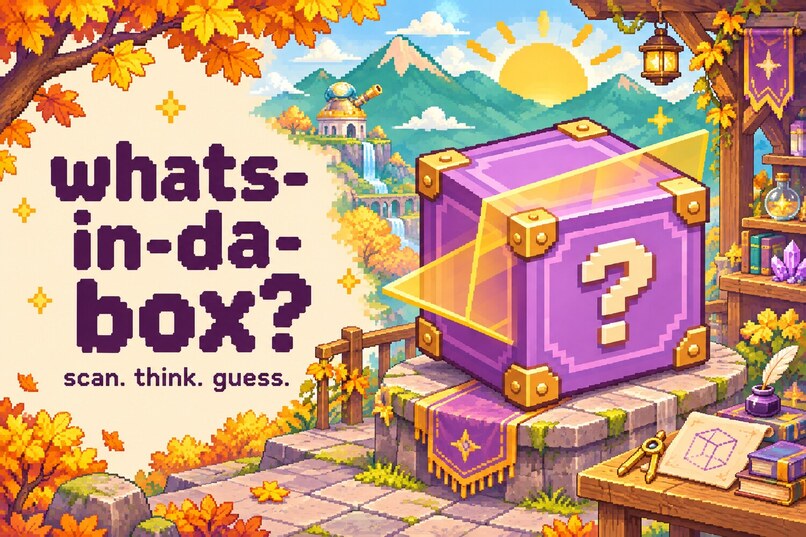
whats-in-da-box?
-
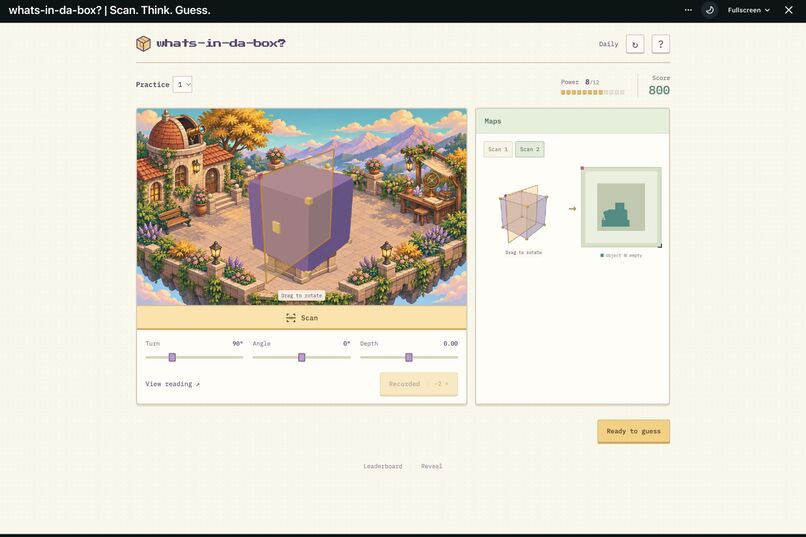
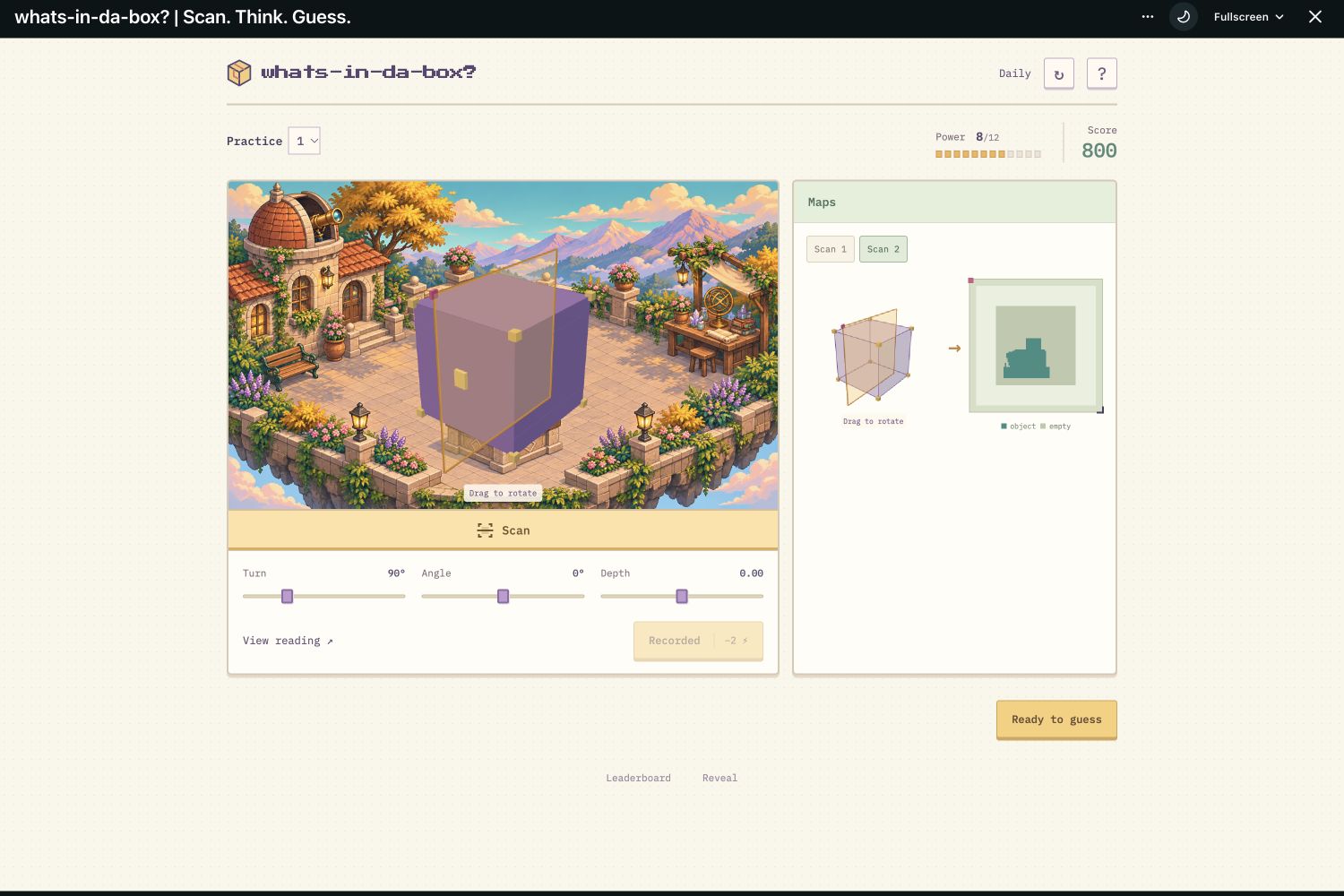
Choose the cutting plane. Each scan reveals a cross-section and lowers your possible score.
-
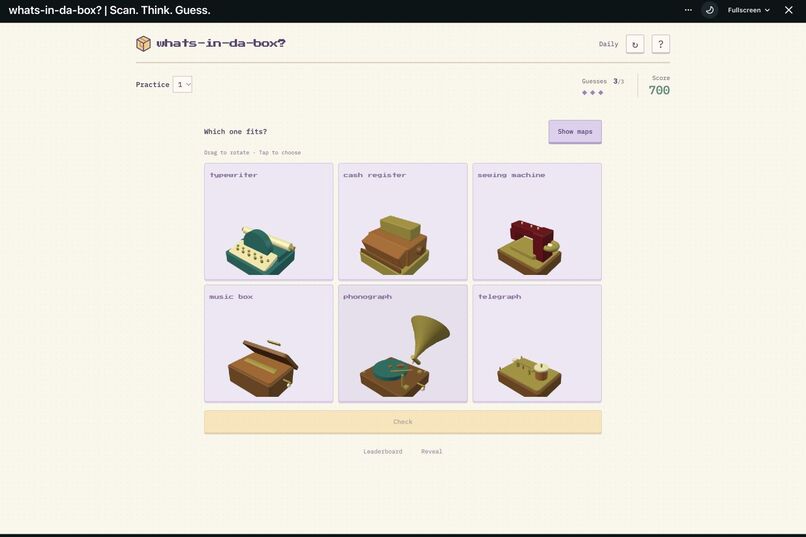
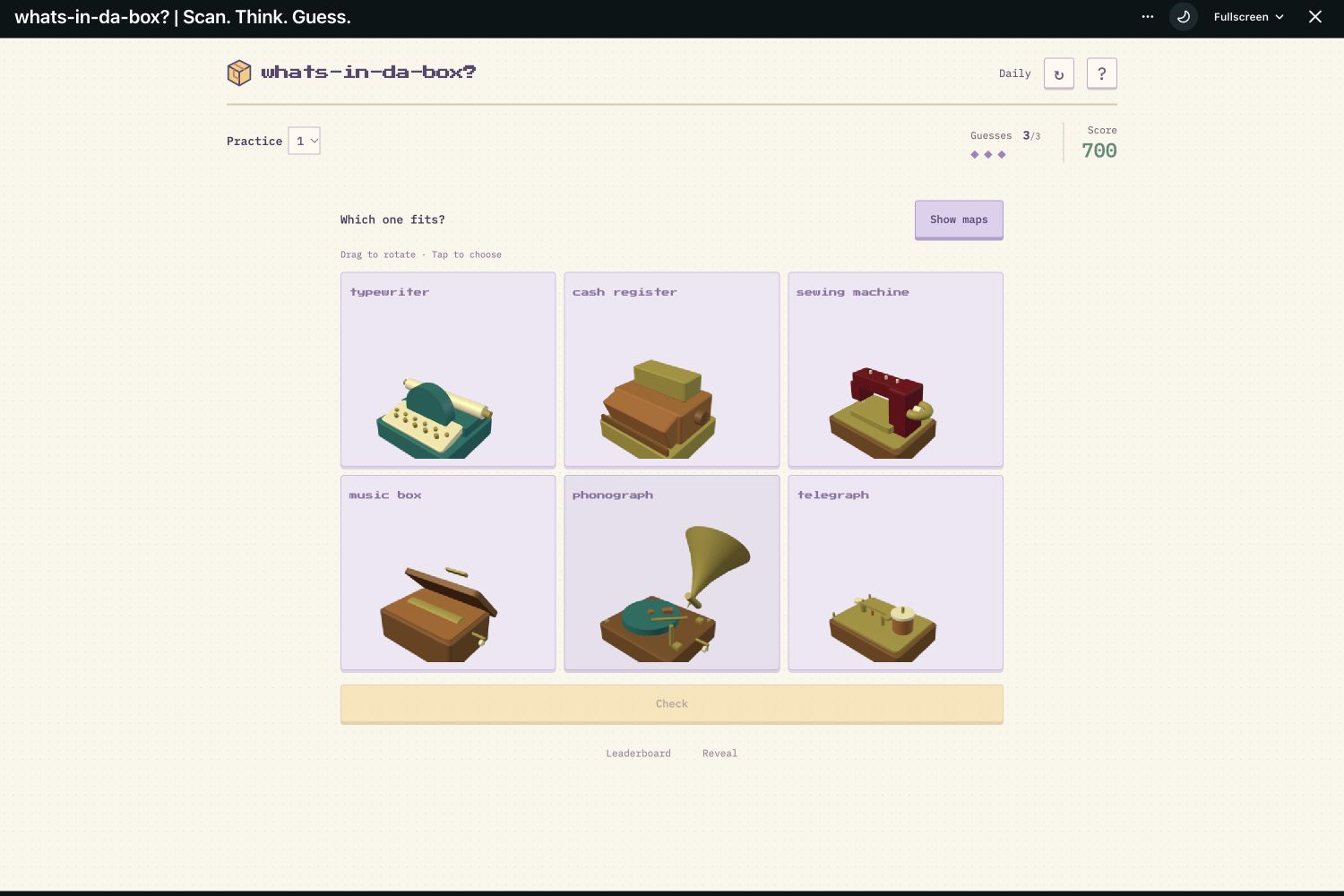
Six different objects. Leave the lab, compare your evidence, and pick the one that fits.
-
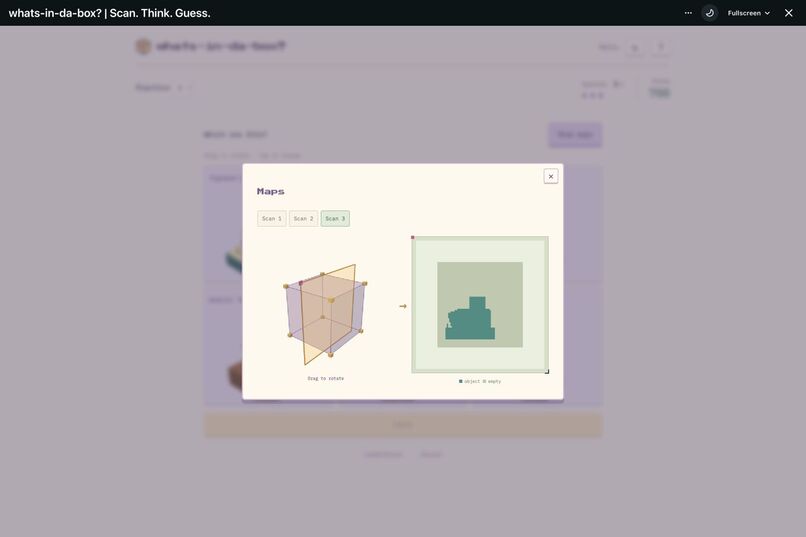
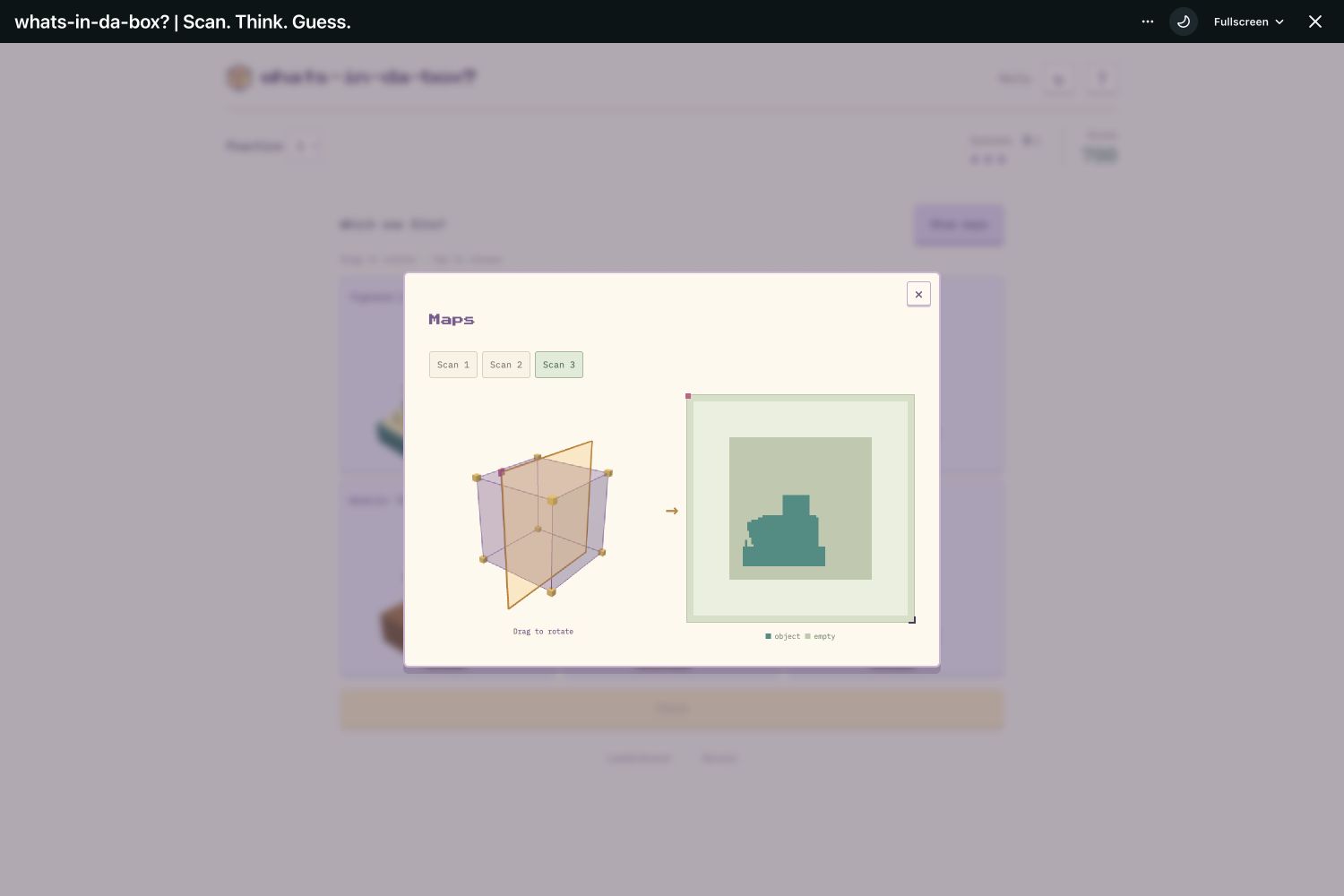
Show maps keeps your cuts close while you compare the six hypotheses.

Inspiration
I like daily guessing games, but I wanted choosing the clue to be part of the puzzle. Then I wanted the core puzzle game to be about information extraction, ie. the user should ask themselves "what would I learn if I sliced here instead of there?"
That led to whats-in-da-box, a little pixel-art lab built around simple intuition where you notice something, form a theory, design a test, observe, then guess.
What it does
There's a hidden 3D object in a sealed cube. You choose where to slice it, and the scanner prints a map of that cross-section. The choices are six different, recognizable objects, like a cash register, a typewriter, and a sewing machine. Their obvious cuts can look alike. A more careful cut reveals the difference.
You start with 12 power and 1,000 points. Each scan uses 2 power and costs 100 points. You have three guesses, separate from power. A wrong guess costs 150 points.
Print at least one scan, take more scans if you need them, then press Ready to guess. You see your remaining points before committing. Once you leave the lab, you can't take any more scans. You can still view every map you collected. The guess screen has six tiles, Check, and Show maps. Drag any object to look around it.
There's no timer. The hard part is choosing cuts that tell similar shapes apart. Everyone gets the same object for the UTC date. Progress saves to your Reddit account, successful solves go on the leaderboard, and daily wins build a streak. Practice and resets are unranked.
How I built it
whats-in-da-box? runs inside Reddit with Devvit Web, React, Three.js, Tailwind, and a Hono API. Redis keeps progress, scores, and the hidden answer on the server.
OpenRouter designs six objects as recipes of solid parts, curved profiles, handles, rims, and small details. We compare common central cuts at 0 and 90 degrees to pick convincing decoys, then check that other cuts can tell them apart. Three.js builds a real 3D mesh from it. The scanner uses the same shapes and transforms, so the maps come from the object itself. These are stylized procedural models, not downloaded assets or photorealistic text-to-3D output.
The date picks the subject and seed. Once a recipe is accepted, it's saved and reused. That saved copy matters because an AI seed alone can't guarantee the same output forever. A private global seed picks the same correct object for every community.
Nine AI-generated days are included in the current app. The background job prepares future objects through OpenRouter, checks that the six choices have different scans, and saves them to a shared library. Reddit's approval for the OpenRouter connection is still pending, so automatic calls from Reddit aren't live yet. The included days are playable now.
Challenges and what I learned
Making a mesh dense doesn't automatically make it a good model. I had to check the shape as well as the geometry. I also rejected generated sets where two choices produced the same scans.
Detailed AI requests can take longer than Reddit's 30-second HTTP limit. The daily pipeline now starts a background batch and checks it later. It keeps the same batch ID across retries so it doesn't keep paying for the same object.
The game also checks repeated actions, stale tabs, the scan-to-guess lock, and scores on the server. The difficulty should come from deciding what to test, not figuring out the controls.
What's next
Better object detail and difficulty tuning from real players. I wanna see which cuts people find useful and which ones leave them more confused.
This is a new game built for the hackathon from the official Devvit React template. The mountain backdrop and promo artwork were made with imagegen. The README covers the rules, setup, privacy, and the current generation status.
Built With
- devvit
- openrouter
- react
- redis
- tailwindcss
- three.js
- typescript
