Inspiration
We built Spec6 because modern enterprises are drowning in fragmented external signals. Competitor moves, customer distrust, counterfeit chatter, pricing shifts, executive statements, supplier risk, and compliance issues are all scattered across the web, reviews, forums, media, and internal business systems. Most teams still handle that with a mix of manual research, dashboards, spreadsheets, and reactive monitoring.
That approach breaks down fast. By the time a team notices a reputation issue, a competitor pricing change, or a risk signal in public conversation, the window to act is already smaller. We wanted to build a system that behaves less like a passive dashboard and more like a high-agency operator: something that continuously researches, remembers, monitors, and explains what matters.
The deeper insight was that the web is not only text. Some of the most important brand and market signals now live inside spoken content: YouTube reviews, earnings calls, interviews, podcasts, and media commentary. So we designed Spec6 not just as a web intelligence system, but as a system that can read the spoken web and also let founders talk back to the intelligence layer naturally.
What it does
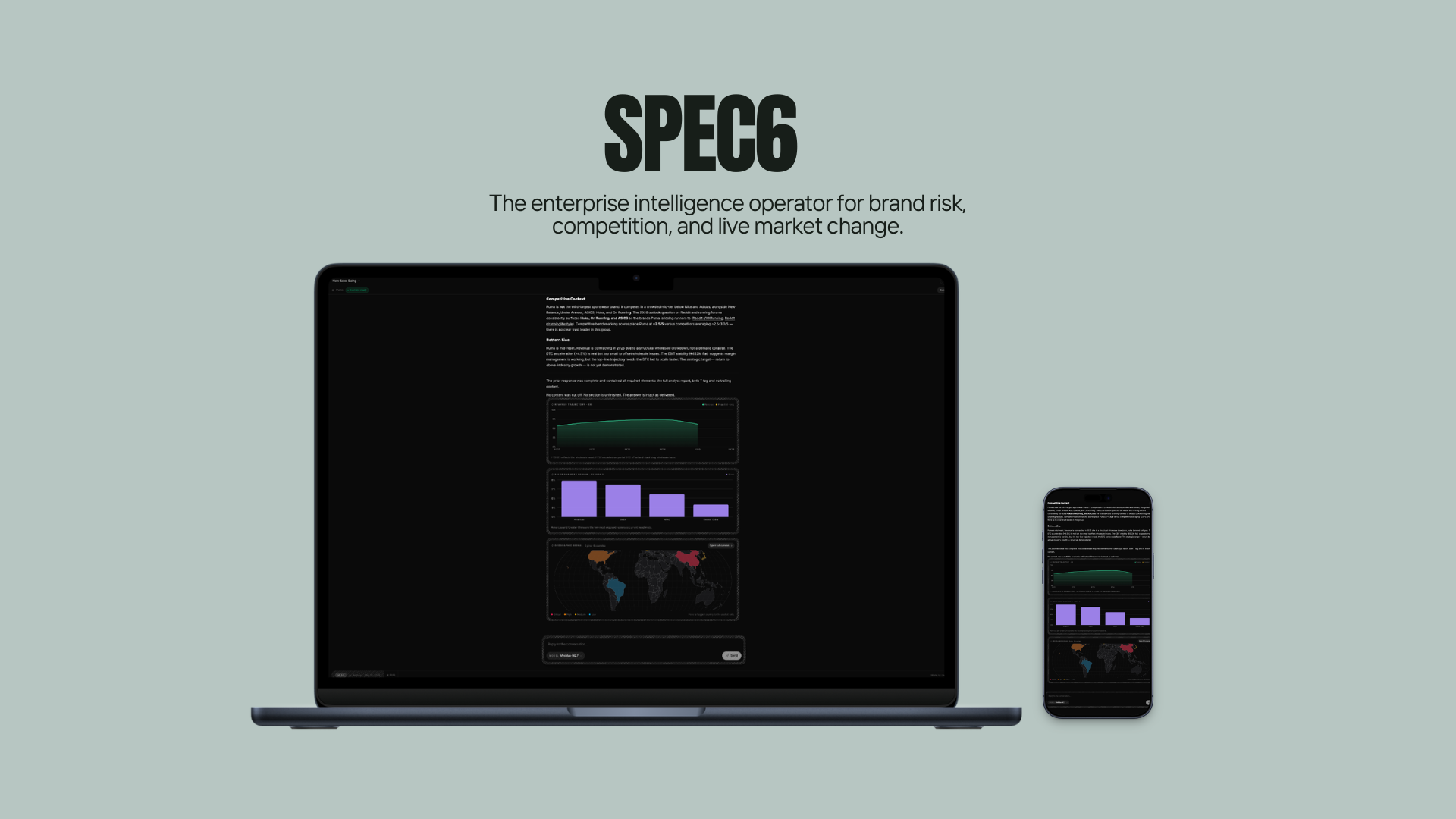
Spec6 is a semi-autonomous enterprise intelligence system that turns the open web into a live decision engine.
It helps companies understand:
- who their real competitors are
- how customers perceive them
- where trust is breaking
- what risks are emerging
- what changed recently across the market
- where they have an opening to win
At a practical level, Spec6:
- researches competitors using live web acquisition
- scans public reviews, search results, forums, and official websites
- uses Speechmatics to transcribe spoken content like video reviews and calls
- synthesizes the evidence into founder-ready overviews
- stores context and findings in memory
- supports chat and voice interaction
- can trigger alerts and follow-up monitoring
The result is a system that feels like an analyst, operator, and monitoring layer combined into one product.
How we built it
We built Spec6 as a full-stack, single-binary enterprise application with an embedded frontend and backend.
The core architecture has five layers:
Input layer
Users can interact with Spec6 through typed chat, company onboarding flows, or a real-time voice assistant.Acquisition layer
We use Bright Data products to retrieve live web evidence:- SERP API for search discovery
- Web Unlocker for protected pages
- Scraping Browser for JS-heavy or gated experiences
- Web Scraper API patterns for structured extraction
- Proxies for regional reach when needed
Speech layer
We integrated Speechmatics in two ways:- Realtime STT for the live voice assistant
- Batch transcription for spoken-web intelligence such as YouTube reviews, interviews, and calls
- TTS so Spec6 can speak answers back
Reasoning and memory layer
We built an agentic orchestration loop that:- classifies the task
- decides when to retrieve more evidence
- synthesizes across multiple sources
- uses Cognee as memory for company context, prior findings, and chat intelligence
Monitoring and action layer
We integrated TriggerWare and our own fallback monitoring logic so Spec6 can watch for changes, poll triggers, and connect those changes back into overviews, chat, and external alerting.
Technically, the project is built primarily with:
- Rust for the backend and core orchestration
- React + TypeScript for the frontend
- MongoDB for persistence
- Bun for frontend tooling and packaging
- WebSockets + SSE for real-time interactivity
- Embedded frontend assets so the app can ship as a single binary
Challenges we ran into
One major challenge was moving from a normal chatbot into a true agentic enterprise system. It is easy to make something that sounds intelligent. It is much harder to make something that reliably grounds itself in live evidence, handles partial failures, and still feels responsive.
A second challenge was source ambiguity and hallucination control. Brand names like “Puma” can collide with unrelated entities such as “Ford Puma,” and naive search pipelines will happily collect wrong evidence. We had to add stronger normalization, source filtering, category anchoring, and evidence checks so the system would not confidently synthesize junk.
A third challenge was streaming quality. We spent a lot of time fixing real-time behavior so that chat responses, tool calls, and voice interactions actually feel live instead of clumped, delayed, or cut off.
Another challenge was integrating Speechmatics meaningfully instead of superficially. We did not want a generic “voice chat” demo. We wanted Speechmatics to be part of the real data pipeline. That meant building both realtime transcription for the assistant and batch transcription for spoken web intelligence.
We also ran into issues around external service reliability and heterogeneity. Search providers, protected pages, and trigger systems all behave differently. So we had to build graceful fallbacks, retries, bounded research loops, and source-aware logic instead of assuming ideal conditions.
Accomplishments that we're proud of
We are proud that Spec6 is not just a UI concept or a wrapper over a single LLM. It is a real working system with multiple integrated layers.
Key accomplishments include:
- building a single-binary deployment model that ships frontend and backend together
- integrating Bright Data deeply into the live research flow
- integrating Speechmatics on both ends of the system:
- for human conversation
- for spoken-web transcription
- building company onboarding that turns directly into research and intelligence generation
- creating a system that stores memory and context instead of restarting from zero each turn
- making the assistant work in both typed and voice-first modes
- designing the product around real enterprise jobs: competitor analysis, trust analysis, risk detection, and monitoring
The most important accomplishment is that Spec6 feels like an actual operating system for external intelligence rather than a one-shot demo.
What we learned
We learned that the biggest gap in AI products is not conversation quality, but evidence quality. If the retrieval layer is weak, the experience collapses no matter how fluent the model sounds.
We also learned that enterprise AI becomes much more valuable when it has:
- persistent memory
- live monitoring
- multimodal input
- strong source grounding
- a way to act continuously, not just answer once
Another major lesson was that spoken content is underused in market intelligence. Reviews, interviews, earnings discussions, and video commentary contain rich signals that text-only systems miss. By combining Bright Data and Speechmatics, we were able to treat those signals as first-class evidence.
Finally, we learned that a system like this needs product discipline. It has to decide when to search more, when to stop, when to say uncertainty is high, and when to preserve user trust by refusing to overstate a conclusion.
What's next for Spec6
The next step for Spec6 is to deepen the transition from “smart assistant” to continuous enterprise operator.
We want to expand:
- deeper autonomous monitoring and trigger creation
- richer connector coverage for internal enterprise systems
- stronger source scoring and confidence calibration
- more structured competitor and trust dashboards
- tighter memory retrieval and longitudinal company histories
- better workflow automation into Slack, Discord, and operational channels
On the Speechmatics side, we want to push further into the idea of the spoken web:
- more automated media discovery
- richer timestamped evidence extraction
- speaker-aware summarization
- direct surfacing of high-signal spoken moments in the company dossier
Longer term, we see Spec6 becoming the external intelligence layer a company runs every day: always watching, always learning, and always ready to explain what changed, why it matters, and what to do next.

Log in or sign up for Devpost to join the conversation.