-
-
How does Speaki work?
Hello! We’re the guys who want to see an idea come to life, and it’s called Speaki.
So, here we go!
1. Who are we?
We are a team of 2 - Mike and Igor. We’ve had very different backgrounds.
Mike (that’s me!) grew up in the capital of Ukraine, was raised as a bilingual in a progressive and tolerant international community. Thanks to this, I’ve had many opportunities to travel and communicate with youth abroad.
Igor spent his years up to high school in a much smaller city, and began honing his English skills much later - upon arriving to another city to study in university. His initiative and enthusiastic approach to life made up for an initial lack of English and he participated in many Erasmus+ programs and youth projects.
The two met at a program for young leaders and eventually began work on an... e-mazagine! It was not a successful project, we must admit… But we got to know each other and work together!
Igor and I have been working together for about 4 years. During this time, we’ve created many many different projects, commercial and social - from a motivational interactive T-Shirt called a DOShirt (and it’s gorgeous! Just look at it: https://www.instagram.com/doshirtua/ ), to opening an English school (London is indeed the capital of Great Britain! Yes, we say silly things like that in post-CIS countries… These and other funny phrases and faces you can see here: https://www.instagram.com/englishwho/ ), to organizing the biggest quest in English in Ukraine and the world (and getting printed in the national records book! Guinness record pending! Pics here: https://saycheese.com.ua/11-11-kharkiv-english-quest-park-gorkogo/ ). Now, we want to see this project happen, because we believe that it can change the world for the better, and give people opportunities, which they never had before!
2. “...so we have a PROBLEM, Houston?” - The problem our project solves
Problem indeed! The bad news is there is a whole string of them. They cause major headaches even in normal times, not to mention the virus! The good news is, we have found the core:
“English…! Do you speak it?” (as spoken by Samuel Jackson).
So okay, we’re not exactly inventing the wheel, or uncovering a shocking truth, like Snowden… But look closely at these STATISTICS, and we’ll show you the faces and facts behind these numbers.i
90% of the information online is in English. - We won’t remind you that that’s an AMAZING resource! We can just open Coursera and learn a new skill while in lockdown - become more useful when it finishes! Or, browse UpWork for some online jobs - a great way to support myself and my family during this time, and maybe in general. Oh, and Mike here is a teacher, and he’s had to make a switch to teaching online, and he’s looking for streaming platforms, tools for teaching and quality control and if it weren’t for the internet - he would have gone CRAZY by now! Also we’ve heard so many sweet and encouraging stories from around the world at this time, this international communication has been a blessing!
...just in case you forgot, how awesome it is to have the internet ;)
6% of the world are native speakers. - These guys have no problem with reading this info, easy-breezy!
15% speak English as a foreign language. - Okay, so they use Google Translate sometimes. Still okay, right?
Ready?
Drumroll...
79% of the world are simply left behind because they don’t know English, and as a result - cannot use the resources that the internet provides!
Perhaps it would be easier to make these 21% forget English and remove all the information on the Internet, because as absurd as it sounds - only 21% of all people have access to 90% of the world's information - knowledge, information, education!
WHY does this happen? PRICES – a good language teacher’s time will not be cheap, and as such – unaffordable for people from a low-income background. Mike is a Cambridge-qualified teacher, and his lessons are not the cheapest!
QUALITY – highly-qualified teachers are not easy to come by. Those found are in high demand, which would result in the former – high prices.
PRACTICE – our research in Ukraine, and beyond, showed a trend, in which upon graduation, pupils and students may be able to demonstrate some skills in reading and writing English, but a simple conversation often stumps them! This is caused by a lack of practice in the language-teaching approach.
COMMUNICATION – in our globalized world people tend to turn more and more inward and introverted. It’s becoming ever-increasingly hard to find people with whom to share interests, open corridors of communication, join a community.
3. Enter… Speaki - The solution we bring to the table
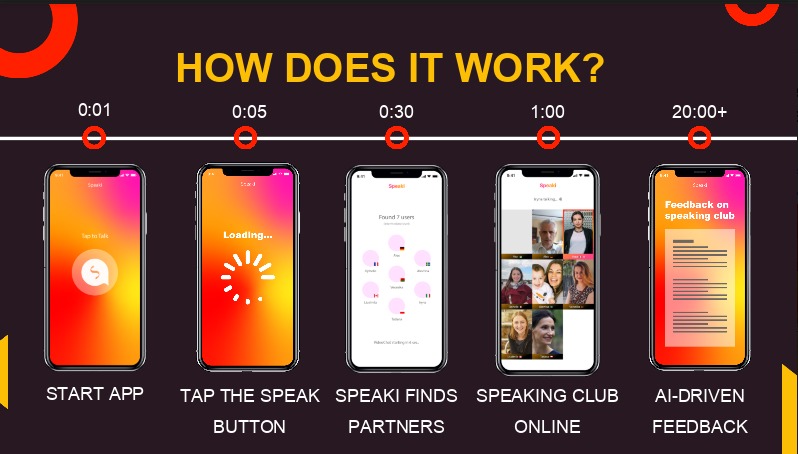
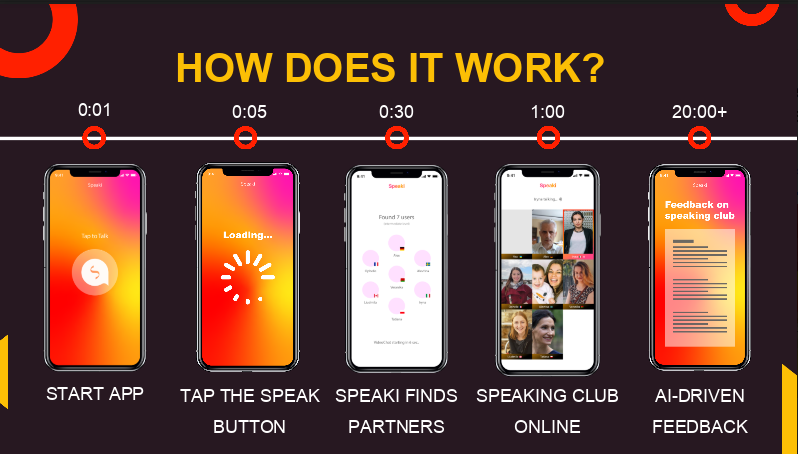
SpeAkI is a platform for improving English and forming communities. With it, the user can connect with people of corresponding interests and language levels from different parts of the world, at any convenient time! It provides an opportunity to exchange ideas and experience, as well as receive feedback on one’s command of English. It works as an app, which matches the user with others of a fitting English level and interest. It then initiates and manages group video conversations - timed division of interlocutors into pairs, regrouping, open-mic feedback, making sure everyone has a chance to express themselves - as dictated by the conversation format. After the end, the user gets feedback from the app ( AI part of app ) about their speaking - grammar mistakes, filler words, etc., and gets links to relevant information and exercises for practicing. An example of how it works can be seen in the attached image gallery .
Wondering how this all works technically? Here’s how we see the TECHNICAL EXECUTION:
FRONT-END: MOBILE APP. For the MVP, the application (Android and/or iOS) connects to a video call between X-number of "clients" through the Internet. The exchange of audio and video streams is performed in the simplest way - all streams are heard by all "clients", similar to Skype and Google Hangouts. For the FULL VERSION, we expect the “client” to receive video and audio streams, as per the algorithm of breaking the group into mini-groups, and then bringing them back together, regrouping - etc. This is controlled on the server side.
BACK-END: SERVER. For the MVP - a Linux-based server (Ubuntu or Debian) to start.
It is necessary to develop an application that will receive streams of video + audio from each client to sockets (constant ip and ports). It will collect and send video + audio of all clients to all clients. In simple words, it's like Skype. It is possible to use ready-made libraries, such as OpenCV to capture video.
Also, during the whole video communication, the “client” records his audio and after the video communication - sends it to the server for analysis. Therefore, it is necessary to "collect" audio from all clients and save it on the server.
To identify clients, we create a database server. The last resource we researched was postgresql. Minimal understanding of database operation on Linux is required.
So far the idea was to implement it in C ++ or Java or Python (basically any language that works safely with sockets, and also has the ability to connect the OpenCV library). If there is a proposal for a finished working source of video communication - we are ready to look into that. Also, once the project gets funding, we will be able to council with our developers on these questions.
For the FULL VERSION, we expect the server to receive and forward video and audio streams, as per a given algorithm of breaking the group into mini-groups, and then bringing them back together, regrouping - etc. We also expect the server to function from the cloud.
This is also where the AI LANGUAGE ANALYSIS comes into play. Using speech-to-text synthesis and context analysis, AI will give objective feedback post-conversation on one’s speech, and help users learn languages (firstly English) while not significantly interfering in the communication process. This particular API hasn’t been developed before (however, it could incorporate existing solutions, such as Google text-to-speech API, Open Data Science’s language analysis rule base. This will save us time and resources for creating them), and it can be applied not only in learning languages. The engine to be created will improve machine-human communication.
4. “How exactly does it IMPACT THE CRISIS, AND POST-CRISIS?” - The solution’s impact to the crisis, and after the crisis
Access to jobs - With the advent of the lockdown, millions of people have lost their jobs. In Ukraine alone, the official number of people, who were forced to stop all work at their current employment places, in the middle of April, was at least 7 million. Many more switched to part-time work, and/or the workload was significantly lessened. And the unofficial numbers are even more eye-opening. However, there are many remote employment opportunities online, most of which have to do with English, to some extent or another.
Online education and honing capacities - many, including professionals, have had to face the fact that they must discontinue their office jobs, or ones that require personal presence and specific skills utilized there. They could retrain and take on new skills and jobs to adapt to the current situation. Again, most of the education platforms and their content are in English.
Providing solutions - many great solutions already exist, in most spheres! Be it education, science, technology, everyday life - you can probably find a tool, a lifehack or tutorial online. This pool of information is, again, predominantly in English. 79% of the world has to resort to “inventing the wheel” - at best, “making do” or “getting by” - at worst. Once again, the gateway is knowledge of English. Even participation in this Hackathon, communication with our mentors, and using given resources - even just hearing about this hackathon would probably not be possible without a working knowledge of English.
Forming communities - this is especially important as a lack of personal communication makes people more distant from one another. For all the benefits of the internet, we have yet to find many more effective ways for it to bring people together, open corridors of discussion, form communication on professional and interpersonal levels. Speaki suggests a novel approach to this.
Employment opportunities for persons from disadvantaged backgrounds - native speakers are highly valued and sought after to practice English with. Users will pay for Premium packages, where they will be able to communicate with native speakers. They will be people with disabilities, and ones with disadvantaged backgrounds. We’ve reached out to Trade Unions in the UK (such as TUC) and the USA with our proposals.
Intercultural communication - breaking stereotypes and building intercultural communication still remains one of the primary goals of the 21st century to ensure stable growth and the successful wellbeing of humanity and modern society. We want to ensure that the intercultural dialogue, integration of immigrants, inclusion of socially disadvantaged circles not only doesn’t stop, but grows and flourishes during this time!
Combating loneliness - the lockdown has been associated, by many psychologists, with a sharp growth in depression rates. Though we’ve got all the social networks at our fingertips, as society we’ve grown more and more reserved, retreating to the comfort of our computers, internet and Netflix. And again, that’s in non-lockdown time. That needs to change, and a crisis can also be the turning point!
5. “WHAT DO WE NEED to bring the project to life?” - The necessities in order to continue the project This is what we need for our MVP, which we must create BEFORE INITIAL TRACTION, BETA TESTING and PRACTICAL MARKET FEEDBACK.
Required Resources - Financial to pay for the programmers who will implement the MVP. Currently, we require the services of the following specialists with the stated tasks facing them:
Back-end programmer, most likely in Java or Python, which implements the server. The server may initially be physical, but ideally a cloud server:
- to ensure the implementation of online calls with the exchange of streams between "clients" in the format of "all with all".
- create and save audio files from an online call. Each individual audio stream created by the "client" during the call must be stored in a separate mp3 file. That is, if there are 4 participants in the call, 4 mp3 files should be stored, with the recordings of what was said by individual participants.
- speech-text conversion. Audio files should be analyzed by software that translates what users have said into text and saves it in text format that can be saved to a PC, opened and edited.
Mobile-dev Android / Apple / cross-platform programmer who will create clients for:
- making said calls.
- receiving push messages with text analysis of customer calls.
- Estimated cost of MVP development: $ 3-5 thousand
We’re very thankful to our mentors for working with us this weekend and helping us with advice on what really needs to be focused on during the crisis. This was a great experience, we’re glad to have worked, developed and fine-tuned the idea. Looking forward to continuing work on it after the (hoping successful!!) hacking final results!
To be continued...)


Log in or sign up for Devpost to join the conversation.