Inspiration
Have you ever been in a meeting where one person dominates the conversation while others struggle to get a word in? Whether in classrooms, workplaces, or group projects, unequal participation can prevent valuable perspectives from being heard.
We were inspired by the challenges women and other underrepresented individuals can face when trying to make their voices heard, particularly in STEM and professional environments. We wanted to create a solution that doesn't just recognize these participation gaps but actively encourages more inclusive and respectful conversations.
That's how SpeakEasy was born: an AI-powered meeting assistant designed to ensure everyone has an opportunity to contribute.
What it does
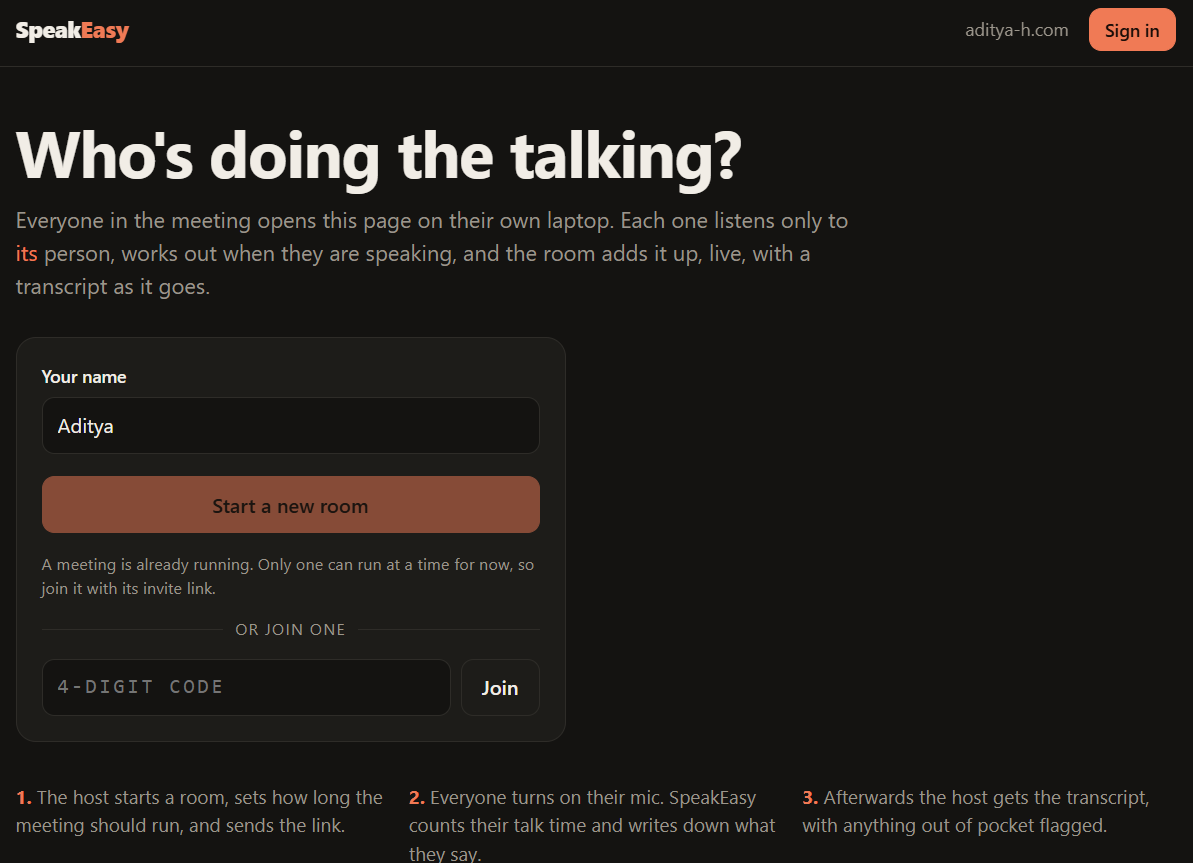
SpeakEasy transforms ordinary meetings into more inclusive, organized, and productive conversations through real-time AI-powered assistance.
Its features include:
Live Speaking-Time Tracking: Visualizes how long each participant speaks throughout a meeting, helping teams recognize participation imbalances.
Participation Nudges: Hosts can gently encourage participants to contribute or wrap it up when they're comfortable doing so by pinging them individually with different notifications.
Interruption Detection: Identifies potential interruptions and helps participants become more aware of their conversational habits.
Respectful Communication Alerts: Flags potentially inappropriate or disrespectful language to encourage healthier discussions.
Meeting Transcription: Creates a transcript that participants can save and revisit.
AI-Powered Summaries: Converts conversations into concise summaries highlighting the most important ideas and decisions.
Meeting History: Allows users to revisit previous meetings, review their notes, and reflect on participation patterns over time.
How we built it
We developed SpeakEasy as a web-based meeting assistant with an emphasis on accessibility, real-time feedback, and a straightforward user experience.
Our application combines an interactive meeting dashboard, participation-tracking logic, and AI-assisted meeting analysis.
The system monitors speaking activity to update participation statistics and provide contextual feedback. Meeting information is organized into transcripts, summaries, notes, and actionable tasks, allowing users to focus on contributing rather than constantly taking notes.
Most of the development was built using generative AI in a way that streamlines the process and formulated the foundation of SpeakEasy along with optimizing the code to fix any bugs and issues that arose.
Challenges we ran into
One of our biggest challenges was figuring out how to measure participation meaningfully without assuming that everyone should speak for exactly the same amount of time.
Speaking frequently doesn't necessarily mean someone is contributing effectively, and speaking less doesn't necessarily mean someone is being excluded. We had to consider how to provide useful feedback without making participants feel pressured or judged.
Another challenge was designing interruption detection and participation notifications that could encourage respectful communication without becoming distracting themselves.
We also had to balance the complexity of multiple features with the limited development time of a hackathon. This pushed us to prioritize the features that would provide the most immediate value to users.
Ultimately, these challenges helped us better understand the importance of building technology that supports people rather than simply measuring their behavior.
What we learned
Building SpeakEasy taught us that creating an impactful application involves more than making its features work.
We learned how to approach real-time participation tracking, organize meeting data, design intuitive dashboards, and explore how AI can turn conversations into useful information.
More importantly, we learned that inclusivity cannot be measured by a single statistic. Effective collaboration requires psychological safety, mutual respect, and opportunities for people to contribute in different ways.
This shaped our approach to SpeakEasy: instead of enforcing equal speaking time, we focused on helping participants recognize patterns and encouraging facilitators to create space for others.
What's next for SpeakEasy
We envision SpeakEasy becoming a tool used in classrooms, student organizations, research teams, and professional workplaces.
Future improvements could include more accurate speaker identification, multilingual transcription, integrations with existing meeting platforms, and personalized insights that help teams understand their communication patterns over time.
We also hope to incorporate user feedback and stronger privacy controls to ensure SpeakEasy remains a supportive and trustworthy tool.
Our ultimate goal isn't to make everyone speak equally. It's to help everyone feel that they have an opportunity to participate.
SpeakEasy — Where every voice has a chance to be heard
Built With
- audioworklet
- cloudflare
- css
- droplet
- html
- javascript
- nginx
- node.js

Log in or sign up for Devpost to join the conversation.