Inspiration
Our team firmly believes that a hackathon is the perfect opportunity to learn technical skills while having fun. Especially because of the hardware focus that MakeUofT provides, we decided to create a game! This electrifying project places two players' minds to the test, working together to solve various puzzles. Taking heavy inspiration from the hit videogame, "Keep Talking and Nobody Explodes", what better way to engage the players than have then defuse a bomb!
What it does
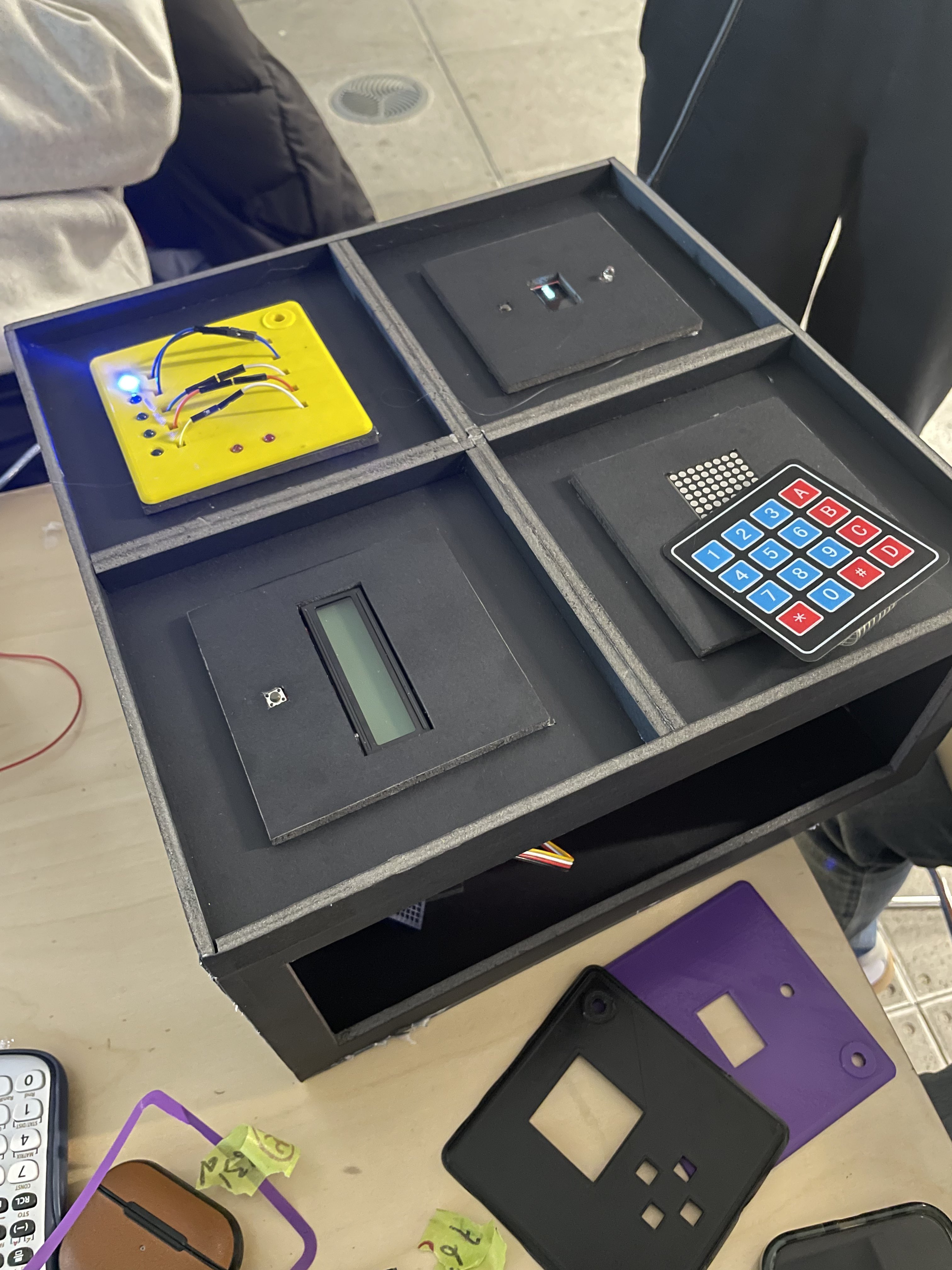
The MakeUofT 2024 Explosive Game includes 4 modules that must be disarmed, each module is discrete and can be disarmed in any order. The modules the explosive includes are a "cut the wire" game where the wires must be cut in the correct order, a "press the button" module where different actions must be taken depending the given text and LED colour, an 8 by 8 "invisible maze" where players must cooperate in order to navigate to the end, and finally a needy module which requires players to stay vigilant and ensure that the bomb does not leak too much "electronic discharge".
How we built it
The Explosive
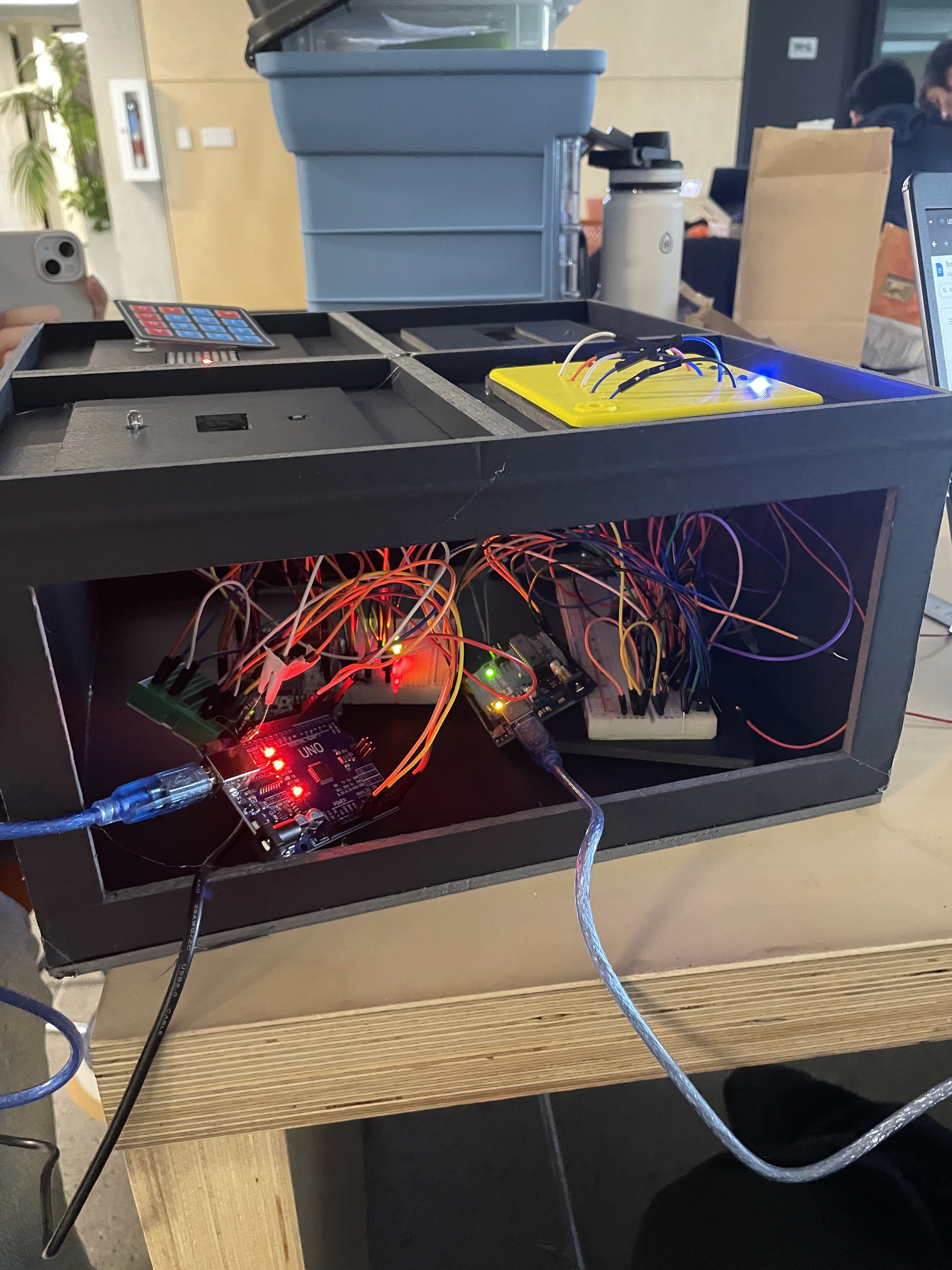
The explosive defuser simulation is a modular game crafted using four distinct modules, built using the Qualcomm Arduino Due Kit, LED matrices, Keypads, Mini OLEDs, and various microcontroller components. The structure of the explosive device is assembled using foam board and 3D printed plates.
The Code
Our explosive defuser simulation tool is programmed entirely within the Arduino IDE. We utilized the Adafruit BusIO, Adafruit GFX Library, Adafruit SSD1306, Membrane Switch Module, and MAX7219 LED Dot Matrix Module libraries. Built separately, our modules were integrated under a unified framework, showcasing a fun-to-play defusal simulation.
Using the Grove LCD RGB Backlight Library, we programmed the screens for our explosive defuser simulation modules (Capacitor Discharge and the Button). This library was used in addition for startup time measurements, facilitating timing-based events, and communicating with displays and sensors that occurred through the I2C protocol.
The MAT7219 IC is a serial input/output common-cathode display driver that interfaces microprocessors to 64 individual LEDs. Using the MAX7219 LED Dot Matrix Module we were able to optimize our maze module controlling all 64 LEDs individually using only 3 pins. Using the Keypad library and the Membrane Switch Module we used the keypad as a matrix keypad to control the movement of the LEDs on the 8 by 8 matrix. This module further optimizes the maze hardware, minimizing the required wiring, and improves signal communication.
Challenges we ran into
Participating in the biggest hardware hackathon in Canada, using all the various hardware components provided such as the keypads or OLED displays posed challenged in terms of wiring and compatibility with the parent code. This forced us to adapt to utilize components that better suited our needs as well as being flexible with the hardware provided.
Each of our members designed a module for the puzzle, requiring coordination of the functionalities within the Arduino framework while maintaining modularity and reusability of our code and pins. Therefore optimizing software and hardware was necessary to have an efficient resource usage, a challenge throughout the development process.
Another issue we faced when dealing with a hardware hack was the noise caused by the system, to counteract this we had to come up with unique solutions mentioned below:
Accomplishments that we're proud of
During the Makeathon we often faced the issue of buttons creating noise, and often times the noise it would create would disrupt the entire system. To counteract this issue we had to discover creative solutions that did not use buttons to get around the noise. For example, instead of using four buttons to determine the movement of the defuser in the maze, our teammate Brian discovered a way to implement the keypad as the movement controller, which both controlled noise in the system and minimized the number of pins we required for the module.
What we learned
- Familiarity with the functionalities of new Arduino components like the "Micro-OLED Display," "8 by 8 LED matrix," and "Keypad" is gained through the development of individual modules.
- Efficient time management is essential for successfully completing the design. Establishing a precise timeline for the workflow aids in maintaining organization and ensuring successful development.
- Enhancing overall group performance is achieved by assigning individual tasks.
What's next for Keep Hacking and Nobody Codes
- Ensure the elimination of any unwanted noises in the wiring between the main board and game modules.
- Expand the range of modules by developing additional games such as "Morse-Code Game," "Memory Game," and others to offer more variety for players.
- Release the game to a wider audience, allowing more people to enjoy and play it.
Built With
- 3dprinting
- adafruit
- arduino
- autocad
- c++
- grove
- i2c


Log in or sign up for Devpost to join the conversation.