
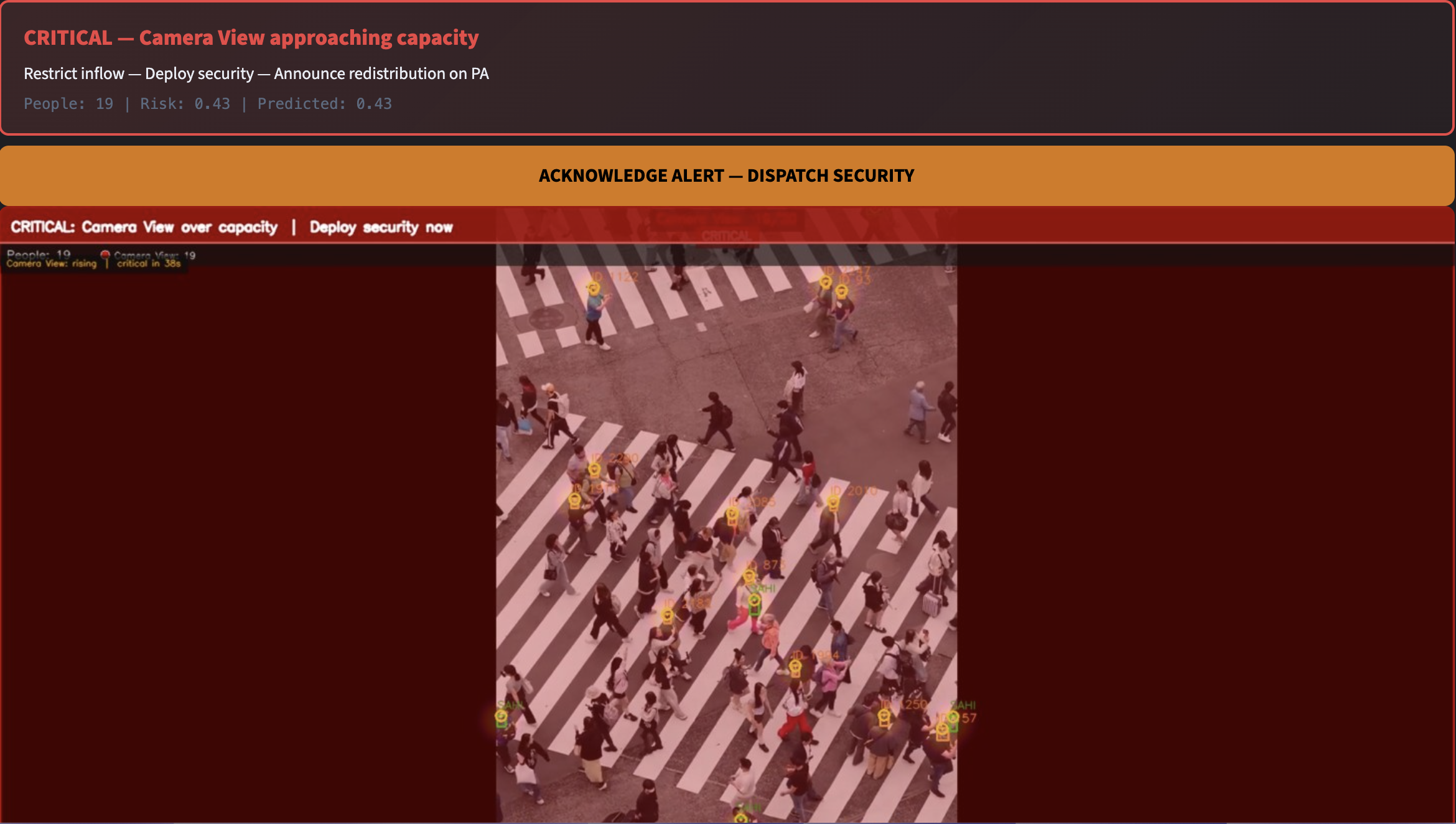
Also please note: In our demo video, the system triggers a CRITICAL alert on a busy crossing - this is intentional. We set the zone capacity threshold low (10 people) to demonstrate how the alert and operator action pipeline activates. In production, thresholds would be calibrated to each venue's actual safe capacity based on fire code and venue specifications. The threshold is fully adjustable by the operator through the dashboard.
Inspiration
159 people died at Itaewon in 2022. The NSW Auditor-General found Sydney Trains rates platform overcrowding as a high strategic risk - but has no strategy to manage it. Crowd crushes don't happen suddenly. Density builds, movement conflicts form, and pressure accumulates near exits minutes before disaster. Existing tools measure crowds after the fact. Nobody predicts what happens next or tells operators what to do about it.
What it does
Spayce transforms existing CCTV feeds into real-time crowd risk intelligence across three layers:
Perception - Detects and tracks every individual using YOLOv8 with SAHI sliced inference and ByteTrack persistent tracking. We switched from full-body detection to face detection to handle dense crowd occlusion, improving detection from 12 to 41 people in a packed crossing.
Prediction - Inspired by BINTS (KDD 2025, KAIST), we combine per-zone density signals with inter-zone flow signals using Gaussian temporal weighting to forecast crowd pressure 15 seconds ahead. The system generates time-to-critical estimates and risk trends (stable / increasing / surging).
Execution - When predicted density crosses a threshold, the system generates specific operator actions: close entry, deploy security, PA announcement, open alternate routes. These match real crowd management protocols validated with security professionals.
How we built it
Python and Streamlit with modular architecture. Detection uses YOLOv8 with a HuggingFace face detection model and SAHI for sliced inference on dense scenes. ByteTrack handles persistent ID tracking. The bi-modal prediction layer adapts the core insight from BINTS - combining node-oriented (density) and edge-oriented (flow) time series for improved crowd forecasting. The risk score is a weighted combination of normalised signals:
$$R = \mathrm{clamp}_{[0,1]} \left( \sum_i w_i t_i \right)$$
Analytics use NumPy, Pandas, and Plotly. Reports generated with ReportLab.
Challenges we ran into
Standard YOLOv8 trained on COCO detected only 12 people in a dense crossing - overlapping bodies get merged into single detections. We pivoted to face detection (faces remain visible even when bodies overlap) and added SAHI sliced inference, tripling detection to 41 people. Tracking stability was 0.00 with BoTSORT - switching to ByteTrack and tuning the pipeline achieved stable persistent IDs with ID switches dropping from 221 to 29.
Customer validation
Andrew Tatrai, PhD - founder of Dynamic Crowd Measurement (winner of the 2025 GSIC x Microsoft Sports-Tech Innovation Challenge) and ACESGroup (46 years in crowd management) - confirmed the prediction and execution gap and offered to explore a partnership. We conducted 4 commuter interviews. We validated operator actions with security professionals (on reddit r/securityguards) who confirmed our recommendations match real crowd crush response protocols. Meeting with Andrew scheduled this Thursday at his Redfern office.
Accomplishments that we're proud of
We built a full end-to-end system from video input to actionable operator guidance - detection, tracking, heatmaps, zone analysis, bi-modal prediction, risk scoring, operator actions, and PDF reporting. The three-layer architecture (perception, prediction, execution) addresses a gap that industry leaders confirmed no existing product fills.
What we learned
Safety systems need clarity and trust, not just accuracy. We also learned that the real product gap isn't detection - it's prediction and execution. DCM can already measure density. What's missing is telling operators what's about to happen and what to do about it. That insight, validated by a PhD founder with 46 years in the industry, shaped every technical decision we made.
What's next for Spayce
Twilio SMS dispatch for real-time guard notification. React frontend replacing Streamlit for production-grade real-time alerts. Integration with venue access control APIs (Kisi/Verkada) for automated gate lockdown. Piloting on DCM's existing venue camera infrastructure, starting with a meeting this Thursday.


Log in or sign up for Devpost to join the conversation.