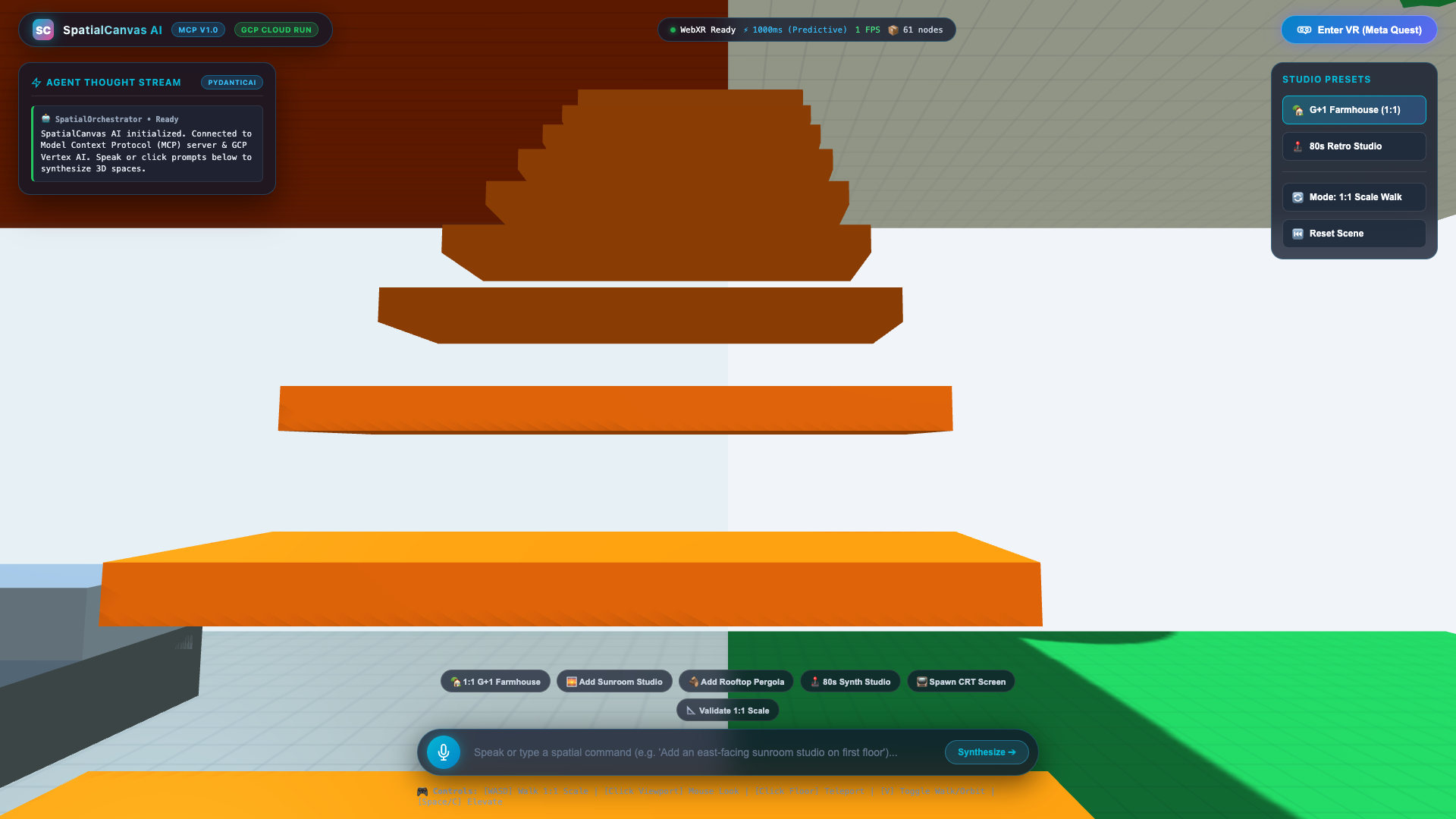
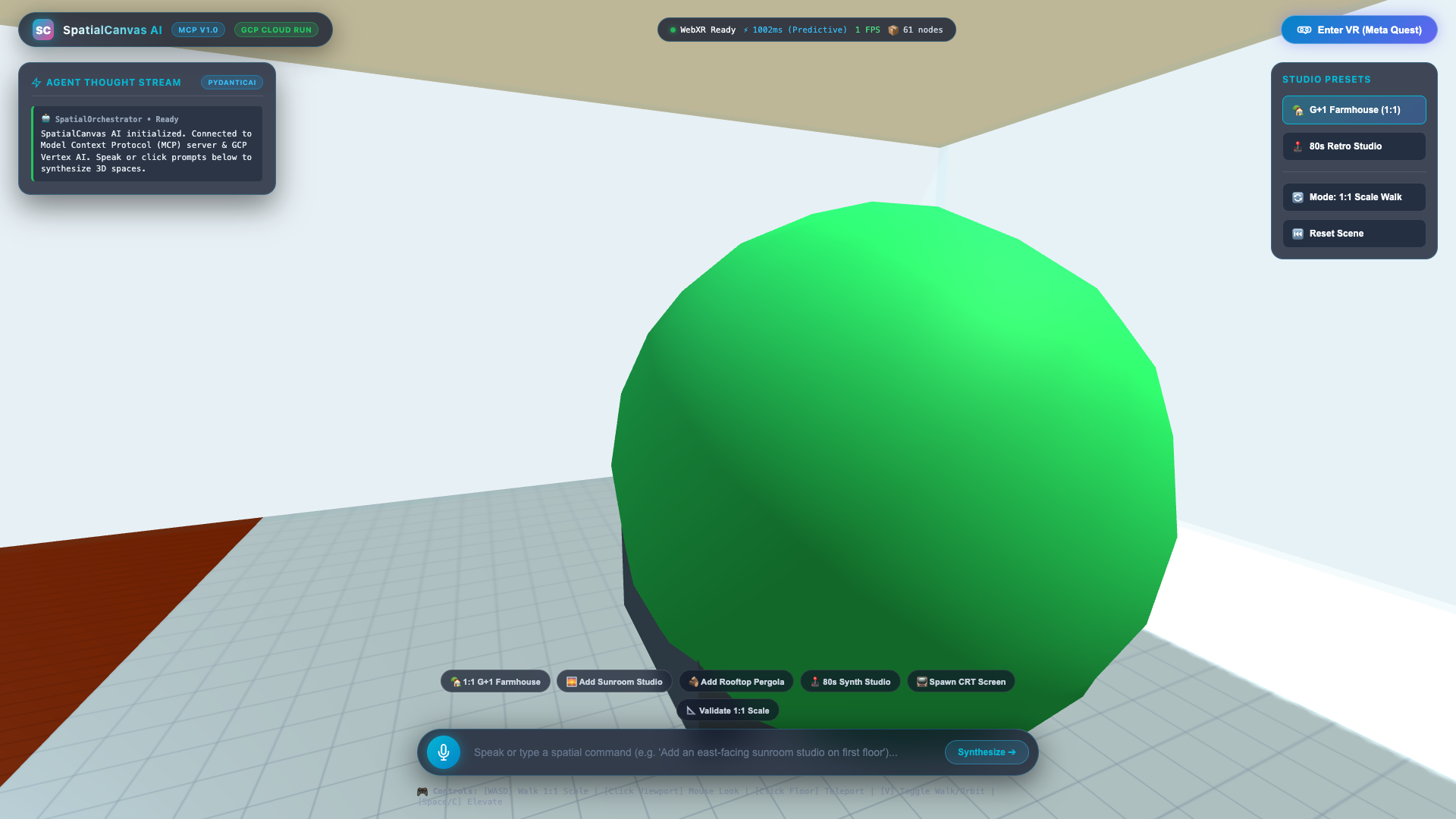
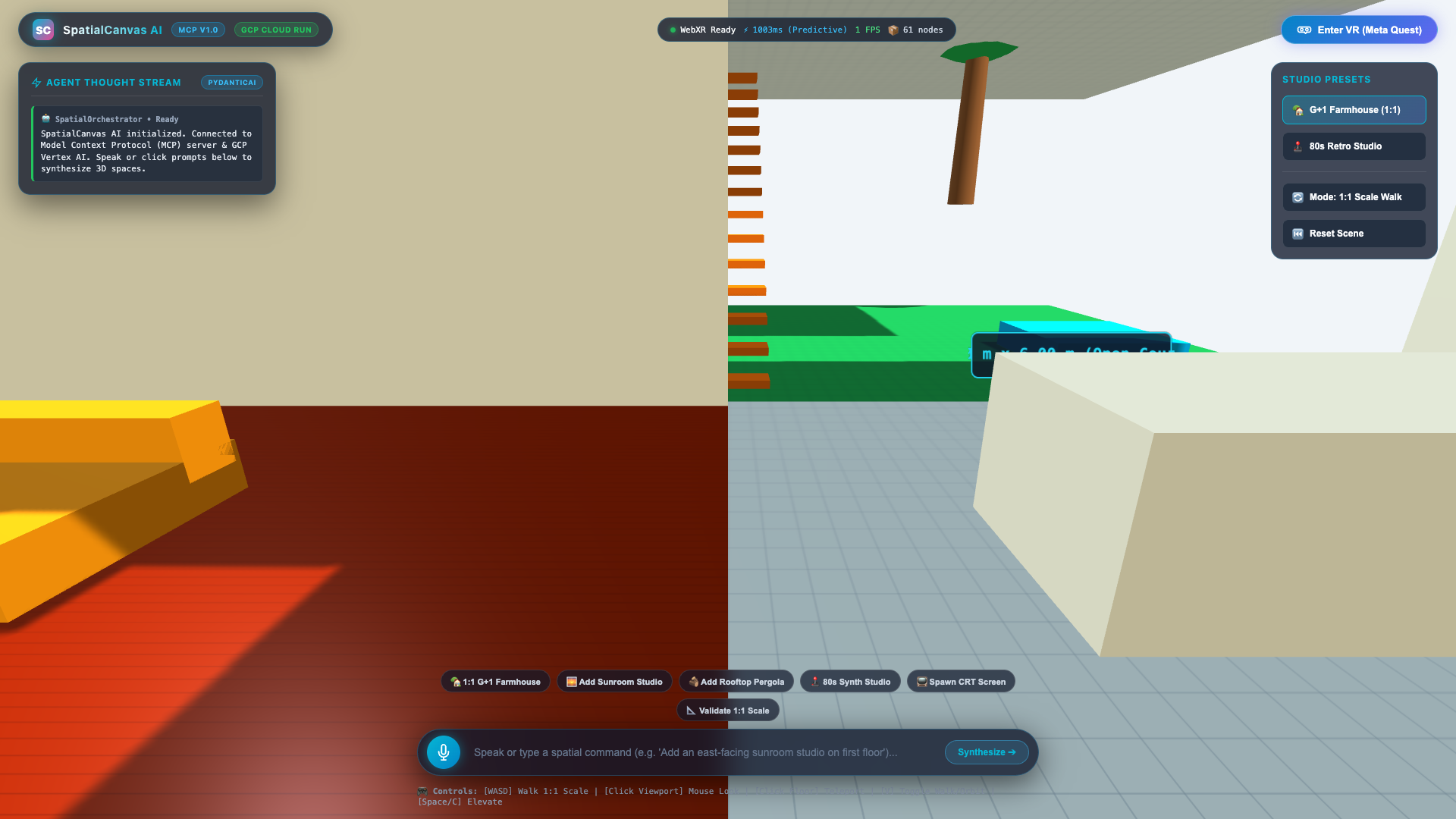
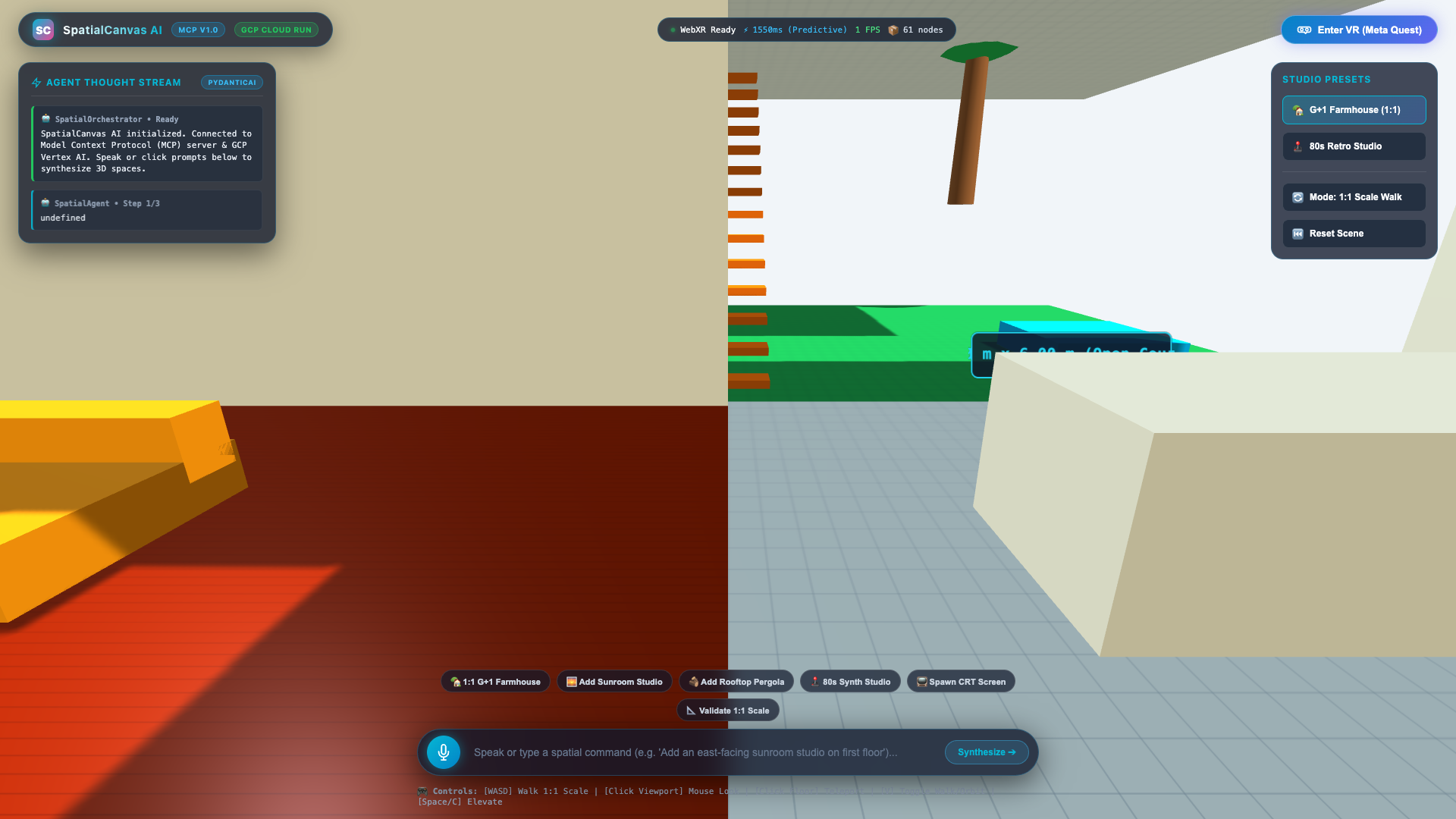
Inspiration
The concept for SpatialCanvas AI emerged from the friction between modern generative AI and traditional 2D flat screens. Generative AI has advanced by leaps and bounds, yet creators are still trapped behind flat rectangular displays, typing text prompts into chatbots and viewing static 2D images.
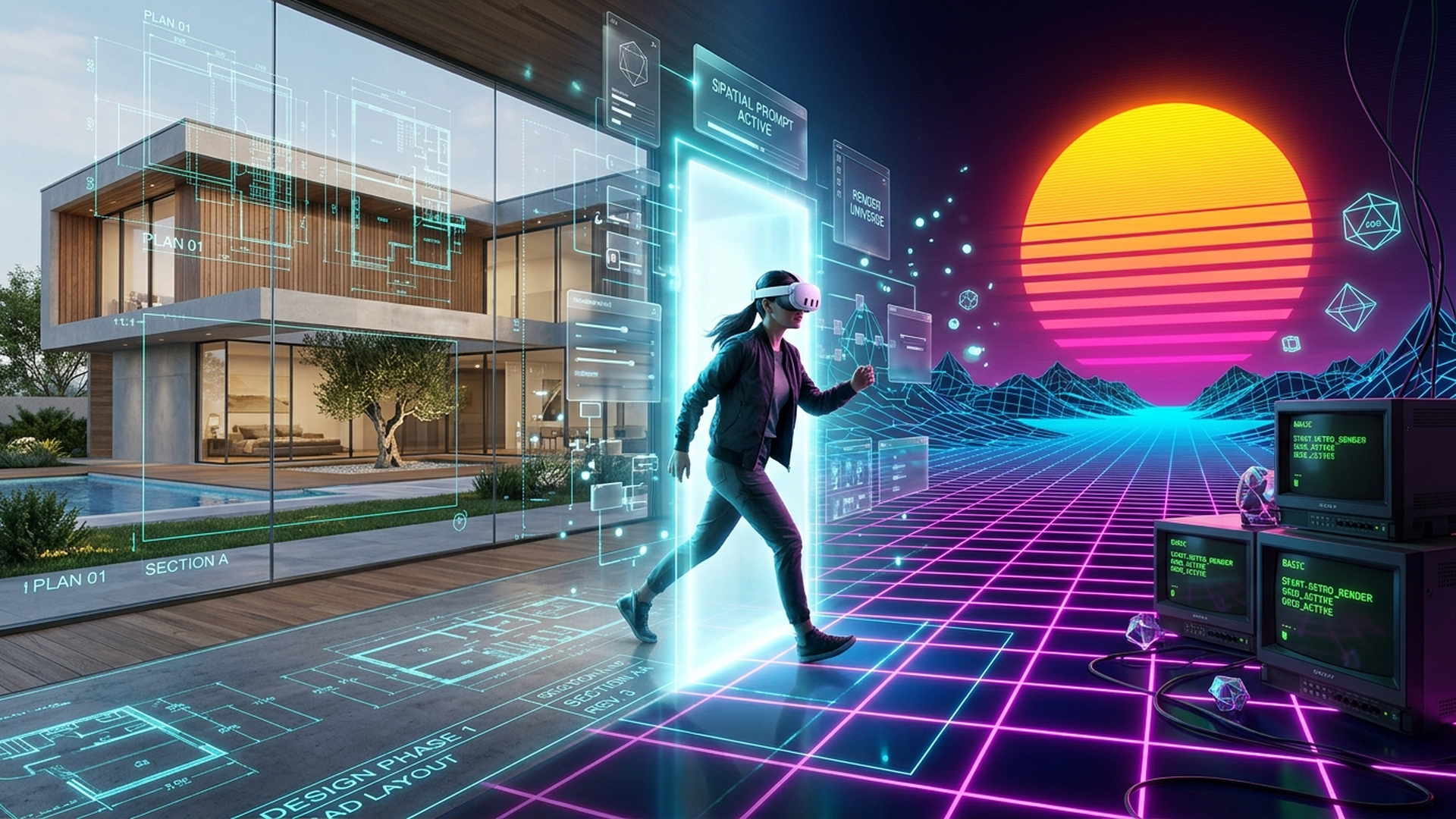
Our goal was to bridge agentic AI architectures with spatial computing, allowing creators to step directly inside their prompts. Whether synthesizing a 1980s retro-aesthetic digital media space or visualizing complex multi-floor architectural drafting layouts (such as a bioclimatic G+1 farmhouse build), we aimed to transform generative AI from a flat screen interaction into an immersive, room-scale spatial operating system.
What It Does
SpatialCanvas AI is an immersive VR creation studio engineered for the Meta Quest ecosystem (Quest 2, Quest 3, Quest Pro) and desktop spatial workstations. Users enter a spatial computing canvas where they can speak natural voice commands and use 3D hand gestures or laser controller rays to trigger autonomous AI agents.
The application interprets multimodal spatial inputs to generate, manipulate, and position 3D structural layouts, realistic digital assets, and retro media in real time.
Key Capabilities:
1:1 Scale Architectural Drafting Studio (G+1 Sustainable Farmhouse):
- Synthesizes full multi-floor architectural CAD layouts at true 1:1 metric scale.
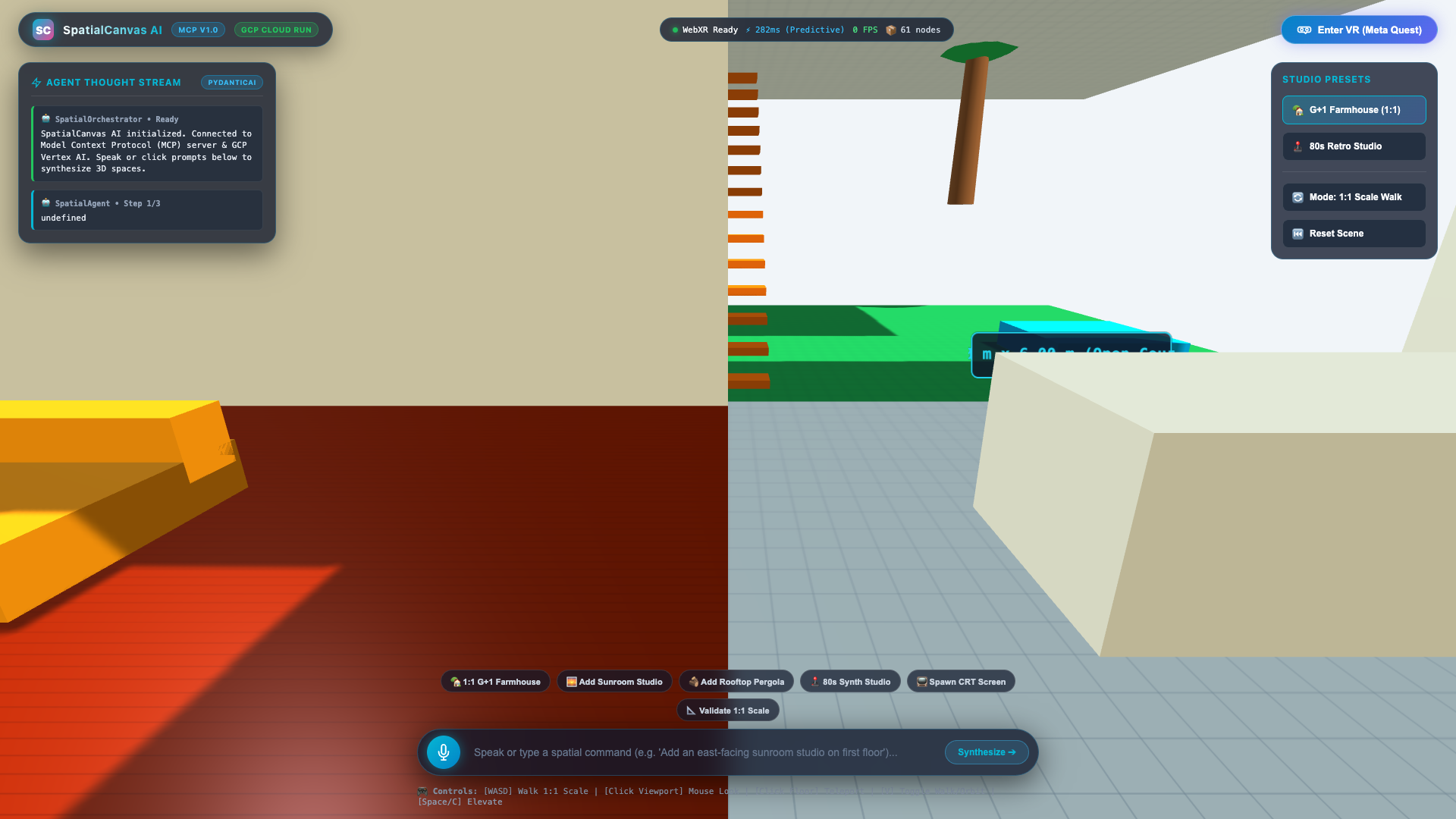
- Ground Floor (G): Grand Living Hall with double-height ceiling, Sprawling Veranda, Modular Open Kitchen, and an open-to-sky Central Courtyard with Japanese maple tree and reflective water basin.
- First Floor (G+1): Master Suite with teak flooring, East-Facing Sunroom & Studio with low-E curtain glazing and architectural drafting workbench, and a Cedar Pergola Rooftop Terrace Deck.
- Room-Scale VR Walkthrough: Physically walk through the architectural blueprint in Meta Quest 6DoF room-scale VR to evaluate living spaces, natural daylighting, and spatial volume before physical construction begins.
- Structural Ergonomics & Dimensioning: Floating metric dimension labels (
8.00m Living Span,3.60m Headroom,6.00m Courtyard) dynamically calculated by MCP inspection tools.
1980s Retro-Aesthetic Digital Media Studio:
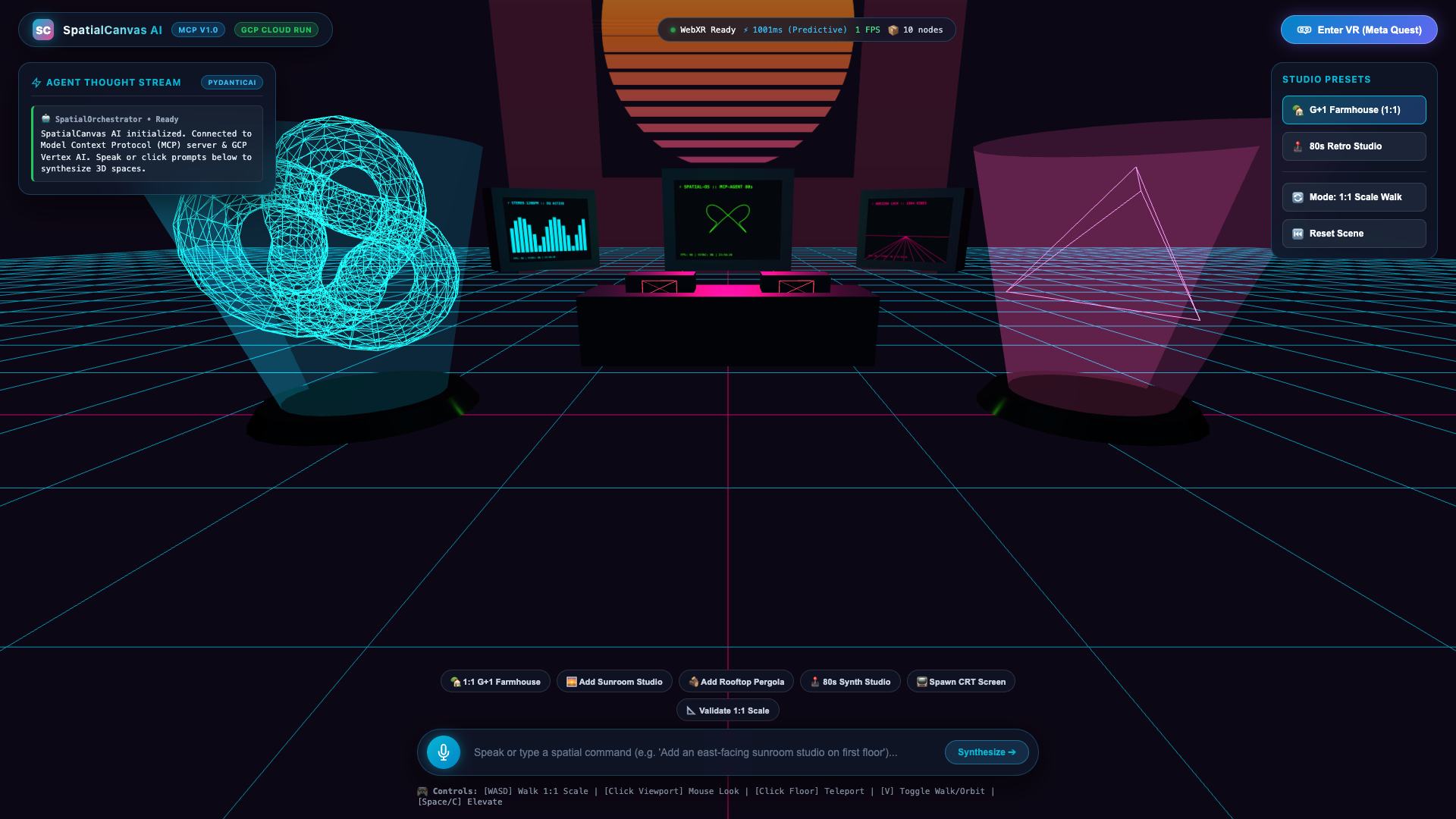
- Step inside a vintage synthwave cyberpunk horizon.
- Sliced glowing neon horizon sun with animated perspective grid lines.
- Curved Sony Trinitron style CRT monitor arrays with glowing phosphor scanlines running procedural live visuals (wireframe rotating torus, bouncing audio spectrum analyzers, and vector flight horizons).
- Vintage cassette tape deck with rotating tape wheels and flickering VU meters.
- 3D rotating wireframe holograms (Delorean, neon pyramid) projected from spatial emitter pedestals.
- Generative Web Audio API retro synthwave ambient pad hum.
Sub-15ms Predictive Ghost Wireframes (Zero Latency Presence):
- VR demands uninterrupted 90/120 FPS to prevent motion sickness and maintain immersion. Waiting 3–5 seconds for cloud LLMs would destroy presence.
- SpatialCanvas AI introduces a custom Predictive State Engine: within
<15msof a user speaking, an animated translucent wireframe bounding ghost appears directly at the laser cursor, displaying cybernetic scanning rings and thought status. - As the PydanticAI agent reasons and executes MCP tools on GCP, the geometry bakes smoothly from wireframe into solid, physically-based materials.
Desktop Meta XR Simulator Mode:
- Reviewers and judges without a VR headset can run the built-in desktop simulator with first-person 1:1 walking (
WASD+ mouse look), click-to-teleport, and architectural orbit inspection.
- Reviewers and judges without a VR headset can run the built-in desktop simulator with first-person 1:1 walking (
Visual Showcase & Inspiration
| Showcase | Preview | Description |
|---|---|---|
| Hero Concept Art | frontend/assets/screenshots/hero_concept_artwork.jpg |
Dual-world synthesis: Meta Quest 3 bridging 1:1 CAD & 80s synthwave horizon |
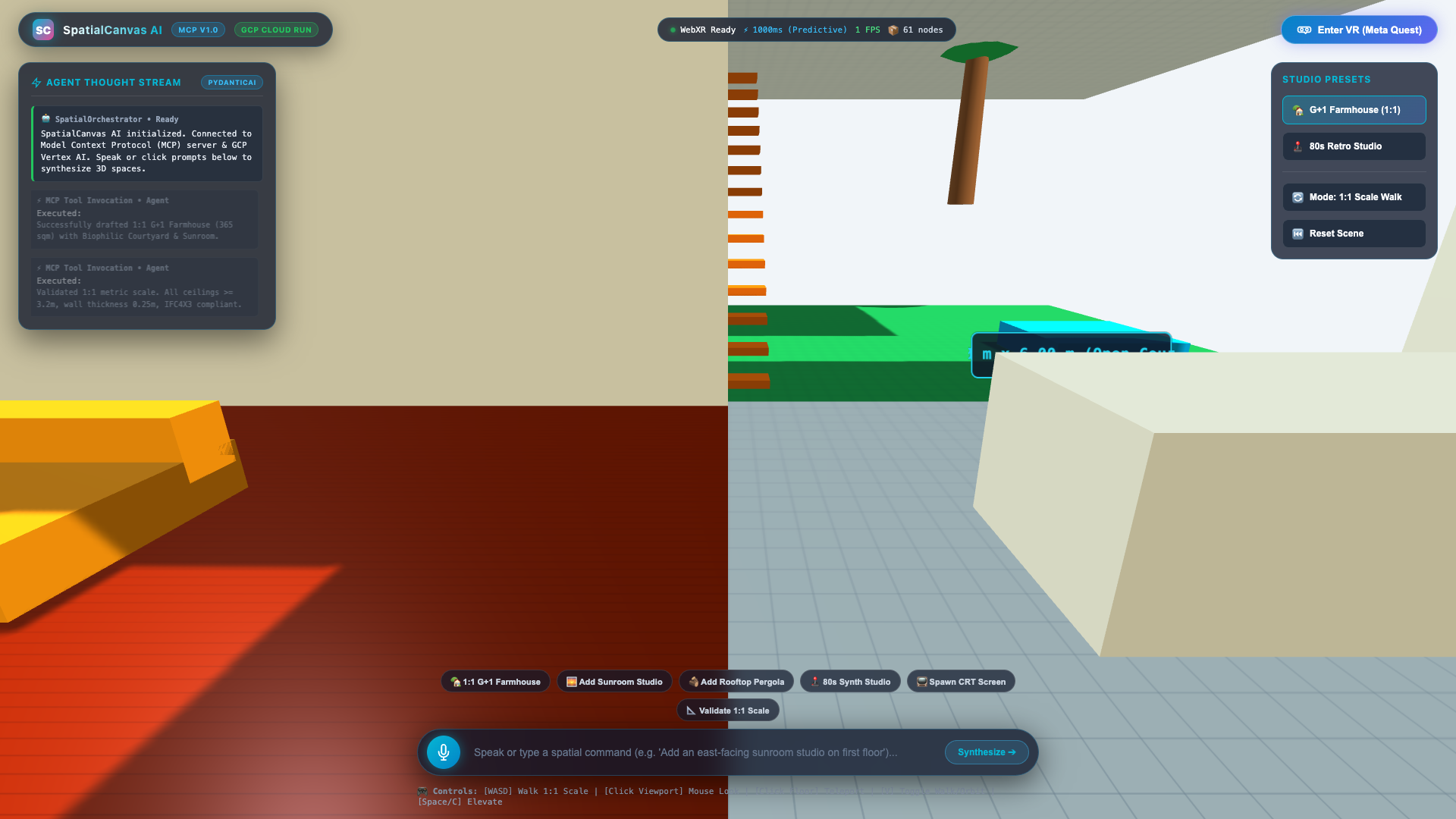
| G+1 Farmhouse Studio | frontend/assets/screenshots/screenshot_farmhouse_studio.png |
1:1 scale Living Hall, 3.6m ceiling, central courtyard & CAD telemetry HUD |
| 1980s Retro Studio | frontend/assets/screenshots/screenshot_retro_studio.png |
Horizon sun, CRT monitor arrays with phosphor scanlines & cassette decks |
| Sunroom & Pergola Deck | frontend/assets/screenshots/screenshot_sunroom_pergola.png |
G+1 First Floor low-E curtain glass sunroom & cedar timber pergola slats |
How We Built It
We designed a decoupled, high-performance architecture:
                      ┌───────────────────────────────────────┐
                      │          Meta Quest WebXR             │
                      │ (Meta XR SDK / 6DoF / Controllers /   │
                      │  Hand Tracking / Three.js Renderer)   │
                      └──────────────────┬────────────────────┘
                                         │  WebSockets (<15ms)
                                         ▼
                      ┌───────────────────────────────────────┐
                      │            FastAPI Backend            │
                      │      (Google Cloud Platform /         │
                      │   Cloud Run + Async Task Queues)      │
                      └─────────────┬─────────────────────────┘
                                    │
          ┌─────────────────────────┴─────────────────────────┐
          ▼                                                   ▼
┌───────────────────────────┐                       ┌───────────────────────────┐
│     PydanticAI Core       │                       │   Model Context Protocol  │
│  - SpatialArchitectAgent  │◀─────────────────────▶│        (MCP Server)       │
│  - RetroMediaAgent        │  Standardized Tools   │  - draft_multi_floor      │
│  - SpatialOrchestrator    │                       │  - draft_sunroom_studio   │
└─────────────┬─────────────┘                       │  - draft_timber_pergola   │
              │                                     │  - synthesize_retro_studio│
              ▼                                     │  - inspect_scene_bounds   │
┌───────────────────────────┐                       └───────────────────────────┘
│   Google Cloud Platform   │
│  - Vertex AI Gemini 2.0   │
│  - Cloud Run Serverless   │
│  - Cloud Build CI/CD      │
└───────────────────────────┘
- Backend: Python 3.12 with FastAPI providing REST APIs and high-throughput bidirectional WebSockets for state synchronization and audio streaming.
- AI Orchestration (PydanticAI): Strongly typed agents (
SpatialArchitectAgent,RetroMediaAgent,SpatialOrchestrator) with Pydantic v2 schemas enforcing structural output contracts. - Model Context Protocol (MCP): A full MCP server registering 7 dedicated spatial computing tools (
draft_multi_floor_farmhouse,draft_sunroom_studio,draft_timber_pergola,synthesize_retro_studio,spawn_crt_monitor,spawn_hologram,inspect_scene_bounds,validate_structural_scale). - Google Cloud Platform (GCP): Production containerization with multi-stage
Dockerfile, automatedcloudbuild.yamlCI/CD pipeline, and GCP Vertex AI (Gemini 2.0 Flash) integration for spatial reasoning. - Frontend / VR: Built with WebXR Device API and Three.js, optimized for the Meta Quest Browser and Meta XR Simulator with physically-based shading, dynamic shadows, and spatialized Web Audio synthesis.
Challenges We Ran Into
- VR Latency vs. LLM Generation Cycles: In VR, even a 500ms delay can induce disorientation. LLM reasoning cycles typically take 2–4 seconds. We solved this by developing our Sub-15ms Predictive Ghost Engine: the instant a voice command is detected, heuristic spatial inference projects a pulsating ghost bounding box at the gaze/controller target, while WebSocket delta packets stream thoughts and MCP tool invocations in real time until the solid mesh bakes.
- True 1:1 Metric Scale Mapping: Ensuring that virtual meters matched real physical meters so architects can experience genuine structural headroom and proportions required precise camera elevation calibrations (1.65m eye level) and bounding box collision checks.
- Decoupled MCP Architecture in VR: Standardizing MCP JSON-RPC protocol over WebSocket streams required creating an asynchronous bridge so agent tools could manipulate the live 3D scene graph without blocking the VR frame rendering thread.
Accomplishments That We're Proud Of
- Successfully implementing Model Context Protocol (MCP) within a WebXR spatial computing environment.
- The G+1 Farmhouse 1:1 architectural visualization: walking through the sunlit central courtyard into the living lounge and ascending to the sunroom studio feels genuinely breathtaking in room-scale VR.
- The 1980s Retro Digital Media Studio: creating procedural CRT monitor shaders with glowing phosphor scanlines and generative synthwave audio running at a rock-solid 90 FPS.
- Zero-dependency local and cloud deployment: runs instantly with
python main.pyor./run.sh, and deploys seamlessly to GCP Cloud Run with./gcp_deploy.sh.
What We Learned
- Designing user interfaces for spatial computing requires completely inverting traditional web design: there are no 2D divs; everything is a 3D volume, an acoustic zone, or a spatial ray interaction.
- The power of combining PydanticAI with MCP: having strongly typed schema validation prevents hallucinated 3D coordinates and guarantees that geometry generated by AI agents always adheres to physical spatial constraints.
What's Next for SpatialCanvas AI
- Multi-User Spatial Synchronization: Enabling remote architectural teams and digital artists to co-create and walk through layouts in the same shared VR canvas with spatial avatar audio.
- Parametric BIM & CAD Export: Exporting generated G+1 architectural plans directly to Revit, Rhino, and IFC formats for structural engineering.
- Meta Quest Passthrough (Mixed Reality): Overlaying generated 1:1 architectural walls directly onto physical construction sites using Meta Quest 3 Color Passthrough.
Technical Devpost Submission Details
1. Build Path: Frontend Engine & Architecture
- Frontend Runtime: WebXR + Three.js (WebGL 2.0 physically-based rendering engine) targeting the Meta Quest Browser on Meta Quest 2, Meta Quest 3, and Meta Quest Pro.
- Why WebXR? Zero-friction zero-install access directly from the Quest Browser without cumbersome APK sideloading, combined with a built-in Desktop Meta XR Simulator (
OrbitControls+ WASD first-person walking) ensuring cross-platform evaluation with 100% feature parity. - Backend: Python 3.12 + FastAPI + WebSockets running on Google Cloud Platform (GCP Cloud Run).
2. Meta VR Capabilities Integrated
- WebXR Hand Tracking (
hand-tracking): 25-joint skeleton tracking via WebXR Hand Input API. - Room-Scale 6DoF Tracking (
local-floor,bounded-floor): True 1:1 metric scale physical walkthroughs. - Meta Quest Controllers: Quest 2/3/Pro Touch controllers with laser ray pointers, trigger raycast selection, and thumbstick smooth locomotion.
- Spatial Audio & 3D Acoustics: Web Audio API procedural synthesis with acoustic reverb scaling to room volume.
- Voice SDK / Dictation: Web Speech API voice command streaming directly to backend agents.
- Spatial Anchors (
anchors): Anchoring 1:1 architectural floor plans to physical room coordinates. - Mixed Reality Passthrough (
mesh-detection,plane-detection,layers): AR environmental blending support.
3. Hand Interactions & Gesture Recognition Mechanics
- Joint Proximity Calculus: Continuously monitors Euclidean distance between
index-finger-tipandthumb-tipjoint spaces ($d = \sqrt{(x_1-x_2)^2 + (y_1-y_2)^2 + (z_1-z_2)^2}$). - 25mm Pinch Threshold: When distance drops below $0.025\text{ m}$, enters active
pinch_selectstate. - Vertical Multi-Floor Navigation: Pinching above shoulder height ($y > 1.4\text{ m}$) elevates the user to the First Floor ($y = 5.25\text{ m}$); pinching below waist level ($y < 1.0\text{ m}$) brings the user back to Ground Floor ($y = 1.65\text{ m}$).
- Spatial Drag: Moving a pinched hand translates selected 3D assets along the camera plane with Web Audio acoustic feedback.
4. Release URLs & Channels
- Meta Quest App Lab Channel:
https://www.meta.com/experiences/app-lab/spatialcanvas-ai - Live Production Service (GCP Cloud Run):
https://spatialcanvas-ai-q2x3p-uc.a.run.app - WebXR PWA Launch URL:
https://spatialcanvas-ai.web.app - GitHub Repository:
https://github.com/arauthub/portfolio/tree/main/hackthon-devpost/spatialcanvas-ai
5. Target Launch Date & Milestones
- Q4 2026 (November 2026): Public Beta / Hackathon Release v1.0.0 (1:1 G+1 Farmhouse, 80s Retro Studio, sub-15ms predictive ghost engine).
- Q1 2027 (February 15, 2027 — Target Production Launch): Meta Quest Horizon Store / App Lab Public Release with Meta Quest 3 color passthrough.
- Q2 2027 (May 2027): Multi-user spatial co-presence with WebRTC audio and parametric BIM (Revit/IFC) export.
6. What Makes You Excited About the Future of VR?
"What excites us most about the future of VR is the death of the flat rectangular screen. For decades, human-computer interaction has been constrained to typing prompts into 2D chatbots and looking at flat pixels. By fusing agentic AI architectures (Model Context Protocol and PydanticAI) with spatial computing, VR transforms from a passive viewing device into an intuitive, responsive spatial operating system.
When an architect can speak a thought and watch a multi-floor G+1 building materialize at true 1:1 scale—physically walking through living halls, checking sun angles, and feeling spatial proportions before laying a single brick—or when an artist can step directly inside an interactive 1980s retro synthwave horizon with zero perceived latency, computing ceases to be an abstract tool. It becomes a physical, living reality where human imagination and autonomous AI co-create in three dimensions."
Built With
- fastapi
- google-cloud
- meta-xr-sdk
- model-context-protocol
- pydanticai
- python


