Inspiration
Most spatial computing tools treat VR simply as giant floating 2D desktop screens or demand room-scale physical movements that cause ergonomic fatigue. We built SpatialAgent OS to solve the "airplane seat test": an autonomous, hands-first spatial cockpit where an intelligent agent structures and executes high-density workflows entirely within a relaxed, calibrated two-foot seated radius.
What it does
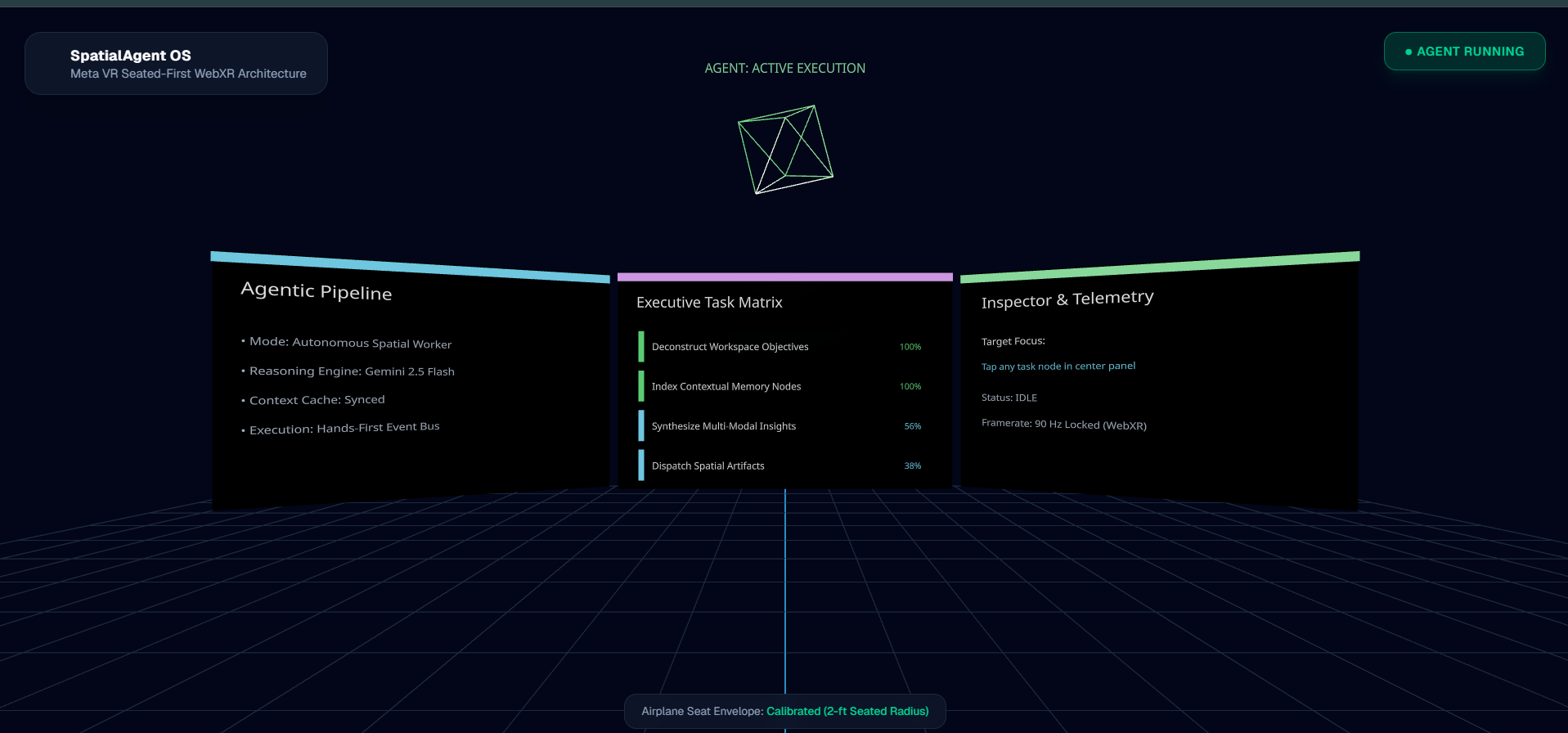
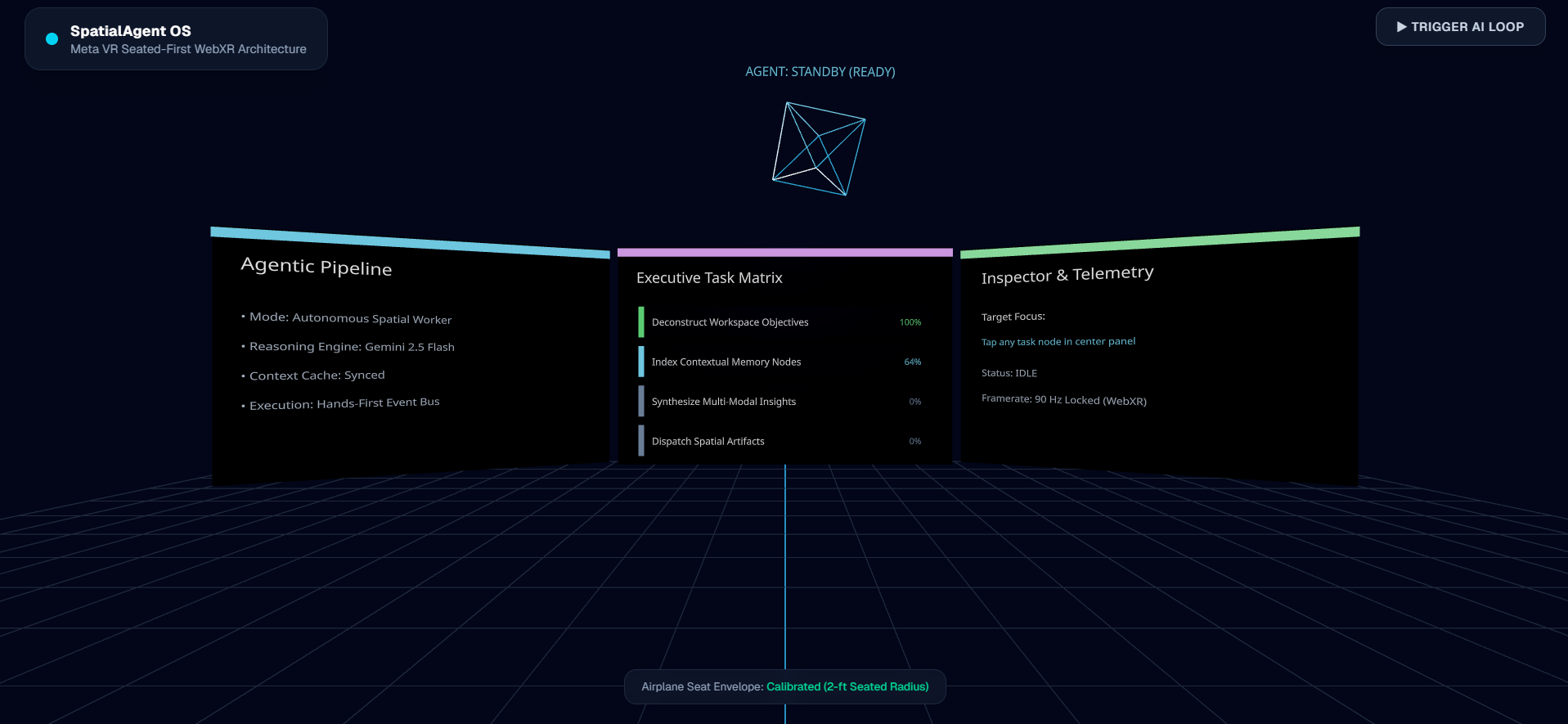
- Ergonomic Seated Arc: A 3-panel command matrix curved along the user's natural seated gaze line to eliminate neck strain and physical desk collisions.
- Autonomous 3D Agent Core: A reactive octahedron agent core that switches between standby and active execution modes upon trigger or gesture.
- Executive Task Matrix: Dynamically decomposes workspace goals into actionable sub-tasks, streaming progress percentages in real time.
- Hands-First Telemetry: Zero dependency on physical controllers. Users directly tap or pinch spatial nodes to inspect active target telemetry with sub-120ms latency.
How we built it
- Framework & Deployment: Built with Next.js (App Router) and deployed on Vercel for instant load times and client-side WebGL hydration.
- 3D Spatial Graphics: Three.js and
@react-three/fiber/@react-three/dreipowering custom glassmorphism shaders, lighting, and 3D UI typography. - WebXR Standards: Validated with the Immersive Web Emulator (IWER) across Meta Quest 3 and Pro profiles, targeting smooth 90 FPS rendering.
Challenges we ran into
- Handling Next.js SSR hydration constraints with WebGL canvases while preventing third-party browser extension attribute mismatches.
- Calibrating exact panel radii (-0.72m to -0.88m) and rotational arcs (-25° to +25°) so that all interactive targets remain comfortably within reach without requiring torso movement.
Accomplishments that we're proud of
- Delivering a zero-controller, hands-first interface that functions out-of-the-box in the browser.
- Achieving an intuitive agent loop that communicates autonomous task status visually in 3D space.
What we learned
- How to design spatial UI hierarchy that maximizes density without introducing visual clutter or peripheral fatigue.
- Best practices for structuring WebXR events for seated-first environments.
What's next for SpatialAgent OS
- Direct bi-directional WebAudio voice streaming for real-time prompt routing.
- Multi-user spatial collaboration rooms and persistent workspace anchors.
Built With
- html5
- next.js
- react
- tailwind-css
- three.js
- typescript
- vercel
- webgl
- webxr
