-
-
DashBoard
Inspiration
Every kid with ADHD knows the cycle: a new obsession arrives (Minecraft, cricket, dinosaurs) and for a few weeks it's the only thing that matters. Then the novelty fades, and with it goes the easiest motivation a parent or teacher ever had.
We kept watching adults fight homework battles with rewards that went stale in days. The insight that sparked SparkPath: the obsession isn't the distraction, it's the fuel. If you could wrap reading, chores and routines in whatever a child loves right now, and catch the moment that love starts fading, you could ride the cycle instead of fighting it.
What it does
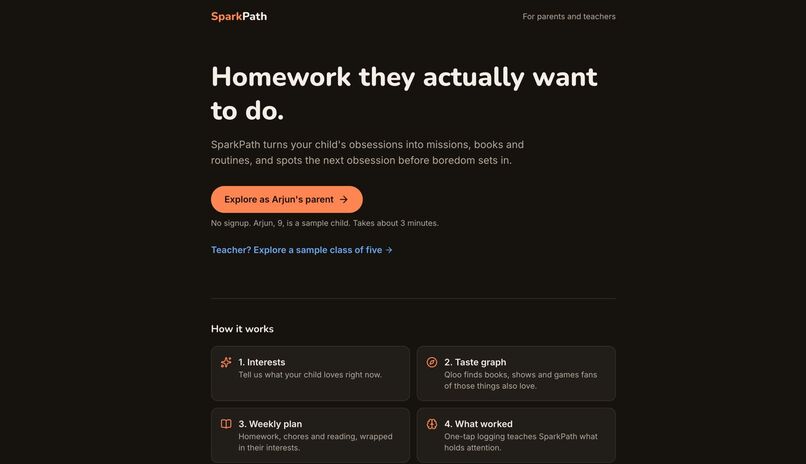
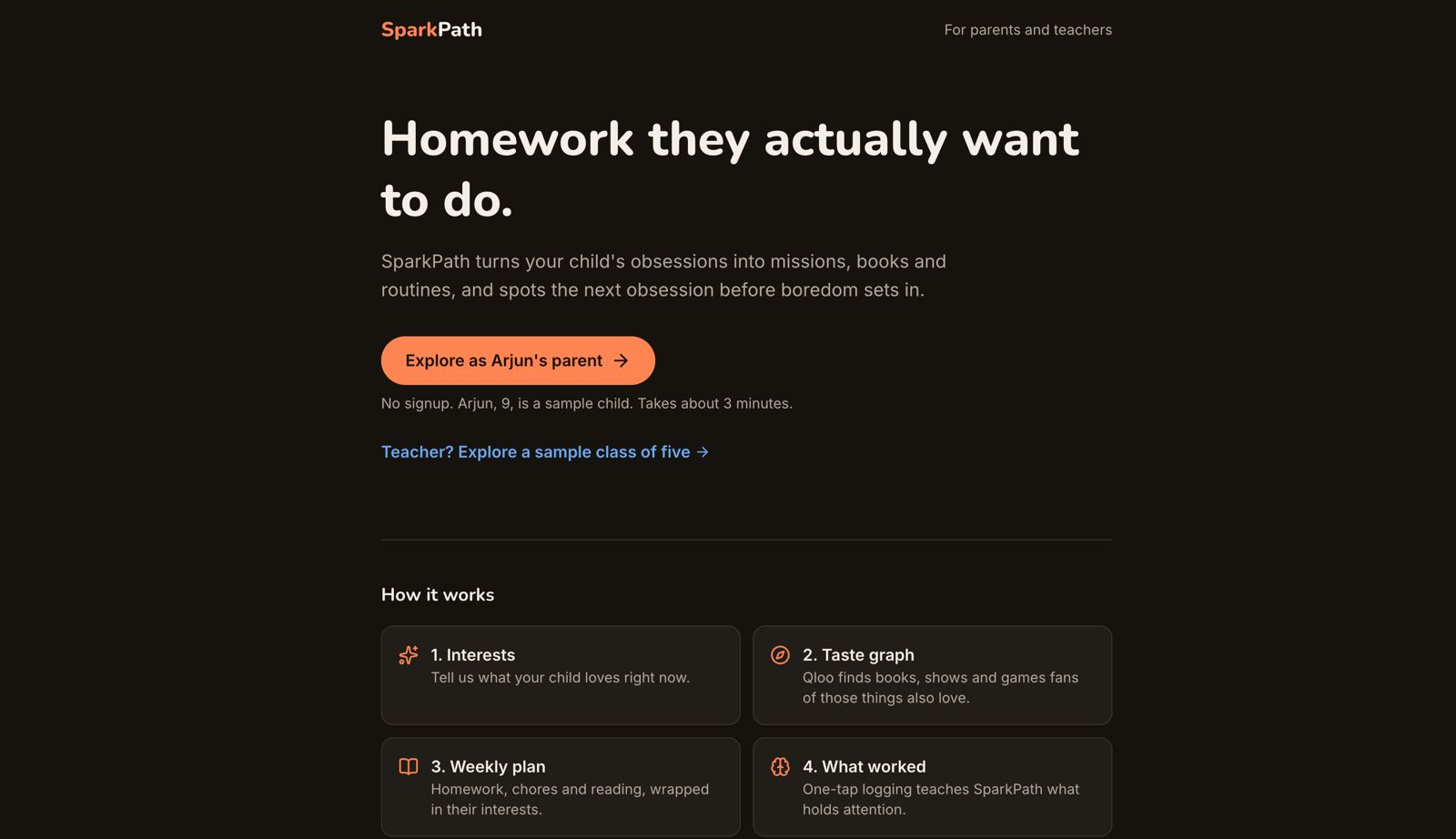
SparkPath is an interest engine for kids with ADHD, built for the adults around them. A parent gets a weekly plan where every mission is themed on the child's current interests: a warm-up movement break, two versions of each mission to choose between, rewards picked from the child's own taste profile, a reading list, a focus playlist and a weekend activity.
Logging takes one tap (Done, Partly, Skipped, Hard moment). Behind the scenes, an engagement scorer watches for the obsession fading and flags it with plain-language evidence, so the parent can rest, retry, or pivot to the next interest before boredom sets in. A school card keeps parent and teacher on the same daily targets, and the teacher view turns one lesson into a hook per child.
How we built it
SparkPath is one Next.js app (App Router, React, Tailwind, shadcn/ui) deployed on Vercel, with Neon Postgres storing profiles, logs and engagement scores through Drizzle. The brain is a Claude tool-use agent that writes each weekly plan, with a hard rule: every pick must ground to a real entity from Qloo's taste graph, fetched through the Qloo Insights API with a kid-safe lens. Hindsight provides one memory bank per child, so what held attention last month shapes this week's plan.
Reliability was a design goal, not an afterthought: without any API keys the whole app still runs on embedded PGlite, a local memory table and a mock Qloo catalog, so the demo never dies on stage. A safety layer keeps the product adult-only, filters age-fit, and lints every output for medical wording. We shipped 44 tests plus an evaluation harness for the planner.
Challenges we ran into
The hardest problem was trust. An agent that invents plausible-but-fake rewards is worse than no agent, so we built the grounding loop that forces every suggestion to resolve to a real Qloo entity, and a comparison mode that scores the AI against a plain baseline.
Fading detection was the second battle. Kids don't announce that an interest is dying, so we went through two versions of the scorer before it could flag fading with confidence and explain itself in words a tired parent actually wants to read at 8pm.
Accomplishments that we're proud of
The full loop works end to end: a one-click demo persona (Arjun, 9, deep into Minecraft and cricket, with three weeks of history) that anyone can explore without setup, live Qloo integration, and plans that read like they were written by someone who knows the kid.
We're also proud of the things that aren't flashy: the offline fallbacks that kept the demo alive no matter what, the teacher view that closes the home-school loop, and a safety layer that treats "not a medical product" as an enforced rule, not a disclaimer.
What we learned
Building with a taste graph taught us that recommendations for kids are a different problem than recommendations for adults: context, age-fit and novelty decay matter more than raw affinity. We also learned that agent reliability comes from constraints, not cleverness: the tighter the tools and grounding, the better the plans.
Most of all, we learned to design for the bad week, not the good one. Streaks and guilt mechanics collapse exactly when a child with ADHD needs the system most, so every flow in SparkPath assumes restarting is normal.
What's next for SparkPath
The roadmap starts with real accounts and onboarding with consent, topic interests mapped to Qloo tags, and bringing the Hindsight memory fully live so recall and reflection replace the local fallback. Printable mission cards with a QR back to logging, a visual timer for time blindness, and a calm weekly digest for parents are next in line.
The bigger piece is the planned gamified experience: Interest Seasons that rotate with the child's obsessions instead of wearing out, collectible badges and a sticker book (never streaks), reward tiers that come straight from the taste graph, a season-themed companion, and co-op family quests and class goals. No leaderboards between children, ever.
Built With
- anthropic-claude
- drizzle-orm
- hindsight
- neon
- next.js
- pglite
- postgresql
- qloo
- react
- shadcn-ui
- tailwind-css
- typescript
- vercel

Log in or sign up for Devpost to join the conversation.