Inspiration
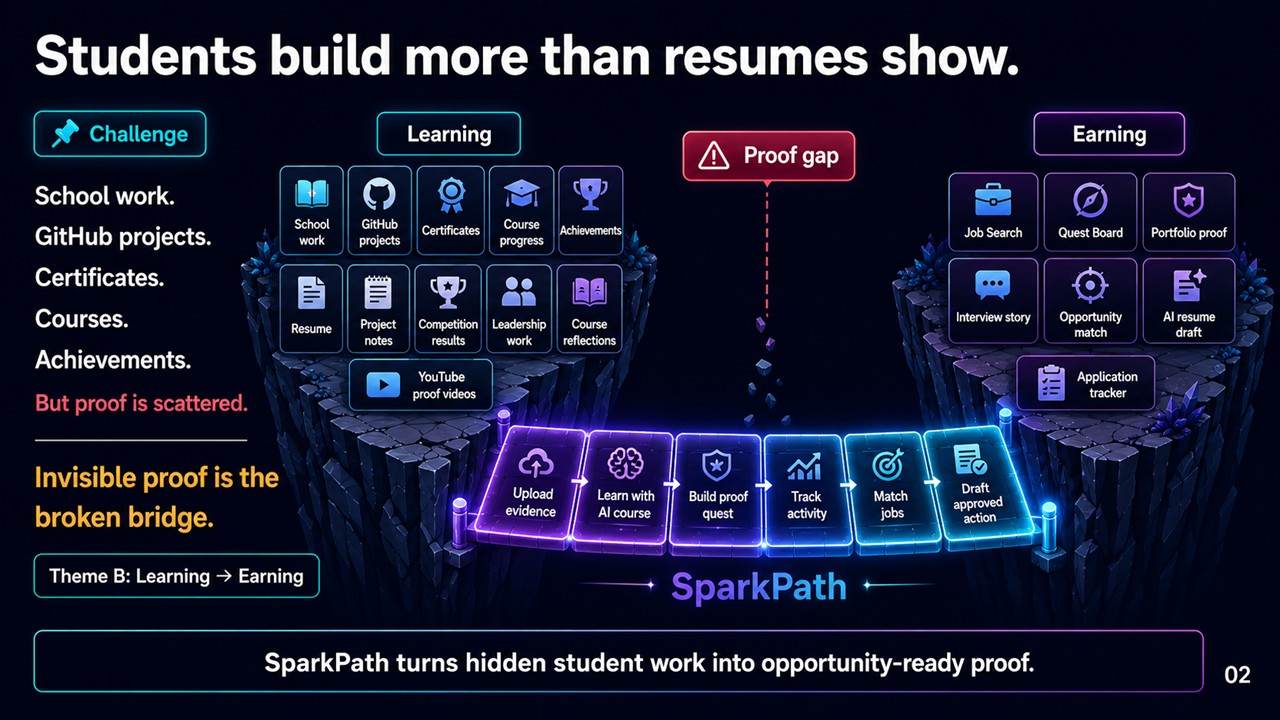
Students are not talentless. Their proof is invisible.
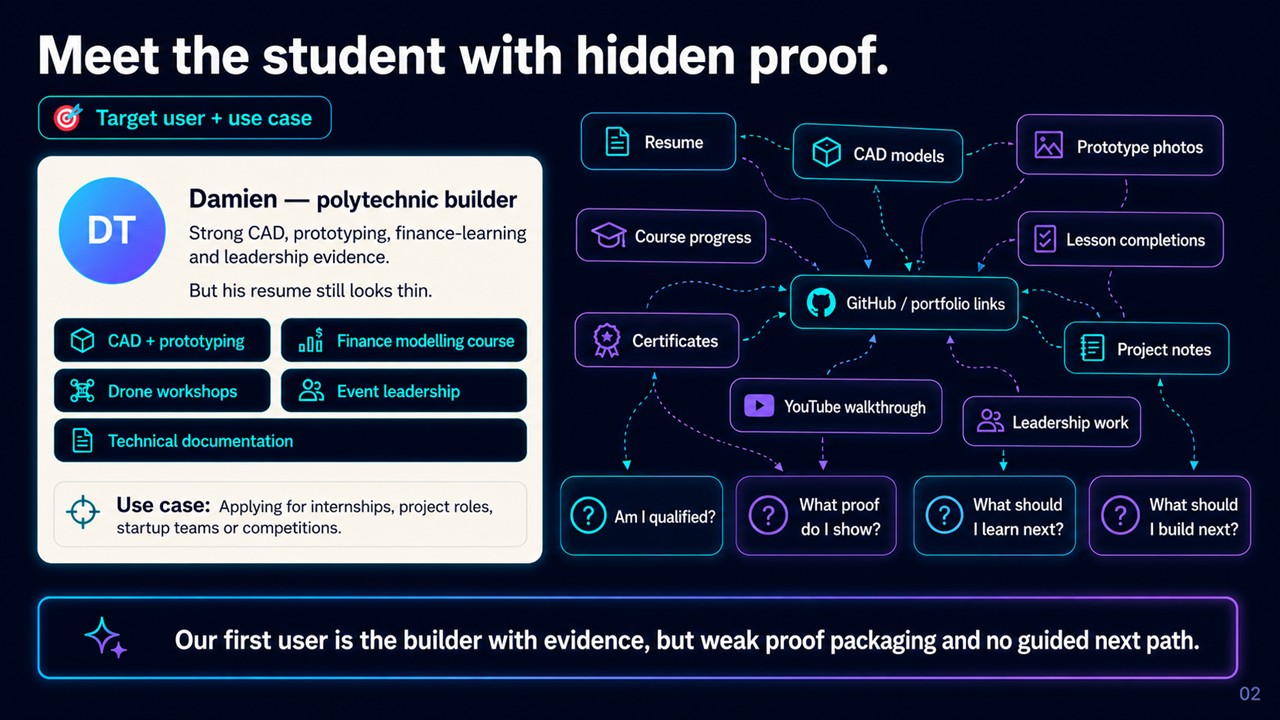
Many students build real skills through school projects, GitHub repos, certificates, hackathons, leadership roles, volunteering, course progress, and side projects. But when they apply for internships, freelance work, startup teams, competitions, or early career opportunities, that evidence is usually scattered across resumes, folders, screenshots, notes, links, and unfinished portfolios.
SparkPath was inspired by the broken bridge from learning to earning. Students may already have capability, but they often struggle to convert learning, evidence, and effort into credible proof that others can understand.
What it does
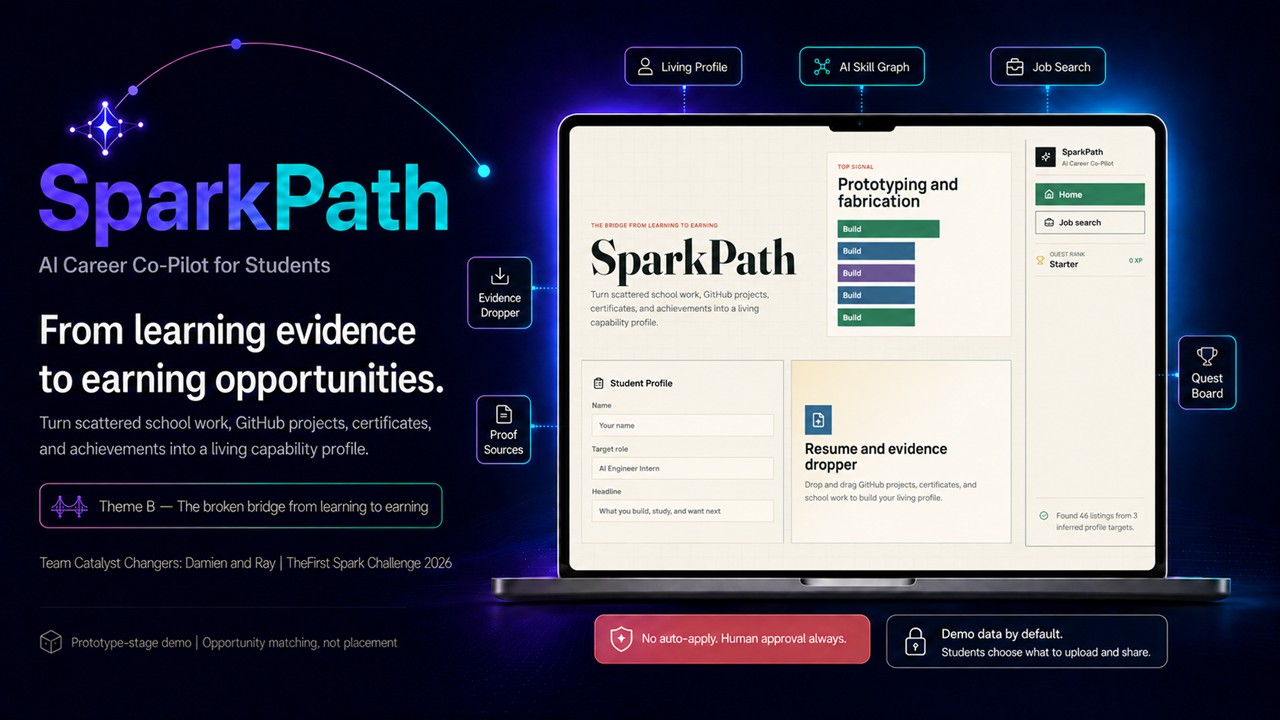
SparkPath is a proof-first AI Career Co-Pilot for Students.
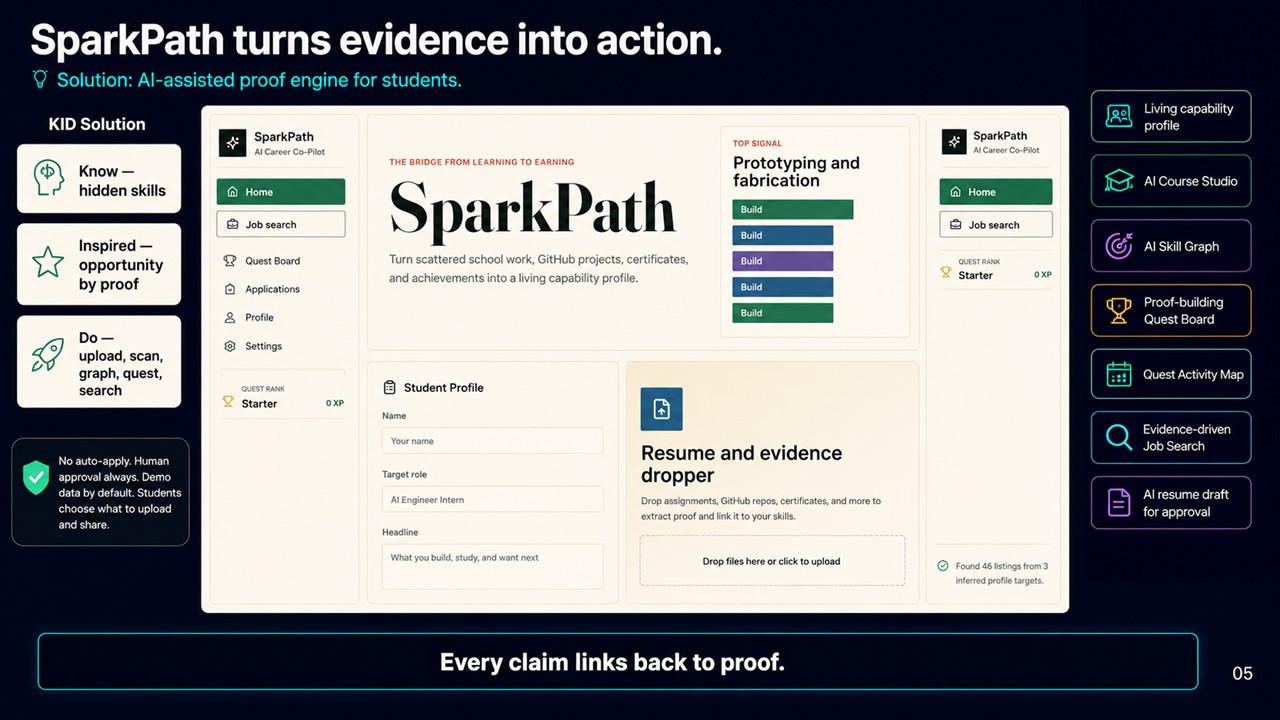
It turns a student’s messy portfolio — resumes, GitHub repos, certificates, school work, project notes, achievements, course progress, quest activity, and proof uploads — into a living capability profile and evidence-linked skill graph.
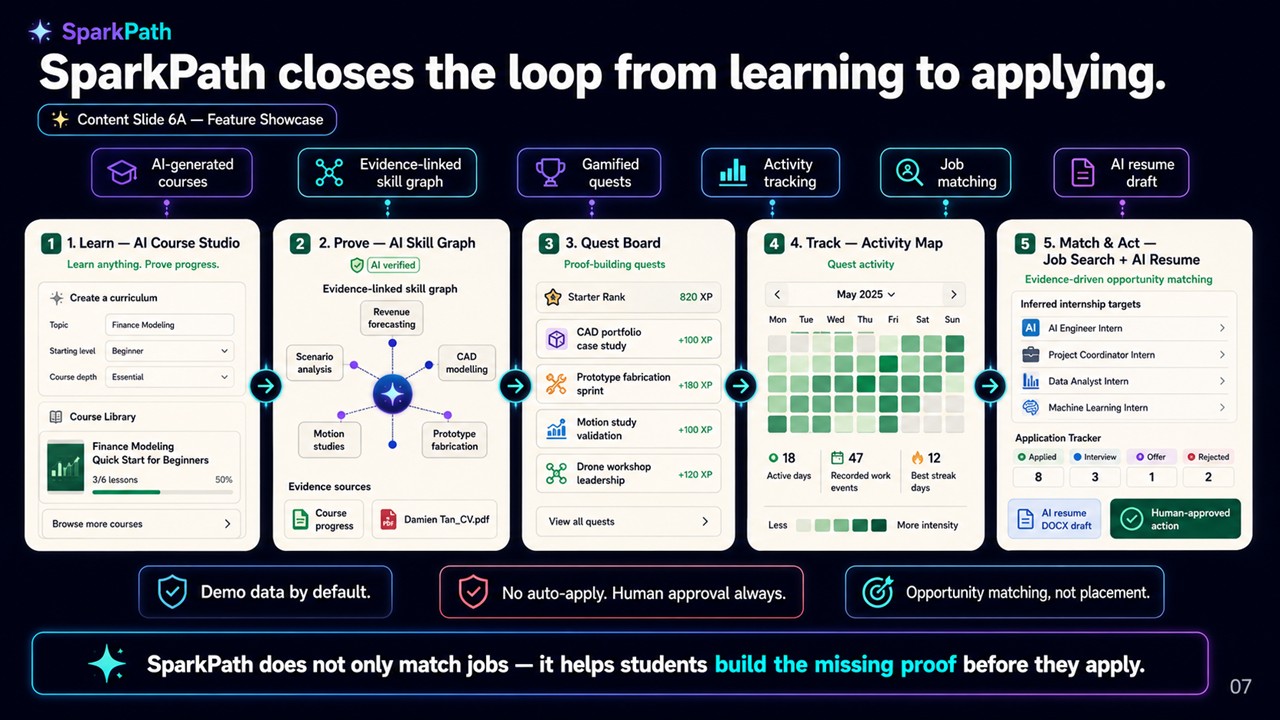
The prototype closes the loop from learning to applying:
Evidence Dropper — students upload or paste resumes, GitHub links, project notes, certificates, class work, competition results, leadership work, course reflections, and proof artifacts.
AI Skill Graph — SparkPath analyses the evidence and converts it into evidence-linked skill signals. Instead of only saying “good at CAD” or “good at finance,” it links skills back to sources such as course progress, CV evidence, project proof, or uploaded work.
AI Course Studio — students can generate personalised courses for topics they want to master. Course progress becomes learning evidence for the living skill graph. For example, a student can generate a finance modelling course, complete lessons, and show progress as proof of learning.
Quest Board — SparkPath identifies proof gaps and turns them into gamified proof-building quests. Example quests include a CAD portfolio case study, prototype fabrication sprint, motion study validation, drone workshop leadership proof, or documentation standardisation kit.
Activity Map — SparkPath tracks quest activity, active days, recorded work events, and streaks so students can show consistency and effort over time, not just static credentials.
Job Search + Application Tracker — SparkPath matches opportunities from the student’s evidence, tracks application progress, and organises statuses such as applied, interview, offer, and rejected.
AI Resume Draft — SparkPath generates a tailored resume draft based on the student’s evidence and the selected job card. The draft is student-reviewed before use.
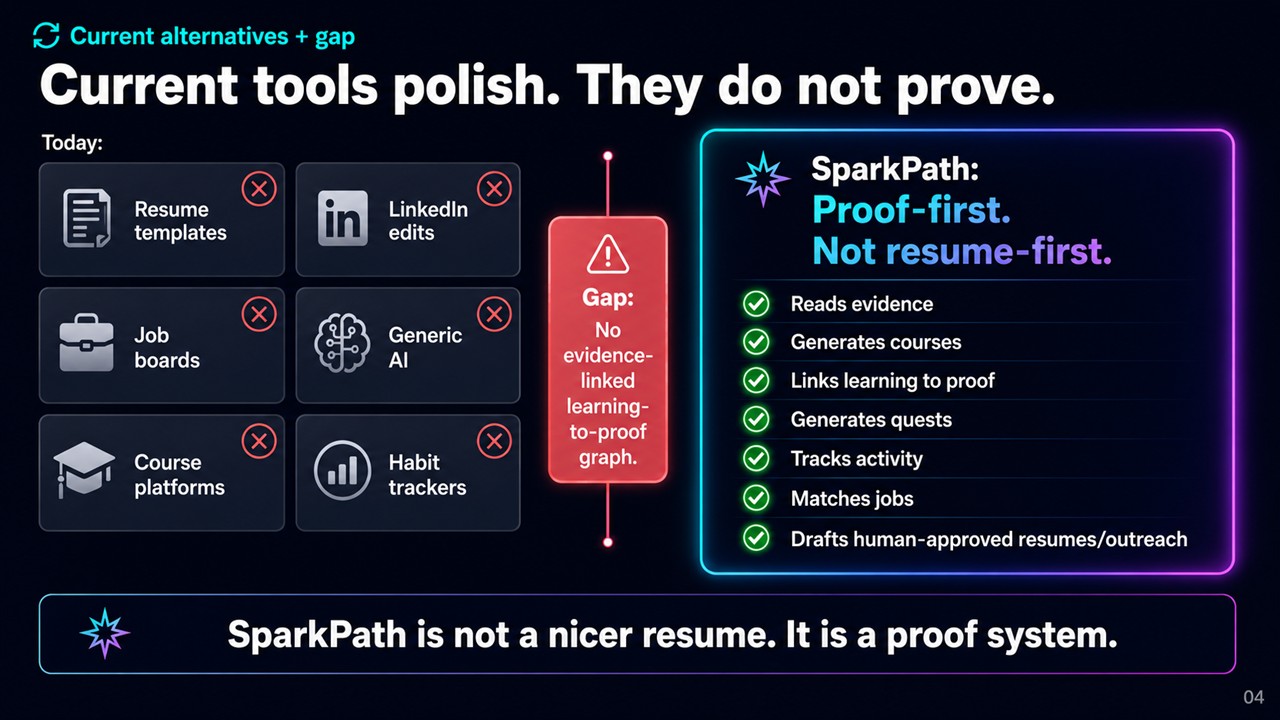
SparkPath is proof-first, not resume-first. It does not promise jobs or internships. It helps students become opportunity-ready by showing what they can prove, what they should learn next, what proof they should build next, and what action they can take.
Our key trust rule is simple:
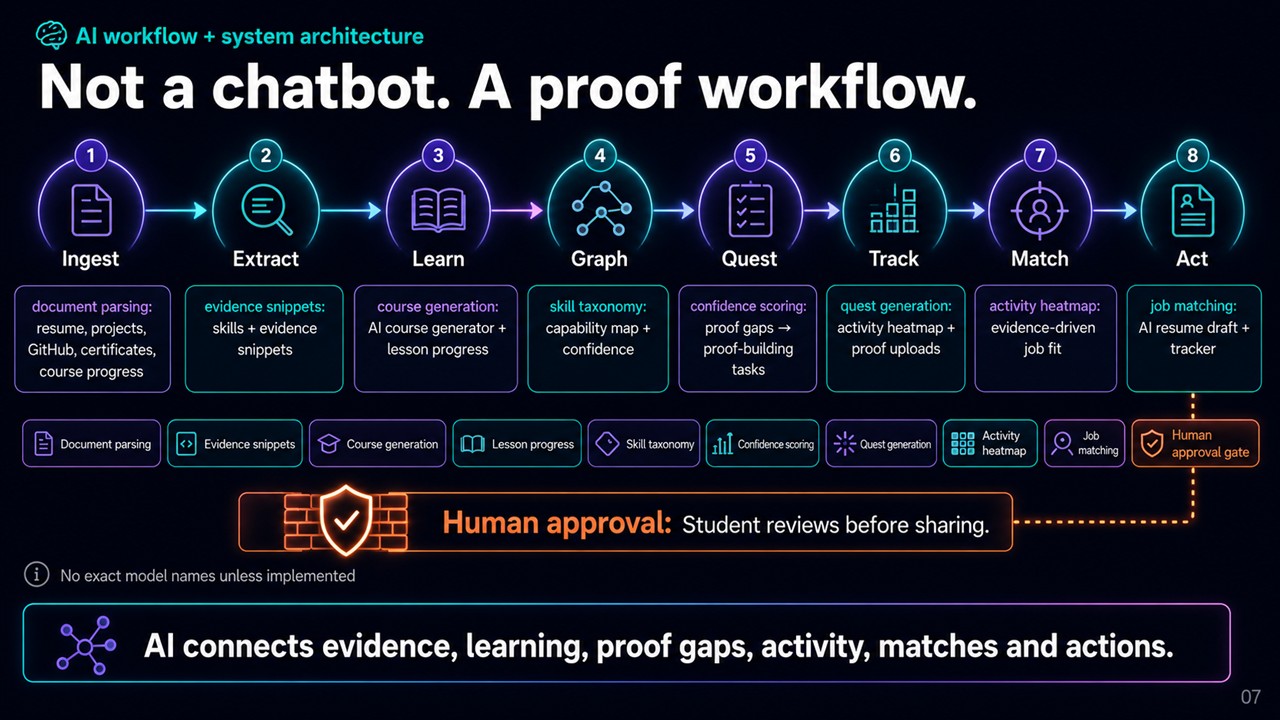
No auto-apply. Human approval always.
How we built it
We built SparkPath as a web prototype focused on the proof-to-opportunity workflow.
The interface starts with a student profile and an evidence dropper. Students can add resumes, project notes, certificates, GitHub or portfolio links, course reflections, and proof artifacts. The AI analysis layer then extracts skill signals and links them back to evidence sources.
From there, SparkPath connects multiple modules:
- Living capability profile
- Resume and evidence dropper
- AI Skill Graph
- Evidence Sources
- AI Course Studio
- Course Library and lesson progress
- Proof-building Quest Board
- Quest Activity Map
- Evidence-driven Job Search
- Application Tracker
- AI resume DOCX draft
The biggest design decision was to make SparkPath more than a resume tool. A resume only describes a student. SparkPath helps the student keep building proof.
The product loop is:
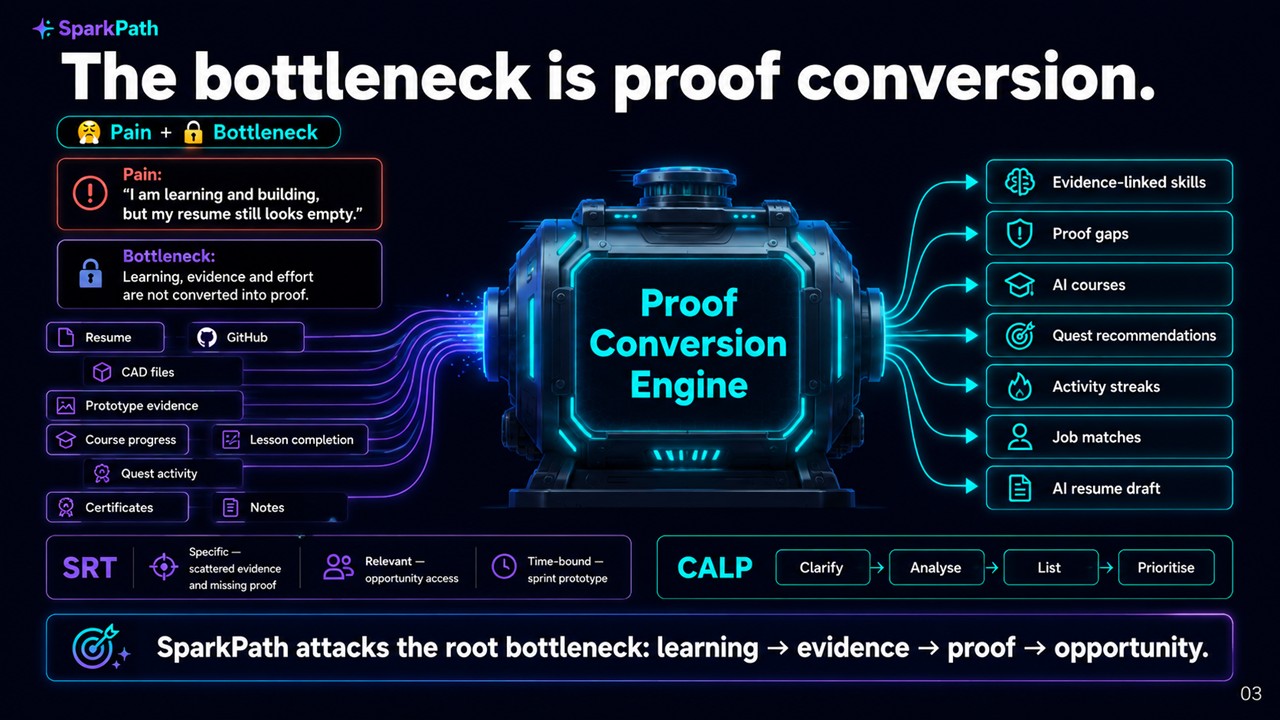
Evidence → Skill Graph → AI Course Studio → Proof Quests → Activity Tracking → Job Matching → AI Resume Draft → Human Approval
Challenges we ran into
The biggest challenge was avoiding the trap of building “just another AI resume tool.”
A resume generator can make a student sound better, but it does not solve the deeper problem: the student still needs credible proof. We had to redesign the product around proof conversion rather than writing polish.
Another challenge was structuring messy student evidence. School work, GitHub projects, certificates, event leadership, CV bullets, course progress, and proof uploads all come in different formats. SparkPath needed a simple workflow that could still turn messy inputs into useful skill signals.
We also had to make the product responsible. SparkPath is not a guaranteed placement service, not an auto-apply tool, not an official credential provider, and not a replacement for career counsellors. Generated courses are framed as learning evidence, not formal qualifications. Job feeds are treated as search sources, not employer partnerships.
Accomplishments we are proud of
We are proud that SparkPath now feels like a complete product workflow instead of a generic chatbot.
The prototype can:
- Accept student evidence and uploaded files
- Build an evidence-linked skill graph
- Show proof sources
- Generate AI courses
- Track course progress
- Generate proof-building quests
- Track quest activity and consistency
- Infer possible target roles
- Match job opportunities from evidence
- Track applications
- Draft a tailored AI resume for student review
The strongest improvement is that SparkPath does not only match jobs. It helps students build the missing proof before they apply.
The AI Course Studio and Quest Board work together: one helps students learn what they are missing, and the other turns that learning into visible proof.
What we learned
We learned that students often do not lack experience. They lack a clear way to translate experience into signals that others can trust.
We also learned that AI is most useful when it is grounded in real evidence. The AI should not replace the student. It should help the student see, organise, and act on their evidence.
Finally, we learned that opportunity matching should not be framed as a guarantee. The responsible target is proof clarity, confidence, and better next actions.
What’s next
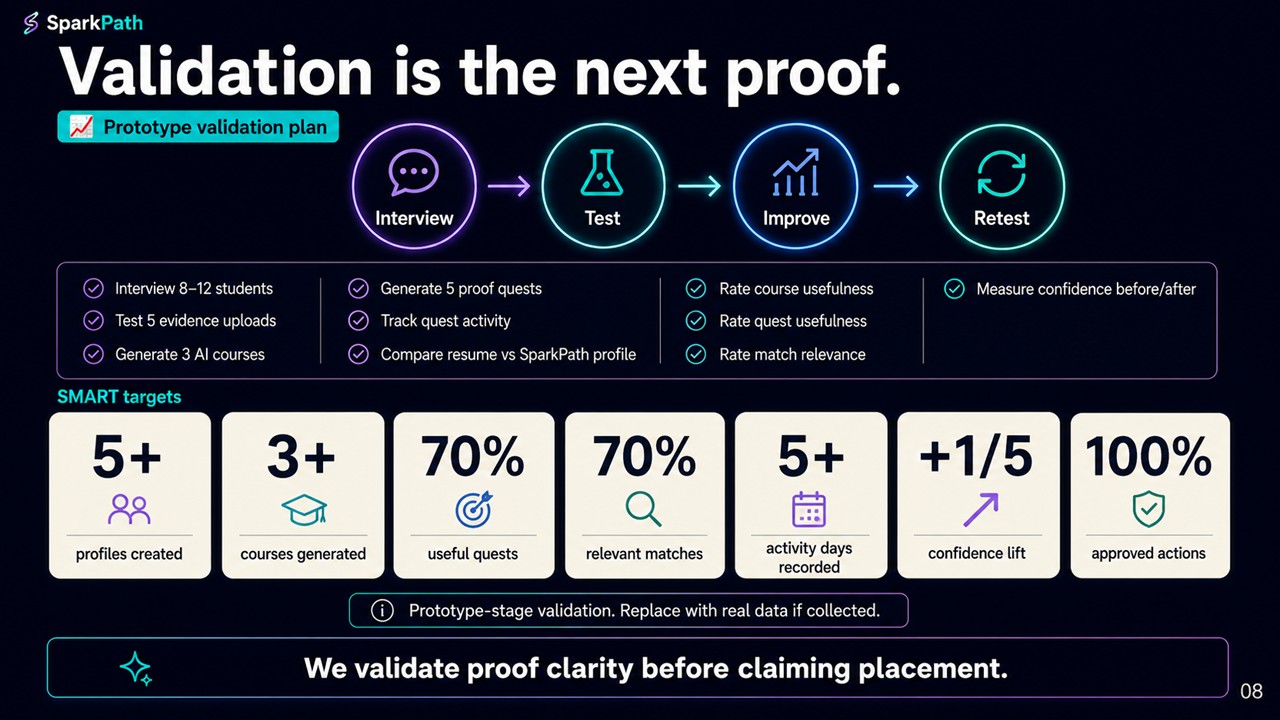
Next, we want to validate SparkPath with real students.
Our first validation plan is to:
- Interview 8–12 students
- Test at least 5 evidence uploads
- Generate at least 3 AI courses
- Generate at least 5 proof-building quests
- Track quest activity
- Compare a normal resume against a SparkPath profile
- Rate course usefulness
- Rate quest usefulness
- Rate match relevance
- Measure confidence before and after using SparkPath
Our early SMART targets are:
- 5+ profiles created
- 3+ courses generated
- 70% useful quests
- 70% relevant matches
- 5+ activity days recorded
- +1/5 confidence lift
- 100% human-approved application actions
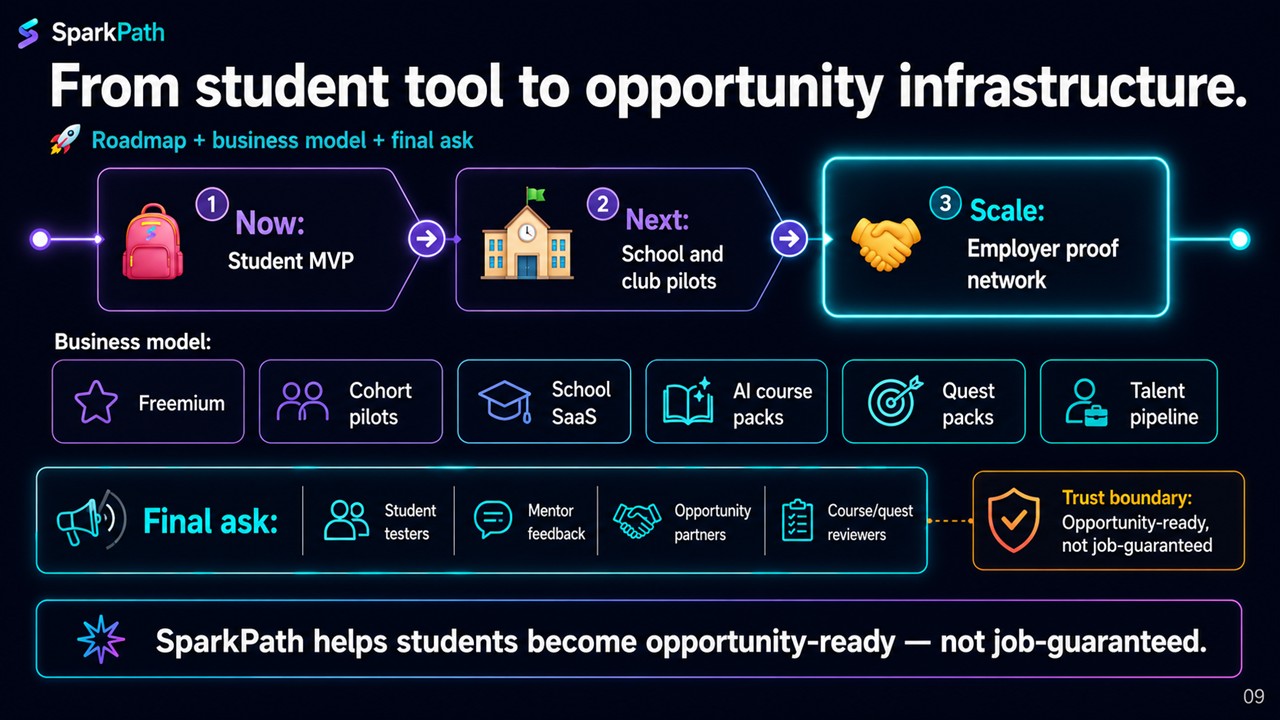
Longer term, SparkPath can grow from a student tool into opportunity infrastructure for schools, bootcamps, clubs, and opportunity hosts.
The goal is not to guarantee jobs. The goal is to help students prove what they can do, build the proof they are missing, and become opportunity-ready.
Built With
- activity-tracking
- ai-assisted-skill-analysis
- ai-course-generator
- application-tracker
- css
- csv
- docx
- evidence-parsing
- html
- javascript
- job-matching
- json
- markdown
- openai-api
- quest-generation
- react
- render
- resume-draft
- skill-graph
- tailwindcss
- txt
- typescript
- vite


Log in or sign up for Devpost to join the conversation.