Demo: https://sparkling.q1f0730.workers.dev Repo: https://github.com/q1f0730/sparkling
Inspiration
We keep our taste in notes apps, screenshots and half-sentences: a film that wrecked us, a song on repeat, a bookshop we meant to visit. Nothing connects those scraps, and when Saturday comes we still scroll the same feeds. We wanted a notebook that notices the cultural things you mention, remembers every return to them, and, only when you ask, helps you go live them.
For judges: the sample notebook
Judges should not need to write thirty notes first. Tap "Open Juno Park's sample notebook" and you land in a full notebook (about 30 notes, 24 cards, an inbox with four open guesses) in about a second. Everything below can be tried there; you can also jot your own line into it.
The agent
Sparkling is a taste-grounded planning agent wrapped in a notebook. You give it a goal in plain words ("Saturday afternoon in Greenpoint, $40", "I want to watch a film tonight"). It then works through a fixed set of tools on its own:
- Read your notebook: which cards you kept, loved or rejected, and how often you came back to them.
- Ground the goal in Qloo: resolve the neighbourhood, map the outing to Qloo place tags, and call /v2/insights with your card entity IDs as taste signals.
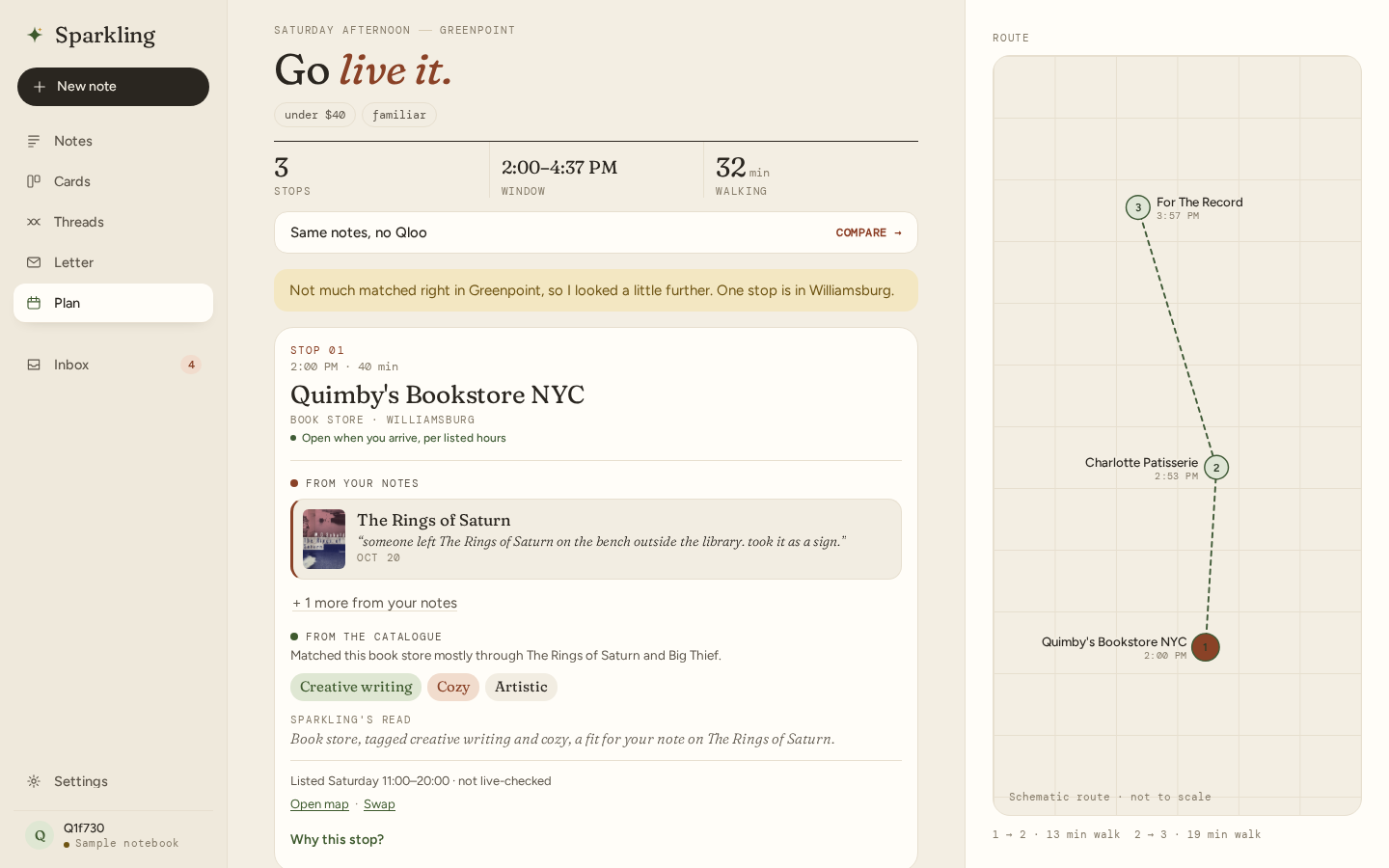
- Check every candidate: right category, inside the area, open at the planned arrival time; if the area is thin it widens the radius and tells you it did.
- Explain each stop with explainability ("matched mainly through The Rings of Saturn and Big Thief") and the exact note behind it.
- Re-plan when you say "Not for me" or swap a stop, keeping what you liked.
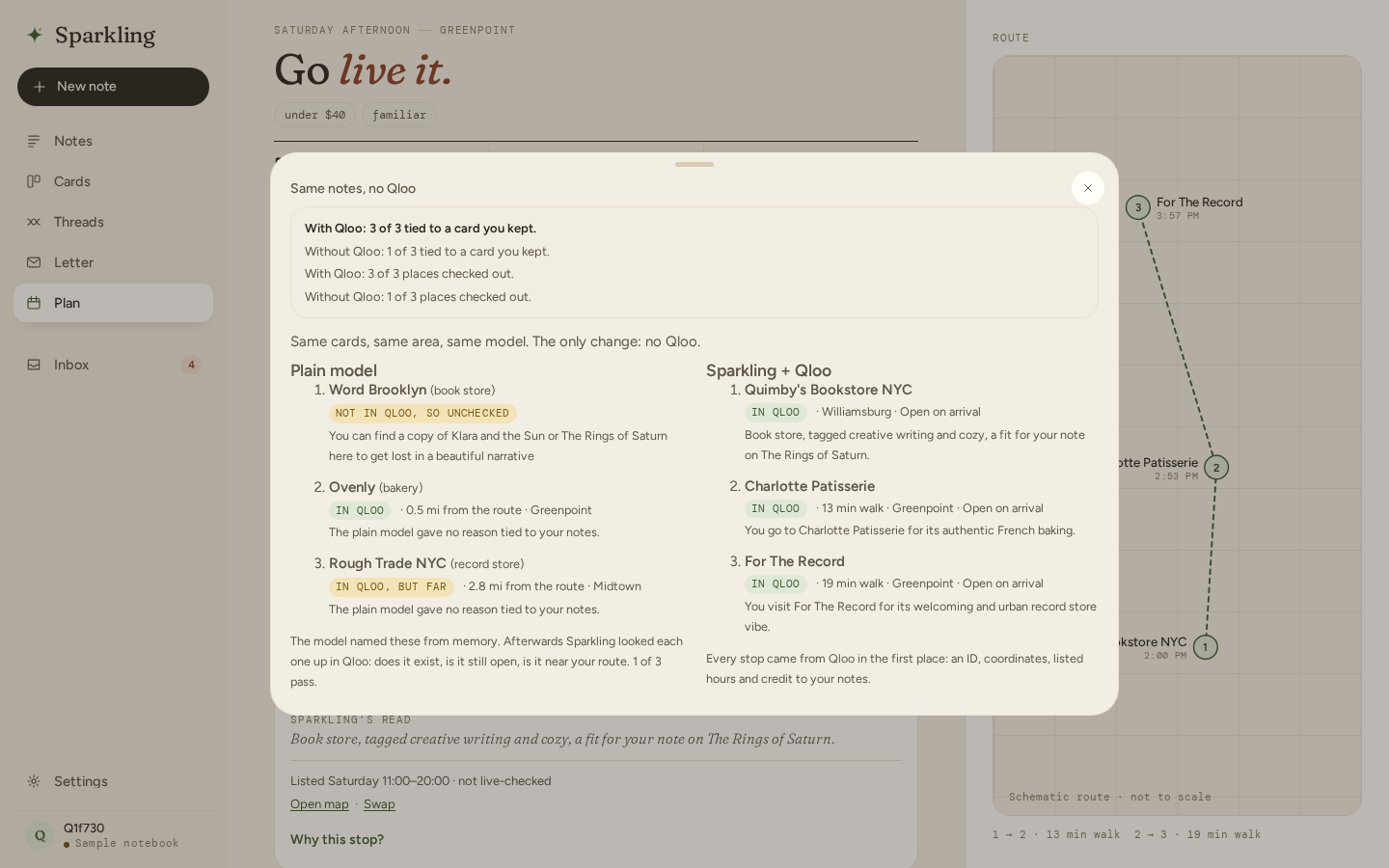
- Audit itself: "Same notes, no catalogue" runs the same model without Qloo and checks each of its places against the catalogue, so you can see what an LLM-only agent gets wrong. The LLM never adds a title or place; Qloo is the only source of entities and places. Without Qloo this agent has nothing to stand on, which is the point.
What it does
- Capture without friction: write a line the way you would in a notes app ("rewatched In the Mood for Love — the corridor, the score"). It appears in the notebook immediately; Sparkling resolves what you mentioned in the background.
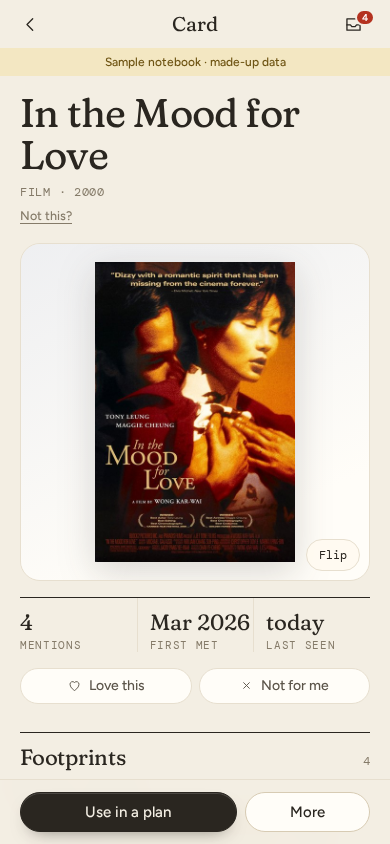
- One card per thing: each film, artist, book or venue Qloo recognises becomes one card with mention count, first met / last seen, Love this / Not for me, and a dated footprint trail in your own words (it even flags when your view changed).
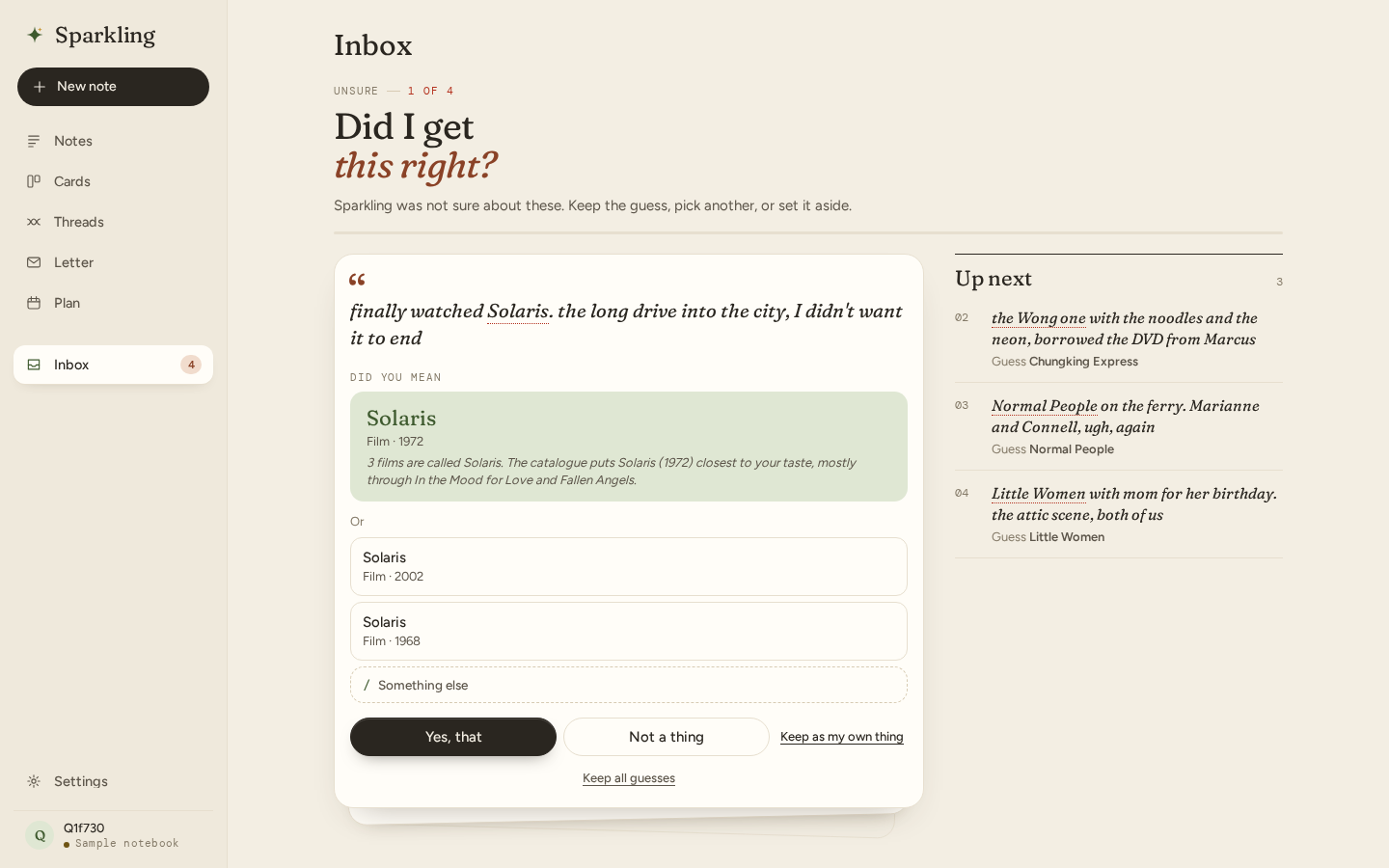
- An inbox for guesses: when a mention is ambiguous ("Little Women" — 2019 or 1994?), Sparkling asks instead of guessing, with the catalogue's reason ("closest to your taste, mostly through Big Thief and McNally Jackson Books Seaport"). Yes, pick another, not a thing, or keep it as your own card.
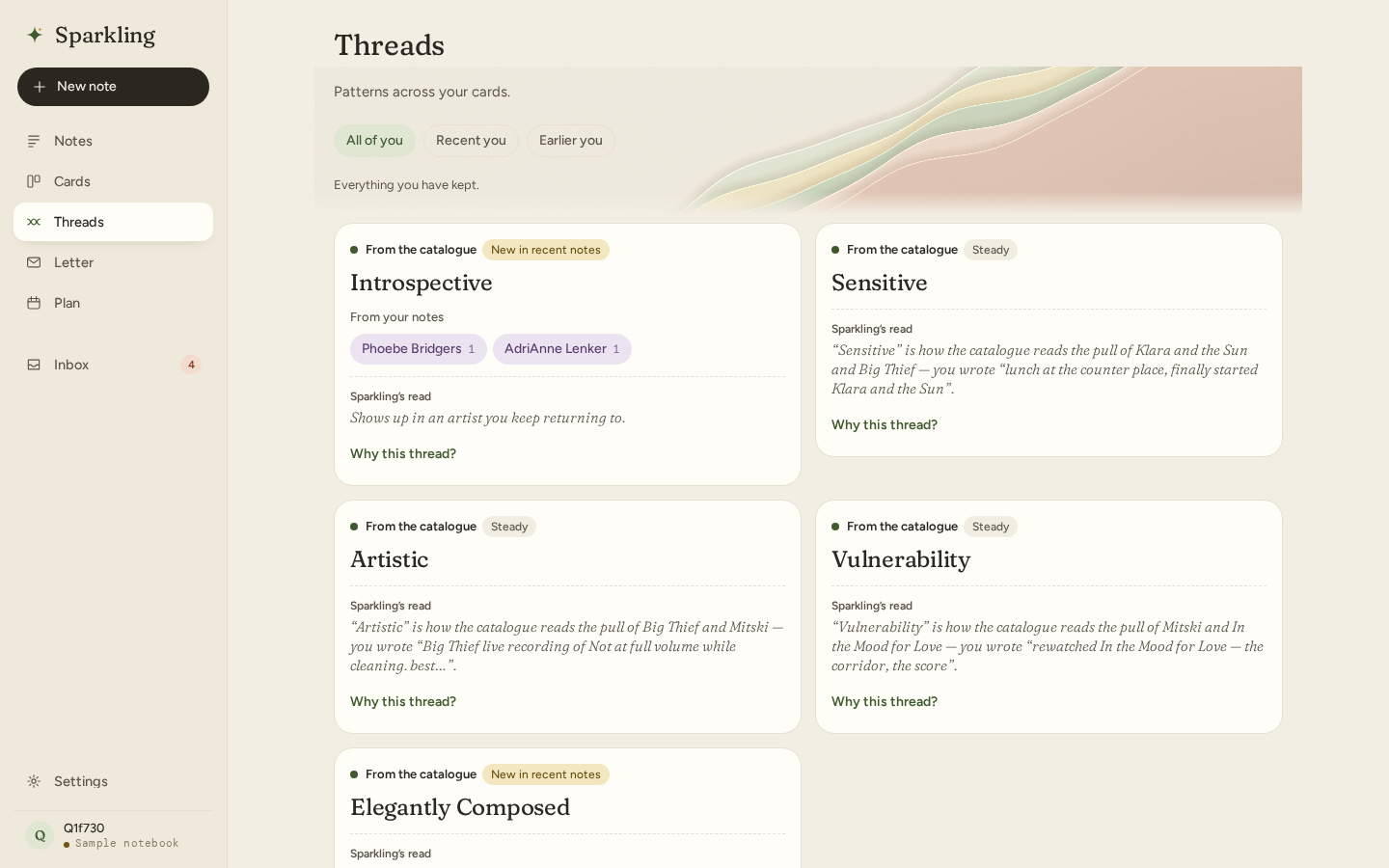
- Threads: Qloo tags that run through your cards ("Introspective", "Sensitive"), each with the cards and your own quotes behind it and "Why this thread?"; All of you / Recent you / Earlier you to compare then and now.
- Go live it: pick "Go out" and get a three-stop afternoon of real Qloo places (e.g. bookstore → patisserie → record shop) with arrival times, stay length, total walking time and a sketch route. If the neighbourhood is thin, it widens the radius and says so. Every stop shows its reasons, labelled by source: from your notes (the exact note and date), from the catalogue ("matched mainly through The Rings of Saturn and Big Thief", plus Qloo tags) and Sparkling's read (one model-written line). Listed hours are shown as "not live-verified". Open map or swap a stop.
- Stay in: the same for a night in — three films (or books, music…) with "because you kept Chungking Express and In the Mood for Love", the synopsis, and the notes that led there.
- Same notes, no catalogue: one tap compares the plan with what the same model suggests from the same cards without Qloo. Each model-only place is checked against the catalogue: "With the catalogue: 3 of 3 places check out. Without: 1 of 3" (not in the catalogue / in it but 2.8 miles off the route). For stay-in it shows how many picks connect to a card you kept.
- English and Simplified Chinese throughout, including plans, synopses and the comparison; mobile and desktop layouts.
How we use Qloo
Qloo is the only source of entities, tags and places: search resolves mentions to entity IDs; tag insights drive Threads; /v2/insights with your card IDs as signals and a location filter returns the places and the stay-in picks; explainability tells us which of your cards a place was matched through, shown as "matched mainly through", never as a probability. Entity properties supply listed hours. The LLM only writes short copy and the no-catalogue comparison; it never adds a title or place to a plan. Only entity IDs, tags and a neighbourhood string go to Qloo, never note text or account data.
How we built it
Cloudflare Workers + D1 + KV; Workers AI (free tier) with a D1 answer cache and rule-based fallbacks; one vanilla-JS app, mobile-first, with a desktop shell; node --test suite (800+ tests) gating every deploy. The judging instance has daily caps, per-IP rate limits and cached sample answers so it stays free, fast and up through the judging period; when a cap is hit it says "busy" honestly instead of failing silently.
Challenges
Sparse places in some neighbourhoods (the plan widens its radius and says so), ambiguous mentions (the inbox), a free-tier model quota (cache + fallbacks + honest busy states), Chinese copy for English catalogue data.
Accomplishments
A taste record where every reason on a plan can be traced to a note you wrote or a catalogue entity.
What's next
Test whether people actually take the outings; reminders.
Built With
- cloudflare-d1
- cloudflare-workers
- javascript
- node.js
- qloo
- workers-ai
