Inspiration
In today’s hyper-connected entertainment and brand landscape, some of the most lucrative and culturally explosive moments come from unexpected cross-vertical collaborations—like gaming IPs partnering with luxury fashion houses, or psychological horror films inspiring electronic music capsules. However, brands and creators usually rely on guesswork or superficial trends to forge these partnerships. We wanted to build a data-driven "Culture-to-Commerce Engine" that taps into Qloo's vast taste graph to find the exact signal between worlds—turning raw cultural affinity into predictable, high-value commercial partnerships.
What it does
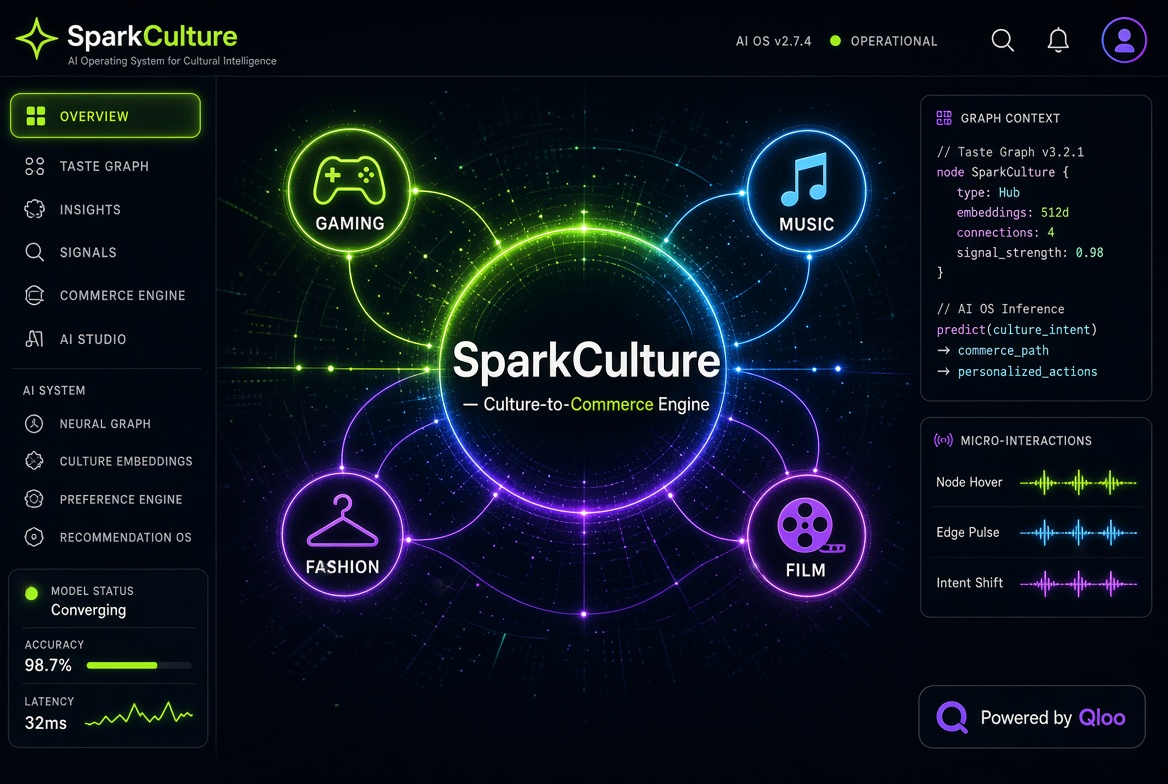
SparkCulture is an advanced cultural intelligence platform that maps consumer taste across music, fashion, dining, gaming, and film.
- IP Briefing: Users brief any intellectual property (e.g., Cyberpunk 2077 or Hereditary) and select its home vertical.
- Cross-Vertical Signal Mapping: The system queries Qloo's official hackathon taste graph to discover non-obvious, high-affinity partner matches across completely different industries.
- Collaboration Blueprints & Pro Formas: For every match, SparkCulture generates tailored collaboration concepts (e.g., limited-run vinyl/capsule capsules) alongside financial pro formas detailing projected gross revenue, production costs, and before-partner splits.
How we built it
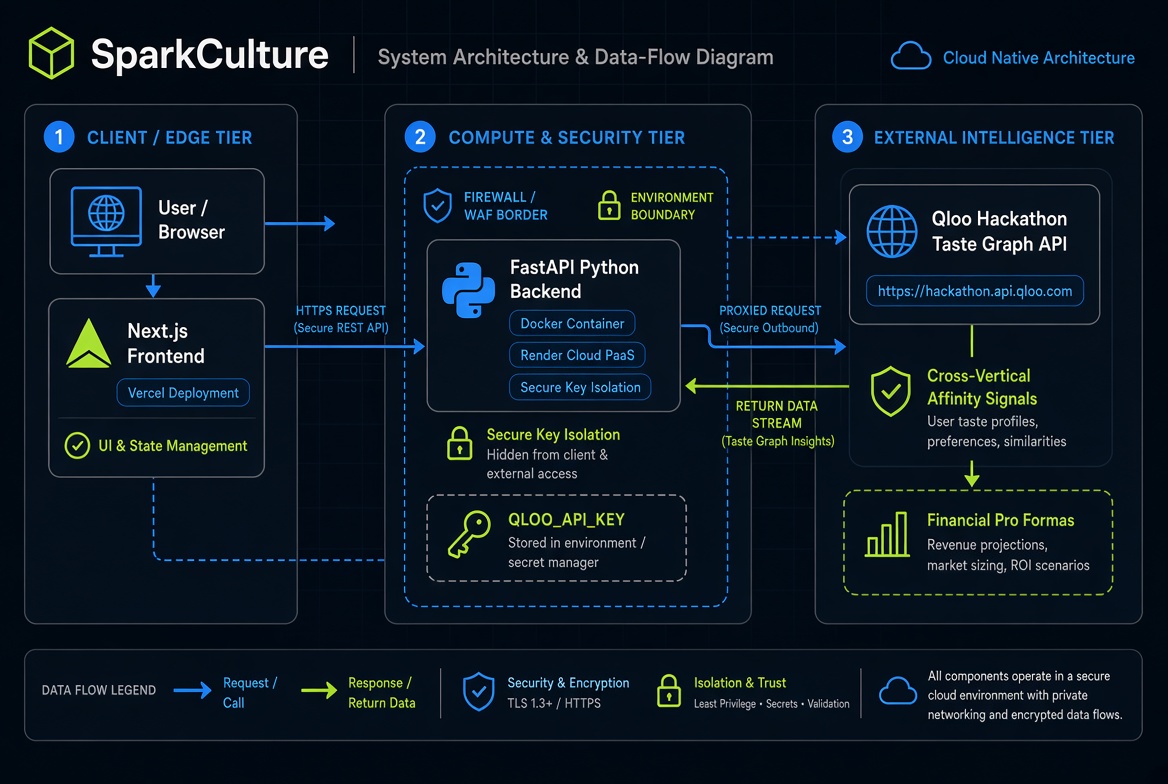
SparkCulture is engineered as a robust, decoupled multi-service monorepo:
- Frontend: Built with Next.js, featuring dynamic data visualization, responsive UI styling, and resilient API proxying logic to handle asynchronous streaming and parse JSON responses safely without server crashes.
- Backend: Powered by Python and FastAPI, acting as a secure intermediary that processes cultural intelligence requests against the official Qloo Hackathon API (
https://hackathon.api.qloo.com). - Infrastructure & DevOps: Deployed using a production-grade architecture. The Next.js frontend is hosted on Vercel, while the FastAPI backend is fully containerized using Docker and deployed on Render via a streamlined Infrastructure-as-Code Blueprint (
render.yaml). - Security: Implemented zero-trust API security ensuring that the
QLOO_API_KEYremains strictly backend-only and never exposes sensitive tokens to the client bundle.
Challenges we ran into
- Cloud Platform Path Resolution: During initial deployments, standard Python buildpacks struggled with nested monorepo paths (
/backend) on cloud providers. We solved this by containerizing the FastAPI service with a custom root-levelDockerfile, achieving complete environment parity between local development (GitHub Codespaces) and production. - API Payload Resiliency: Mapping multi-vertical Qloo taste graph responses required robust error handling to gracefully manage rate limits, missing metadata tags, or edge-case null values without breaking the frontend layout.
Accomplishments that we're proud of
- Successfully deploying a resilient, production-grade, multi-service architecture (Vercel + Dockerized Render backend) under tight hackathon timelines.
- Creating an interface that doesn't just display raw data points, but translates deep cultural affinity scores into actionable business intelligence (complete with revenue projections and creative briefs).
- Achieving lightning-fast query response times and flawless integration with Qloo’s live endpoints.
What we learned
- The absolute power of Docker containerization in eliminating environment drift and deployment headaches when launching multi-service apps to cloud PaaS providers like Render.
- How structured taste intelligence can completely automate and de-risk creative brand strategy by proving consumer affinity with hard data.
What's next for SparkCulture
- Agentic Contract Generation: Integrating LLM agents to automatically draft full partnership proposals, marketing copy, and legal licensing scopes based on the generated collaboration blueprints.
- Multi-Party Bundling: Expanding the engine to calculate multi-brand crossover synergies (e.g., Gaming IP + Fashion Brand + Artisan Dining).
- Geospatial & Demographic Filtering: Layering regional taste variance to optimize localized product launches.

Log in or sign up for Devpost to join the conversation.