-
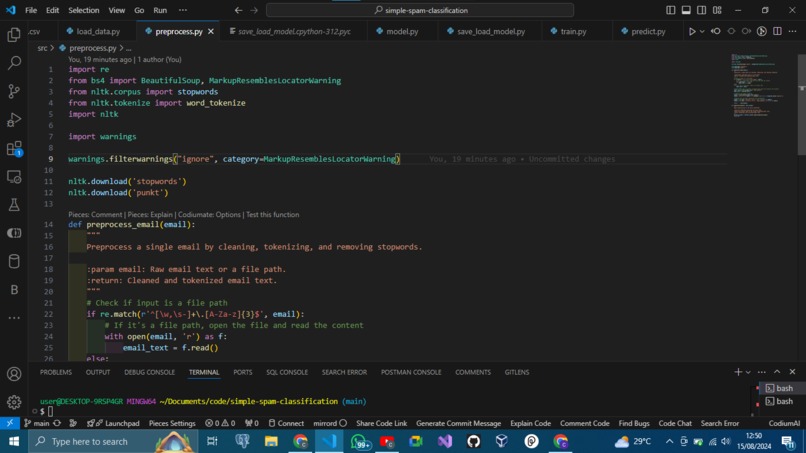
screenshot of page with nlp
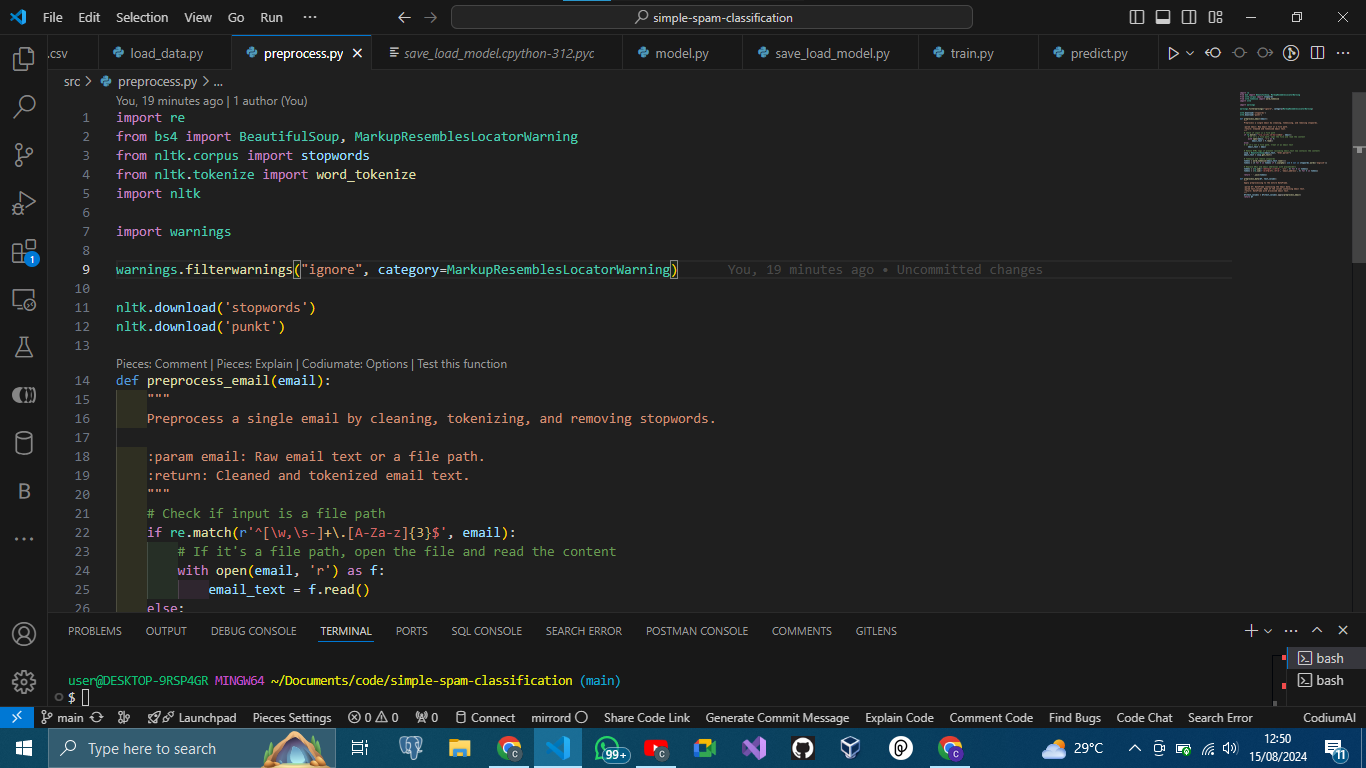
SpamSieve
Inspiration
The constant influx of unwanted spam emails has become a significant issue for both individuals and businesses. We wanted to create a powerful yet accessible tool that leverages Natural Language Processing (NLP) to automatically detect and filter out spam emails, making inbox management easier and more efficient.
What it does
SpamSieve classifies incoming emails as either spam or non-spam based on their content. By preprocessing email text, extracting features, and applying machine learning models, SpamSieve can accurately determine whether an email should be flagged as spam, helping users maintain a clean and organized inbox.
How we built it
We built SpamSieve using Python, with a focus on modularity and best practices. The project is organized into separate components for data loading, preprocessing, model training, and prediction. We used the following technologies:
- BeautifulSoup for HTML parsing and text extraction.
- NLTK for tokenization and stopword removal.
- scikit-learn for building and training a machine learning model (Naive Bayes) using a TF-IDF vectorizer.
- joblib for saving and loading trained models.
- The project follows a structured folder setup to ensure maintainability and scalability.
Challenges we ran into
One of the primary challenges was handling different formats of email content, including HTML and plain text. Ensuring that the model could accurately preprocess and extract meaningful information from a wide variety of email formats was crucial. Additionally, balancing the model's complexity with its ability to generalize well across different datasets was another significant challenge.
Accomplishments that we're proud of
We are proud of successfully implementing a robust email spam detection system that can be easily extended and maintained. The project’s structure allows for future enhancements, and the accuracy of the model in distinguishing between spam and non-spam emails demonstrates the effectiveness of our approach.
What we learned
Through this project, we gained valuable insights into NLP techniques for text preprocessing and feature extraction. We also learned about the intricacies of training machine learning models for classification tasks, especially in dealing with imbalanced datasets like spam detection. Additionally, we honed our skills in organizing a complex project into modular, reusable components.
What's next for SpamSieve
Moving forward, we plan to enhance SpamSieve by incorporating more advanced machine learning algorithms, such as deep learning models, to improve accuracy further. We also aim to add support for real-time spam detection and create an easy-to-use API that can be integrated with various email clients. Finally, expanding the dataset to include more diverse examples will help make the model even more robust and versatile.


Log in or sign up for Devpost to join the conversation.