-
-
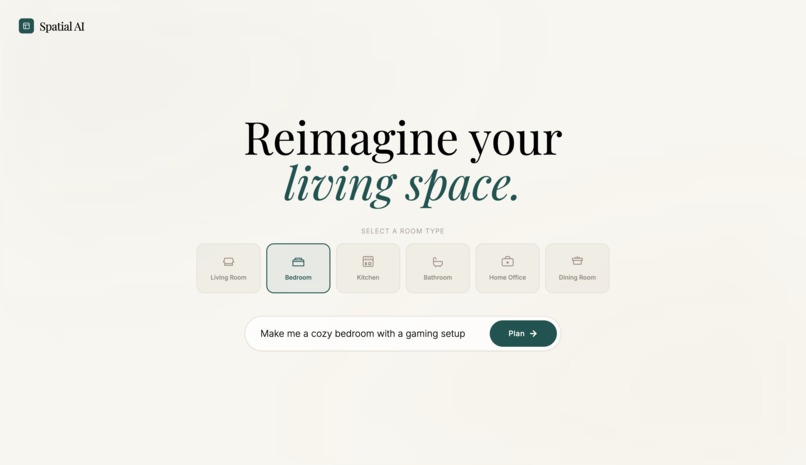
Landing Page
-
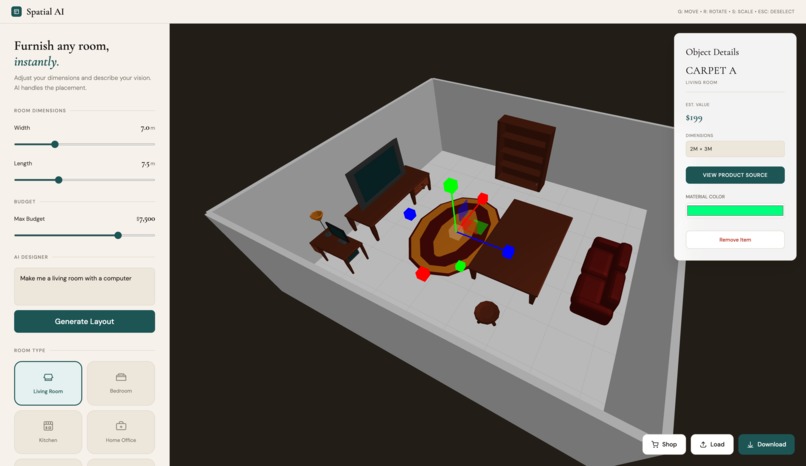
Room Editor
-

Shopping Page

Inspiration
Moving into a new place is exciting but overwhelming. An empty room is hard to visualize. Spatial AI lets you recreate your space and have an AI assistant help you design it — from blank room to furnished home in minutes.
What it does
Recreate your room dimensions, instantly generate a navigable 3D model, then describe your ideal space in plain English. AI furnishes the room intelligently, respecting traffic flow and spatial balance. Drag, rotate, and scale anything manually, then hit Generate Shopping List for real IKEA/Wayfair products with prices matched to your budget.
How we built it
Our web app uses Vite for fast development and optimized builds, Tailwind CSS for responsive, utility-first UI styling, and Three.js to render interactive 3D furniture models. Users give natural language commands interpreted by Gemini AI, which returns placement instructions applied in real time to the Three.js scene. FBX models from https://lowpolyassets.itch.io/low-poly-household-item-pack are combined with a local JSON database storing item dimensions, costs, and shopping links, creating a seamless, AI-driven tool for visualizing and planning interior spaces.
Challenges we ran into
Getting Gemini to return consistently structured JSON required multiple rounds of prompt engineering. Malformed or conversational responses broke our parser, and we couldn't fail on demo day. Learning Three.js from scratch under time pressure was tough; loading FBX models, handling camera controls, and making objects interactive was entirely new to us. Bridging Gemini's output to live 3D transformations required careful mapping between what the model returned and what the renderer expected.
Accomplishments that we're proud of
We're proud that the full loop works. The user describes their space and vibe, Gemini interprets it, and the room furnishes itself in 3D in real time. Building that end-to-end connection between a language model and a live 3D environment in 36 hours, with no prior Three.js experience, is something we're genuinely proud of.
What we learned
Prompt engineering is a far deeper discipline than we expected going in. Getting an AI model to return consistent, structured, parseable output every single time... not just most of the time, requires precise instruction, explicit formatting rules, and a lot of iteration. A response that works nine times out of ten will break your app on the demo. We also learned to scope aggressively early. We had bigger ambitions at the start of the hackathon, but cutting features that weren't essential to the core experience was the right call. It kept us focused, reduced stress, and meant we shipped something that actually worked end to end rather than something half finished.
What's next for SpAItial
We want to expand the furniture database, improve Gemini's placement logic for multi-room floor plans, and add phone-based room scanning so users can skip the floor plan upload entirely. AR mode is on the roadmap, so you can see your furnished room overlaid on your actual space. Longer term, we see real estate integration as a major opportunity — every home listing on Zillow or Realtor.com could come with a Spatial AI link where buyers visualize the space furnished to their own taste before ever stepping inside. We also want to build out a collaboration mode for interior designers and their clients to work together in real time.
Built With
- css
- gemini-api
- html
- javascript
- tailwind
- three.js
- vite

Log in or sign up for Devpost to join the conversation.