Inspiration
People be writing trash code. In CS 220 here at UMass, we try to fix that! A whole class dedicated to programming methodology where you painstakingly have to avoid obscure coding mistakes that you're not even sure are mistakes. All you can think about while submitting the assignments is whether or not you missed some arcane paradigm that was mentioned in a footnote of a programming book from 1980. The whole time you're wondering, "How the hell do I get better at this??" Well, what better way than to be aggressively insulted! Everyone knows errors like missing semicolons, syntax errors, and common issues like that, but how often does someone point out something like repeated code (blasphemous), high cyclomatic complexity, and other harder to notice smells and issues? Our motivation for this project was to provide a tool to do just that... but with a bit of flair and sarcasm to keep it interesting
What it does
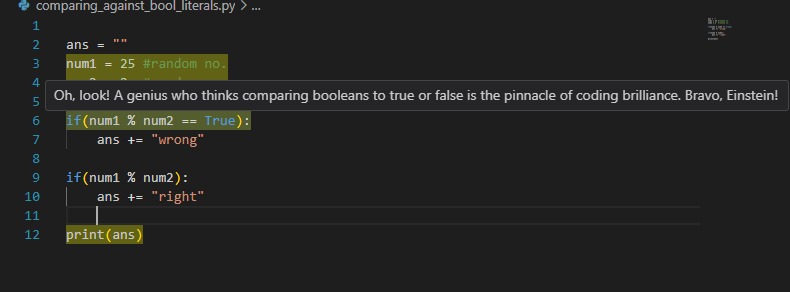
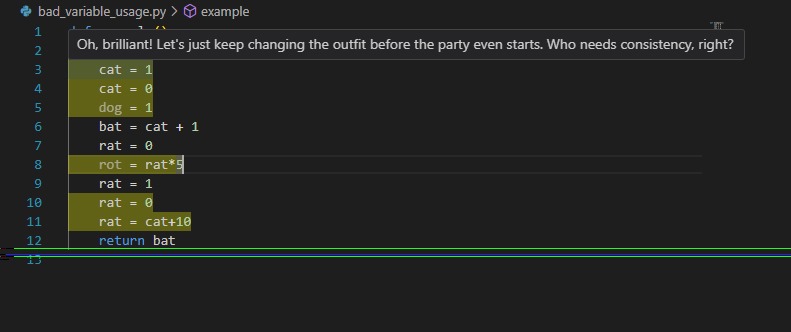
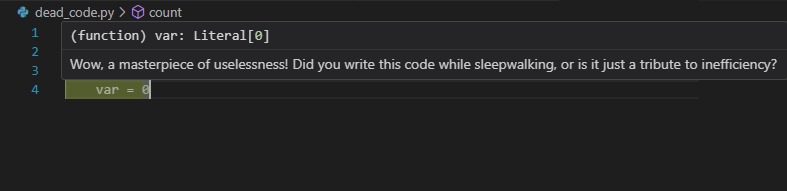
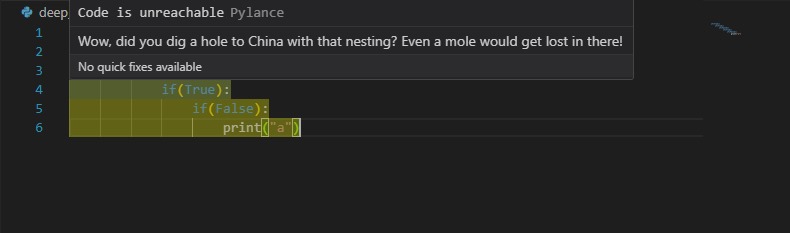
The 220bot passive-aggressively points out common code smells. It does this by parsing through the program's Abstract Syntax Tree and using tree parsing algorithms to find patterns and subtrees that arise from bad coding practices. It highlights the exact line that's responsible and shows a passive-aggressively insulting message for the issue. It works dynamically as you code so you're constantly reminded of how bad you are. It's available as a VSCode extension so it's super easy to install and use straight out of the box! Here's a comprehensive list of code smells and errors it detects:
- High Cyclomatic Complexity
- Dead Code
- Deep Nesting
- Duplicate Code
- Magic Numbers
- Long Functions
- Print Statements
- Functions with too many parameters
- Comparing directly with True or False (Ex: "if a == True" instead of "if a")
- Lack of context management (Ex: opening files outside of a "with" statement)
- Non-specific Exception Handling (using a general "except" statement instead of specifying the exact exception)
- Unused variables/imports
- Cyclic imports
How we built it
The VSCode frontend was built with javascript. The backend server was written in python with extensive use of the ast library to parse the abstract syntax tree of the program. We wrote the algorithms to detect all the code smells by ourselves. We then used LangChain with OpenAI APIs to generate the sarcastic code review comments
Challenges we ran into
Certain code smells like duplicate code were pretty hard to code. We also had a lot of trouble integrating the business logic with the VSCode extension because it was pretty cumbersome to test. Also testing it on 4 different systems was tough because we kept running into a variety of problems. Getting an LLM running was also very difficult as we didn't have any GPUs or powerful computing resources.
Accomplishments that we're proud of
None of us have worked with Abstract Syntax Trees or VS Code extensions before. We're proud that we were able to finish a viable product. We're also proud of the number of code smells that we were able to write the code for. It's a fairly large number given the complexity. We were also able to integrate a live LLM despite not having a GPU or a lot of computational power.
What we learned
ast parsing, vscode extension building, backend/frontend integration, LangChain, etc.
What's next for SpaghettiSniffer
Add support for languages other than python. Also do a lot of stress testing. It's also currently a little slow for larger files and directories. We can try to make it faster.
Built With
- ast
- javascript
- langchain
- python
- vscode


Log in or sign up for Devpost to join the conversation.