-
-
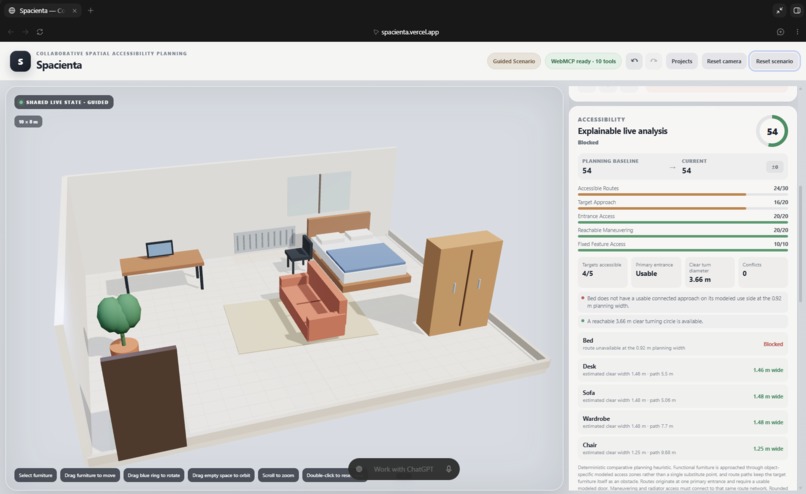
Demo Scenario
-
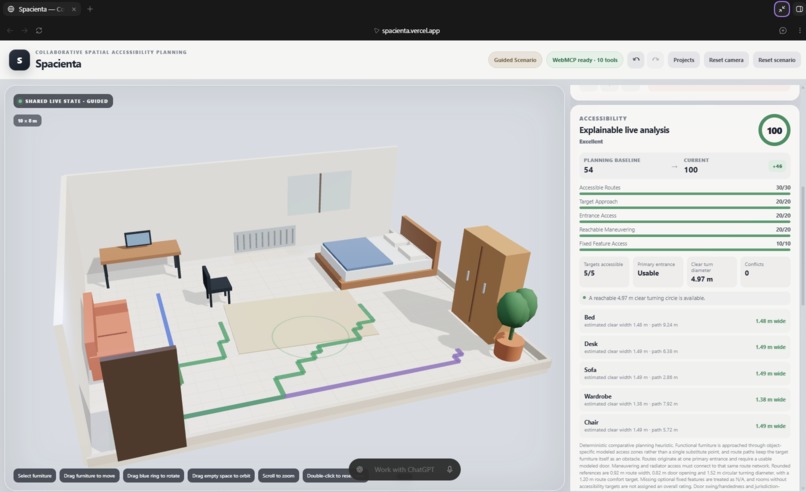
Agent improves the room layout using WebMCP
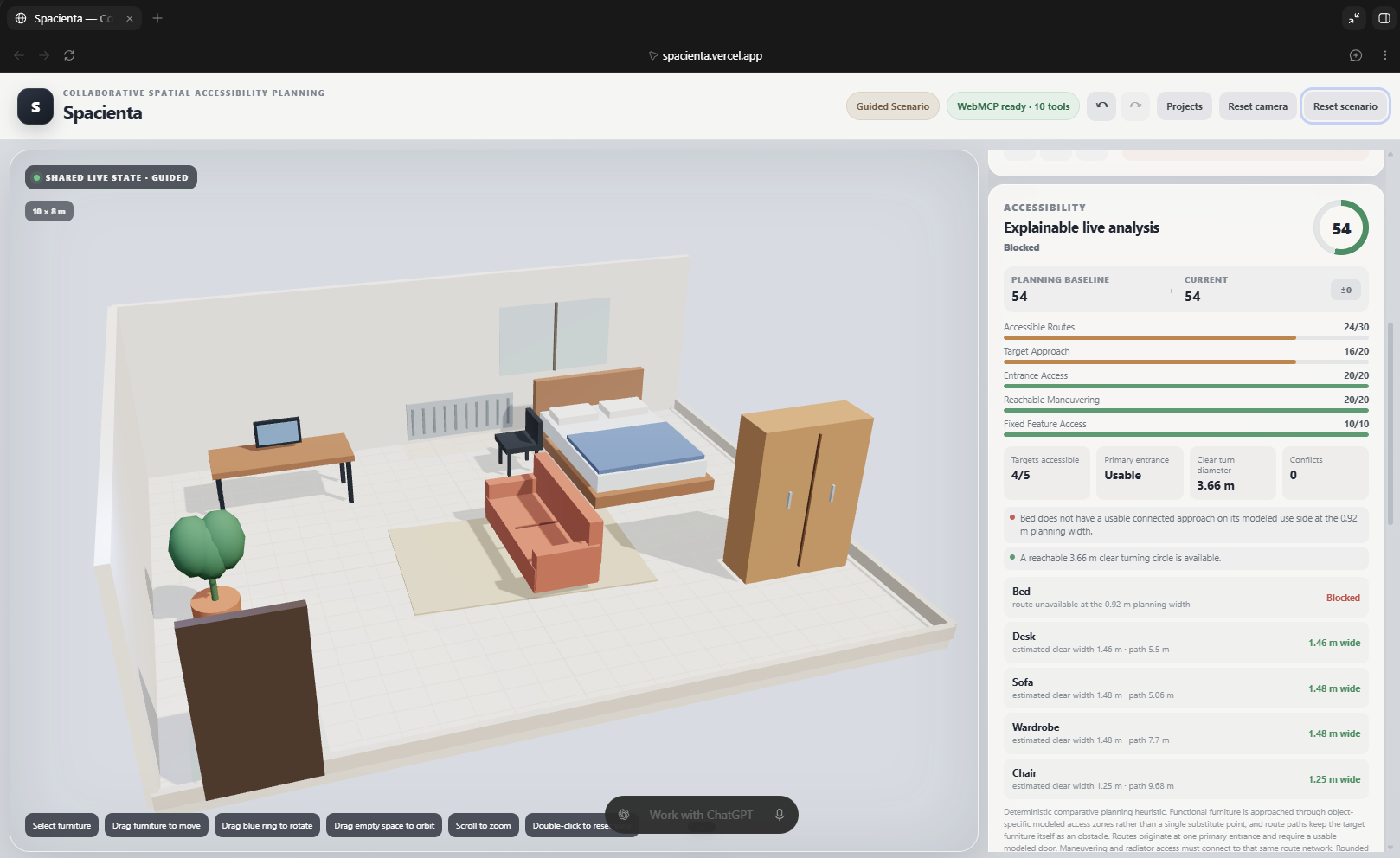
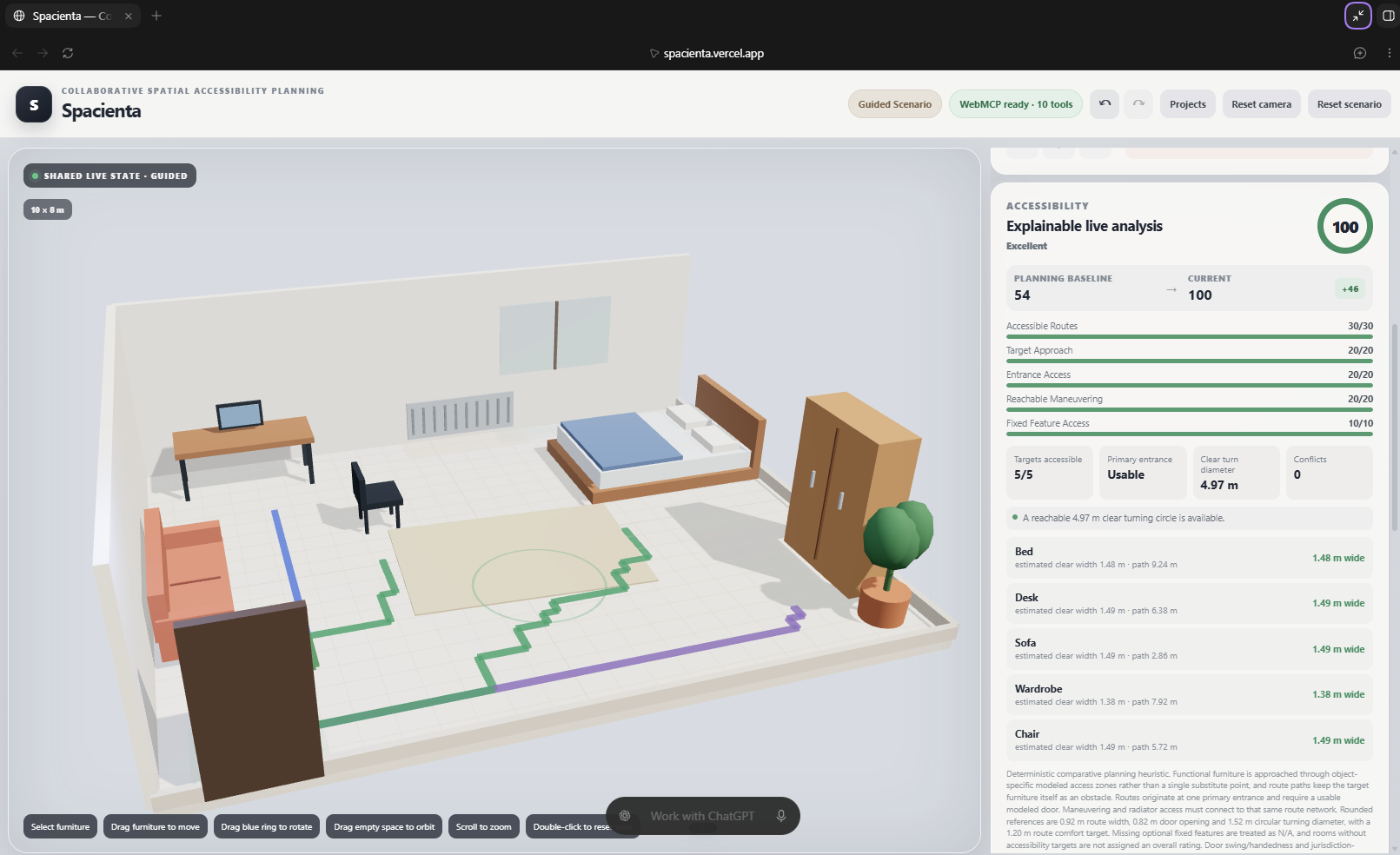
Why Spacienta
For the WebMCP Challenge, I wanted to explore a use case where structured agent access provides a real advantage over screenshots and traditional browser automation. Spatial planning is a strong example: an agent needs precise information about positions, dimensions, rotations, clearances, and relationships between objects. That information is difficult to infer reliably from pixels alone.
That led to Spacienta -> a shared 3D workspace where a human and an AI agent can improve room accessibility together.
What it does
Spacienta is a WebMCP-powered 3D accessibility-planning workspace. Users can create and edit a room directly in the browser by adding, moving, rotating, and removing furniture. Spacienta can analyze the current arrangement, visualize paths through the room, and calculate a planning-oriented accessibility score. Through WebMCP, an AI agent can work with the exact same live room state. It can inspect the room, identify accessibility problems, explore alternative arrangements, compare layouts, apply an improved solution, and verify the result afterwards.
This creates a collaborative workflow: the human remains in control of the visual room while the agent can reason about precise structured spatial data. The concept is aimed at people planning rooms around mobility constraints, as well as families, caregivers, or planners who want to evaluate an arrangement before physically moving furniture.
Why WebMCP
WebMCP is fundamental to Spacienta rather than an additional feature. Without WebMCP, an AI agent would have to interpret screenshots or indirectly operate the interface through mouse and keyboard automation. That is especially limiting for spatial tasks, where exact coordinates, dimensions, rotations, and clearances matter.
With WebMCP, Spacienta exposes meaningful application capabilities directly to the agent. The agent can understand and act on the same underlying room model that the human sees in the 3D interface. This makes the interaction more reliable and also allows the human and agent to share one live workspace instead of working with separate representations of the room.
How I built it
Spacienta is a browser-based 3D application built with JavaScript, HTML, CSS, Three.js, and Vite. The application exposes ten structured WebMCP tools using the browser's WebMCP interface. Together, these tools cover the complete planning workflow: inspecting room state and furniture, analyzing accessibility, simulating alternative layouts, comparing alternatives, applying changes, configuring the room, managing furniture and room features, verifying the final layout, and managing history.
The WebMCP tools operate on the same application state that drives the visible 3D scene.
When the user moves furniture, the updated state becomes available to the agent. When the agent applies a layout, the result becomes immediately visible and editable by the user. I also separated exploration from commitment: an agent can simulate and compare possible layouts before applying one to the live room.
Challenges I ran into
One of the main challenges was translating a visual 3D environment into structured information that an AI agent could reason about reliably. A screenshot can show roughly where furniture is located, but it does not provide the exact spatial information required for dependable layout analysis.
Another challenge was automated furniture placement. A layout can improve a numerical accessibility score while still looking unnatural. I refined the layout logic so that accessibility improvements also consider room boundaries, furniture relationships, usable paths, and more natural placement.
Designing the WebMCP tool set was another important part of the project. Instead of exposing one large all-purpose action, Spacienta uses clearly separated operations so the agent can inspect, analyze, explore, compare, apply, and verify its work step by step.
Accomplishments I'm proud of
Spacienta demonstrates a complete closed-loop WebMCP workflow rather than a single tool call. An agent can start with an existing room, understand its current state, identify problems, investigate alternatives, make a change, and then analyze the result again. The most important accomplishment is that the human and agent are not working with separate versions of the room. They collaborate on the same live spatial model.
What I learned
Building Spacienta showed me that agent-friendly web applications can expose much more than buttons and pixels. WebMCP makes it possible to expose the meaning and capabilities behind an interface as structured tools while keeping the normal visual interface available to humans.
I also learned that smaller tools with clear responsibilities are easier for an agent to use predictably than one large all-purpose command.
Built With
- css3
- html5
- javascript
- three.js
- vercel
- vite
- webmcp


Log in or sign up for Devpost to join the conversation.