Inspiration
SpaceVision started from a very practical problem. I am currently doing a home reconstruction and was already using Nano banana pro through the chat UI to experiment with interior design ideas: changing floors, styles, materials, and layouts on images of real rooms.
While Gemini was powerful, the workflow was not. Chat-based interaction made it difficult to analyze specific objects, understand why certain designs failed, and iteratively revise a space in a controlled way.
After seeing the Gemini Hackathon announcement on LinkedIn, it became clear that Gemini already had the core capabilities needed - multimodal vision, reasoning, and image generation - but needed a purpose-built workflow. SpaceVision was created to rebuild the renovation and design process around Gemini instead of treating it as a chat feature.
What it does
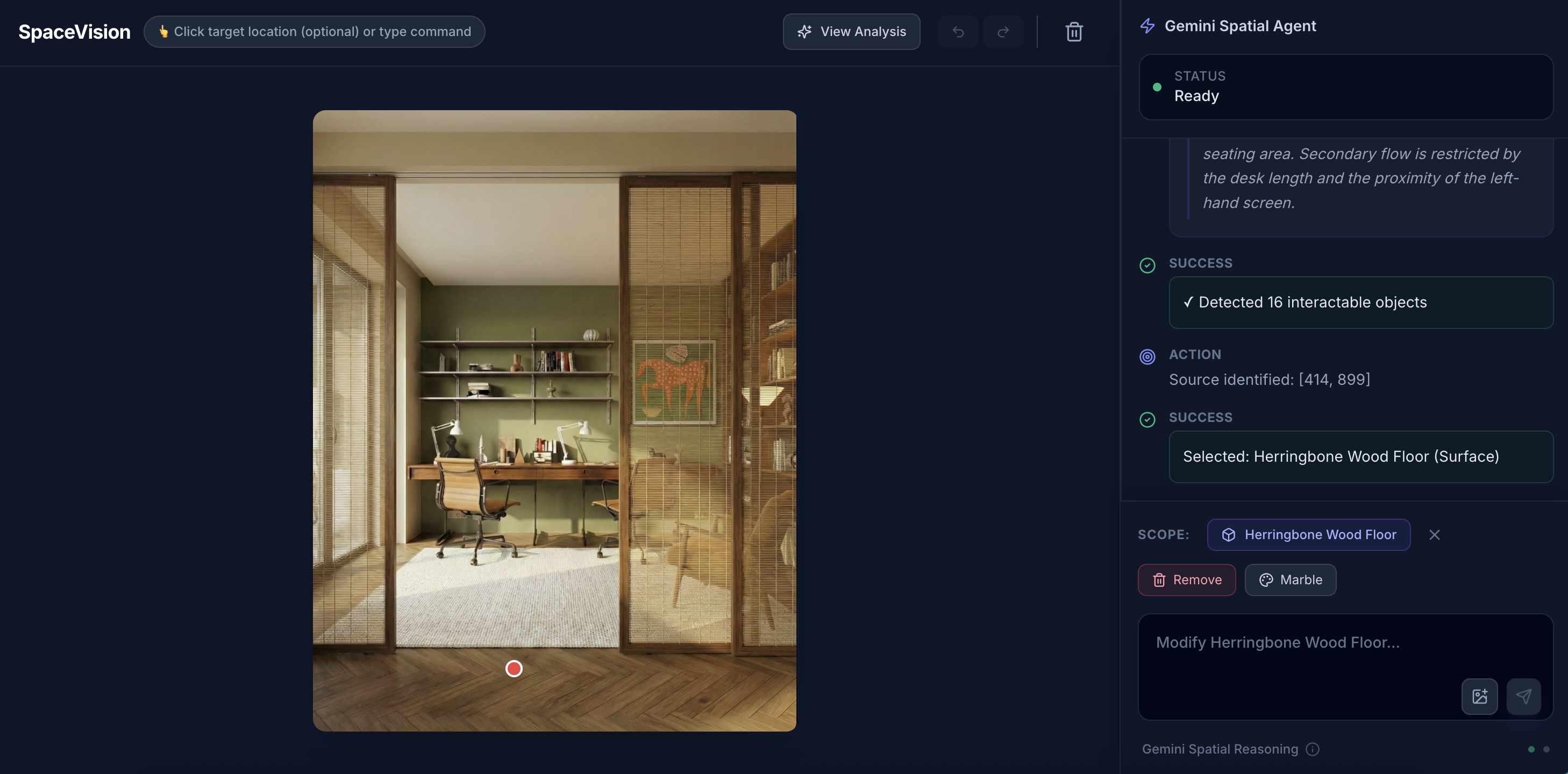
SpaceVision is a Gemini-powered spatial design assistant that analyzes real spaces from images, renders, or floor plans and redesigns them intelligently.
Gemini detects objects such as walls, floors, furniture, doors, and windows which users can interact with, then reasons about layout, function, and visual consistency. Users can modify specific elements, apply styles, or provide reference images, and Gemini redesigns the space while respecting existing boundaries.
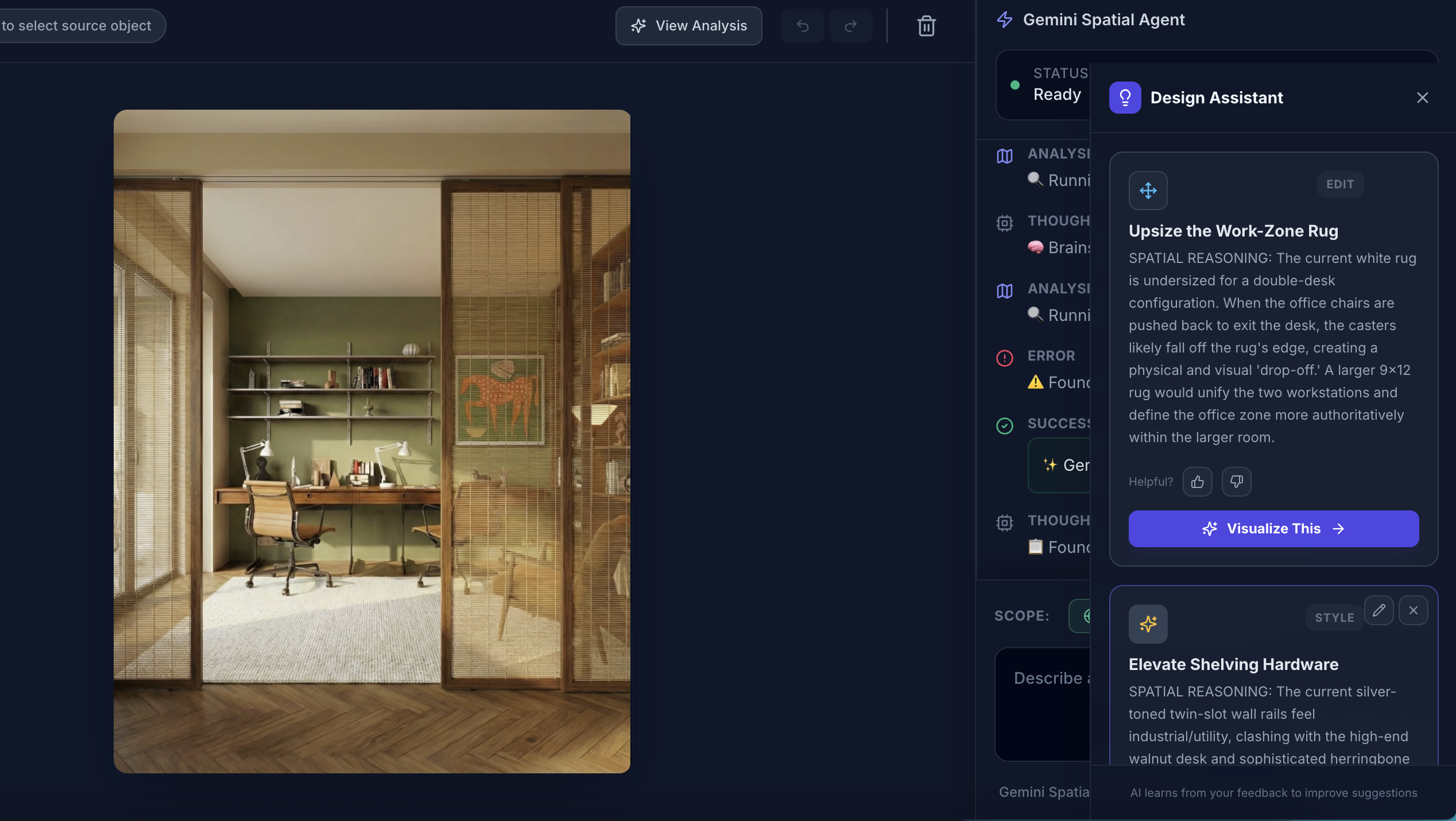
The system runs a tight loop of analysis → reasoning → revision, allowing Gemini to explain failures, adjust constraints, and improve results over time. SpaceVision also adapts to user preferences and learns from past mistakes through contextual reasoning.
How I've built it
SpaceVision is built around Gemini’s multimodal capabilities and treats the model as infrastructure rather than a feature.
Images and plans are first analyzed by Gemini to extract objects, layout, and spatial structure. This analysis is converted into structured context used during reasoning and generation.
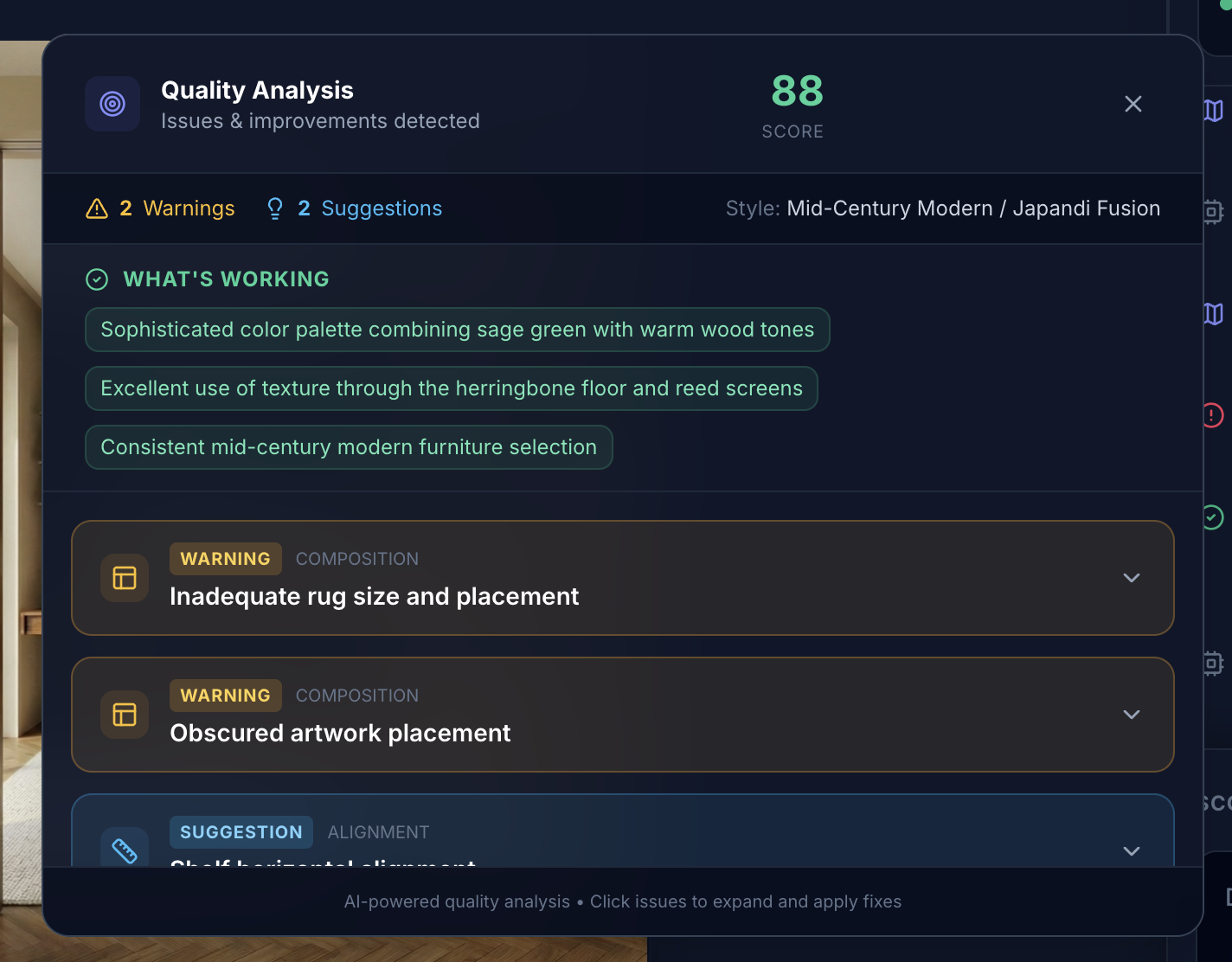
Gemini evaluates generated designs for functional correctness, visual coherence, and alignment with user preferences. When issues are detected, the reasoning layer modifies prompts and generation parameters and produces revised outputs.
The frontend provides a clean UX that allows users to trigger actions directly from analysis or assistant views, making Gemini’s reasoning transparent and controllable.
Challenges I've ran into
One of the main challenges was ensuring that SpaceVision did more than generate visually appealing images. The system needed to understand why a design worked or failed and revise intelligently instead of regenerating randomly.
Another challenge was designing guardrails and UX for moments when Gemini’s output was incorrect. Making failures visible and useful - rather than hidden - required careful prompt and workflow design.
Interpreting abstract inputs like 2D floor plans while maintaining realistic spatial constraints was also a significant challenge.
Accomplishments that I am proud of
Built a full workflow around Gemini’s analysis, reasoning, and image generation capabilities
Created an adaptive system that learns user preferences and improves through feedback
Enabled object-level understanding and boundary-aware redesigns
What I've learned
I've learned that Gemini becomes significantly more powerful when analysis, reasoning, and generation are treated as a continuous loop rather than a single step.
I've also learned that transparency matters - explaining why a design failed builds trust and enables better iteration. Contextual learning from preferences and mistakes can create adaptive behavior without retraining models.


Log in or sign up for Devpost to join the conversation.