Inspiration
With the "Metropolis" theme in mind, we realized that cities aren't actually overcrowded: they are just inefficiently mapped. We saw "dead space" everywhere: empty driveways while people are at work and unused gardens. We wanted to create a platform that treats every square foot of the city as a liquid asset, making the "15-minute city" a reality by unlocking hidden inventory for parking, storage, and urban farming.
What it does
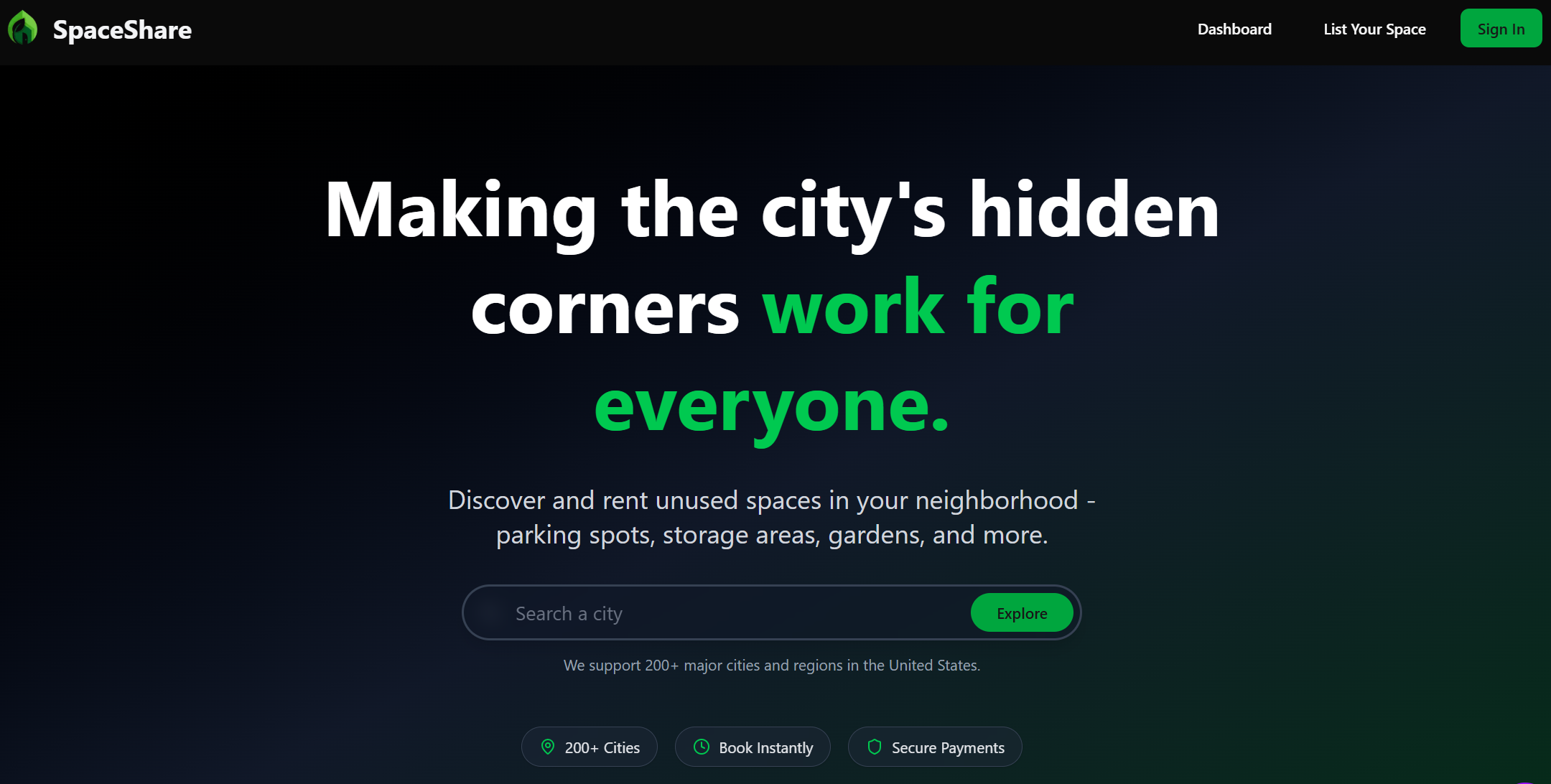
SpaceShare is a peer-to-peer marketplace for urban micro-spaces. Using "Uber-style" predictive logic, the app prompts users to reserve a private driveway or lot exactly when they are approaching their destination. It features a 50-meter geofence for "hard-locking" spots, an integrated smart-lock system that uses IoT to grant physical access to private property once a payment is confirmed, and a policy-driven financial engine that automatically calculates transaction fees and routes earnings to homeowners.
How we built it
We built the core engine using AWS Location Service for high-precision geofencing and Supabase/PostgreSQL to track the real-time "state" of the city. We integrated payouts to homeowners and used Visa Direct APIs to push funds to lister's cards. For the financial layer, we implemented Capital One APIs to create a "Micro-Savings Sweep" that automatically funnels 20% of earnings into savings accounts. For the UI, we used React and Tailwind, co-writing the logic with generative AI to ensure the navigation flow felt as intuitive as a ride-sharing app.
Challenges we ran into
One of our primary technical hurdles was building a reliable geofencing system with AWS Location Service to ensure real-time accuracy when users approach their destination. We also had to design a financial logic layer where earnings are correctly routed to the lister (not the booker), with proper fee breakdown: 2% platform fee, 78% lister payout, and 20% automatic tax savings sweep. We faced a major strategic crossroads in deciding whether to keep our service narrowly focused on parking or to expand into a multi-use marketplace for storage and garden spaces, ultimately choosing to prioritize a robust, specialized experience over a cluttered one.
Accomplishments that we're proud of
We successfully developed a fully automated, policy-driven financial engine that dynamically calculates transaction fees and distributes payouts, transforming a simple payment process into a sophisticated tool for urban economic coordination. To ensure a seamless user experience, we delivered a cohesive, high-fidelity UI design that prioritizes intuitive navigation and features a streamlined, autofill-powered onboarding flow to reduce user friction. Our most significant technical achievement was the implementation of a real-time IoT integration that grants immediate physical access to spaces once payment is confirmed, enabling truly frictionless micro-transactions in the physical world.
What we learned
Through this project, we explored the integration of AWS Location Services and real-time mapping software to create a scalable digital twin of the city, ensuring our geospatial data remained accurate and responsive under high user loads. We also gained a deep understanding of urban marketplace financing, specifically how to design a policy-driven engine that accounts for complex variables like transaction fees, lister payouts, and automatic savings transfers. Finally, we learned the art of rapid product strategizing by navigating a high-pressure development window, which forced us to prioritize a core specialized service over expanding into storage or gardens to ensure a polished, market-ready delivery.
What's next for SpaceShare
We want to integrate Fetch.ai agents so your car can autonomously "negotiate" parking prices with driveways while you drive. We also plan to expand into "Micro-Loading Zones" for delivery fleets like Amazon and FedEx to reduce double-parking congestion. Finally, we want to add AR wayfinding to help users see their reserved "Square" through their phone camera.


Log in or sign up for Devpost to join the conversation.