-
-
Thumbnail_SpaceProof
-
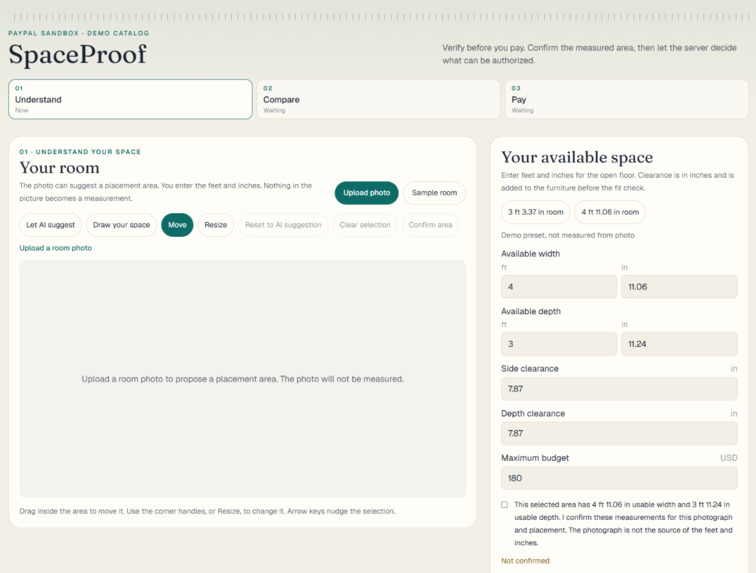
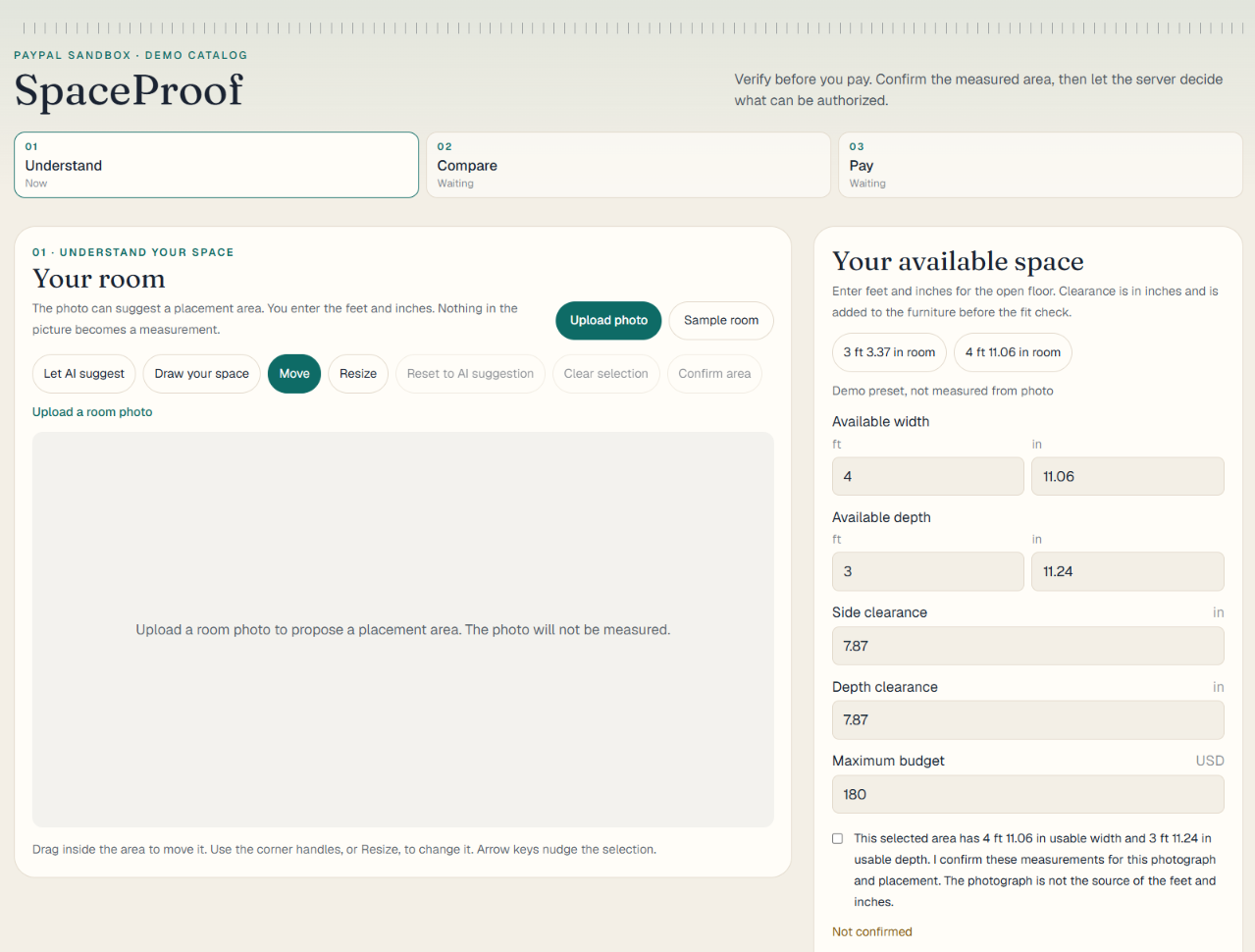
SpaceProof_homePage
-
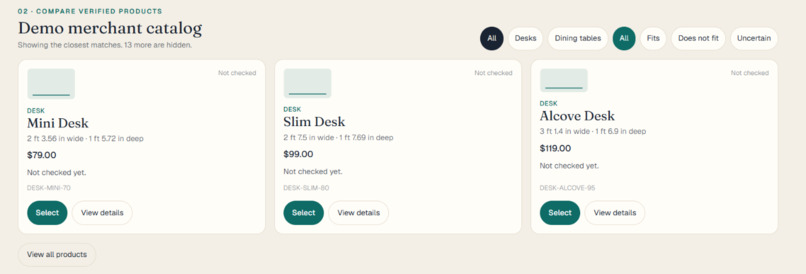
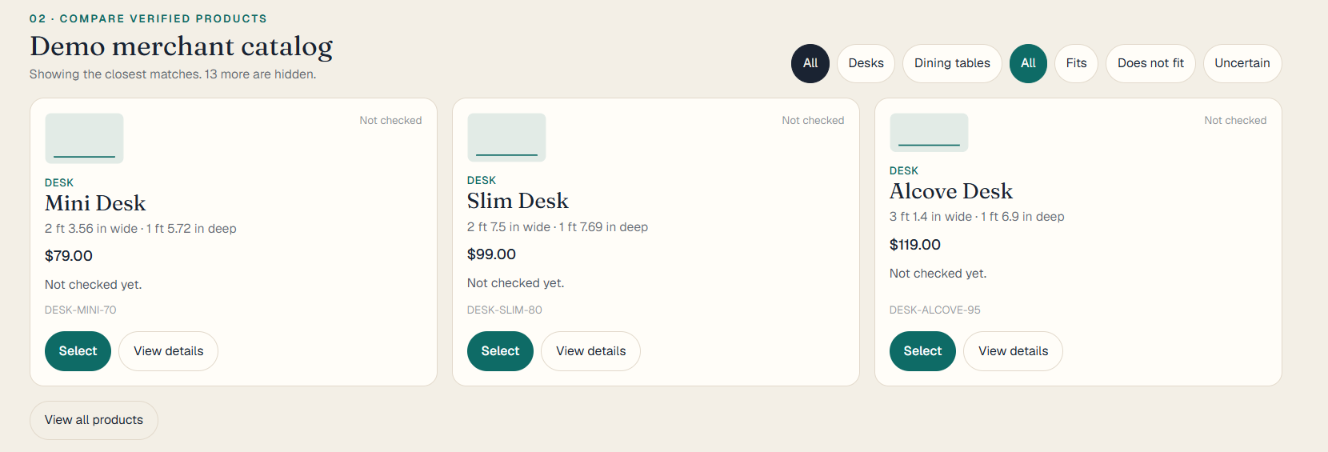
Demo Merchant catalog
-
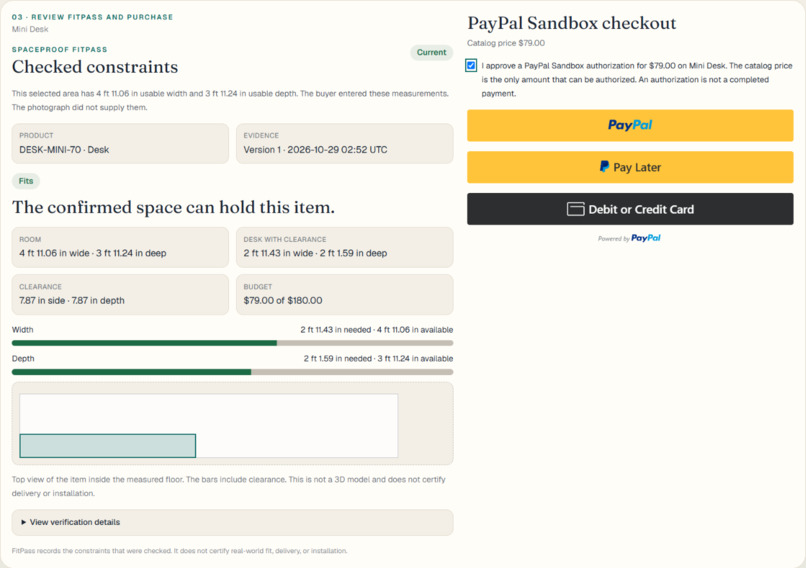
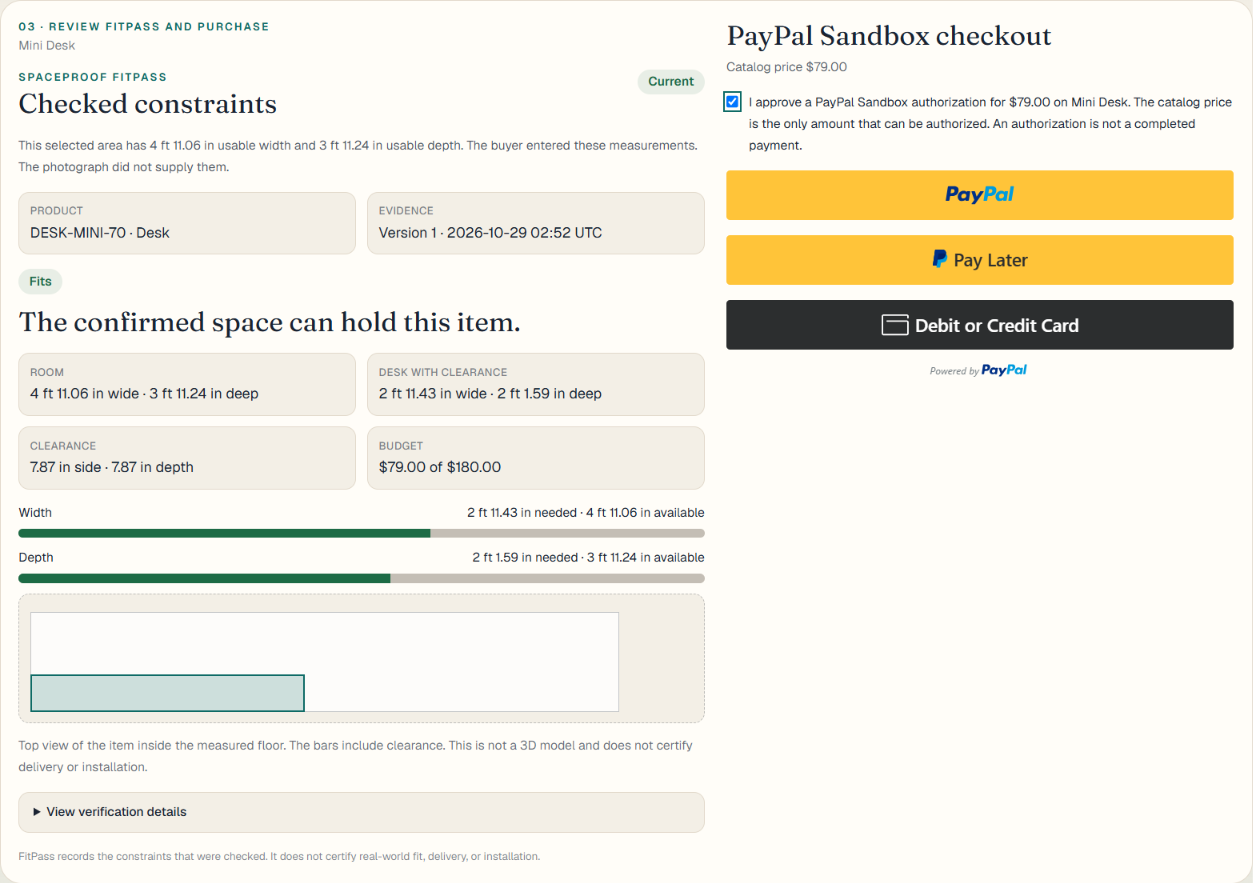
Checkout page with verification fits
-
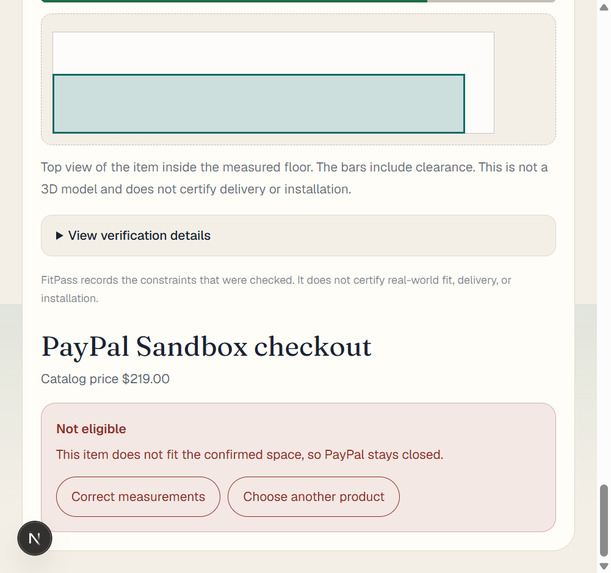
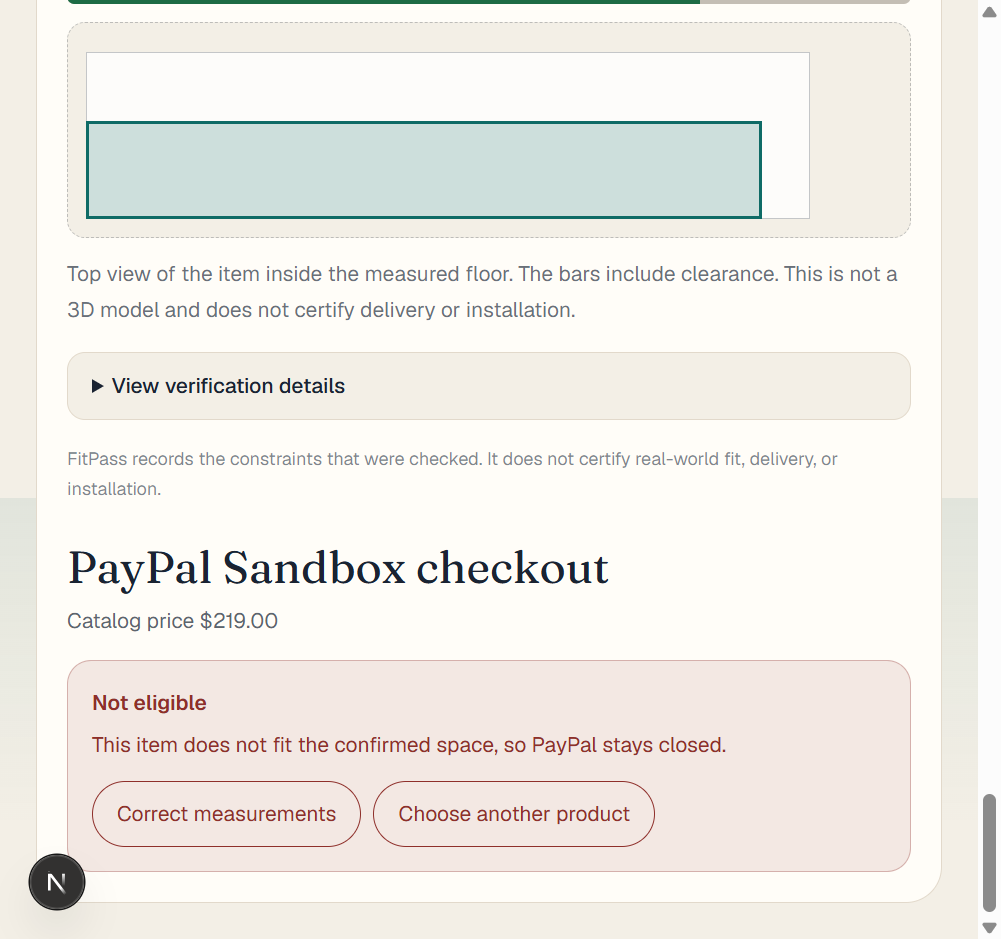
if not fits not eligible to checkout
SpaceProof: Verify Before You Pay
Inspiration
Imagine buying a beautiful desk online, only to discover that it doesn't fit your room. The dimensions looked reasonable, the price was right, and an AI shopping assistant even recommended it. But the purchase still failed because nobody verified the actual space.
This highlights a bigger problem in AI-powered commerce: AI can recommend what to buy, but who verifies that the recommendation satisfies the buyer's real-world constraints before money changes hands?
Existing shopping assistants can understand preferences, analyze images, and suggest products. However, recommendations alone cannot guarantee that furniture fits a particular space, leaves sufficient clearance, or stays within a buyer's budget.
I built SpaceProof to bridge that gap by connecting AI-assisted visual understanding, deterministic constraint verification, and conditional PayPal payments.
The idea is simple:
AI proposes. Geometry verifies. The buyer approves. PayPal captures or voids.
What it does
SpaceProof is an AI-assisted spatial commerce application that verifies furniture purchases against buyer-confirmed constraints before completing payment.
The experience follows five steps:
1. Understand the space
Users upload a room photograph or select a sample room. SpaceProof uses a multimodal vision model to identify possible furniture placement areas and visible obstacles.
2. Give users control
AI-generated placement suggestions are editable. Users can draw, move, resize, or replace the proposed area and confirm the available measurements in feet and inches.
3. Verify before checkout
SpaceProof evaluates furniture against confirmed space dimensions, clearance requirements, product specifications, and budget.
Its verification engine returns three possible outcomes:
- FIT: All required checks pass.
- DOES NOT FIT: At least one verified constraint fails.
- UNCERTAIN: Required information is missing or unconfirmed.
Each assessment is explained through FitPass, an evidence-backed record of the constraints checked.
4. Authorize through PayPal
Only a product with a current, valid FIT assessment can proceed to checkout. The buyer explicitly approves the transaction through PayPal Sandbox.
Instead of immediately capturing payment, SpaceProof first obtains an authorization.
5. Revalidate before capturing
Before payment capture, the server checks the purchase conditions again.
If the product remains eligible, SpaceProof captures the authorized payment.
If a relevant measurement or purchasing constraint changes and the assessment becomes invalid, SpaceProof blocks capture and voids the uncaptured authorization.
This is what makes SpaceProof different from a conventional AI shopping chatbot: verification is enforced by the transaction workflow, not simply described in an AI response.
How we built it
I developed SpaceProof as a full-stack application that combines multimodal AI, computer vision, deterministic geometry, and PayPal's developer platform.
Frontend
- Next.js, React, TypeScript, and Tailwind CSS
- Interactive room placement editor
- Product comparison and FitPass interface
- Responsive shopping and checkout experience
AI and computer vision
- NVIDIA Nemotron-3.5-Super-VL through Nebius Token Factory
- Python, FastAPI, and OpenCV
- Structured room-image understanding and placement suggestions
- User-correctable spatial selections
Backend and database
- Next.js server-side APIs
- PostgreSQL and Prisma
- Versioned fit assessments
- Server-enforced product, clearance, and budget verification
- Purchase and transaction state tracking
Payments
- PayPal Orders v2 API
- PayPal Payments v2 API
- Buyer-approved authorization
- Final eligibility revalidation
- Authorization capture and void
Deployment
- Render for the public Next.js application and FastAPI vision service
- PostgreSQL for persistent application data
A key architectural decision was to separate AI reasoning from financial authority.
The AI model can interpret an image, propose a placement area, and assist with product selection. However, it cannot invent trusted measurements, change catalog prices, override a failed fit assessment, or directly authorize a payment.
Those decisions are enforced by the server.
Challenges we ran into
1. Turning image understanding into trustworthy spatial decisions
A vision model can identify useful placement regions, but it cannot reliably infer exact real-world dimensions from an ordinary uncalibrated photograph.
I addressed this by treating AI output as a suggestion rather than verified measurement evidence. Users confirm the relevant dimensions, and the deterministic geometry engine performs the actual fit checks.
2. Preventing AI or client-side errors from affecting payment
A shopping assistant should not be able to approve an incompatible product simply because its model predicts that the product fits.
SpaceProof uses server-side verification, trusted catalog prices, and versioned fit assessments. The browser cannot override the backend's eligibility decision.
3. Handling changes after payment authorization
One of the hardest problems was dealing with an order that was valid when payment began but became invalid before capture.
I built an authorization-first workflow that rechecks the purchase conditions before settlement.
When the constraints remain valid, the authorization can be captured. When they become invalid, the system blocks capture and voids the uncaptured authorization.
4. Integrating AI, geometry, and payment infrastructure
SpaceProof combines separate services for image analysis, application logic, database persistence, and payment processing.
Maintaining consistent state across those services required careful handling of measurement changes, stale assessments, payment statuses, and provider responses.
Accomplishments that we're proud of
As a solo developer, I built and deployed a working application that demonstrates:
- AI-assisted room understanding using Nebius Nemotron-3.5-Super-VL.
- An editable furniture placement interface that keeps the buyer in control.
- Deterministic verification of dimensions, clearance, and budget.
- FitPass assessments that explain why a purchase is eligible or blocked.
- Server-side prevention of purchases that fail verification.
- Real PayPal Sandbox authorization and successful capture.
- Authorization voiding when a purchase becomes ineligible before capture.
- A publicly accessible full-stack application deployed on Render.
The most important accomplishment is connecting a changing physical-world constraint to an enforceable payment decision.
Rather than simply recommending a product, SpaceProof can prevent an ineligible purchase from completing.
What we learned
Building SpaceProof reinforced an important lesson: AI should assist decision-making without automatically becoming the authority for every consequential action.
Multimodal AI is useful for understanding the physical environment, but measurable constraints should be validated independently.
I also learned how PayPal's authorization and capture lifecycle can support more deliberate commerce workflows.
Authorization is not the same as capture. That distinction provides an opportunity to verify conditions again before completing a payment.
More broadly, I learned that trustworthy AI commerce requires three things working together: useful intelligence, verifiable constraints, and explicit buyer control.
What's next
SpaceProof currently focuses on furniture shopping, but the underlying approach could extend to other purchasing decisions involving measurable requirements.
My next priorities include:
- Improving visual placement accuracy using real-world evaluation data.
- Exploring more reliable spatial calibration methods.
- Extending verification to additional furniture types and installation constraints.
- Strengthening the FitPass evidence model.
- Exploring reusable verification policies for AI-assisted commerce.
The long-term goal is to make constraint verification a practical part of AI-powered purchasing experiences.
Try SpaceProof
Live Demo: https://spaceproof.onrender.com/
GitHub Repository: https://github.com/Mukesh-SCS/SpaceProof
AI Model: NVIDIA Nemotron-3.5-Super-VL via Nebius Token Factory
Payments: PayPal Developer Platform (Sandbox)
SpaceProof is a working demonstration using a sample furniture catalog and PayPal Sandbox transactions. It does not process real-money purchases.
Important limitation: A FIT result means the product passed SpaceProof's implemented checks using buyer-confirmed measurements. It is not a guarantee of physical compatibility or an independently certified measurement.
SpaceProof: Verify Before You Pay.
Built With
- ai
- css
- fastapi
- nebius
- nemotron
- next.js
- nvidia
- opencv
- paypal-rest-api
- paypal-sandbox
- postgresql
- prisma
- python
- react
- render
- tailwind
- typescript
