-
-
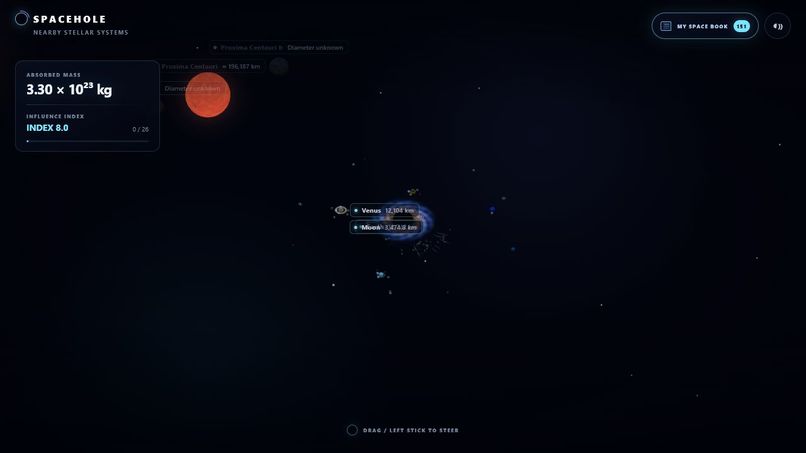
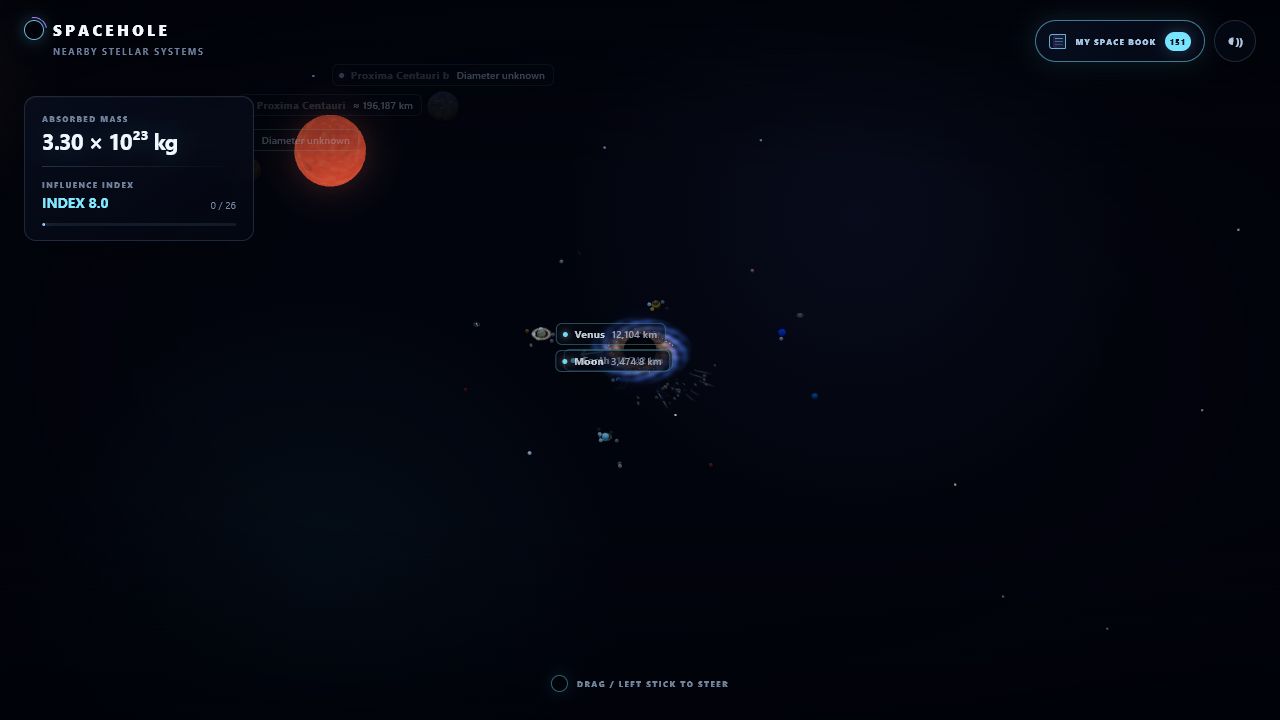
Beyond the Sun: nearby stars invite a first step into the wider universe.
-
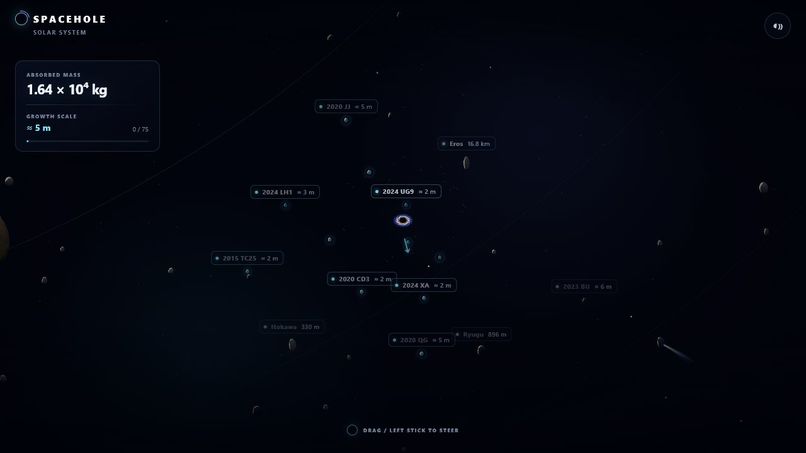
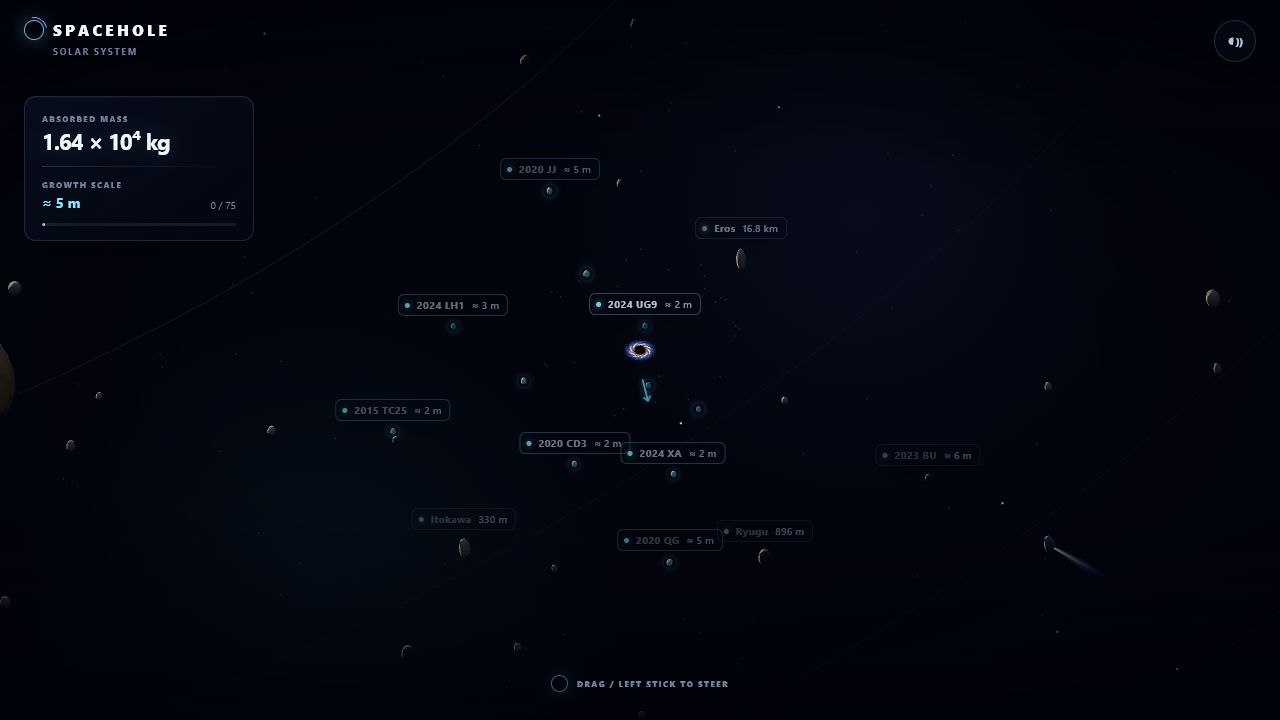
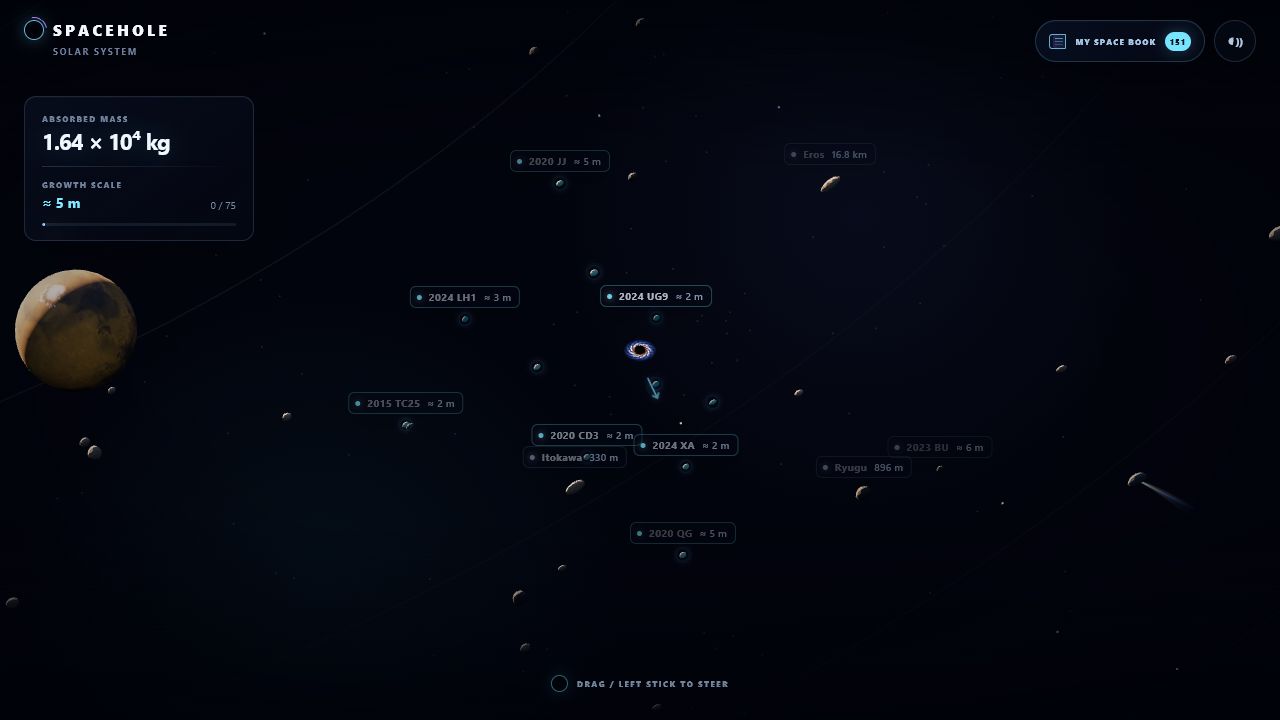
A living Solar System filled with asteroids and planets to explore—no quizzes, just curiosity and motion.
-
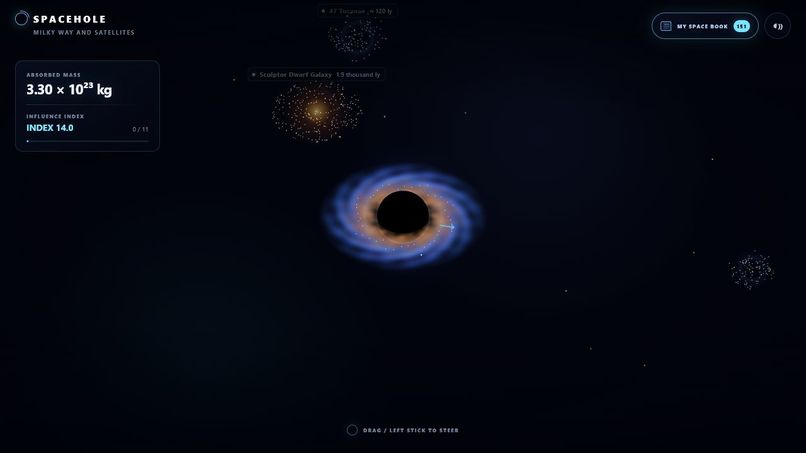
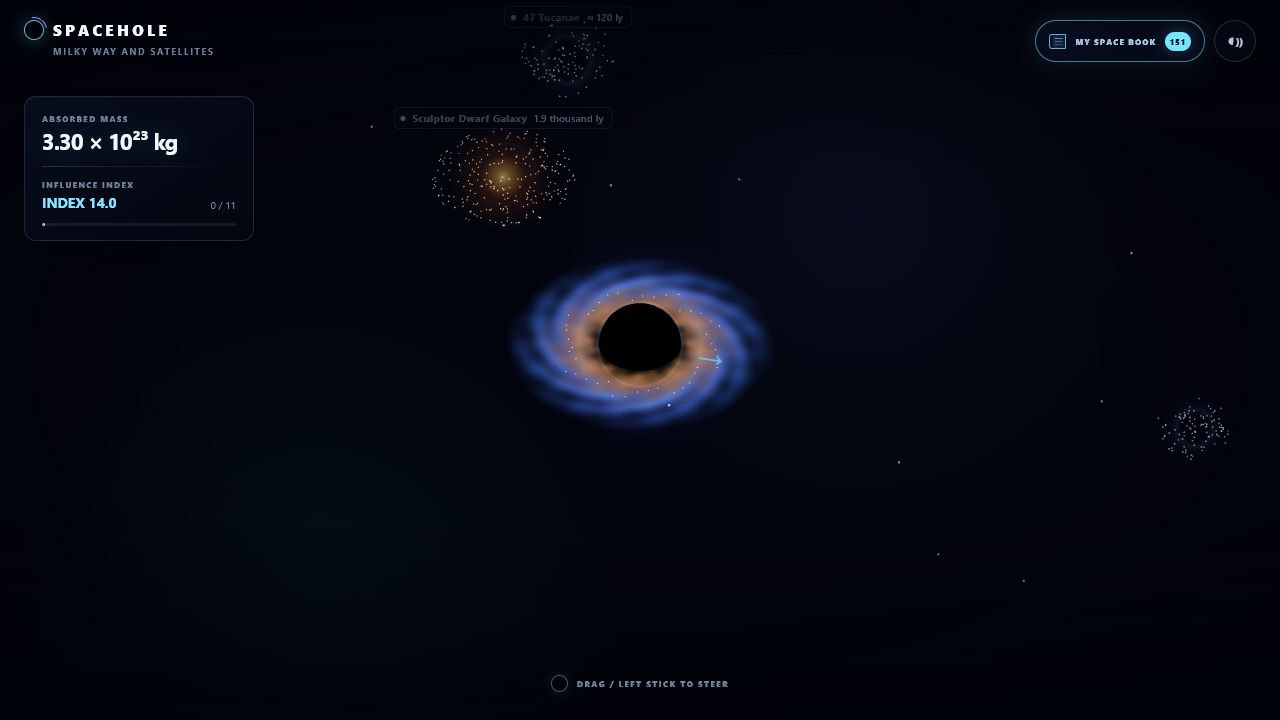
At galaxy scale, the Milky Way becomes a place to explore not just a distant idea.
-
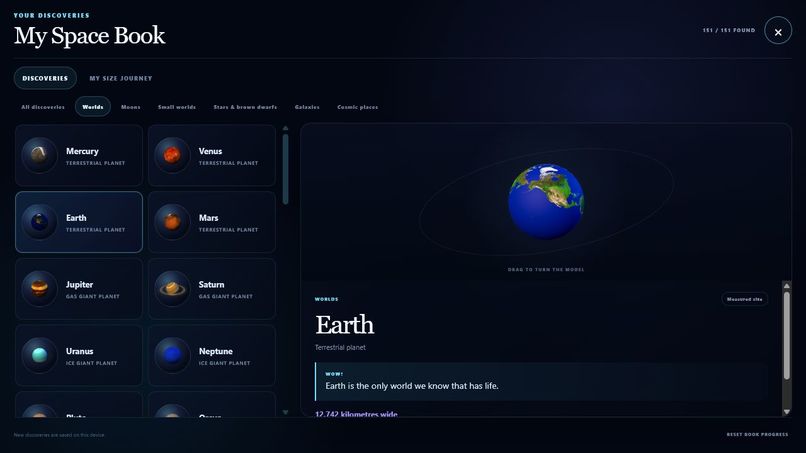
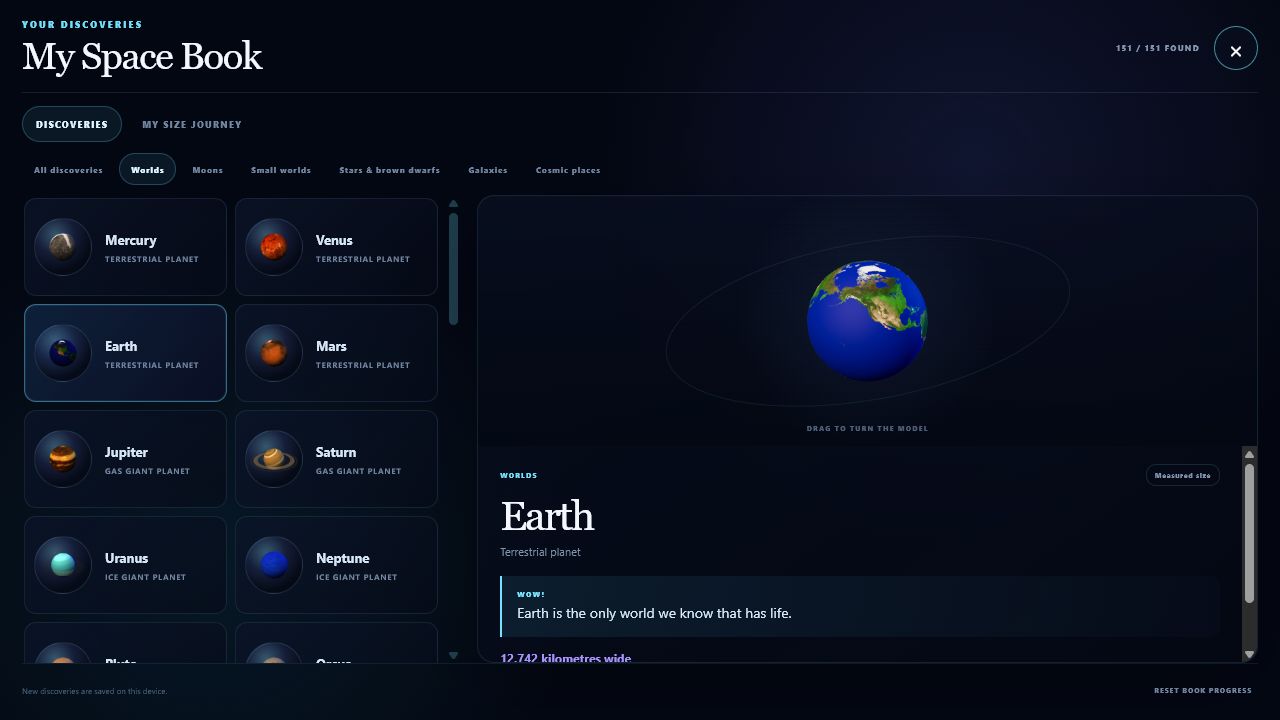
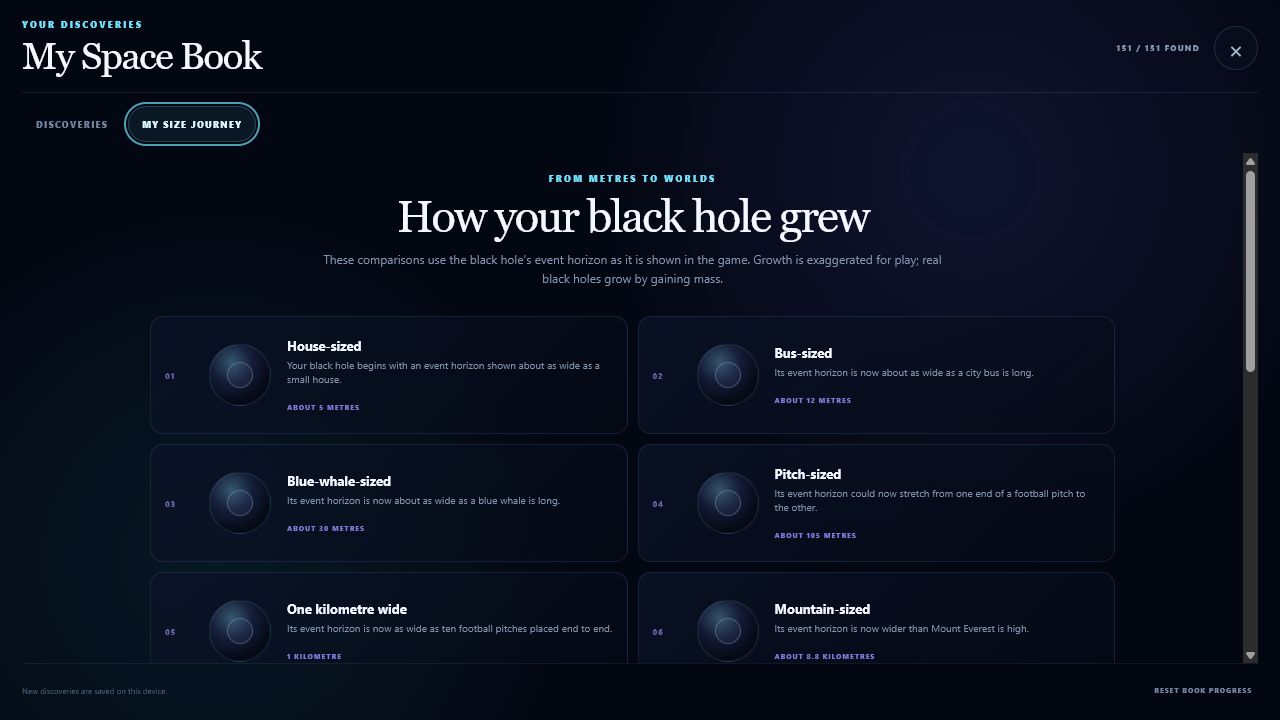
My Space Book turns each discovery into a child-friendly fact and a memorable visual.
-
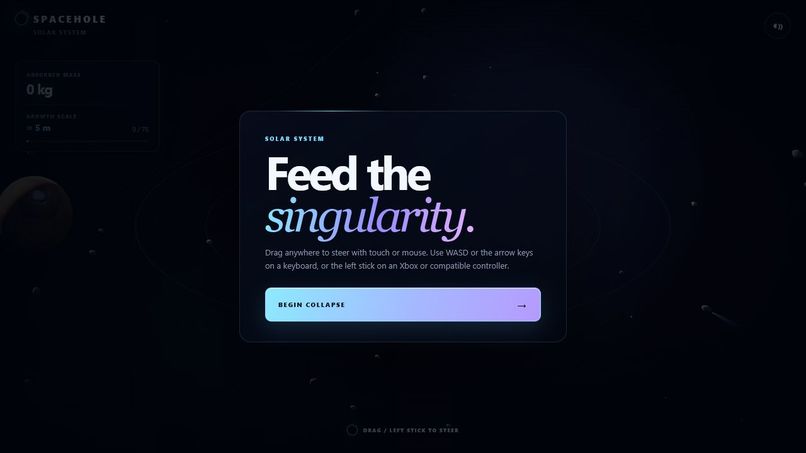
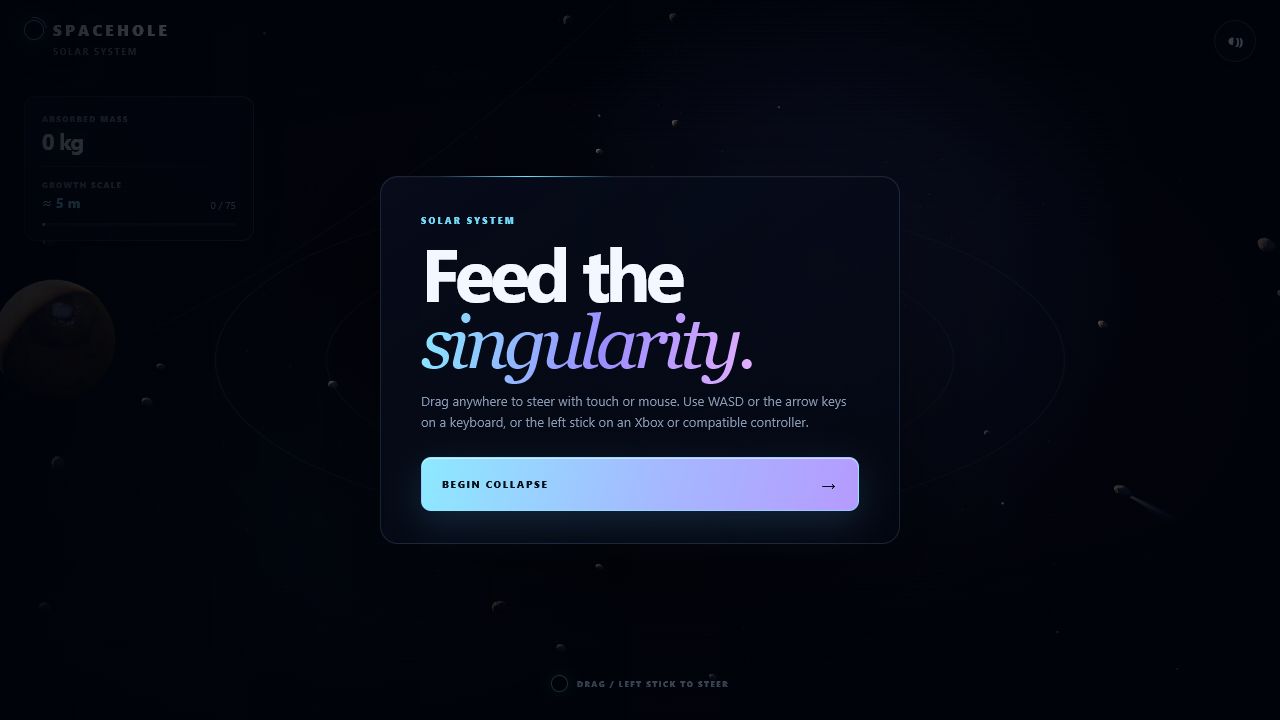
Begin at the edge of the Solar System: steer, grow, and discover the universe through play.
-
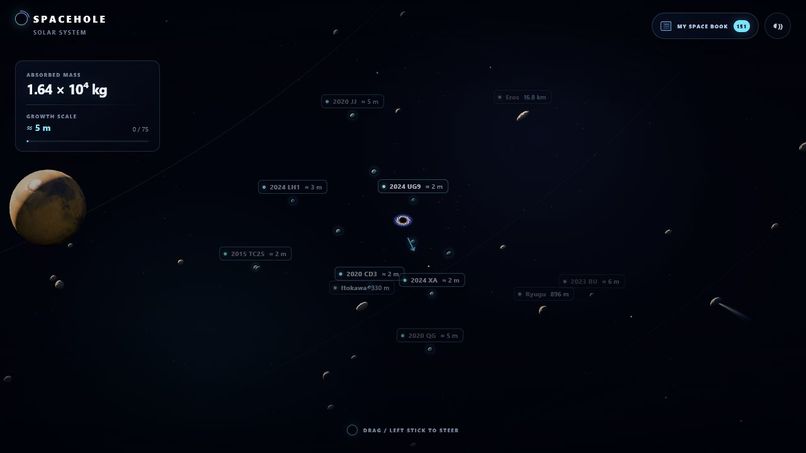
From tiny objects to vast distances, the Solar System evolves as players explore.
-
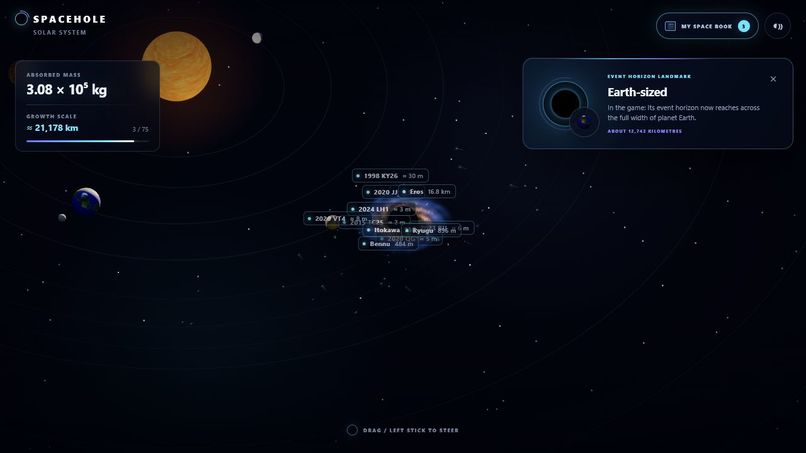
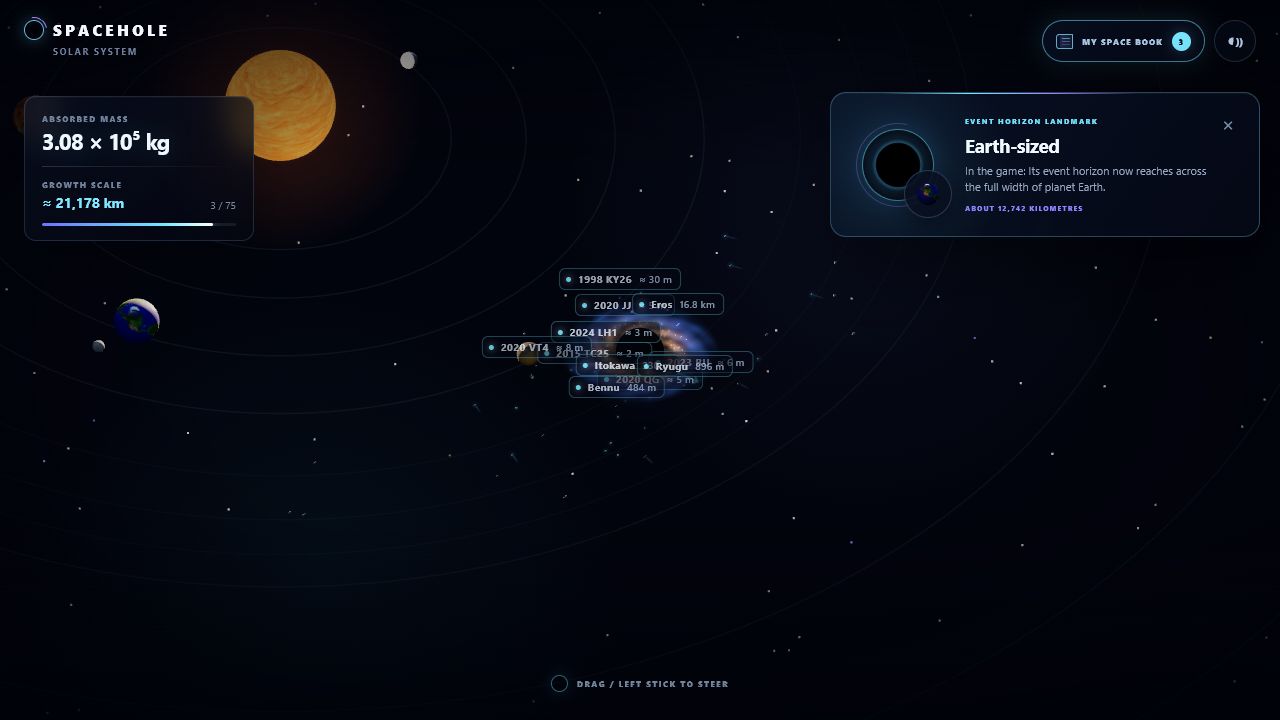
Growth becomes tangible when your event horizon reaches Earth-sized scale.
-
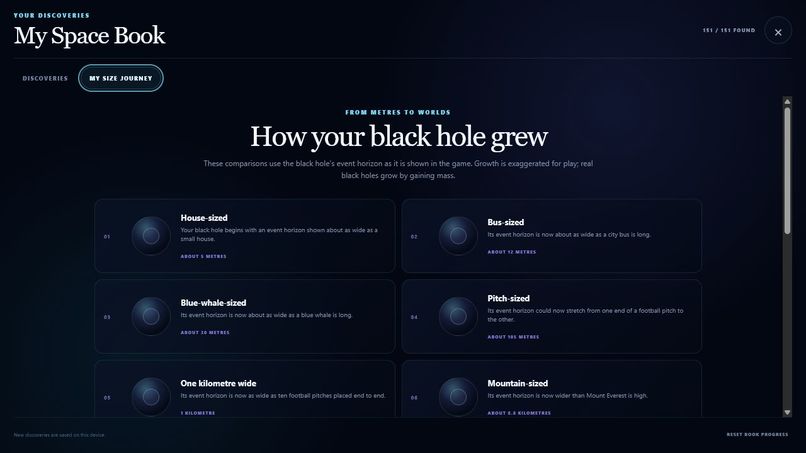
A playful size journey connects a growing black hole to houses, buses, worlds, and beyond.
Spacehole: Learn the Universe Through Play
Inspiration
Spacehole began with a simple question from trying to teach my five-year-old about space: what comes after the planets?
There are lots of great resources about the Solar System, but it is much harder to help a young child feel the jump from an asteroid to a planet, then to stars, galaxies, galaxy clusters, and the observable Universe. I wanted to make those enormous changes in scale playful, visual, and memorable rather than overwhelming.
Learning Through Play
I wanted the game to teach through curiosity and play—not through answering questions, passing knowledge checks, or being blocked by quizzes.
In Spacehole, facts are rewards for exploration. Players steer, discover, grow, and unlock entries in My Space Book. They can return to those discoveries whenever they like, allowing learning to happen naturally as part of the game rather than interrupting it.
What I Built
Spacehole is a mobile-first browser game built with JavaScript, Three.js, Vite, and CSS.
Players guide a growing black hole through:
- The Solar System
- Nearby stellar systems
- The Local Arm
- The Milky Way and its satellites
- The Local Group
- The cosmic web and deep observable Universe
| Feature | Details |
|---|---|
| Discoveries | 151 named celestial discoveries |
| Learning | Child-friendly facts, size comparisons, uncertainty labels, and interactive 3D models |
| Scale | 16 landmarks, from a house and bus to Earth, Jupiter, and the Sun |
| Accessibility | Touch, keyboard, compatible gamepad, sound controls, and reduced-motion support |
My Role and How I Built It with Codex
I am a game designer by trade, not a programmer. I did not write a single line of code or hand-create an art asset for this project.
Instead, I built Spacehole by guiding Codex with GPT-5.6: setting the product vision, describing the learning experience I wanted, reviewing iterations, identifying problems, and making the key product, design, and scientific-communication decisions.
Codex and GPT-5.6 accelerated the implementation of the responsive game, WebGL visuals, controls, learning collection, data model, and automated validation. This let me focus on what I do best: game design, player experience, and iteration.
A crucial design decision was separating real astronomical data from compressed gameplay values. The Universe cannot fit onto a playable screen at true scale, so distances, camera ranges, and growth thresholds are adapted for play. Physical sizes, classifications, uncertainty notes, and sources remain separate, ensuring that a convenient game value is never presented as scientific fact.
GPT-5.6 and Codex were used to create the product; Spacehole has no runtime AI or network dependency.
Playtesting and Iteration
My five-year-old was the most important playtester during the final day of development.
Watching them play revealed small but important onboarding details:
- How quickly they understood steering
- Where visual guidance needed to be clearer
- When an interaction needed simplifying to feel natural for a five-year-old
Their feedback led to minor adjustments to player onboarding and the moment-to-moment experience. The goal was not to explain everything with text, but to help the player learn by moving, trying, discovering, and receiving clear feedback from the game.
The most meaningful result happened away from the screen. Since playing Spacehole, my child has started drawing celestial bodies outside our Solar System in their pictures, based on how they were depicted in the game. That felt like a genuine sign that the game had sparked curiosity and made these unfamiliar objects memorable.
Challenges and What I Learned
The hardest challenge was making a game about enormous scale without losing either fun or scientific honesty.
A galaxy cannot be treated like a solid planet, and some cosmic structures do not have a clear physical edge. I learned to distinguish between objects that can be collected in the game and regions that should be represented as non-collidable milestones, such as the Local Arm, Laniakea, and the observable horizon.
I also learned that educational design is often about choosing what not to explain all at once. My Space Book keeps facts short, approachable, and discoverable through play, while still marking information as measured, estimated, calculated, unknown, or hypothetical when appropriate.
Without Codex and GPT-5.6, I would not have had time to build something this robust in just under three days. My child loves Spacehole, and seeing them draw distant stars and galaxies in their own pictures afterwards is the most valuable validation I could have hoped for.
Built With
- codex
- gpt
- javascript
- render
- three.js
- vite

Log in or sign up for Devpost to join the conversation.