-
-
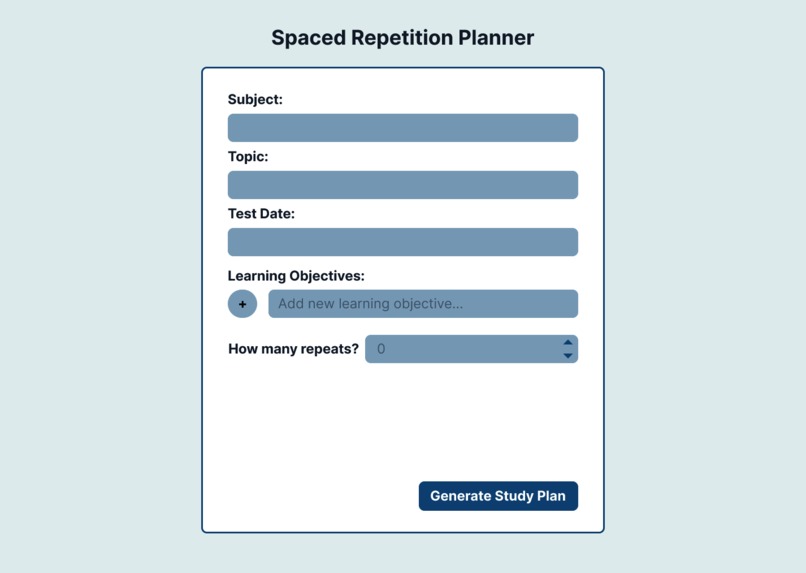
Spaced Repetition Planner Input
-
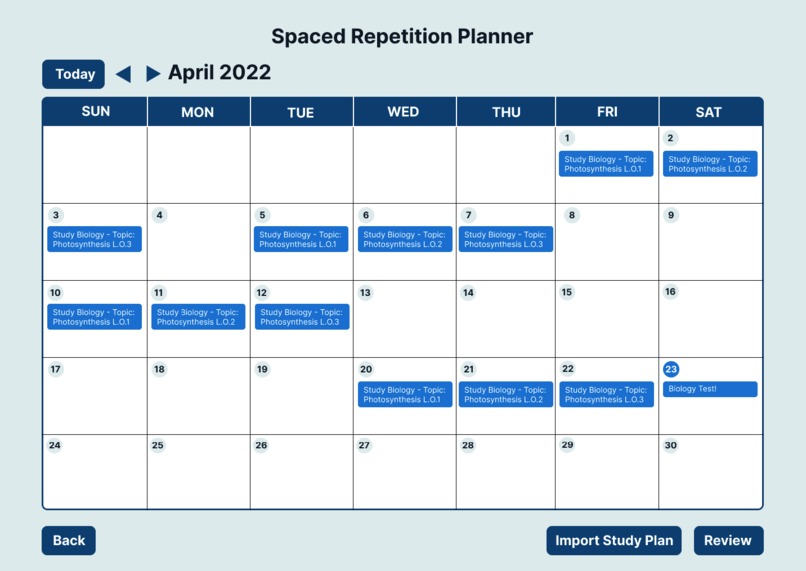
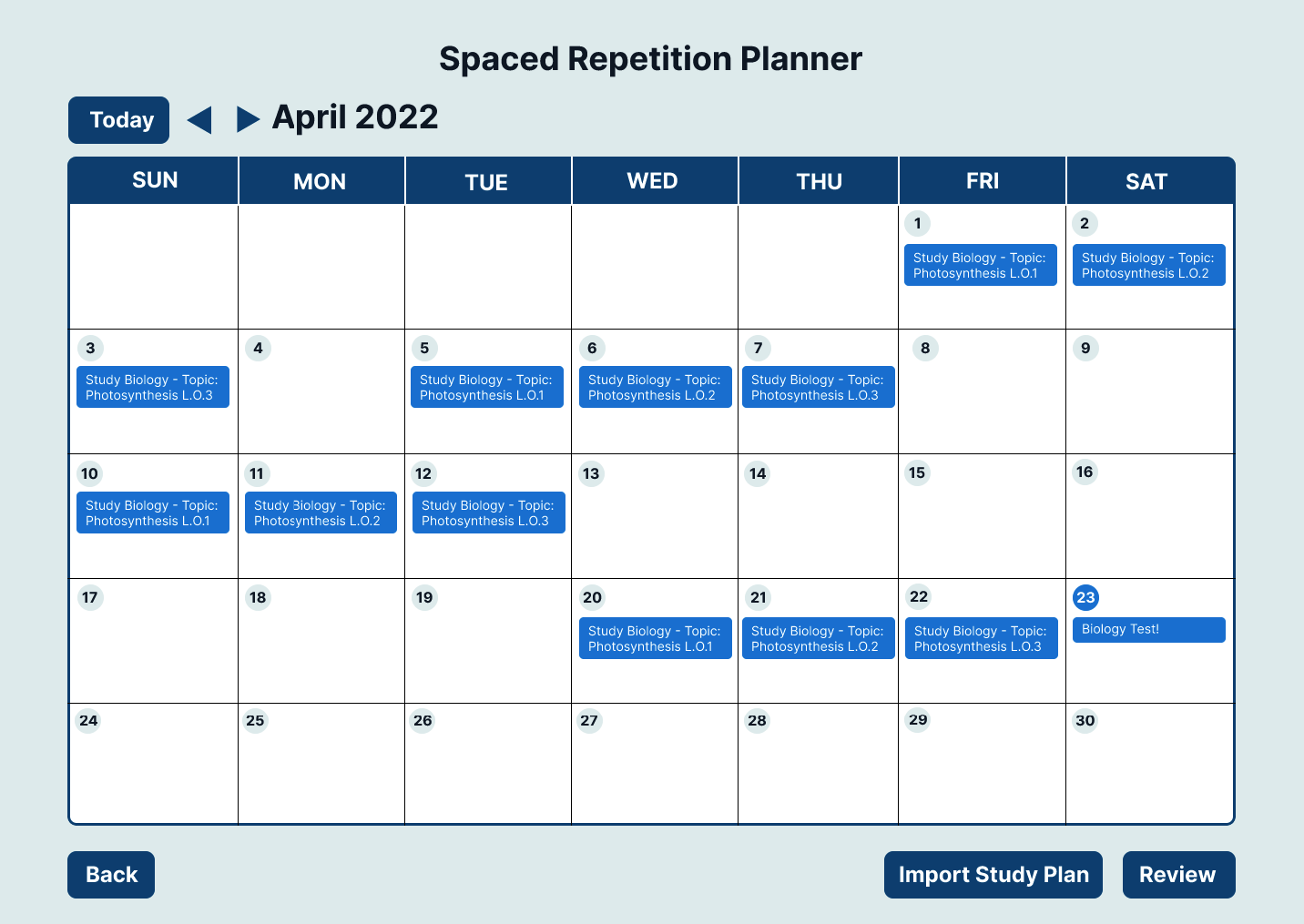
Example calendar with the Spaced Repetition Plan

We are an officially registered team for Melbourne Hack 2022
April Chen, Anouska Gievan, Song Chen team Lazy Innovators
Problem
There are many tools that help students plan out their study timetables, what to study and when. There is also a lot of evidence that shows spaced repetition is an effective studying tool. This website aims to combine the two in a new way. By creating a study plan for an exam by incorporating a forgetting the curve algorithm to allocate days to study the different learning outcomes based on the student's rating of difficulty they find those outcomes
Inspiration
Basically, our inspiration for this project was that we tend to procrastinate until the very last day to begin efficient study. This practice is very difficult to ignore with the prevalence of online learning and the many distraction son the internet. Hence we decided to create a tool to help students plan out their study timetable before a test. This study timetable will implement spaced repetition in the form of reminders in an attempt to push students to begin effective studying many days or even weeks before a test. This spaced method of study has been shown by many studies to be an effective way of memorising information or content. Additionally, we are going to be implementing a forgetting curve algorithm which allocates the number of days the students needs to study depending on the student’;s rating of difficulty and learning outcomes.
What it does
Our project is a website which attains an input from the user about an upcoming exam and takes this input in an attempt to create an effective study plan based on the amount of days, the users rating of the difficulty of the different and spaced repetition.
How we built it
The technologies we used were Mural for brainstorming, Figma for designing the UI, Github to share our code with other team members, JavaScript, HTML and CSS for building the project.
Challenges we ran into
Firstly, a challenge we faced was that our team was working remotely, so it was difficult to collaborate with and work on the project in a hands-on manner. We solved this by identifying our strengths and assigning roles and tasks for each team member to work on. April worked on the design, Song worked on the research and Anouska worked on building the actual project. Another challenge we faced was that neither of our team members had much experience with coding, as this was our first hackathon so we didn’t have the technical knowledge on how to code a project from scratch. We did what we could and in the end we learnt something new.
Accomplishments that we're proud of
Our team is most proud of creating a project that resembles the user interface that had been designed.
What we learned
We learned how to code in HTML, CSS and JavaScript. Building a coding project from scratch - from brainstorming, designing, building and presenting.
What's next for Spaced Repetition Planner
We hope to add more functionality to the website - from adding more courses, topics, learning outcomes. We also thought that implementing a way to import and sync to existing calendar apps such as Google calendar and Apple Calendar would be particularly useful.

Log in or sign up for Devpost to join the conversation.