-
-

-

Spacebound AI logo
-
-
Arm64
-


Inspiration
Monolithic, single-track LLM calls are brittle, slow, and expensive. When applications rely on a single prompt loop to think, evaluate, and format responses, they introduce single points of failure and lack deterministic safety controls. Furthermore, using an "LLM-as-a-judge" to validate output quality introduces high monetary cost, significant network latency, and non-deterministic variance.
Inspired by distributed systems design, SPACE_BOUND_AI v1.0 was built to externalize the "thought window" into an open, parallel middleware engine. By leveraging high-density Arm64 multi-core compute, the system coordinates concurrent execution, runs deterministic non-LLM heuristic safety checks, and logs empirical execution telemetry in real time.
What it does
SPACE_BOUND_AI v1.0 is an open, model-agnostic multi-track asynchronous reasoning harness and heuristic governor designed for high-concurrency cloud and edge environments:
- Asynchronous Multi-Track Dispatch: Executes Direct, Validation, and Perspective reasoning tracks concurrently using non-blocking asynchronous coroutines.
- Zero-LLM Heuristic Logic Governor: Audits outputs across 6 deterministic mathematical dimensions (Contradiction Detection, Levenshtein Drift Scoring, Hallucination Risk, Policy Compliance, Weighted Confidence) without relying on slow evaluator LLMs.
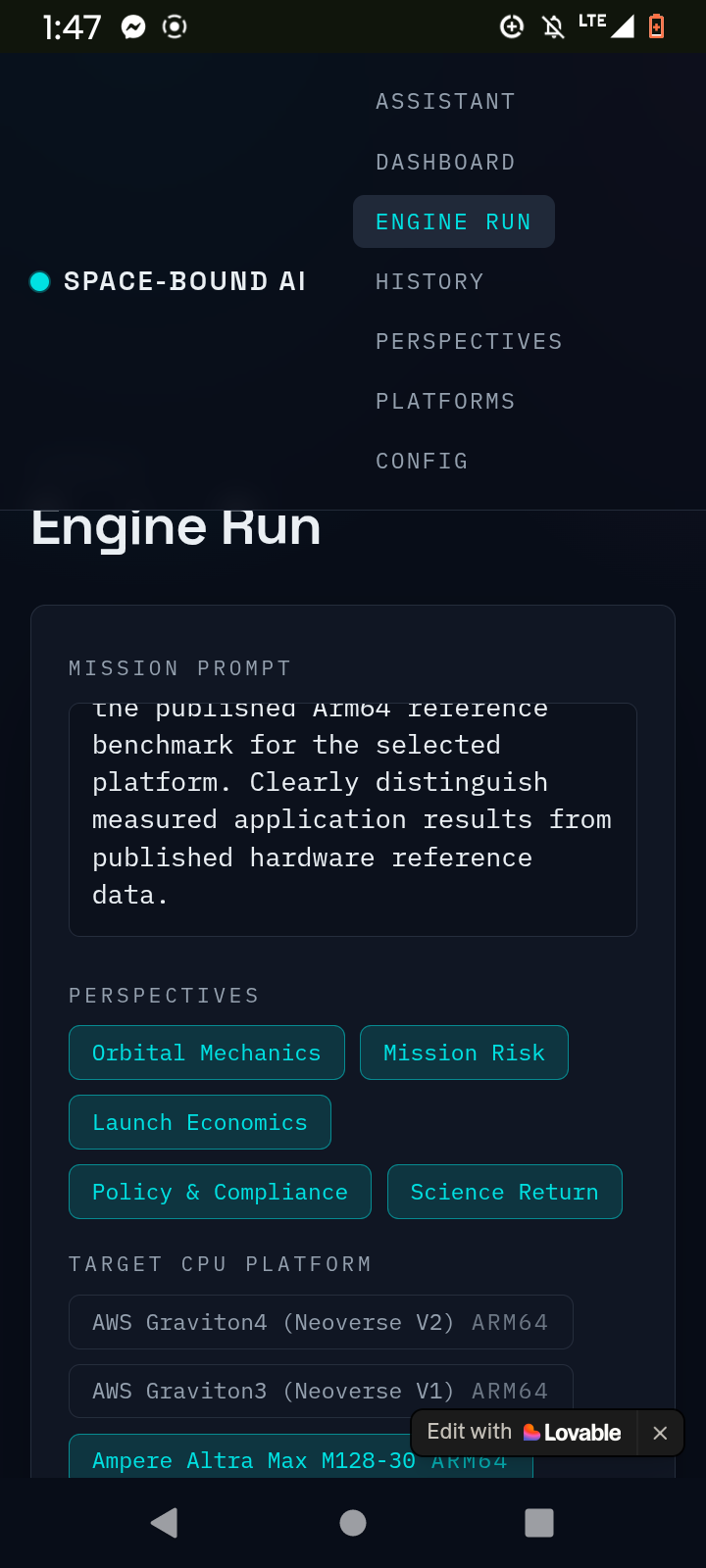
- Dynamic Perspective Synthesis: Features 12 domain analytical lenses (Engineering, Security, Legal, UX, Operations, System Design, etc.) triggered via keyword-based routing to conserve API tokens.
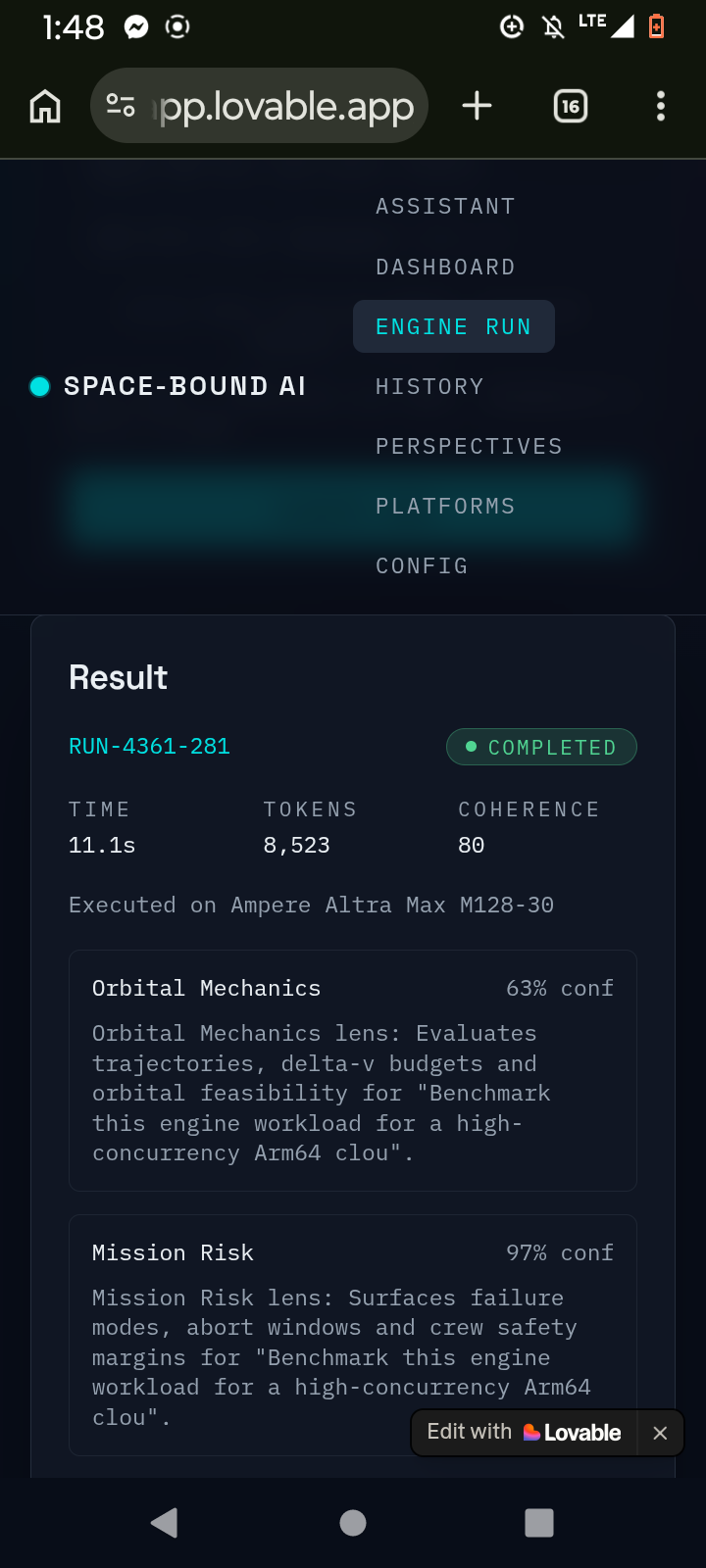
- Relational Telemetry Ledger: Logs session traces, token counts, monetary cost, and execution timelines across 8 relational SQLite tables.
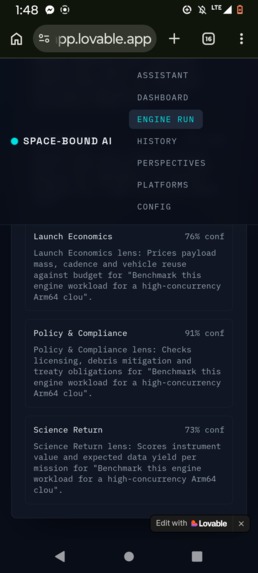
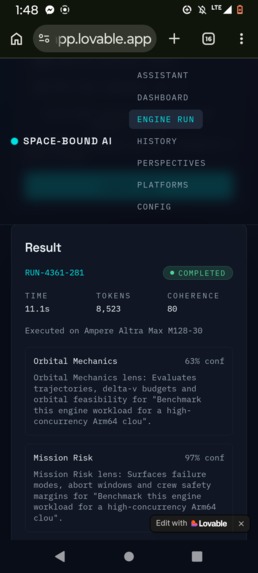
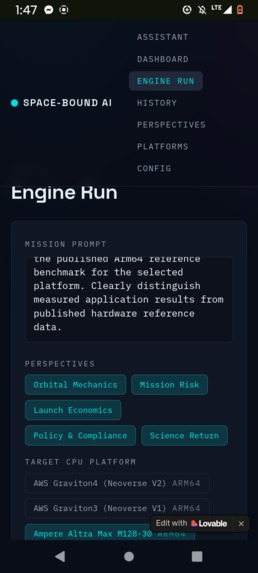
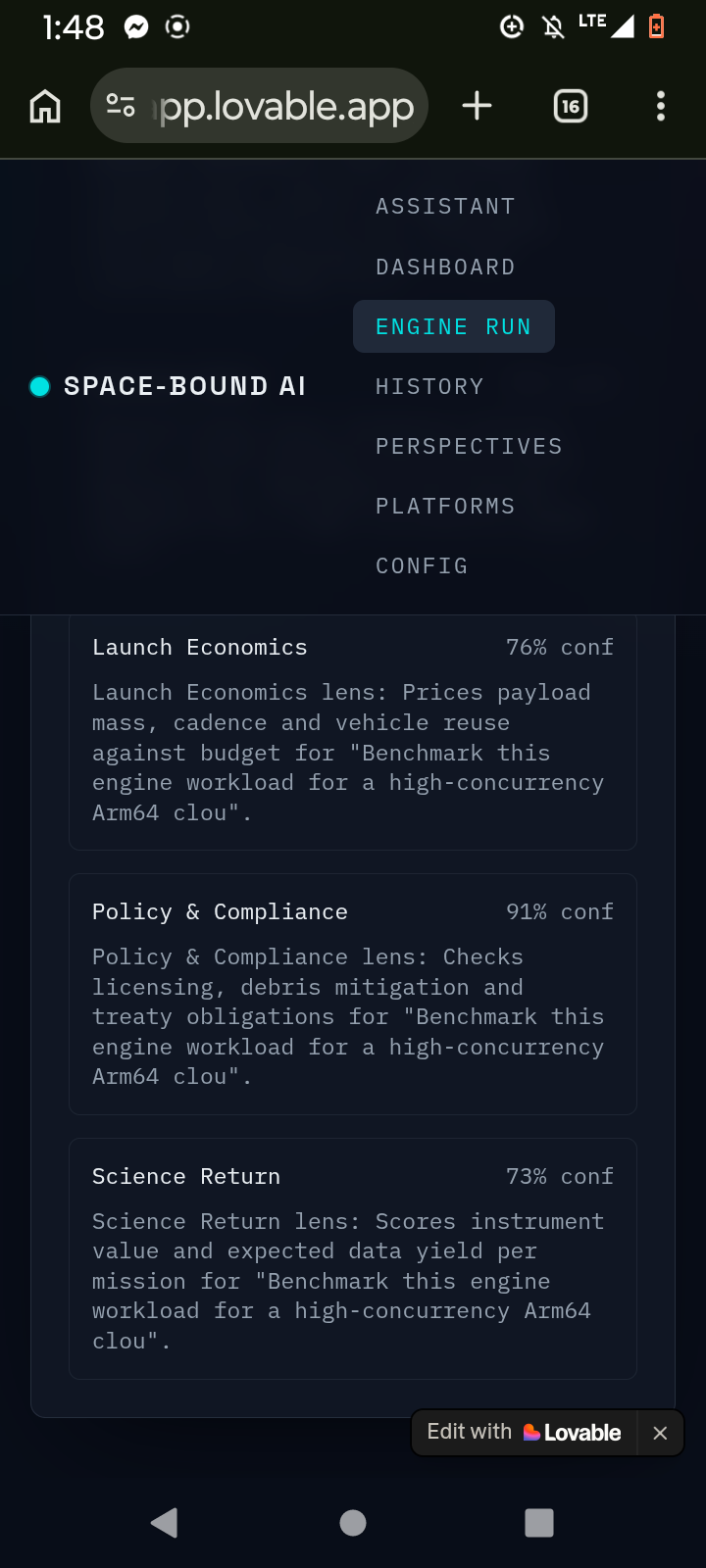
- REST Gateway & Dashboard: Provides 10 documented FastAPI endpoints and an integrated Vite/React dashboard for real-time visualization.
How we built it
- Core Runtime: Built natively in Python 3.10+ using
asynciofor non-blocking task scheduling, targetingaarch64/ Arm64 execution environments. - Scheduler & Afterthought Floor: Designed
app/scheduler.pywithasyncio.gatherto bound overall latency to the slowest single track, incorporating an Afterthought Window floor to guarantee background validation completes before connection yield. - Heuristic Governor: Implemented string-similarity algorithms and negation-parsing rules in
app/validator.pyto calculate exact confidence scores (0.0 to 1.0) down to six decimal places. - Unified Adapter Framework: Standardized integrations across local providers (
Ollama,LMStudio,Llama), cloud platforms (OpenAI,Anthropic,Gemini), and an offlineMockAdapter. - Backend & Storage: Powered by
FastAPIwith Pydantic payload validation and thread-safe SQLite connection pooling. - Empirical Verification: Built a 69-test automated verification suite covering concurrency, failover, schema integrity, and API contract adherence.
Challenges we ran into
- False Positive Negation Parsing: Standard string searches for negation words were initially misidentifying metadata headers like "No contradictions detected" as active contradiction flags. We resolved this by implementing system metadata stripping prior to heuristic evaluation.
- Concurrent Task Isolation: Preventing a network drop or timeout on an auxiliary track from crashing the primary user output required strict exception boundaries around individual coroutines inside
asyncio.gather. - Database Concurrency: High-velocity asynchronous writes created occasional lock contention in SQLite, which was resolved by implementing thread-safe connection pooling and WAL (Write-Ahead Logging) mode.
Accomplishments that we're proud of
- 100% Test Suite Pass Rate: Engineered a comprehensive 69-test verification suite that compiles and passes in 9.32 seconds.
- Deterministic Metric Stability: Achieved 100% identical metric outputs down to six decimal places across 100+ continuous test iterations, completely eliminating evaluator variance.
- Seamless Offline Failover: Designed an adapter registry that automatically degrades from cloud endpoints to local mock adapters upon detecting missing API keys or network drops.
- Arm64 Compute Efficiency: Optimized multi-track task dispatching to fully exploit high core-density Arm CPU layouts (AWS Graviton, Apple Silicon, Raspberry Pi 5).
What we learned
- Application-Layer Rigor Beats Black Boxes: Externalizing validation and perspective synthesis into lightweight middleware produces dramatically higher system reliability than relying on single monolithic prompts.
- Arm64 Async Efficiency: Non-blocking asynchronous scheduling paired with Arm's multi-core architecture delivers exceptional middleware throughput with minimal CPU overhead and zero GC memory spikes.
- Value of Mathematical Heuristics: Mathematical text metrics (Levenshtein edit distance, assertion density) provide predictable, real-time guardrails at near-zero compute cost.
What's next for SPACE_BOUND_AI v1.0
- On-Device Arm Edge Deployment: Compile native C/Rust bindings for the heuristic governor to execute on embedded Arm Cortex-M/NPU microcontrollers and edge hardware.
- Expanded Agent Skill Modules: Integrate native tool-calling, persistent vector storage, and automated web grounding tracks.
- Arm Performix Benchmarking: Publish full hardware profiling and token throughput benchmark reports across AWS Graviton4 and Raspberry Pi 5 clusters.


Log in or sign up for Devpost to join the conversation.