-
-
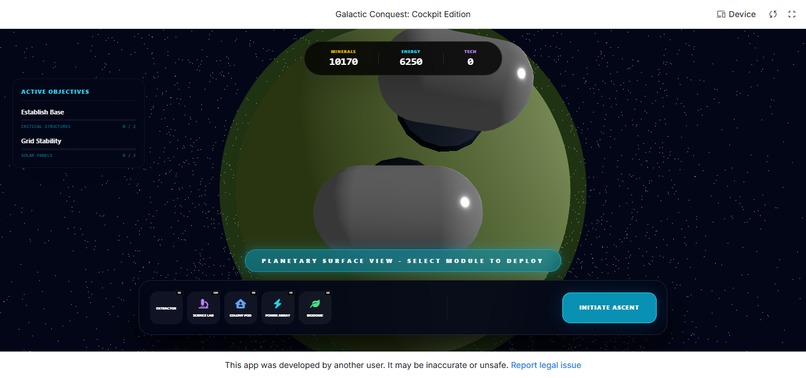
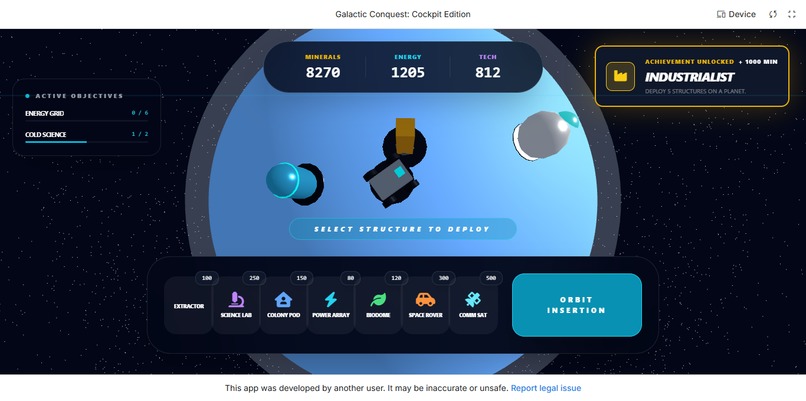
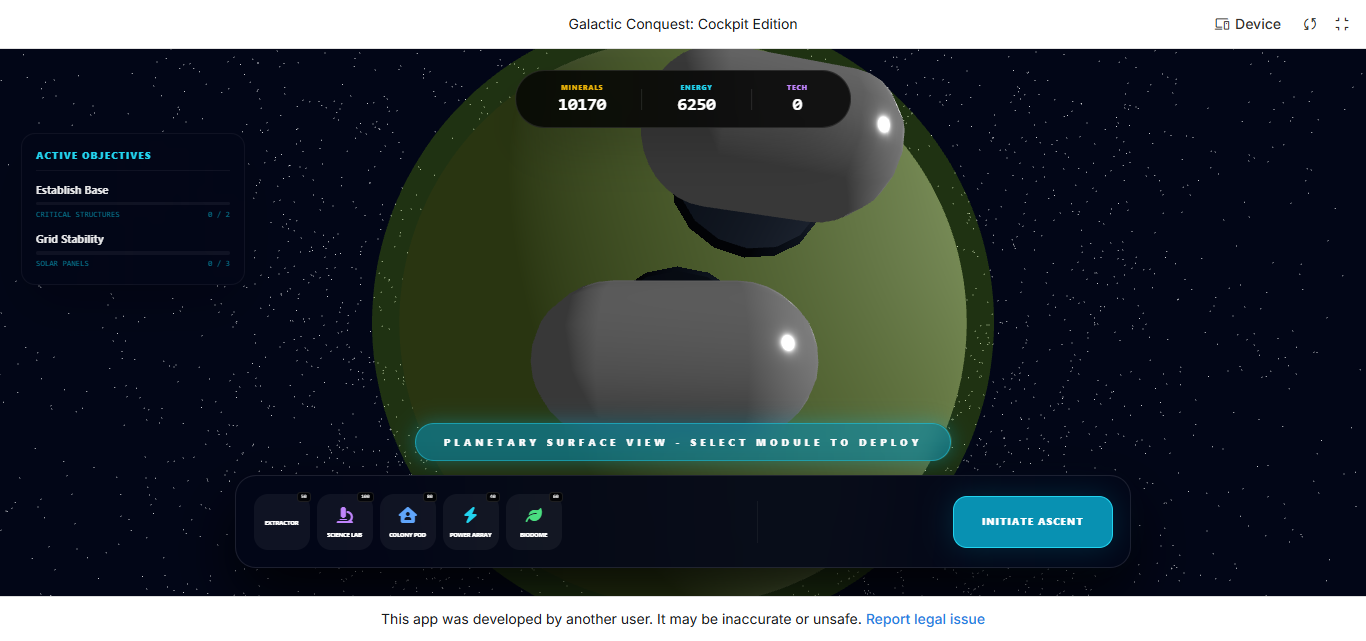
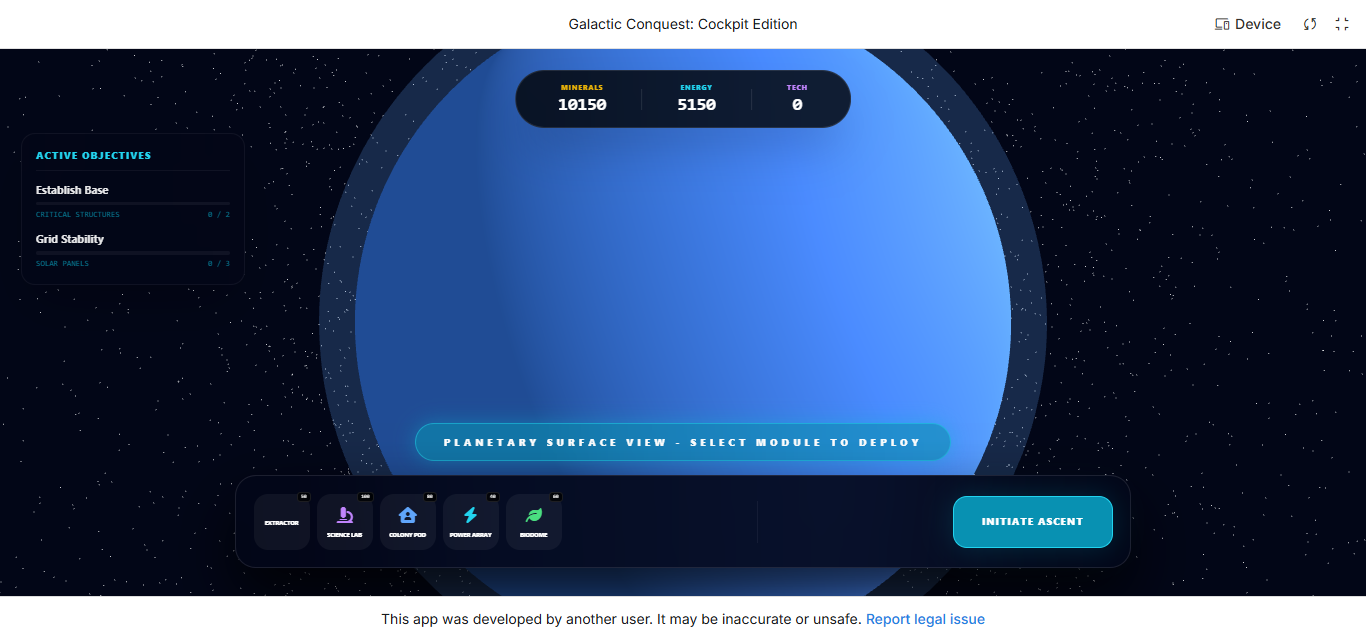
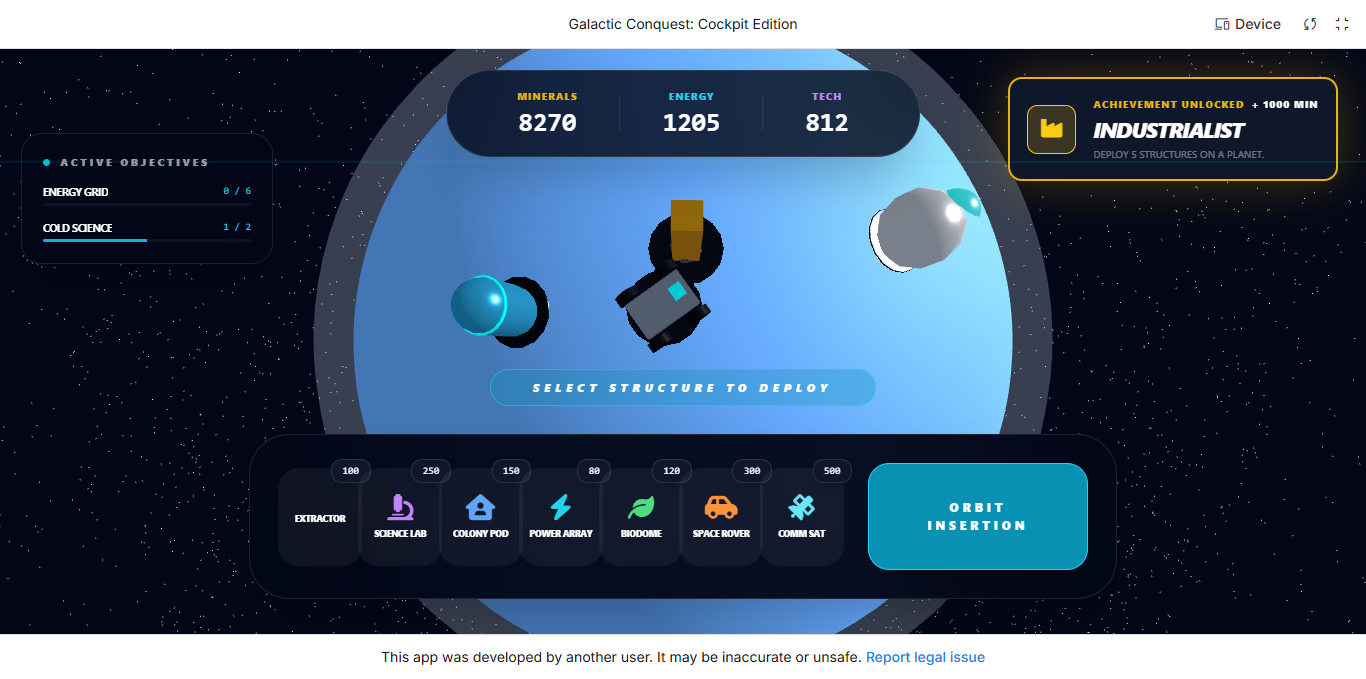
deploy object on a planet
-
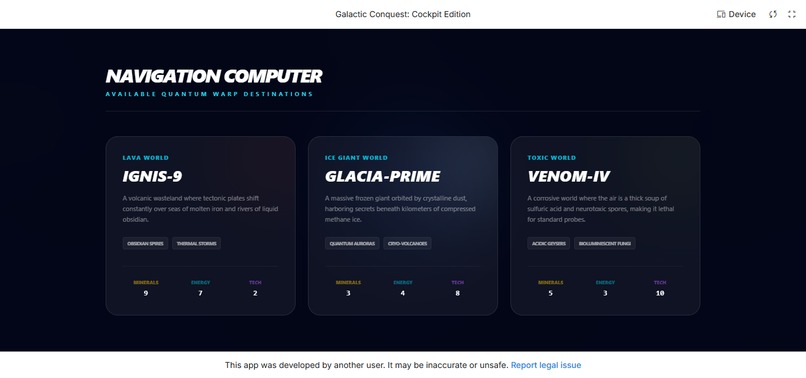
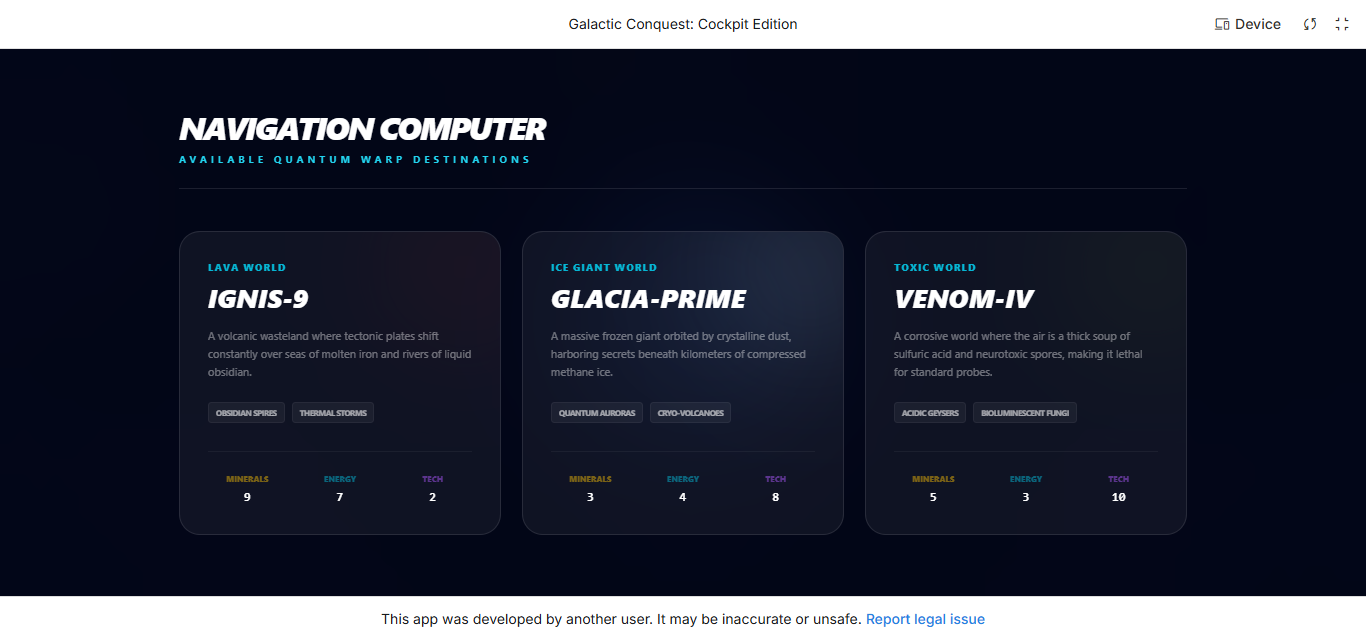
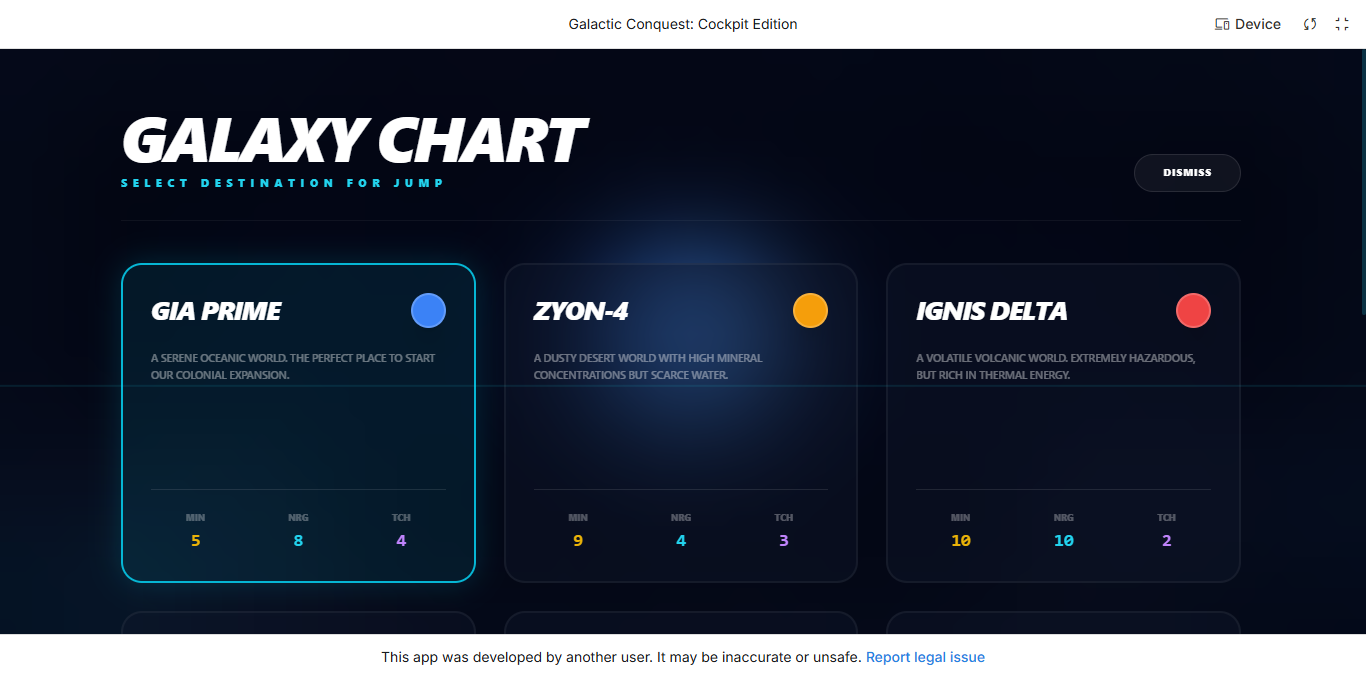
choose planet to travel to
-
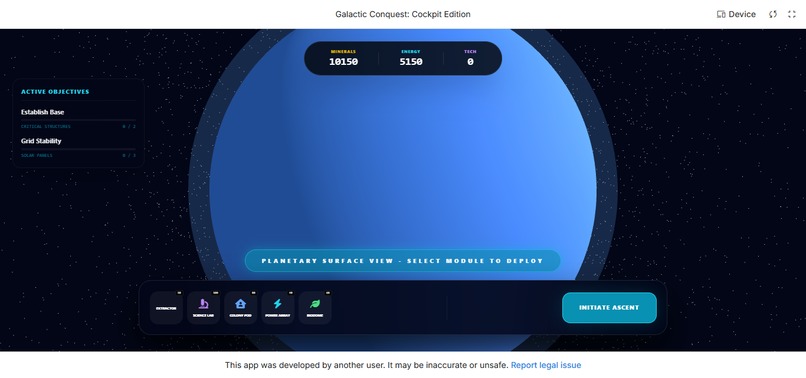
A planet
-
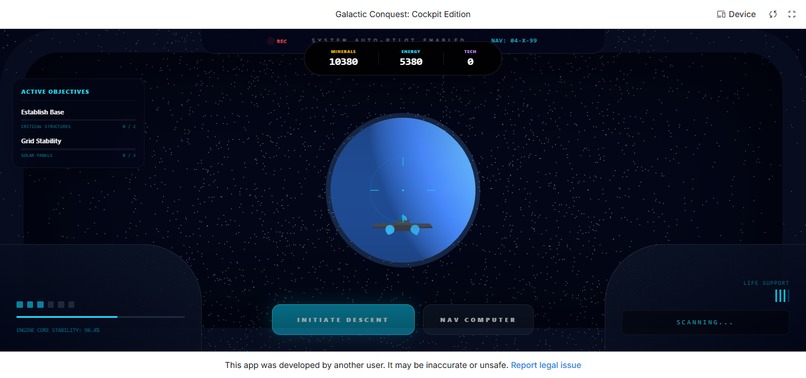
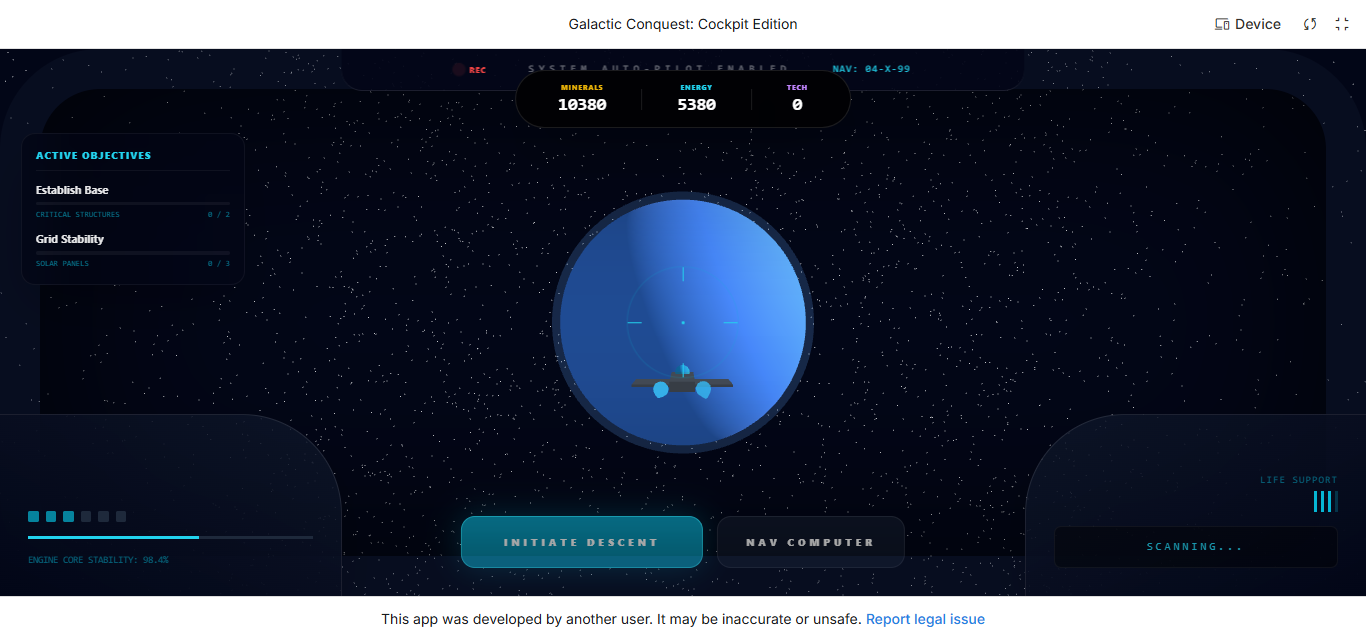
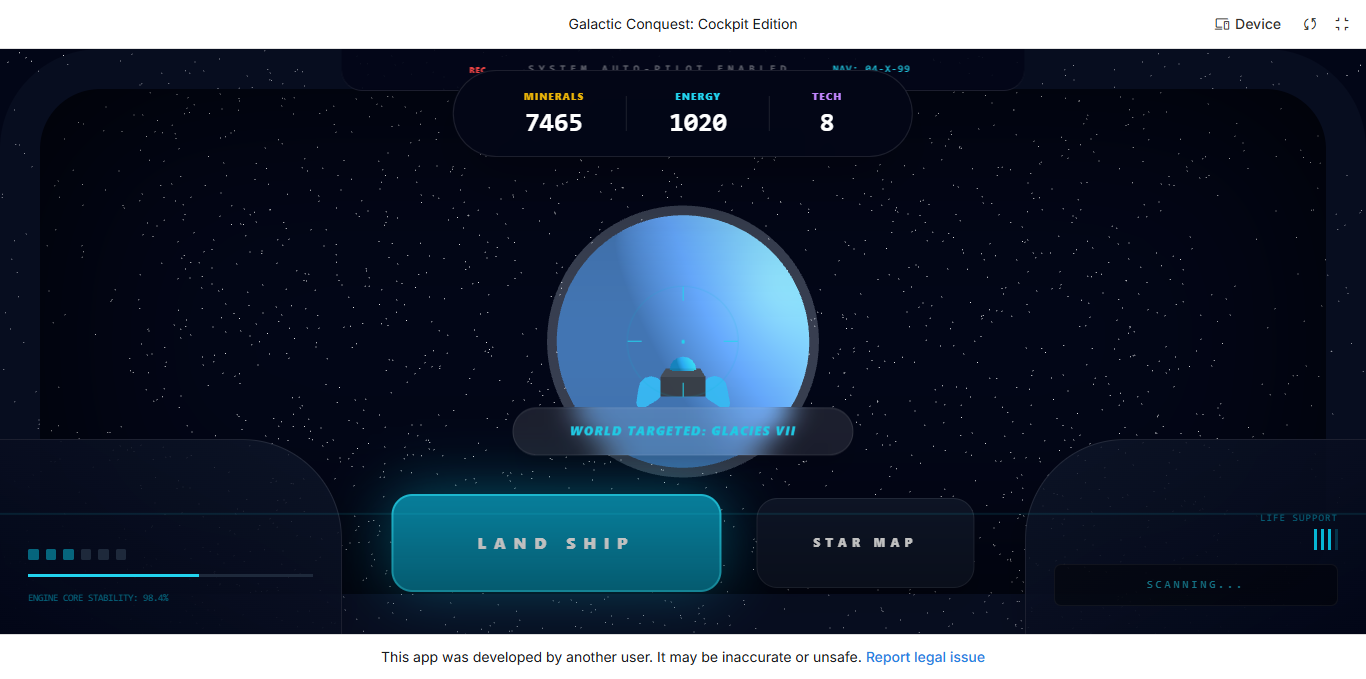
Spaceship cockpit ui
-
-
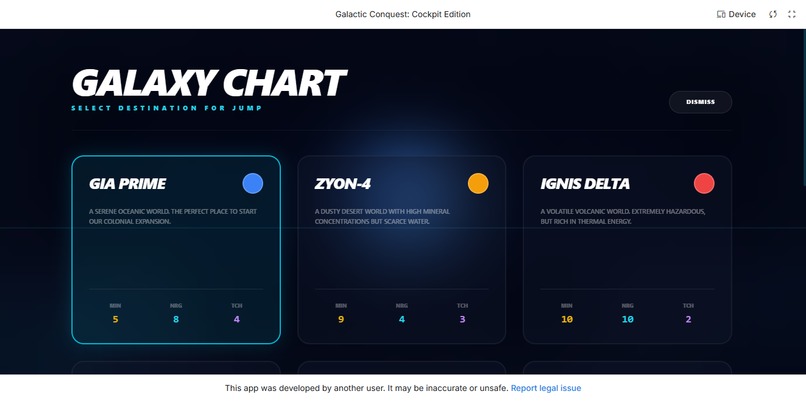
Selecting a planet to travel to
-
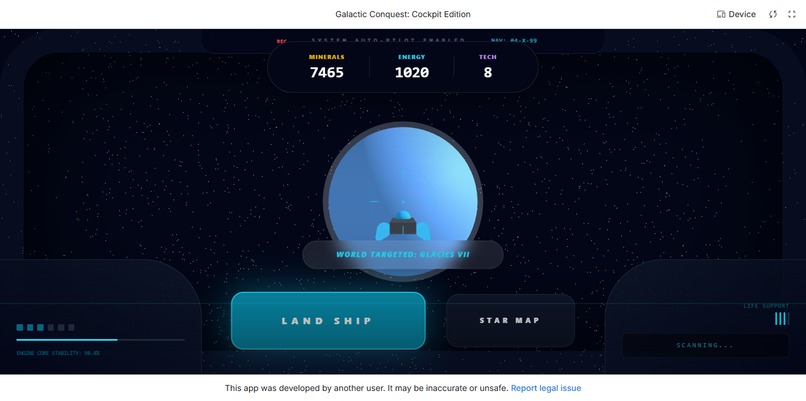
Travelling to a distance planet
-
Game Hero

🌟 Inspiration
We've always been captivated by humanity's innate desire to explore the unknown, to push beyond boundaries and discover what lies beyond the next horizon. Voyage was born from that fundamental curiosity—the same spark that drove early astronomers to map the stars and modern space agencies to send probes to distant worlds. We wanted to create an experience that captures the awe of discovery, but makes it accessible to anyone with an internet connection, not just scientists or astronauts with billion-dollar equipment.
Our inspiration came from three core places: the boundless procedural universes of games like No Man's Sky, the educational depth of simulations like Kerbal Space Program, and the emerging potential of generative AI to create truly responsive worlds. We imagined what might happen if Carl Sagan had access to modern AI—a universe not just observed, but conversed with, where every discovery could tell its own unique story. We were particularly inspired by the democratization of technology; just as Three.js makes 3D graphics available to web developers, and Gemini API makes advanced AI accessible, we wanted to make the wonder of space exploration available to everyone.
🚀 What it does
Voyage is a living, breathing universe in your web browser—a space exploration game where AI doesn't just assist your journey, but actively shapes the cosmos you're exploring. Players pilot their spacecraft through a beautifully rendered solar system, approaching planets that aren't just textured spheres but unique worlds with AI-generated personalities, resources, and mysteries.
The core gameplay revolves around the exploration loop: scan planets from orbit, choose landing sites, deploy structures like research labs to study alien biology or satellites to map resources, and build solar panels to power your expanding operations. But the magic happens in the details—the way a planet described by the AI as having "bioluminescent fungal forests" actually affects your research bonuses, or how a "geologically unstable" world might suddenly trigger volcanic events that test your base management skills.
What truly sets Voyage apart is its conversational interface with the universe itself. Using natural language, you can ask your AI co-pilot to analyze strange signals, speculate on the origins of peculiar rock formations, or even suggest where to search for rare minerals based on planetary composition. The game remembers your discoveries and weaves them into an ongoing narrative, creating a personalized space exploration story that feels both epic and uniquely yours.
🛠️ How we built it
We built Voyage as a harmonious blend of cutting-edge web technologies and creative problem-solving. At its core, Three.js provides the stunning 3D visualization—the shimmering starfields, the rotating planets with realistic atmospheric scattering, and the delicate spacecraft models that feel both futuristic and plausible. We layered physics engines on top to simulate orbital mechanics, ensuring that travel between planets followed realistic trajectories rather than magical teleportation.
The true innovation lies in our integration of Google's Gemini AI. We created a sophisticated middleware system that translates game states into rich narrative prompts and then converts AI responses back into gameplay elements. When you discover a new planet, our system sends relevant data—planetary size, position, discovered resources—to Gemini, which returns not just a description, but a complete personality for the world, complete with geological history, potential hazards, and suggested points of interest.
Our architecture follows a modular philosophy: separate systems handle rendering, physics simulation, AI interaction, and game state management, all communicating through clean interfaces. We used Firebase for cloud saves, allowing players to pick up their exploration across devices, and implemented progressive web app features for smooth performance even with fluctuating internet connectivity. The entire experience is wrapped in a custom UI that balances scientific instrumentation aesthetics with intuitive gameplay controls.
🧗 Challenges we ran into
The journey to create Voyage was filled with technical and creative obstacles that tested our team's perseverance. One of our most daunting challenges was performance optimization—making a complex 3D space simulation run smoothly in a web browser. Early prototypes choked when rendering multiple planets with detailed surfaces, forcing us to master advanced Three.js techniques like level-of-detail systems that simplify distant objects and frustum culling that only renders what's actually visible.
Perhaps our most time-intensive struggle was refining our AI integration. Gemini provided incredible generative capabilities, but harnessing them for consistent, game-appropriate content required endless iteration. We'd craft what seemed like perfect prompts, only to receive planetary descriptions that were either too dryly scientific or wildly fantastical. Finding that sweet spot—where AI-generated content felt both scientifically plausible and imaginatively compelling—became an art form in itself. We learned to create layered prompt templates that could adapt based on game context, player progression, and even the tone of previous discoveries.
Another significant hurdle was creating meaningful persistence in an AI-generated universe. How do you save a planet whose very description was created dynamically? Our solution involved storing not just the AI's output, but the seed data and parameters that generated it, allowing us to recreate consistent worlds while still allowing for emergent storytelling. Balancing this technical requirement with gameplay smoothness took countless iterations.
We also faced the classic game design challenge of balancing realism with fun. True orbital mechanics can involve hours of waiting for optimal transfer windows, while resource management can devolve into spreadsheet simulation. We had to make deliberate compromises—simplifying some physics, abstracting some systems—while preserving that core sense of authenticity that makes space exploration so compelling.
🏆 Accomplishments that we're proud of
We're immensely proud of creating what we believe is one of the first truly AI-integrated 3D space exploration experiences that runs entirely in a web browser. Our seamless marriage of generative AI with interactive gameplay sets a new standard for what's possible with modern web technologies.
Technically, we're proud of our rendering system that delivers stunning visual fidelity without requiring high-end hardware, and our AI middleware that creates genuinely responsive storytelling. But beyond the code, we're proud of creating an experience that genuinely captures the wonder of space exploration—the breathless moment when a new planet comes into view, the satisfaction of building your first functional base on an alien world, the curiosity that drives you to investigate that strange signal from the canyon floor.
We're particularly proud of our natural language interface, which started as an experimental feature but became the soul of the game. Watching players type conversational commands like "What's causing that atmospheric disturbance?" or "Should I be worried about these seismic readings?" and receiving thoughtful, context-aware responses from the AI validates our vision of a more intuitive, human-centered gaming experience.
Perhaps our deepest pride comes from creating something that's both entertaining and educational. We've heard from teachers interested in using Voyage to spark interest in space science, and from parents appreciating how the game encourages curiosity and problem-solving. In an era of disposable entertainment, we've built something that nurtures the explorer in all of us.
📚 What we learned
Developing Voyage taught us profound lessons about both technology and human nature. Technically, we learned that modern web browsers are far more capable than commonly assumed—with careful optimization, they can deliver experiences once reserved for dedicated game engines. We gained deep expertise in 3D graphics optimization, AI prompt engineering as a discipline, and the delicate art of procedural generation that feels neither random nor repetitive.
We learned that players crave both freedom and narrative. Left entirely to their own devices in a vast universe, many felt aimless; but with too much scripted story, they felt constrained. Our AI-driven approach—providing emergent narrative suggestions rather than fixed plots—struck that perfect balance, and watching players engage with this system taught us about the future of interactive storytelling.
Perhaps our most surprising learning was about the relationship between scientific accuracy and emotional engagement. Early versions leaned heavily toward realism, but playtesting revealed that what players truly wanted wasn't a physics simulator, but the feeling of being an explorer. We learned to prioritize emotional truth over literal truth—to create experiences that felt authentic rather than merely accurate.
We also learned the immense value of interdisciplinary collaboration. Our team brought together expertise in 3D graphics, AI integration, game design, and astrophysics basics. The magic happened in the intersections—when our AI specialist understood enough about orbital mechanics to craft better prompts, or when our graphics developer understood enough about AI constraints to optimize rendering pipelines accordingly.
Finally, we learned that good game design is often about what you remove, not just what you add. Our most beloved features emerged not from elaborate planning, but from observing how players interacted with our systems and having the humility to iterate based on their behavior rather than our assumptions.
🔮 What's next for Voyage
Voyage is just beginning its journey. In the immediate future, we're focusing on expanding the social dimension of exploration. Our next major update will introduce shared universes where friends can explore the same solar system, see each other's bases twinkling on planetary surfaces, and collaborate on ambitious projects like orbital space stations or deep-space telescopes. We're particularly excited about our planned "collective discovery" system, where one player's findings can unlock new research paths for everyone.
Longer-term, we envision Voyage evolving from a single solar system to an entire procedurally generated galaxy, with different regions having distinct characteristics and mysteries. We're experimenting with more advanced AI systems that could generate not just planet descriptions, but entire alien ecologies, cultures, and histories that players could encounter and interact with in meaningful ways.
Built With
- googleaistudio
- three.js
- typescript

Log in or sign up for Devpost to join the conversation.