Inspiration
Most things that go wrong for people come down to ordinary human habits, not genius attackers or broken machines. Verizon's 2025 Data Breach Investigations Report found that about 60% of breaches involve a human element, and stolen or guessed credentials were the top way in, at 22% of breaches (Security Magazine). We're predictable, we mishear instructions, and most of us couldn't name one star above our own house. The theme "Into the Hackosmos" gave us the idea of a space station where each room uses AI to train one of those human skills, and feels like a game, not a lecture.
What it does
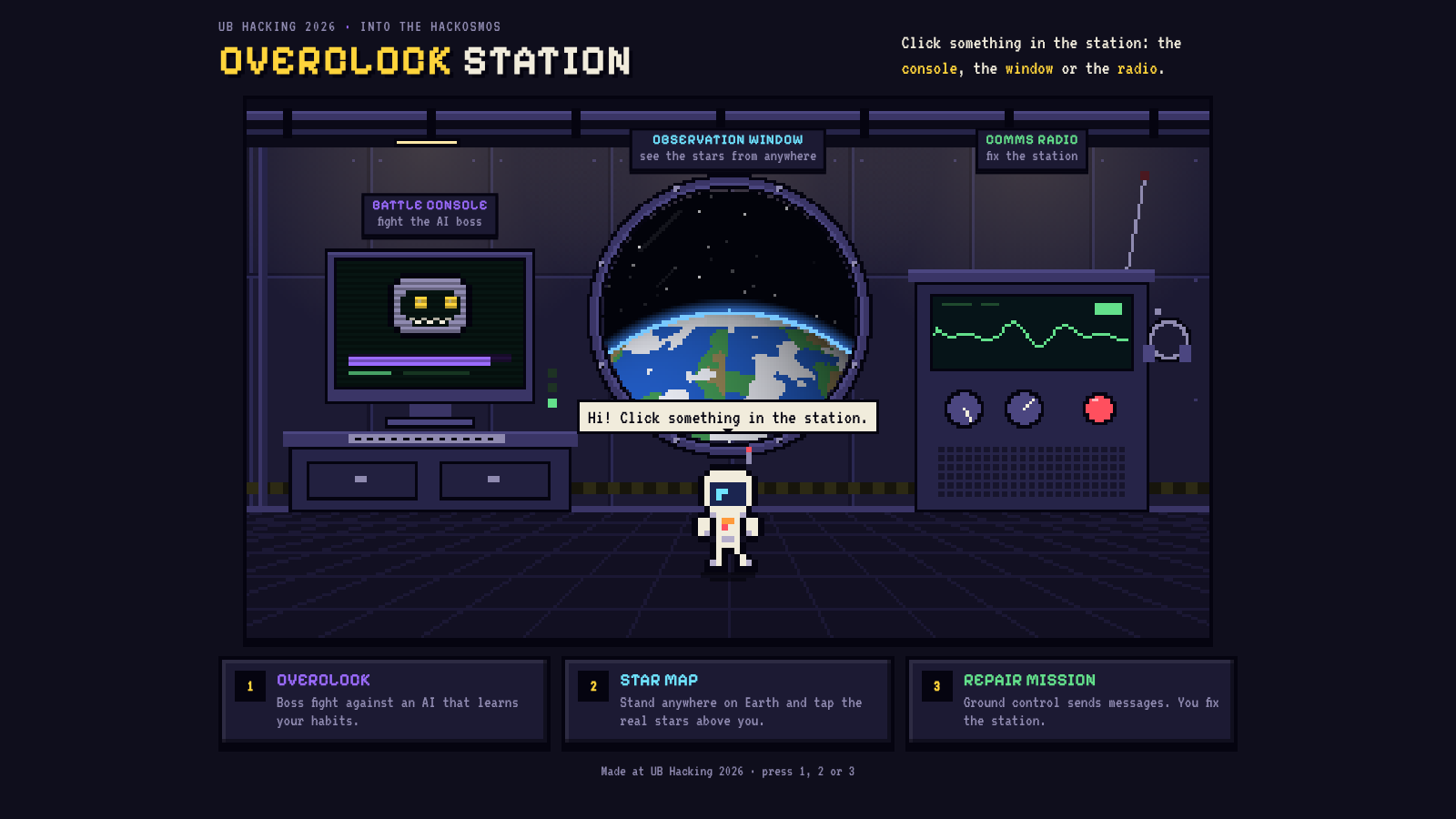
You start inside a pixel space station. Click an object and your astronaut walks over and zooms in.
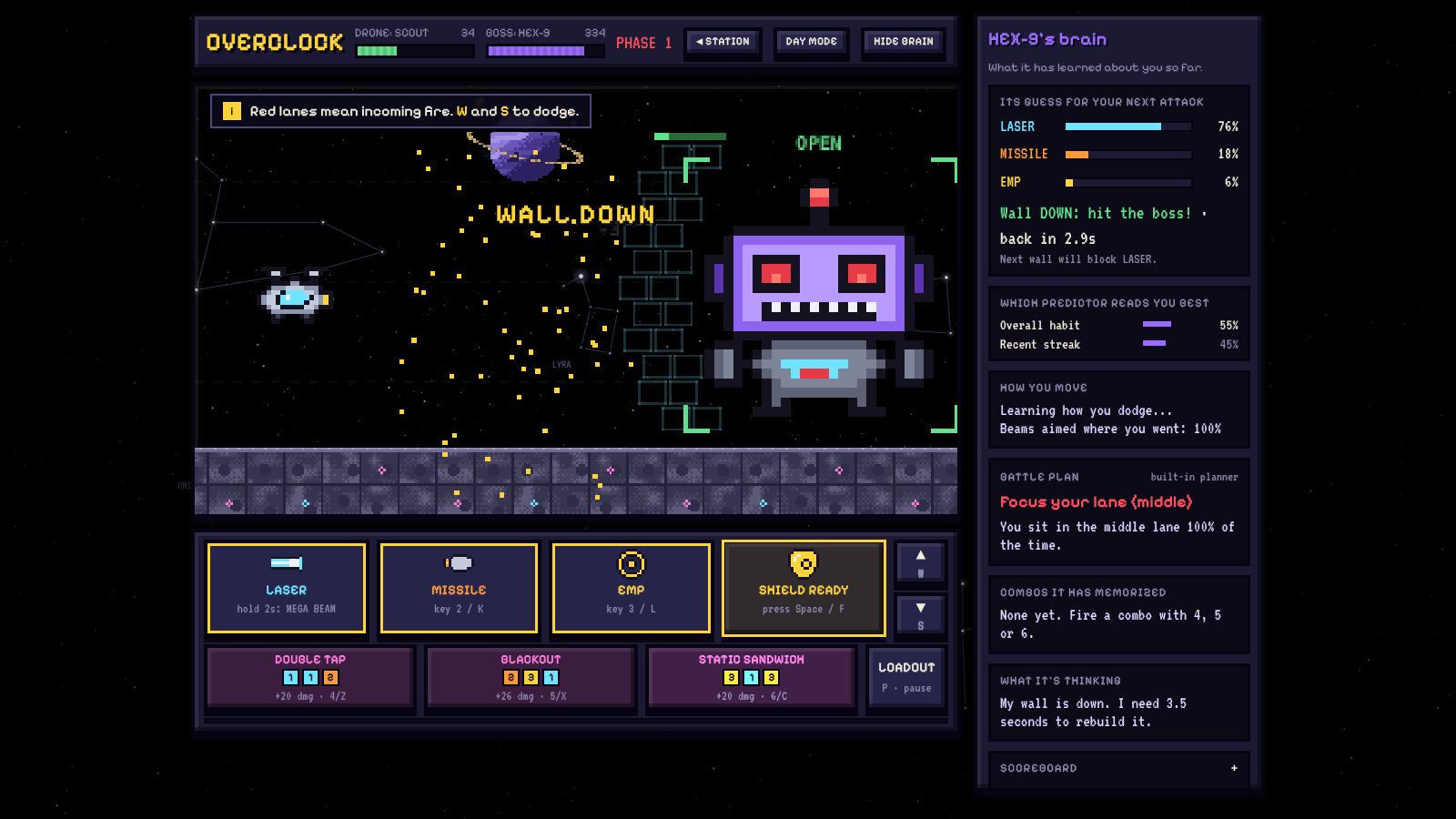
- Battle console: OVERCLOCK. You fly a drone against an AI boss that learns your habits. Six predictors guess your next attack and the boss builds its wall to block it. Gemini reads a summary of your play every few seconds and picks the boss's tactic, and each boss trash-talks you in its own ElevenLabs voice. The only way to win is to stop being predictable. The ending shows how predictable you were, and how attackers use the same trick on passwords.
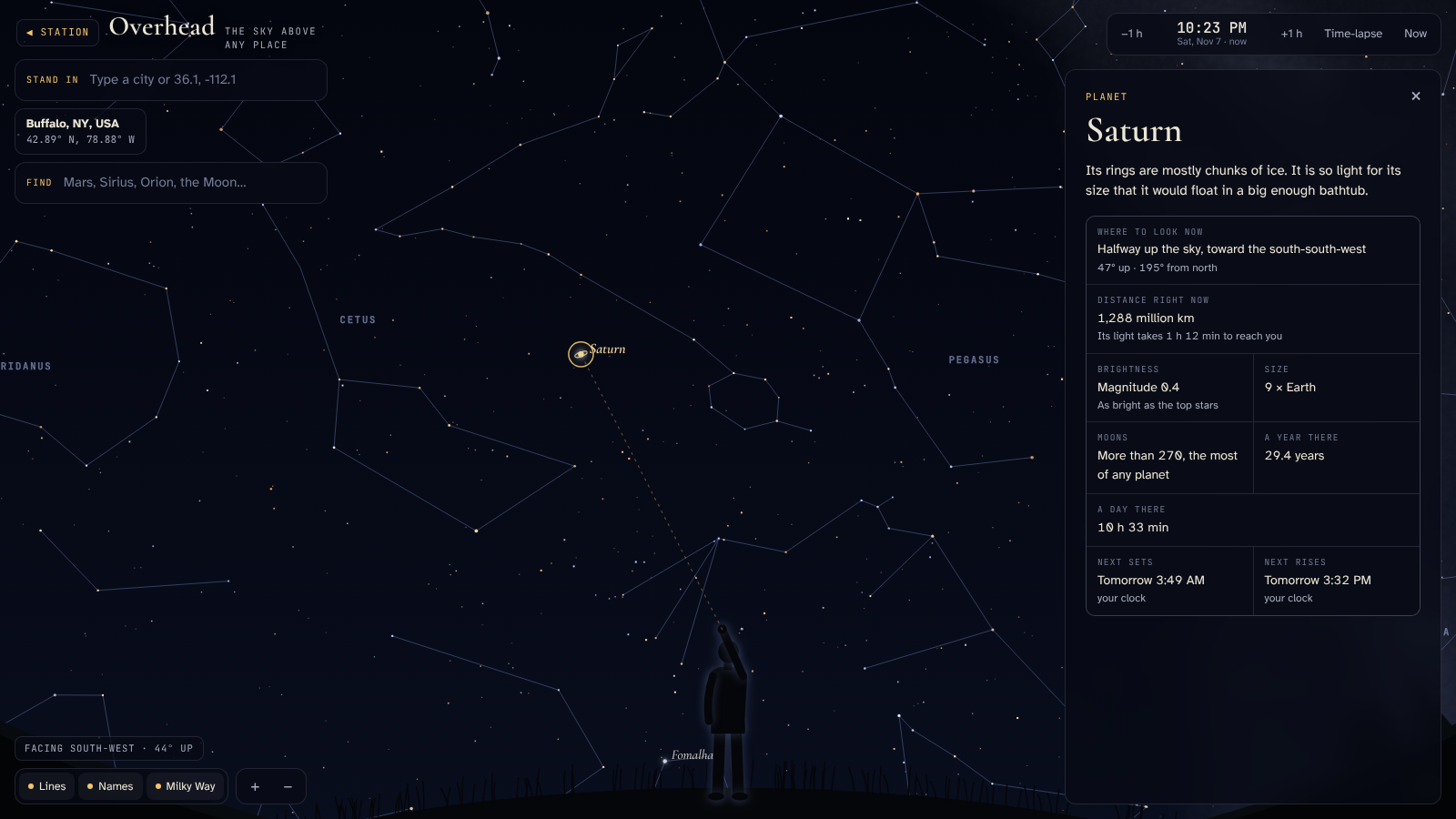
- Observation window: the star map. Type any place on Earth and you're standing in a field there, under the real sky for right now. About 5,000 stars, the planets, the Moon and all 88 constellations sit in their true positions. Drag to look around, and tap anything for its story, distance and when it rises. If a place isn't in our list of 6,700 cities, Gemini finds it.
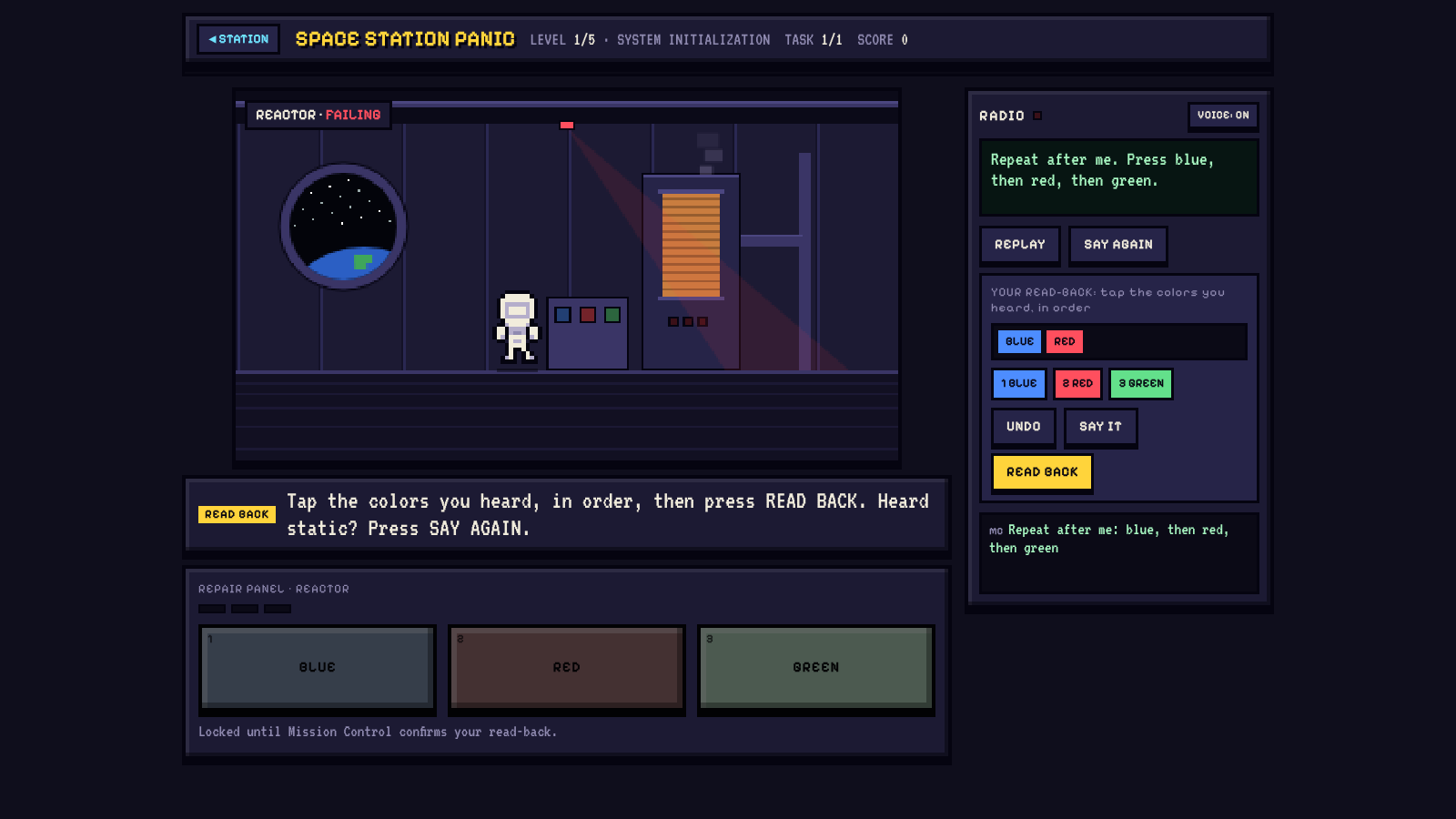
- Comms radio: Space Station Panic. The station is failing. Mission Control knows the repair code, the astronaut has the switches. Mission Control reads the code over a crackly radio, the astronaut reads it back, and only after Mission Control confirms can the astronaut press the switches, against the clock. Play with a friend on two screens, or solo with an AI Mission Control voice. It teaches closed-loop communication, the read-back habit pilots and nurses use.
How we built it
- One server, three rooms. Node and Express serve the station and keep the API keys secret. Gemini and ElevenLabs are only called from the server, with rate limits and built-in fallbacks, so nothing breaks if Wi-Fi drops.
- The station: a 320x180 canvas drawn pixel by pixel in code, including a rotating Earth made from noise.
- OVERCLOCK: the boss runs six predictors at once (overall habit, recent streak, last 1, 2 and 3 moves, lane and wall context), weighted with the Hedge (multiplicative weights) algorithm. Gemini returns a tactic from a fixed menu as JSON; the game checks it and always leaves one lane safe.
- Star map: star positions from the Hipparcos catalog (via the d3-celestial data set) and planets from the astronomy-engine library. We rotate every star into the viewer's horizon for their place and time, then draw it with a stereographic projection.
- Space Station Panic: our teammates designed the original game. We moved its rules into one shared engine that runs in the browser for solo play and on our server for two players, using Server-Sent Events. The AI Mission Control speaks through ElevenLabs with a radio filter, and the Web Speech API lets you say your read-back out loud.
Challenges we ran into
- An AI that's smart but fair. One predictor kept taking all the weight, so the boss couldn't adapt. We added a fixed share and lowered the learning rate. Gemini can't be trusted with game rules, so it only picks from a menu.
- Making AI understandable. Our first boss shield confused every tester, so we rebuilt it as a wall with a health bar that blinks, shatters and rebuilds.
- Getting the sky right. Star catalogs use one coordinate system and your eyes use another. We checked our math by confirming the North Star sits at the same angle as the viewer's latitude.
- Three projects, one station. Merging three games into one server without breaking any of them, the night before judging.
Accomplishments that we're proud of
- The boss really learns: spam lasers and it shuts lasers down within seconds.
- The star map is accurate for anywhere on Earth and any time.
- Space Station Panic works with one player or two, with real voice read-back.
- Everything is drawn and synthesized in code. There are no image or sound files.
What we learned
How online learning works, how the sky is calculated, how to call AI APIs safely from a server, and that the hardest part of any AI feature is making people understand what it's doing.
What's next for Space Station Zero
- An AI coach after each OVERCLOCK fight that compares your habits to how password crackers guess.
- A fourth room where the station AI answers questions by voice.
- A classroom mode, so a teacher can run all three rooms with a class.
Credits
Space Station Panic was originally designed by our teammates. Star positions come from the Hipparcos catalog via the d3-celestial data set, and planet positions from the open-source astronomy-engine library (MIT). We used Claude (Anthropic) as an AI coding assistant to help write and debug the code. Gemini and ElevenLabs are part of the product itself. The design choices, testing, tuning and the pitch are ours.
Built With
- astronomy-engine
- canvas
- css
- elevenlabs
- express.js
- gemini
- html5
- javascript
- node.js
- web-audio-api
- web-speech-api
