-
-
Logo
-
Flow
-
Repository Scanner 1
-
Repository Scanner 2
-
Repository Scanner 3
-
Blind Spot Investigator
-
Blind Spot Investigator: Missed Spots
-
Blind Spots Investigator: Details
-
Model Ranking

KEVexploit
Site: https://kevexploit.us
KEVexploit ranks newly published vulnerabilities by how likely attackers are to use them, then shows why. It is built for IBM’s Before the Breach challenge at Sheridan Datathon 2026.
The problem
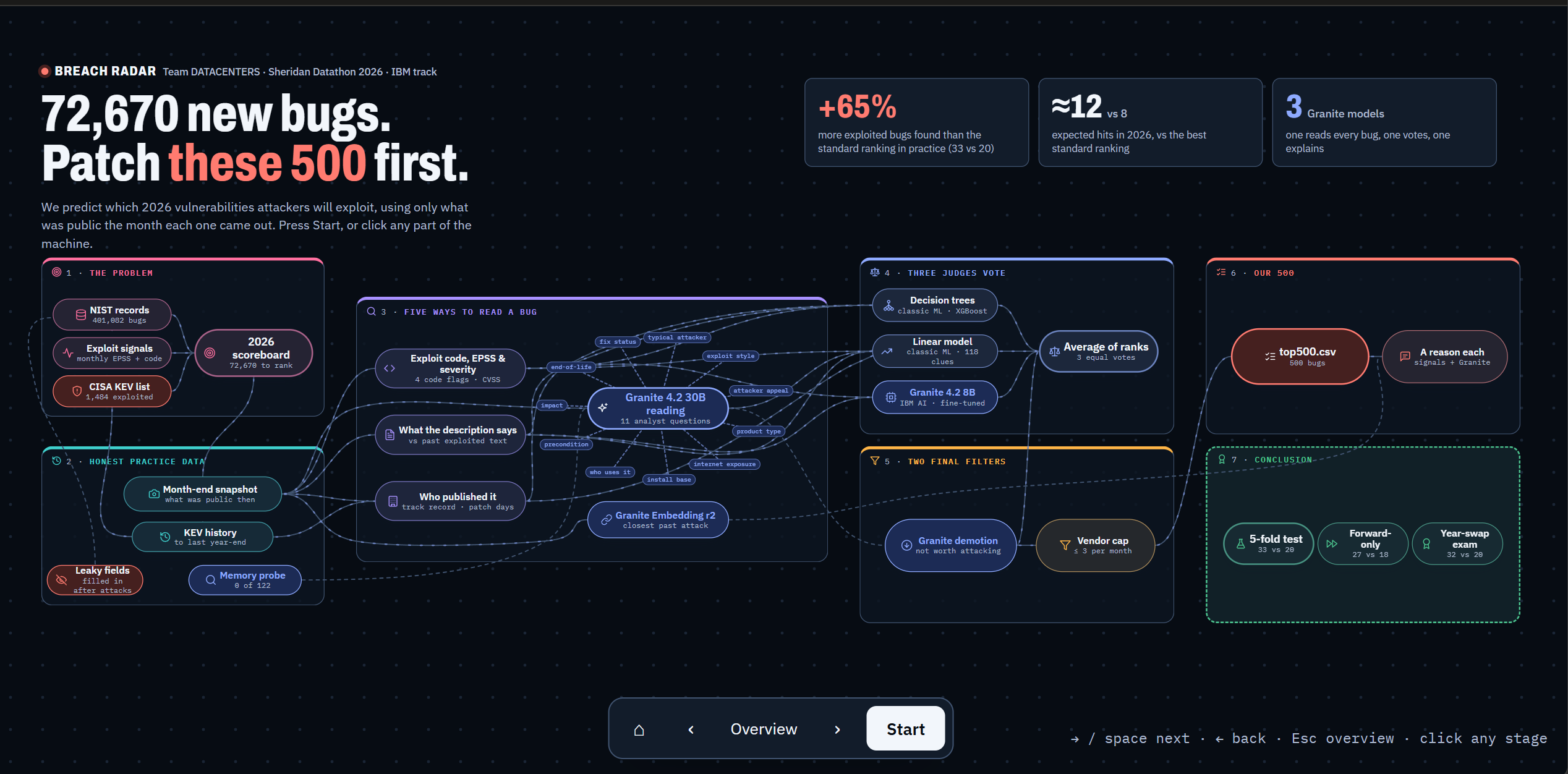
In 2026, 72,670 vulnerabilities were published between January and September. Security teams cannot patch everything, so they need one ordered list:
Which 500 should we fix first, because attackers are most likely to exploit them?
Severity is the wrong ranking. CVSS measures how damaging an exploit could be, not whether anyone will use it. On the official 2026 scoreboard, ranking by CVSS found 7 exploited vulnerabilities in the top 500. EPSS found 6. Public exploit code, then EPSS, found 8.
58% of the vulnerabilities CISA later confirmed as exploited in 2024–2025 had no public exploit code when they were published.
What we built
Three tools, one model, on kevexploit.us:
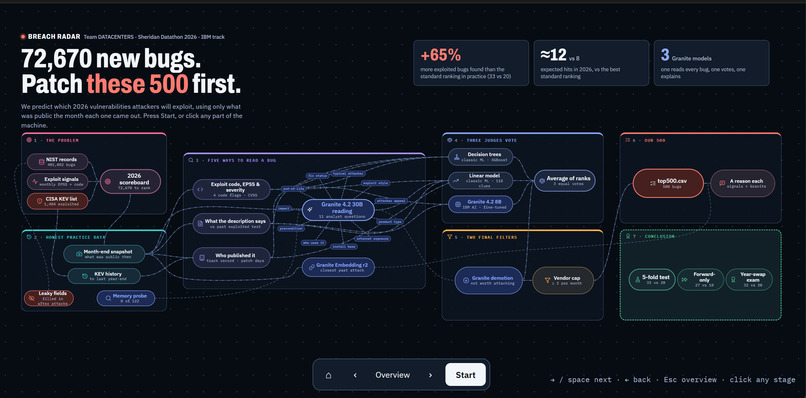
- Breach Radar. The public walkthrough of the pipeline, the historical tests, and the submitted top 500, each with a plain-language reason.
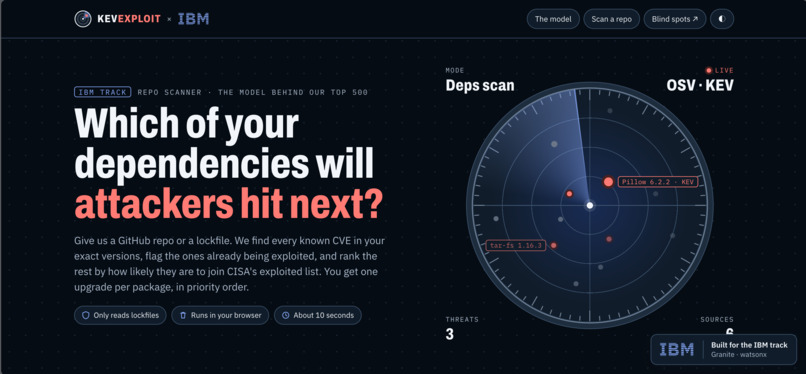
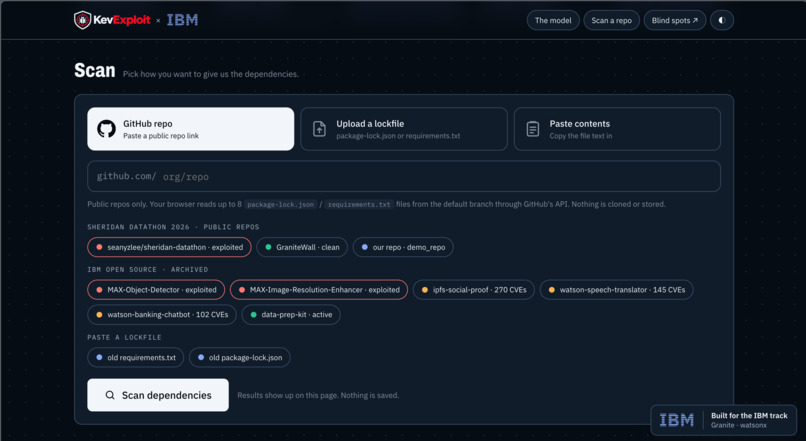
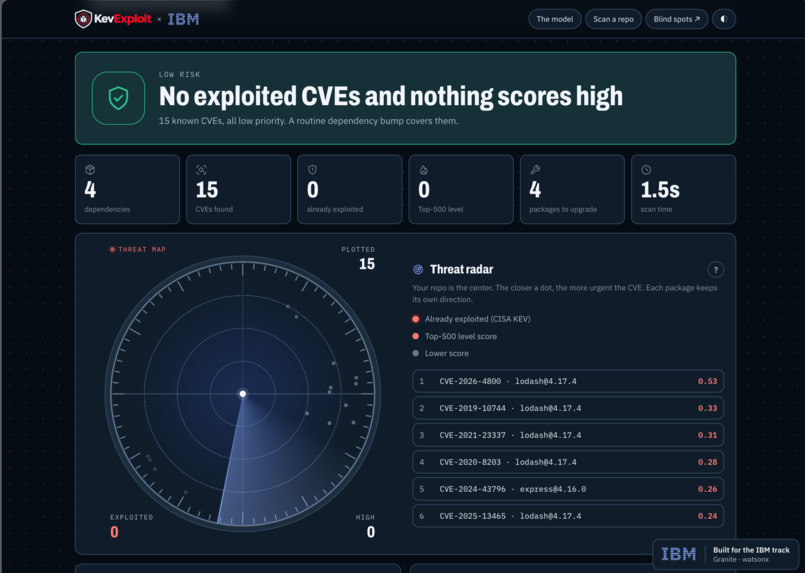
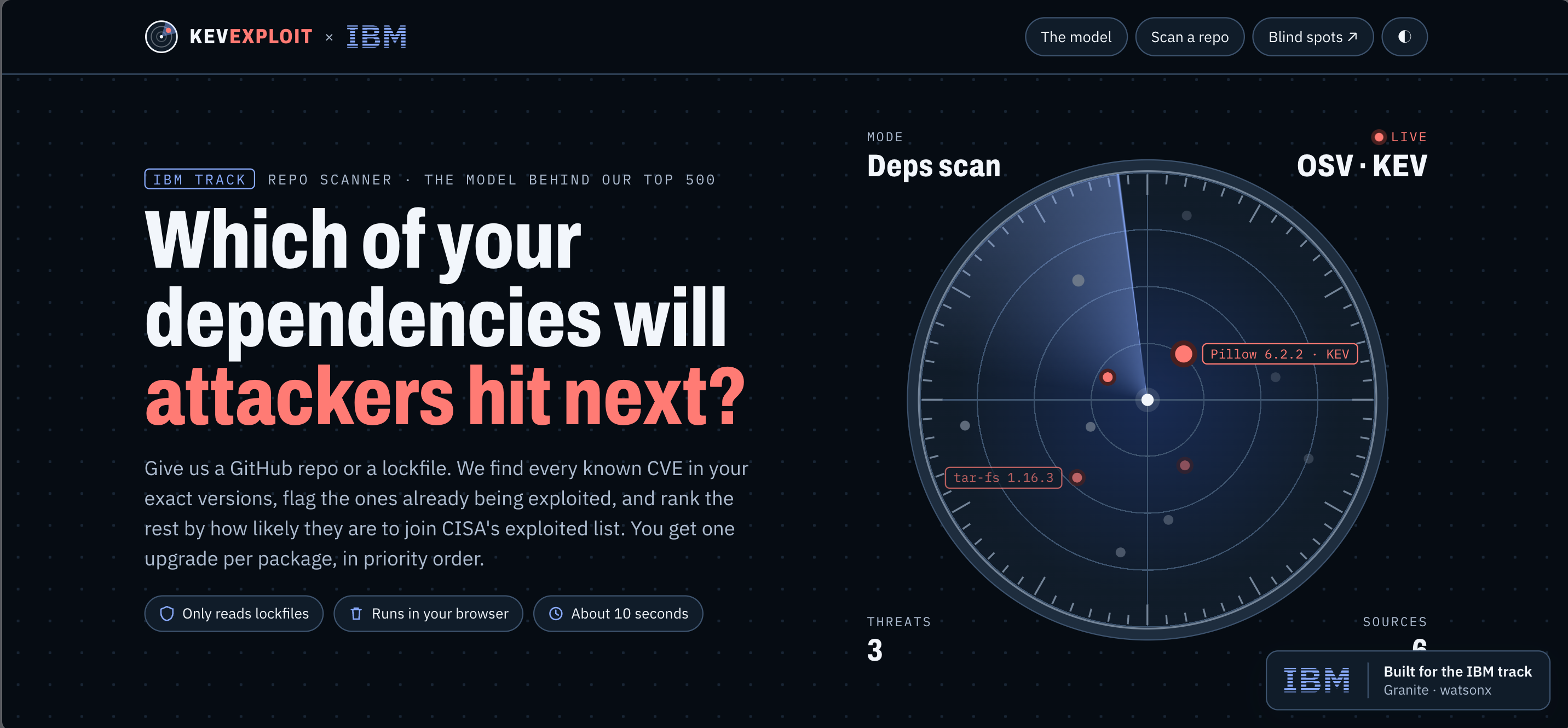
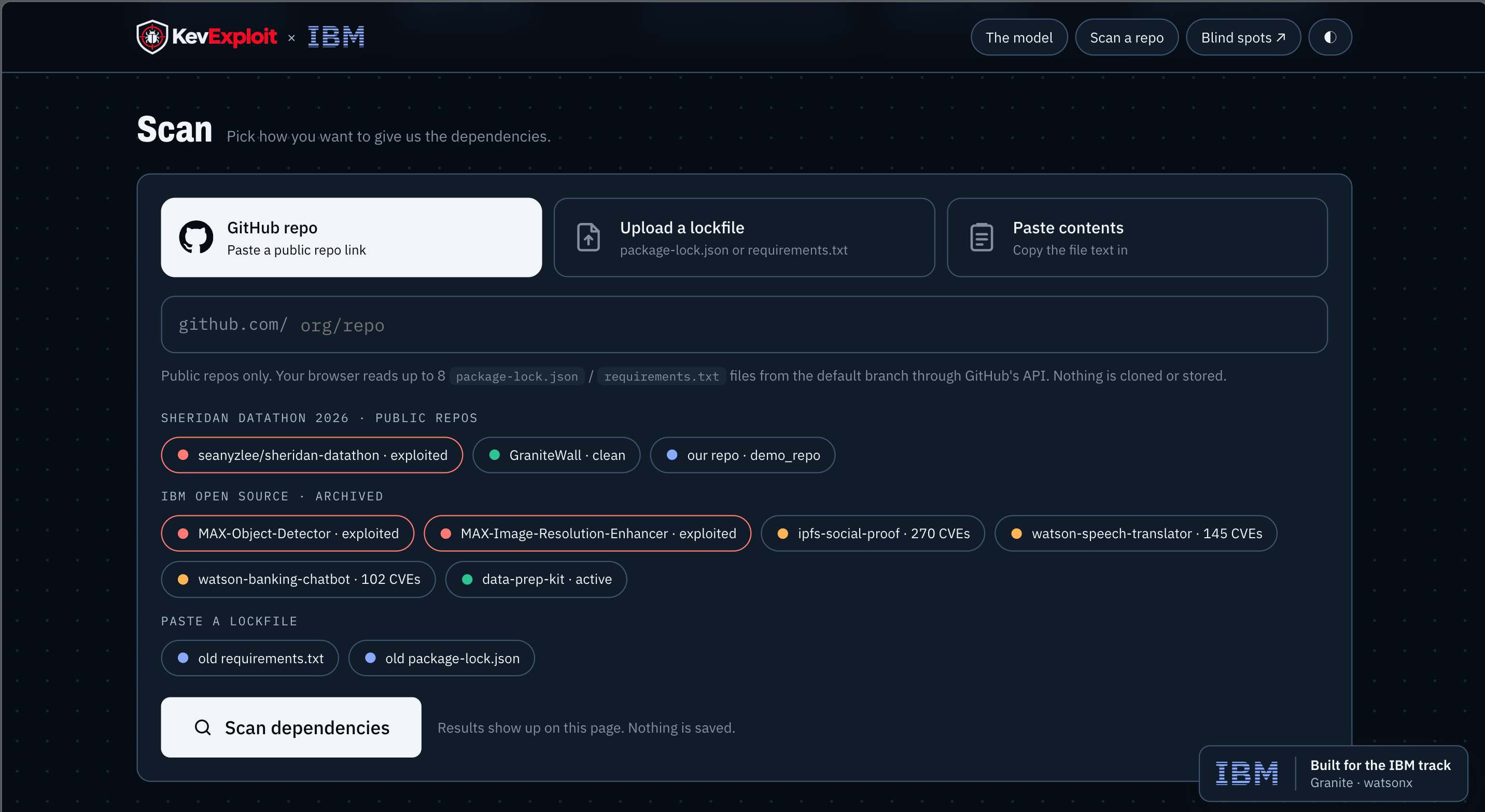
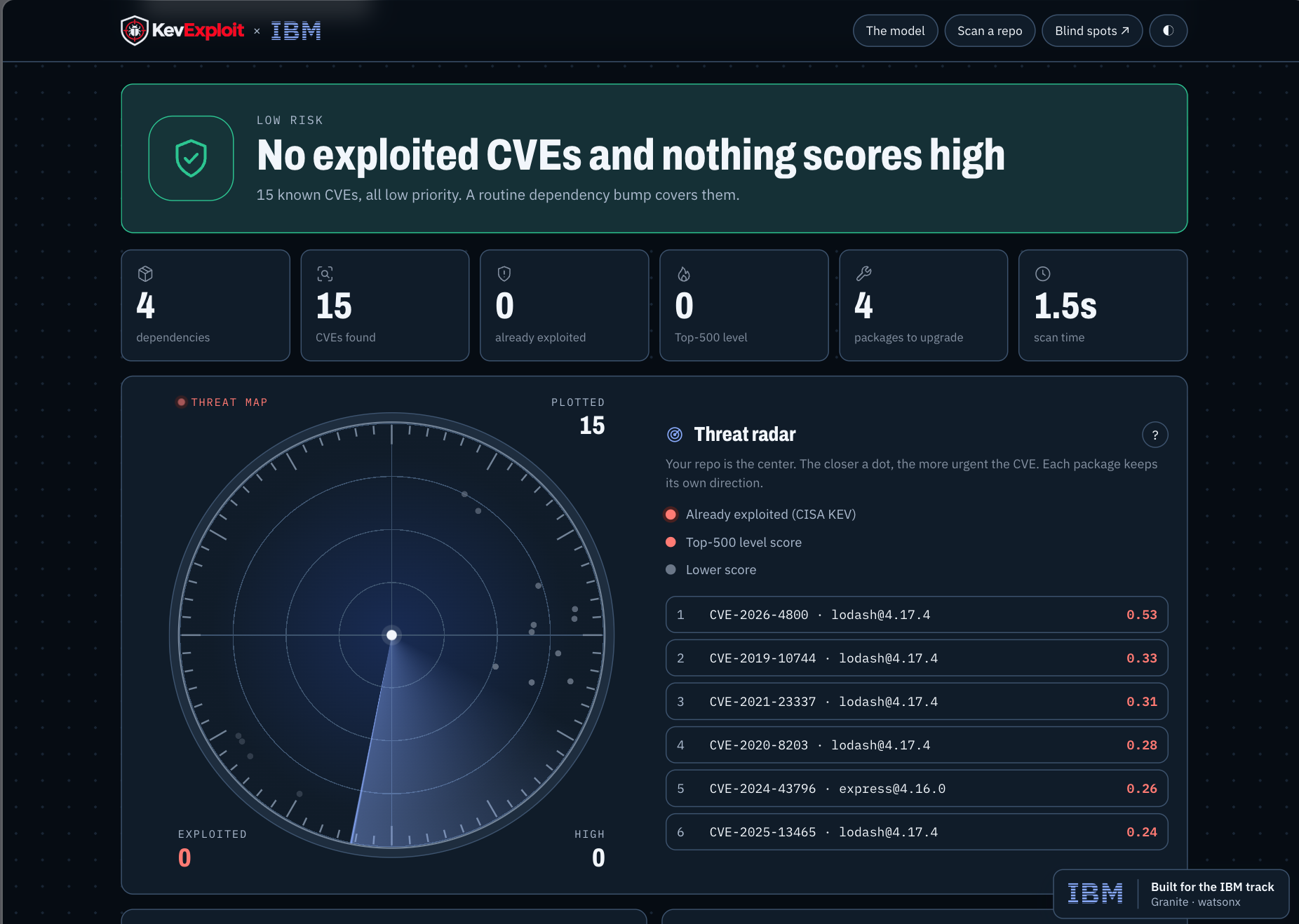
- Repository scanner. The same ranking, pointed at a real codebase. Paste a GitHub URL or a lockfile. It matches exact dependency versions through OSV.dev and scores each CVE with the team model. Already-exploited bugs go to the top; the rest are in patch order.
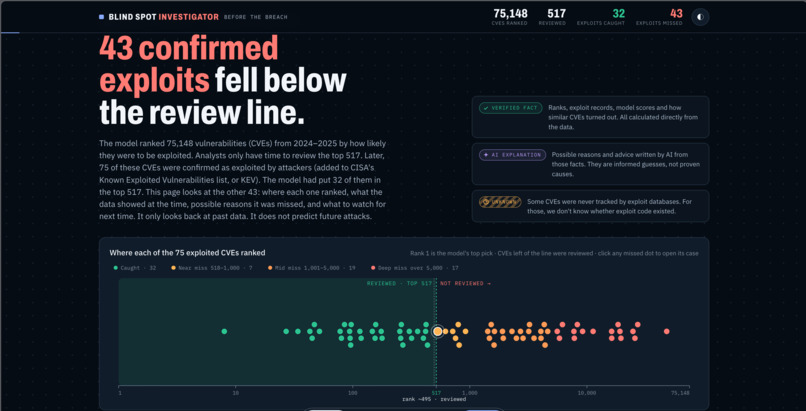
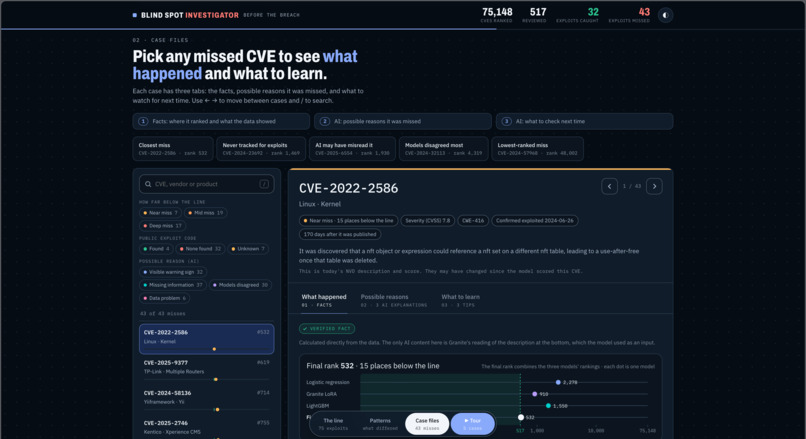
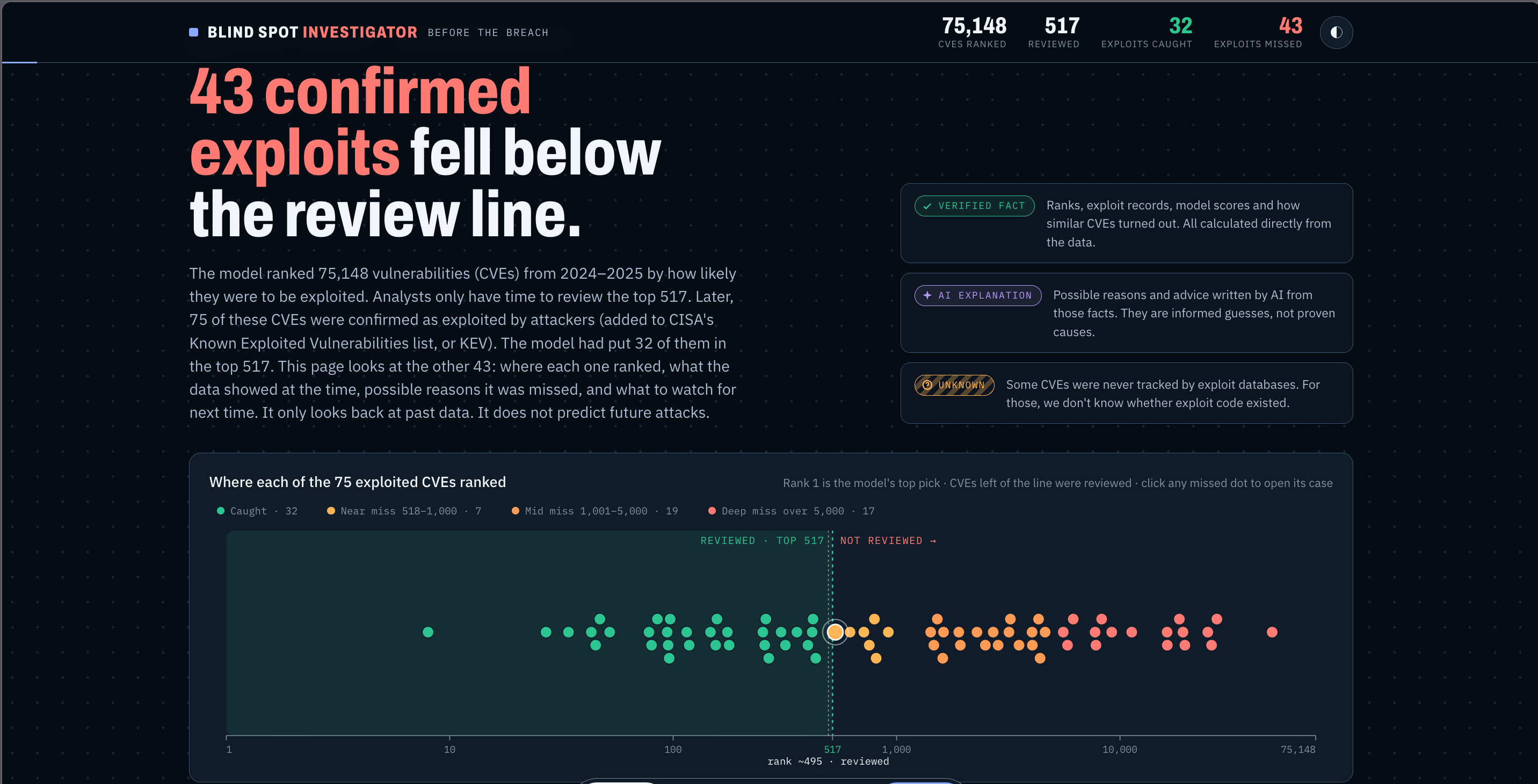
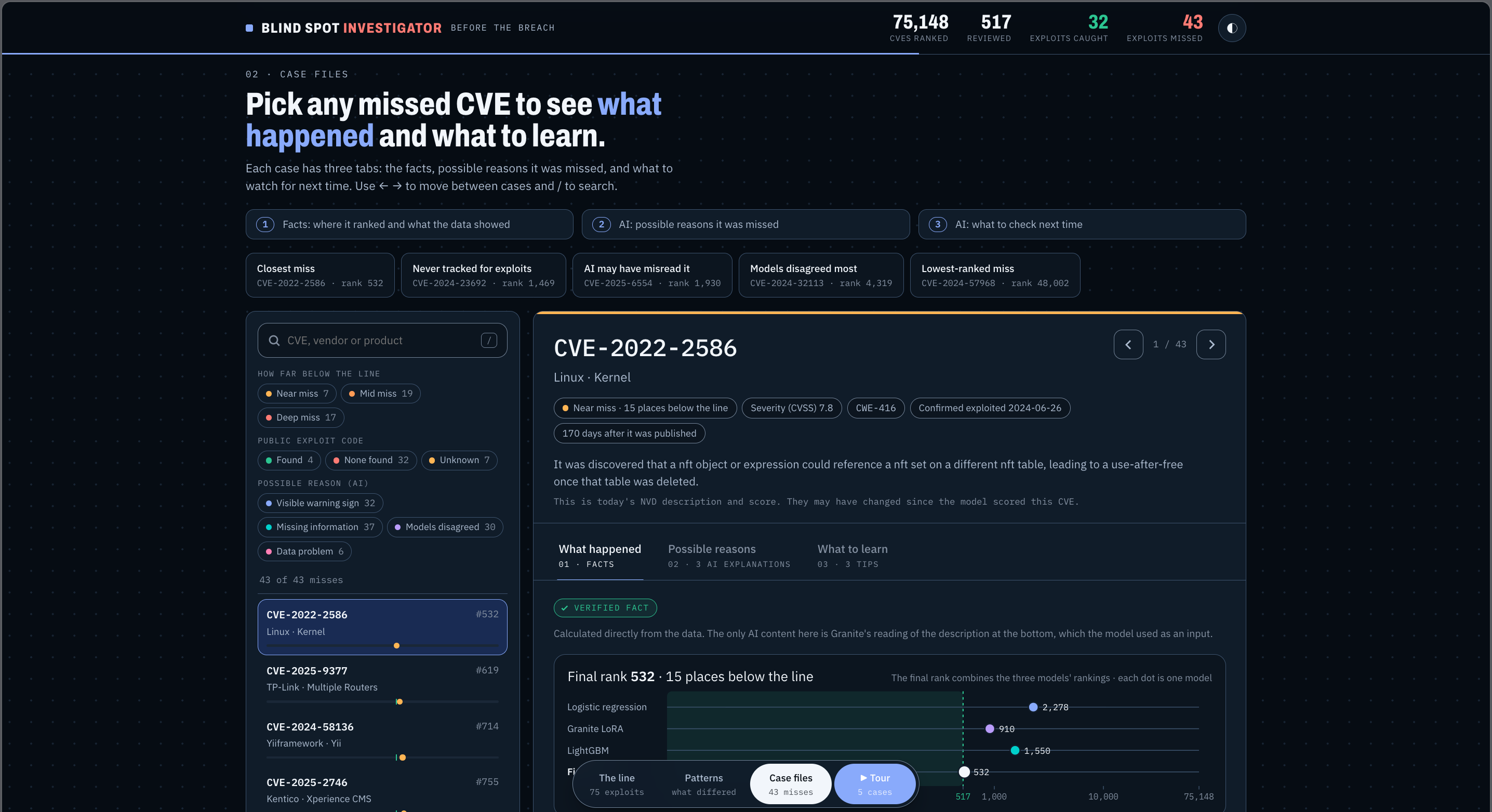
- Blind Spot Investigator. A case file on every confirmed exploit the historical model ranked below the review line: what the data showed at the time, possible reasons it was missed, and what to check next time.
The site is static. No API keys are in the browser. The 2026 labels were never used to train or tune the model.
How the ranking works
For every CVE we use only what was public at the end of its snapshot month:
- EPSS and point-in-time exploit signals (Exploit-DB, Metasploit, Nuclei, GitHub proof-of-concept)
- The vulnerability description and attack language
- The publisher’s historical KEV record, frozen at the previous year-end
- CWE and CVSS attack characteristics
- Related CVE clusters and same-day disclosure patterns
- IBM Granite readings of product type, exposure, and attacker appeal
We drop fields that are often filled in after an attack: current NVD analysis status, reference counts, affected-product counts, last-modified timestamps, CVSS source metadata, and “exploited in the wild” wording.
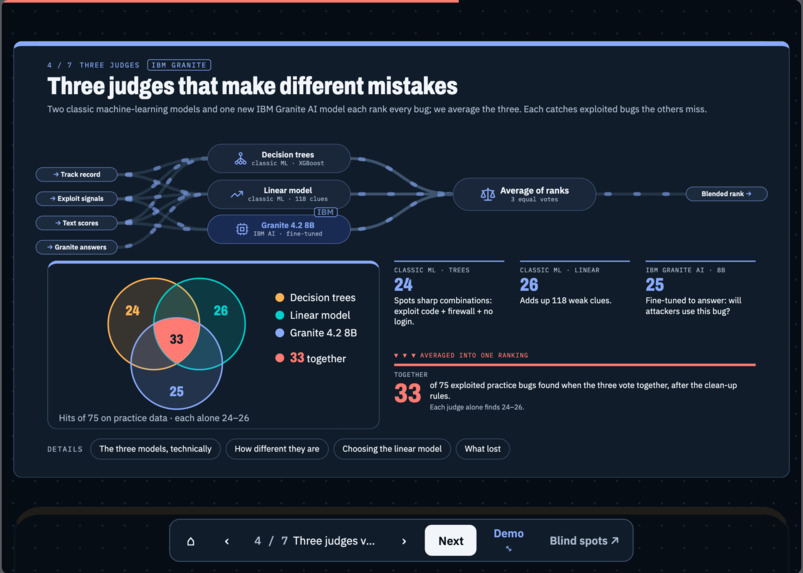
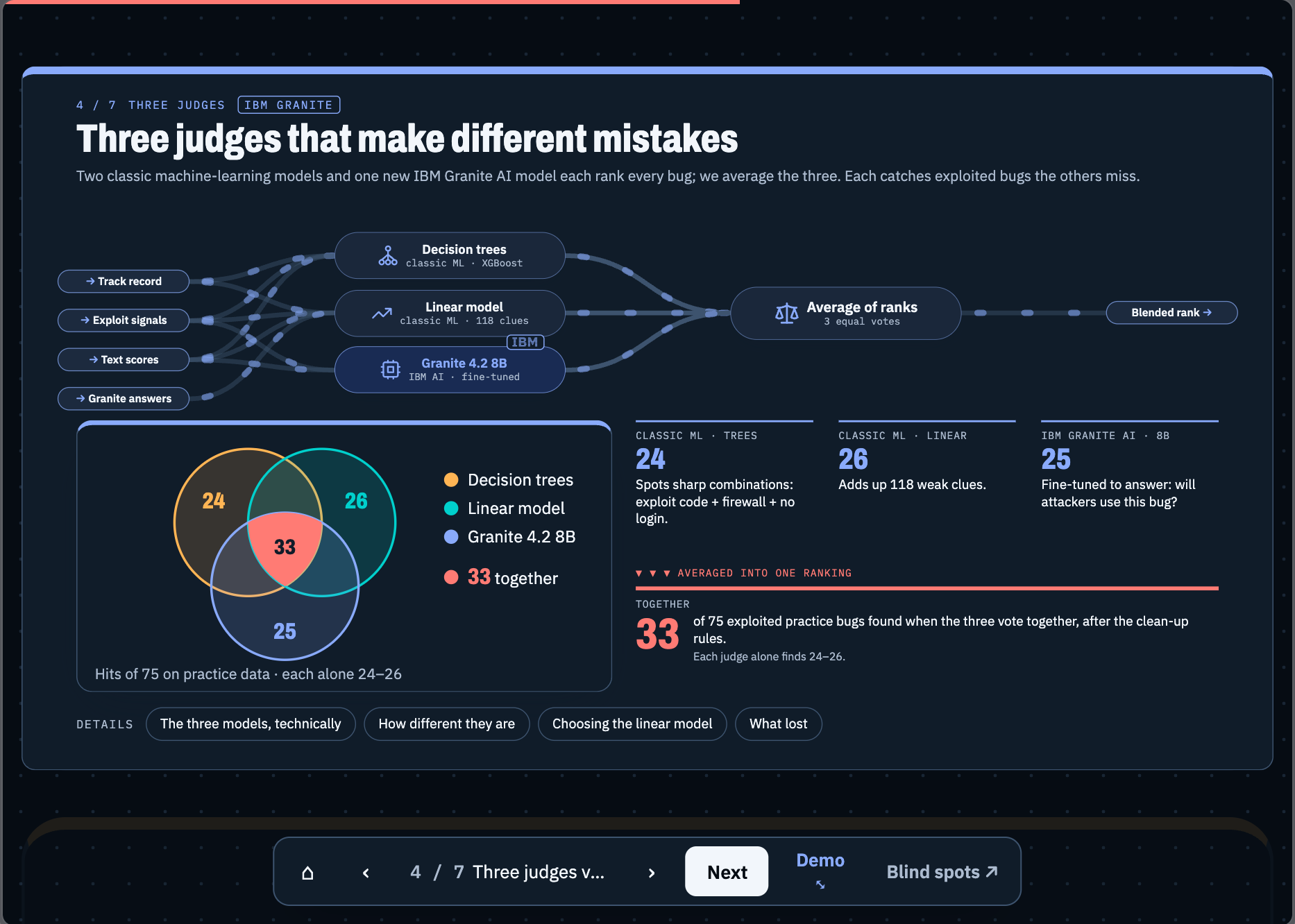
Three models each rank every CVE. We average the ranks:
- Bagged XGBoost (40 seeds)
- A unified regularized logistic regression (118 leak-free features)
- IBM Granite 4.2 8B, fine-tuned with LoRA, as a third independent voter
Then two rules clean the list:
- Granite demotion: move candidates that are denial-of-service only, low attacker appeal, unlikely targets, or WordPress add-ons to the bottom. On practice data this flagged 1 of 75 confirmed exploits.
- Vendor cap: at most three CVEs per assigner per month, so one vendor patch batch cannot fill the top 500.
Historical tests, not the 2026 score
The 2026 answer is hidden. We rebuilt the contest on 2024–2025 CVEs.
On the main 5-fold test (75,148 CVEs, review line 517, 75 later added to KEV), the ensemble found 33 exploited CVEs. The exploit-code-then-EPSS ranking found 20. That is 65% more. A forward-only test, training only on earlier time blocks, found 27 vs 18.
Those numbers are practice results. They are not the 2026 leaderboard. Judges score the submitted 500 using KEV additions through November 4, 2026. From the historical lift, we expect about 12 hits against 8 for the best official baseline. That is a forecast, not a result.
About 40 of the 75 practice exploits look ordinary at publish time. No model we built found them. That is why the Blind Spot Investigator exists.
IBM Granite
Granite is in the ranking, not only in the write-up.
- Granite Embedding finds clusters of technologies and products tied to past exploitation.
- Granite 4.2 30B reads every description and extracts product type, internet exposure, enterprise relevance, attacker appeal, and normalized vendor/product names.
- Granite 4.2 8B with LoRA is a voting model. Alone it found 25 of the 75 practice exploits. The 30B LoRA found 19. We kept the 8B.
- Granite writes the short reason attached to each of the 500, and supplies the demotion labels.
A memory check: Granite 30B named 0 of 122 exploited CVEs from the ID alone. Its answers come from the text, not from memorizing CISA’s list.
IBM watsonx
watsonx.governance watches the ranking model. We registered it in Toronto as an external model, with a factsheet. A drift check on 1,000 training CVEs vs 1,000 2026 scoreboard CVEs found feature drift (0.17) as CISA’s list grows. Prediction drift and estimated accuracy drop stayed under IBM’s 0.05 alert line (about 2 points). We rank within each year so that whole-year shift does not rewrite the top 500.
watsonx.ai investigates the misses. On the historical evaluation, 32 of 75 confirmed exploits were inside the top 517. 43 were not. The Blind Spot Investigator opens a case on each of those 43.
Each case keeps two things separate:
- Verified facts from the historical data: each model’s rank, whether public exploit code existed that month, which linear-model features lowered or raised the score, and how similar CVEs turned out.
- Possible reasons and advice, written by watsonx.ai from those facts. Every claim is checked against the evidence. These are hypotheses, not proven causes, and not 2026 predictions.
A CVE that exploit databases never tracked is labelled unknown, not “no exploit existed.” Most investigations were generated by watsonx.ai. A smaller set was written or corrected offline from the same evidence packets after the API quota ran out, and passed the same checks. The dashboard labels the source on every case.
What we learned
- Severity is not exploitability.
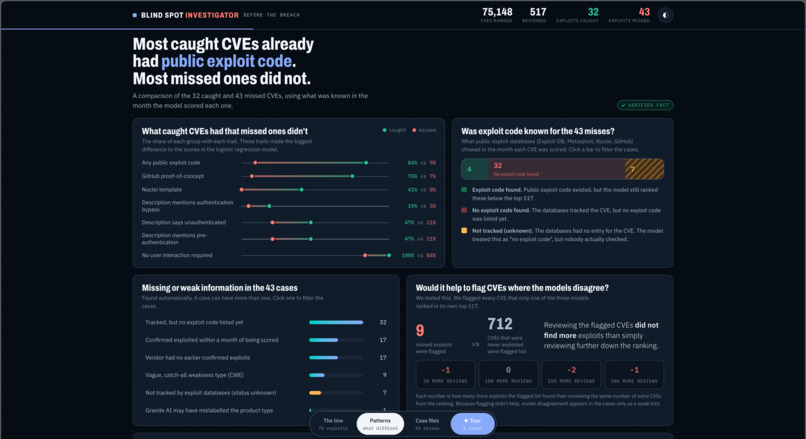
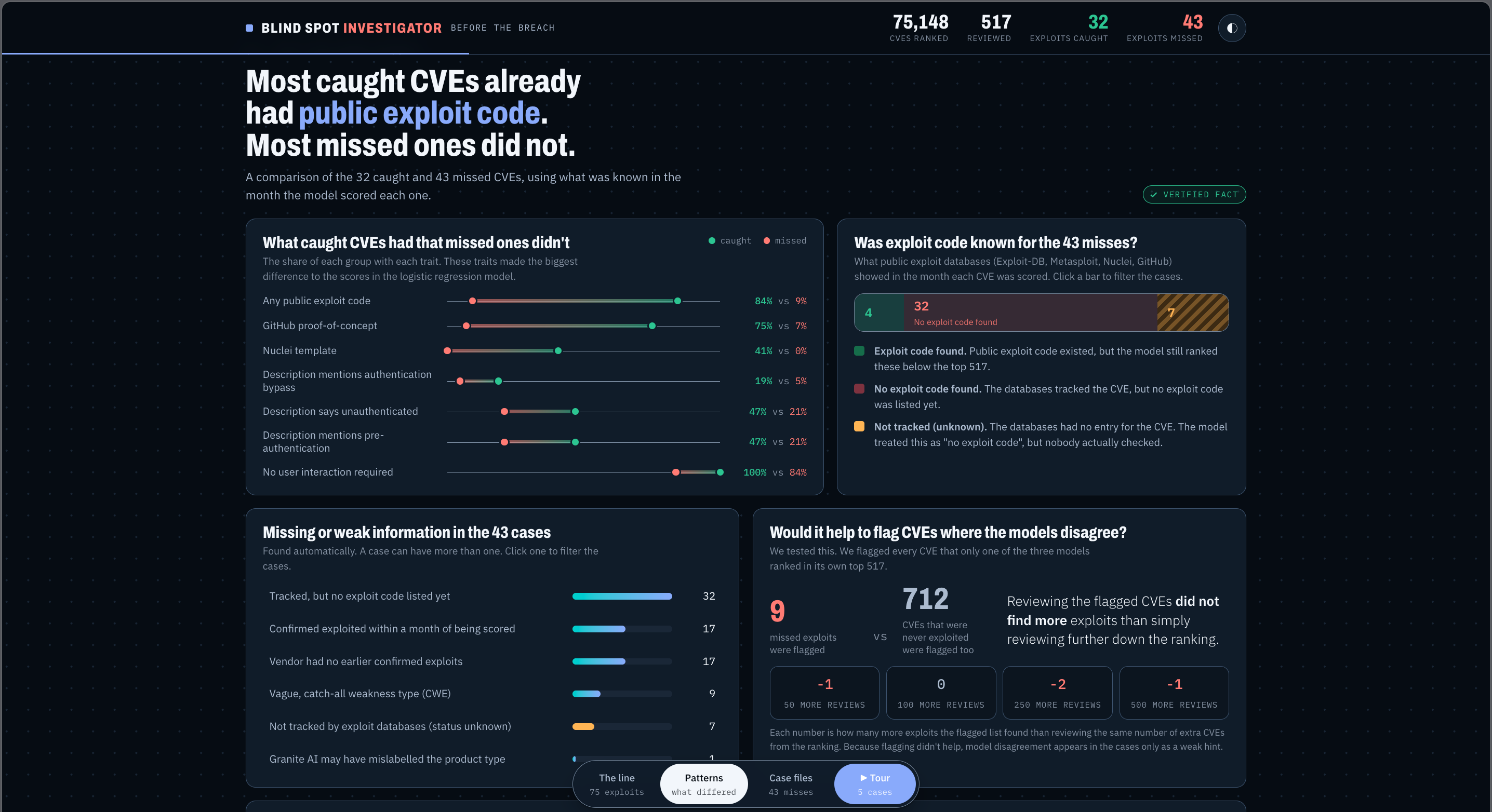
- Public exploit code is strong and incomplete. Most caught practice exploits already had it. Most missed ones did not.
- Product and technology context can matter more than a generic severity score.
- Averaging three models that fail differently finds more exploits than any one of them (24–26 alone, 33 together).
- Flagging model disagreement by itself does not find the misses. Reviewing further down the existing ranking did better.
- A vendor cap is insurance. Oracle published 1,097 CVEs on one day in July 2026.
- Engineers need both the ordered list and the misses. Ranking without an audit trail is not enough.
Practical impact
The same scores cover 401,082 CVEs, not only the 500. That is why the scanner works on a real repo instead of only on the scoreboard.
KEVexploit turns 72,670 new bugs into a patch queue of 500, with a reason for each, and a case file for the ones the ranking still misses.
Patch these 500 first.
Built With
- cisa
- cybersecurity
- data
- epss
- granite
- ibm
- intelligence
- kev
- language
- learning
- lightgbm
- lora
- machine
- management
- natural
- nvd
- osv
- processing
- python
- scikit-learn
- threat
- vllm
- vulnerability
- watsonx
- xgboost
