


Inspiration
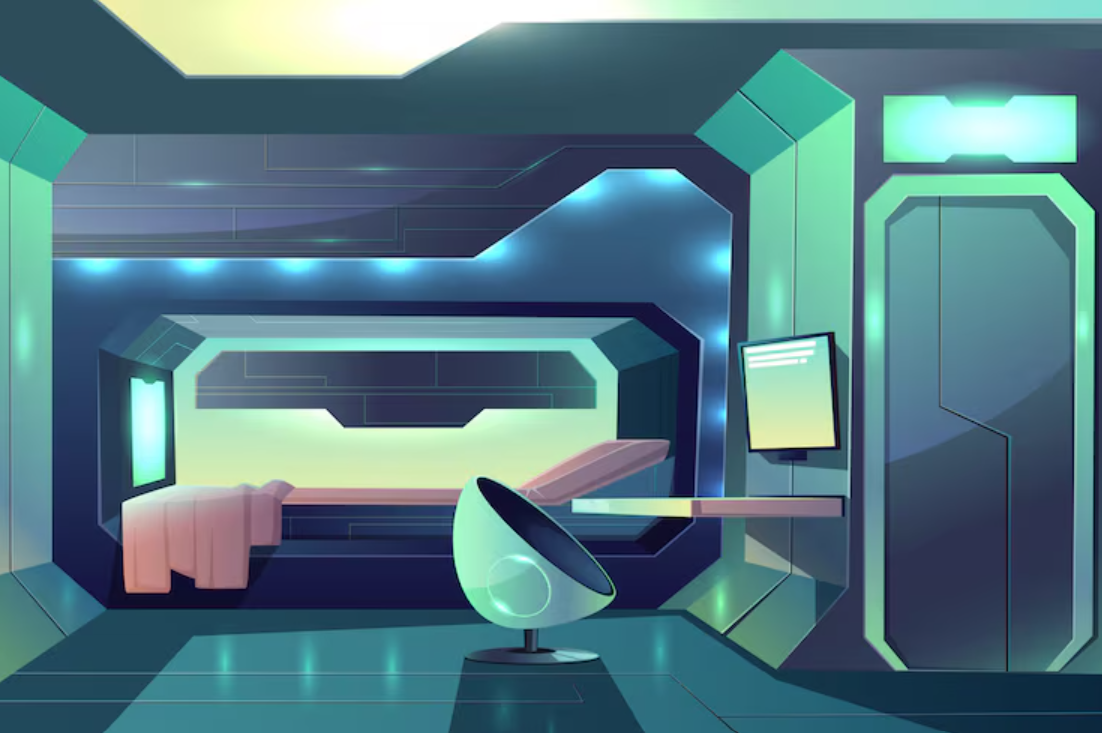
For us, it started with a simple question: what would healthcare look like in space? Not for a small crew of six people, but for thousands of people living their entire lives on a ship traveling between stars. The more we thought about it, the more we realized that the problem was not just medical, but optimizing the resources avaible,in order to maintain physical and mental health.
What it does
Space Health Tracker is a week by week health simulation designed for every generation living aboard. Rather than treating everyone on board the same, it takes into consideration that a child, a working adult, and an elderly passenger each have fundamentally different health needs, and it responds to each of them accordingly. Every week, a crew member inputs six things: their age, hours of sleep, stress level, exercise time, water intake, and how many weeks they have left in flight to track the differences each week. From those six inputs, the Space Health Tracker tool calculates two scores. The first is a mental health state, ranging from critical to low risk, based on the relationship between sleep and stress levels that week. The second is a physical health state, rated as bad, neutral, or good, based on the time spent at the gym, sleeping, and the individual's age group. Alongside these scores, the tool provides the user with more water depending on their age and the amount of time they spend at the gym in order to maintain hygiene onboard while saving resources. To reflect the reality of living in deep space, the simulation also generates random mission events. A solar storm might spike stress levels. An equipment failure might cut into exercise time. These unpredictable events keep the simulation maintain the real space feel. For the crew members under the age of 10, a separate child-friendly interface built in Pygame delivers the exact same health logic through an interactive visual experience, making the tool accessible to every age group on board. In short, Space Health Tracker does what no existing tool does. It considers every person as an individual, tracks their health over time, and helps prevent problems before they become emergencies.
How we built it
We started by determining what actually affects human health week to week. While there are other aspects, the ones we chose are sleep, stress, exercise, and hydration, and we determined how those factors interact differently depending on age. From there we designed a scoring system that calculates both a mental health state and a physical health state, adjusted for three age groups: children, adults, and seniors. We built the main interface to take six inputs and return personalized weekly outputs, including a water recommendation and a specific advisory. To target children, we used Pygame which will be more visual than the version targeting adults. Which has a slider and buttons created using Tkinter.
Challenges we ran into
The parameters and the scoring functions were the most difficult to code as sleep, stress, and exercise, for example, don’t impact health independently; rather, they interact with one another. Additionally, we had to assign levels of importance for certain values, making them have a higher value than others.
Accomplishments that we're proud of
As all new hackers, we are proud of completing our first hackathon and being able to come up with a tool with multiple interfaces, scoring logic and events to make the simulation more realistic. We are proud to have built something that actually works and not a prototype that sort of runs. Designing a health scoring system that accounts for age, models the interaction between sleep and stress, and interaction between sleep and stress, is something we did not think we were capable of.
What we learned
We’ve learned how to bring user input into pygame and how to use Tkinter for the first time. Also, by sharing ideas and taking on different roles, we’ve learned how to collaborate more efficiently and effectively. Furthermore, we discovered the physical and mental dangers of space, and the different levels of impact it has on different age groups.
What's next for Space Health Tracker
Expanding the Health Inputs Right now the tool tracks six inputs. In the future we want to incorporate more biometric data, things like heart rate, blood pressure, caloric intake, and vitamin levels. The more data points the system has, the more accurate and personalized the recommendations can be. Having wearable technology could feed this data in automatically, removing the need for manual input entirely.
AI Powered Recommendations Right now the advisories are generated by fixed logic. A future version would integrate a machine learning model trained on long term health data, allowing the recommendations to become smarter over time and adapt to patterns unique to each individual crew member.
Crew Wide Health Dashboard While individual tracking is important, so is monitoring the bigger picture. A future update would introduce a crew-wide dashboard that gives mission commanders and health care professionals a better idea of the health of everyone on board, identifying trends, flagging at-risk individuals, and helping allocate resources more efficiently.
Built With
- canva
- drive
- pycharm
- pygame
- thonny
- tkinter

Log in or sign up for Devpost to join the conversation.