-
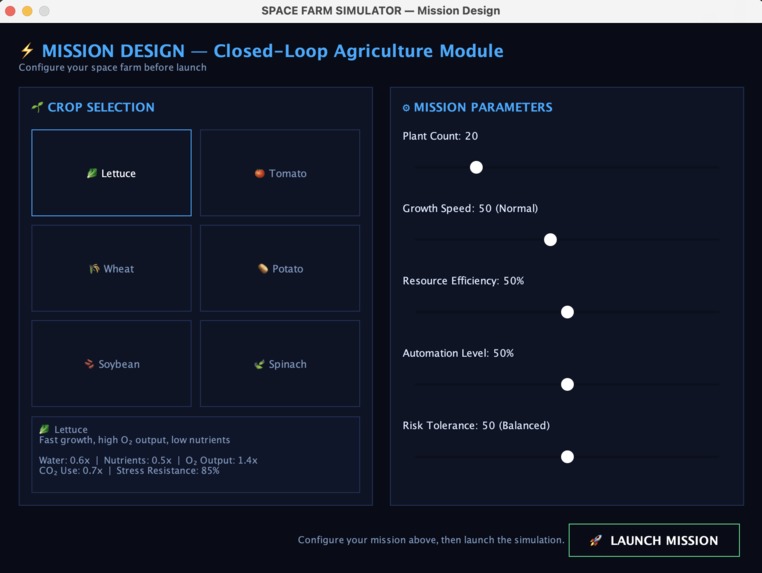
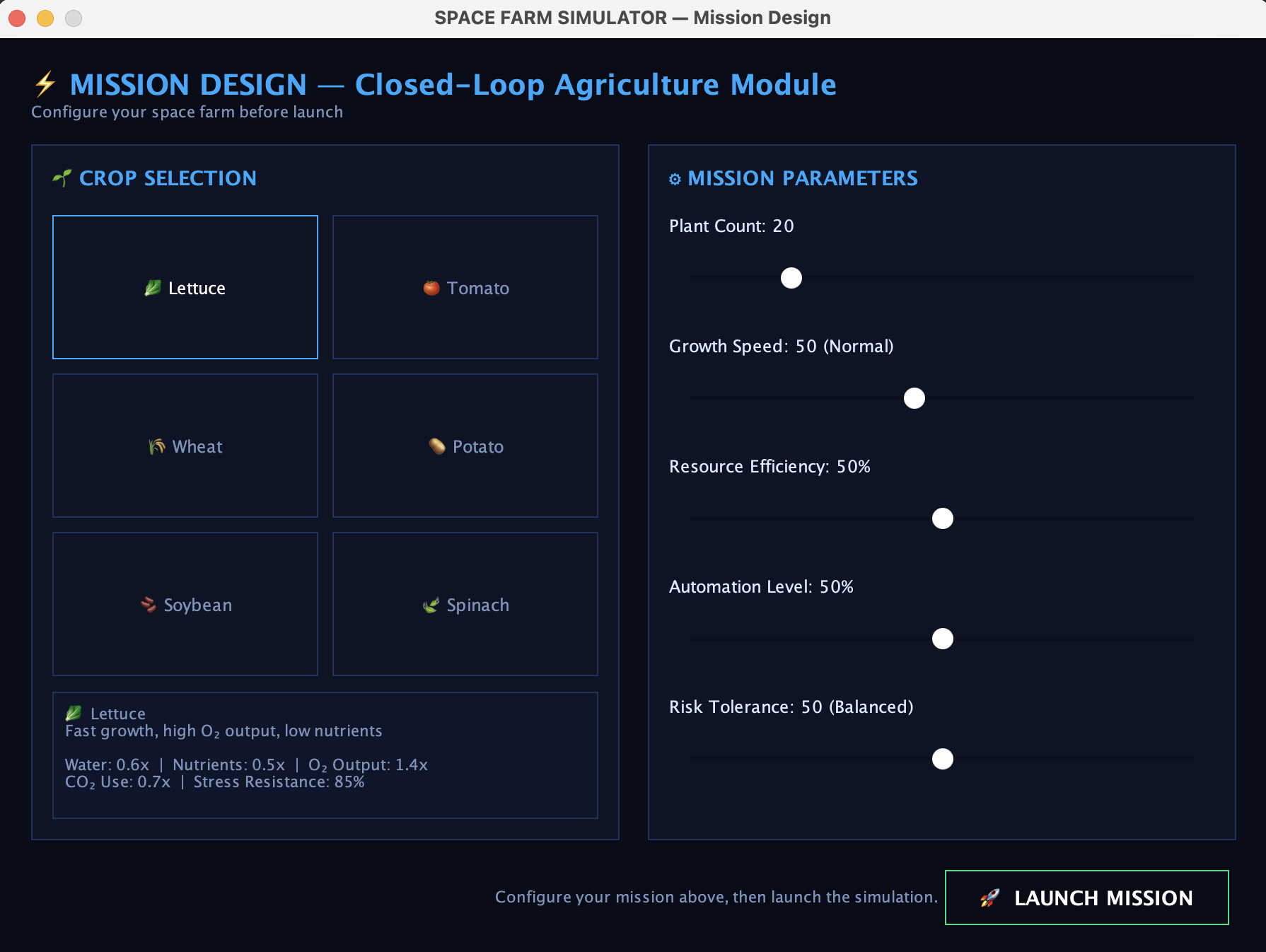
Launching page
-
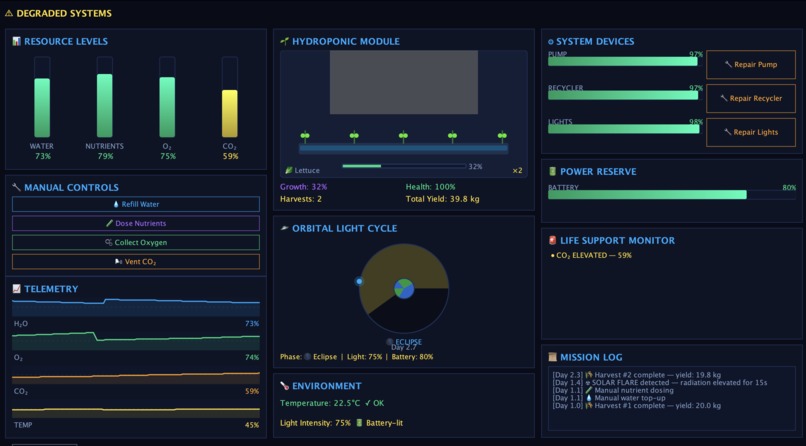
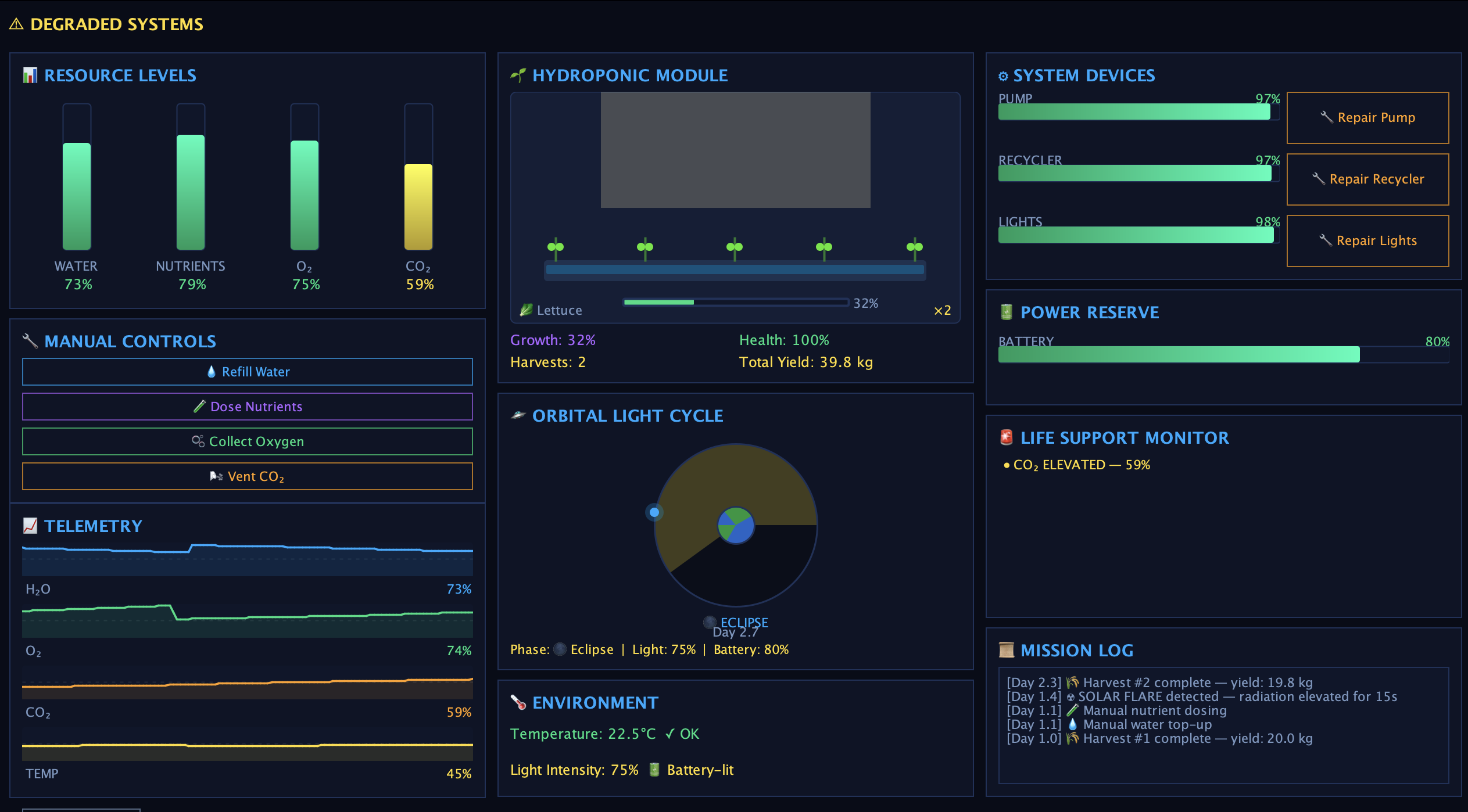
Monitoring page
Inspiration:
Space missions today still rely heavily on packaged and repetitive food supplies. We wanted to explore how future astronauts could grow fresh food sustainably while living in orbit. Our inspiration came from the challenge of balancing limited resources in space and creating a system where plants, technology, and environmental controls all depend on one another to survive.
What it does:
Space Farming Simulator models a closed-loop hydroponic farming system inside a space station. Players design a farming mission by selecting crop types, plant capacity, automation level, growth speed, and recycling efficiency.
Inside the control room, users monitor water, nutrients, oxygen, carbon dioxide, battery power, temperature, and crop health in real time. The simulator includes orbital day/night cycles, oxygen production, crop growth, equipment failures, random space events, and emergency management systems. Players must manually keep the ecosystem stable while maximizing food production in space.
How we built it:
The project was built entirely in Java using Swing GUI components. We designed the hydroponic module with the assistance of claude, simulating the growth of plants as time goes on. We also created custom visual elements such as gauges, telemetry graphs, orbital animations, crop visualization systems, and futuristic control panels to make the simulator feel like a real spacecraft interface. The simulation logic connects environmental variables together so that failures in one system affect the others dynamically.
Challenges we ran into:
Small problems were everywhere during development. Much of our time was spent learning concepts in GUI, debugging GUI layouts, fixing event listeners, connecting variables between classes, and making the simulation update correctly in real time.
We constantly searched the web for solutions to specific Java Swing issues, such as timers, sliders, updating labels dynamically, and handling interactions between multiple components. Designing a simulation where systems affect one another realistically was also difficult because changing one variable often broke another part of the ecosystem.Accomplishments that we're proud of
We are proud that the simulator feels interactive, cohesive, and visually immersive. The closed-loop ecosystem, orbital light cycle, alert system, telemetry displays, and emergency events work together to create a believable space agriculture environment.
We are also proud that we built a large-scale GUI project from scratch with custom-designed visuals and interconnected systems.
What we learned:
We learned almost everything about Java GUI development during this project since we are beginners, including organizing larger Java projects into multiple classes and connect simulation logic with visual systems effectively.
What's even more important is that, we learned how to solve dynamic problems in a fixed amount of time and became more resilient.
What's next for Space Farming Simulator:
In the future, we want to expand the simulator with multiplayer mission management, additional crop genetics, AI automation systems, weather and radiation forecasting, and larger station modules. We also hope to improve the realism of the biological systems and create a more advanced resource economy for long-term space traveling scenarios.
Built With
- claude
- java


Log in or sign up for Devpost to join the conversation.