-
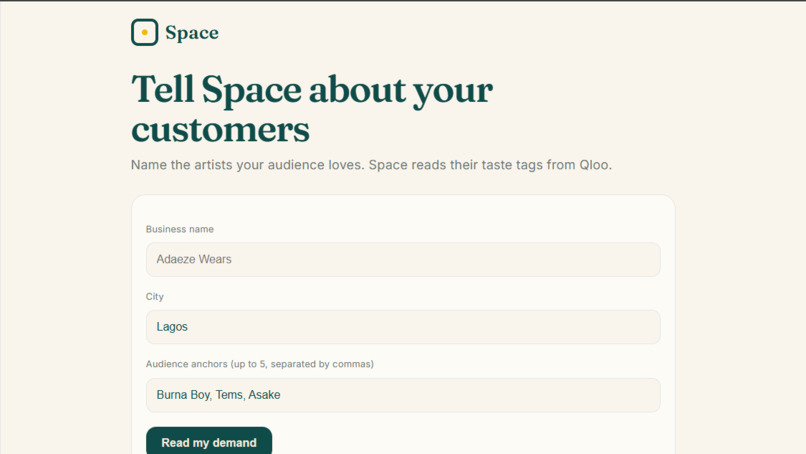
Introductory point
-
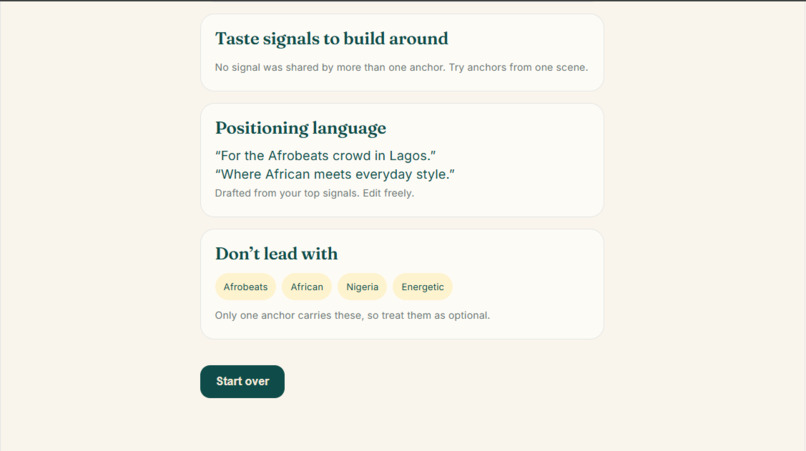
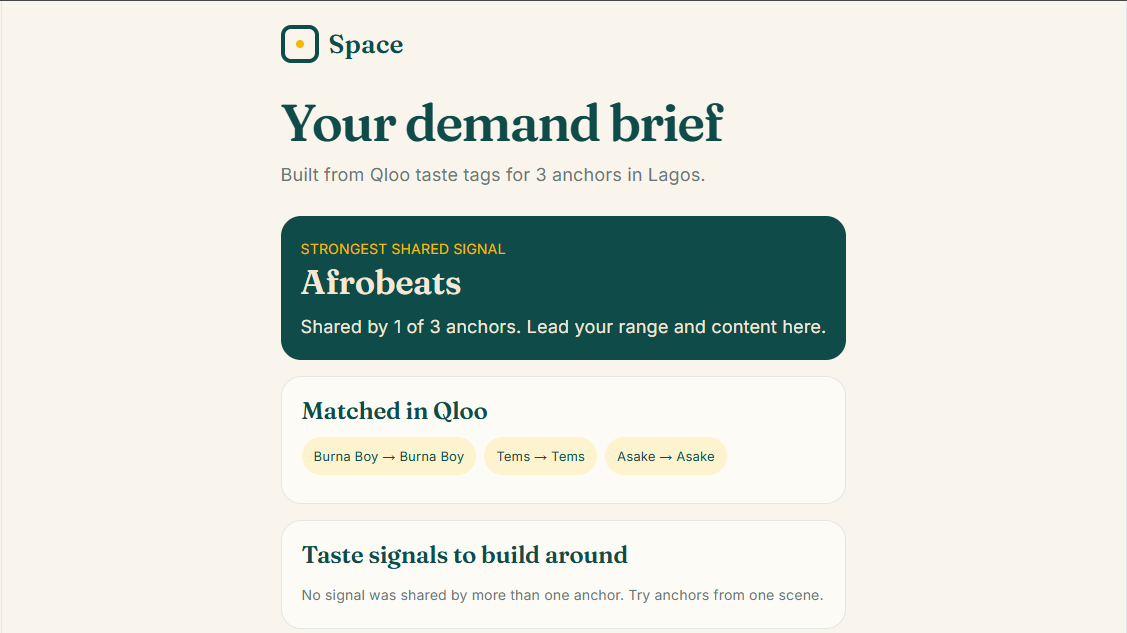
The demand brief
-
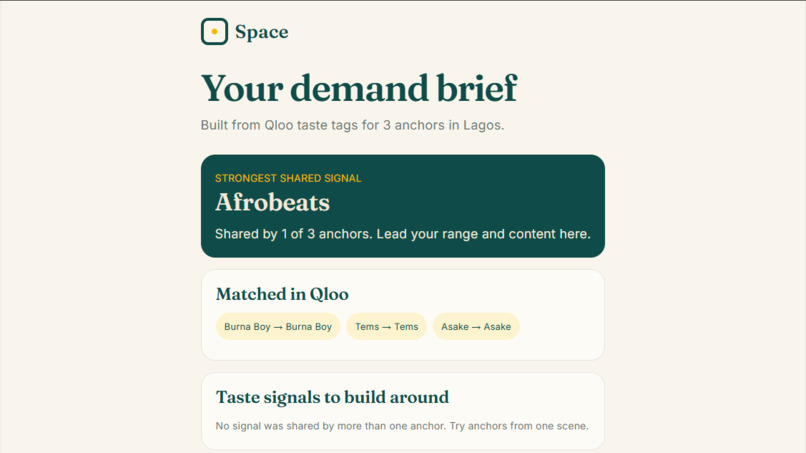
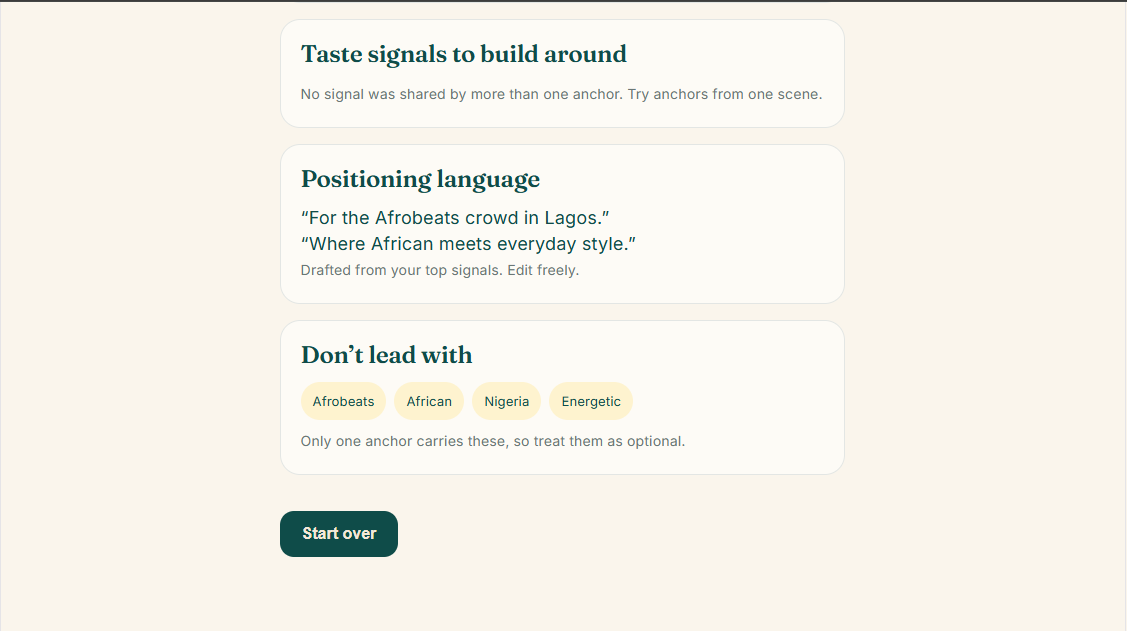
The demand brief
Inspiration
Space is an African demand intelligence agent, grounded in what people love.
Small sellers across African markets often make business decisions based on assumptions about what their customers want. They may know the artists, musicians, and cultural figures their audiences love, but translating those preferences into useful market insights is not always straightforward.
I wanted to explore how cultural intelligence could help small business owners move beyond guesswork and understand the interests, tastes, and cultural signals that shape their audiences.
This inspired Space: an AI-powered approach to market discovery that starts with what people already love and turns those preferences into meaningful demand signals.
What it does
Space helps small sellers discover audience taste signals through cultural references.
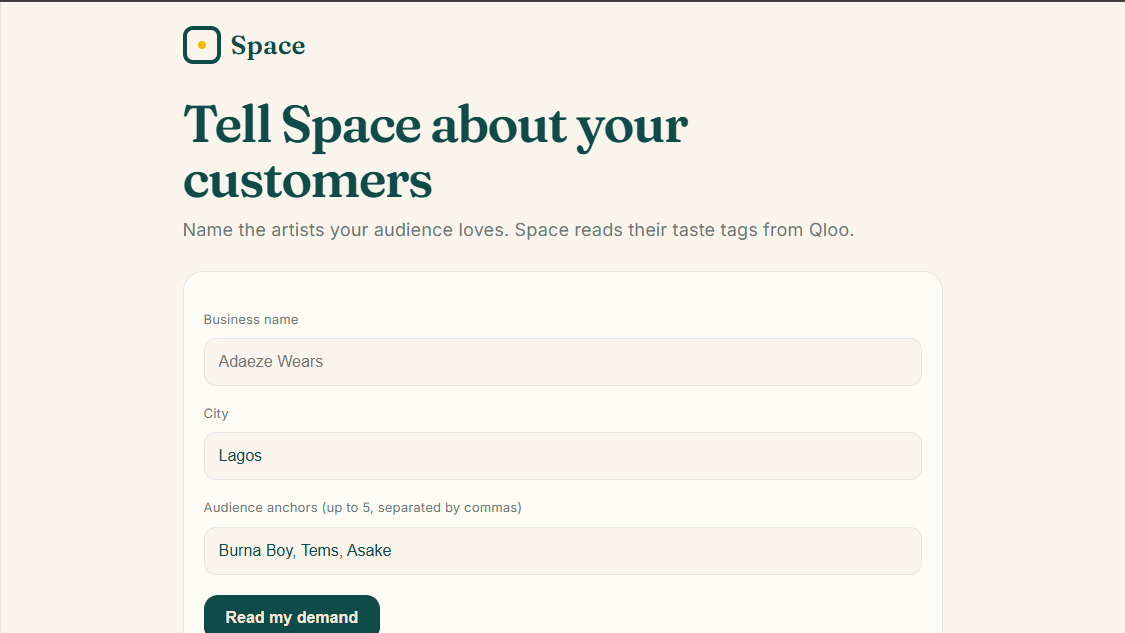
Instead of asking sellers to guess what their customers want, Space allows them to name artists their target audience loves.
Discover: Sellers enter the names of artists their target audience loves.
Search: Space searches for each artist in Qloo's Taste Graph.
Analyze: It retrieves the taste tags associated with each matched entity.
Connect: It identifies overlapping taste signals across the selected artists.
Generate: It creates a structured Demand Brief containing the strongest taste signals, matched entities, and positioning language drafted from those signals.
The result is a data-grounded Demand Brief that helps sellers explore what might resonate with their target audience.
Space currently focuses on taste discovery and positioning rather than specific product recommendations. Music anchors work best in the current implementation, while food and fashion anchors are planned next.
How we built it
I built Space using Qloo's Taste AI skill and API, integrating Qloo's Taste Graph as the intelligence layer behind the product.
The core workflow connects user-provided cultural references to Qloo's taste data and transforms the retrieved information into a structured Demand Brief.
The process follows four stages:
Input: Accept artist names as cultural anchors.
Retrieval: Search each artist through Qloo's API.
Analysis: Extract taste tags and identify shared signals.
Synthesis: Generate a Demand Brief with taste insights, matched entities, and positioning language.
Qloo provides the underlying taste intelligence, while Space makes those insights accessible and useful within a small-business context.
The API integration is central to the product. Without Qloo's taste graph and data, Space would be guessing rather than identifying data-backed taste signals.
Challenges we ran into
Translating culture into business intelligence: Finding a practical way to connect artists and their associated taste profiles to useful market signals.
Working with Qloo's Taste Graph: Understanding how to retrieve relevant entities and extract their associated taste tags.
Identifying shared signals: Building a process that looks beyond individual artists to discover overlapping audience interests.
Maintaining data integrity: Ensuring that the Demand Brief reflects signals retrieved from Qloo rather than unsupported assumptions.
Defining the initial scope: Focusing on music-based anchors first while keeping the architecture open to food and fashion categories.
Accomplishments that we're proud of
Building an African-focused demand intelligence agent powered by Qloo.
Successfully integrating Qloo's Taste AI skill and API into a functional product workflow.
Turning multiple cultural references into shared taste signals.
Generating structured Demand Briefs with matched entities and positioning language.
Exploring a new approach to market discovery for small sellers using cultural intelligence
What we learned
I learned that understanding what people love can offer a different starting point for understanding markets.
I also learned the importance of grounding AI-powered experiences in reliable data. AI can help organize, interpret, and communicate insights, but the quality of those insights depends on the intelligence source behind them.
Building with Qloo helped me explore how taste data can move beyond entertainment and become useful in business discovery and market positioning.
What's next for Space
Food Intelligence: Expand taste discovery to food-related entities and preferences.
Fashion Intelligence: Introduce fashion anchors to explore audience style preferences and cultural interests.
Product Opportunity Mapping: Connect identified taste signals to relevant product categories and potential opportunities.
African Market Context: Improve contextual relevance across different African markets, cultures, and consumer segments.
Advanced Demand Briefs: Introduce richer audience insights, clearer explanations, and more actionable positioning recommendations.
The vision: Space will help African sellers make more informed business decisions by turning cultural taste into market intelligence.
Built With
- qloo
- qlooapi
- react
- typescript
- vercel
- vite

Log in or sign up for Devpost to join the conversation.